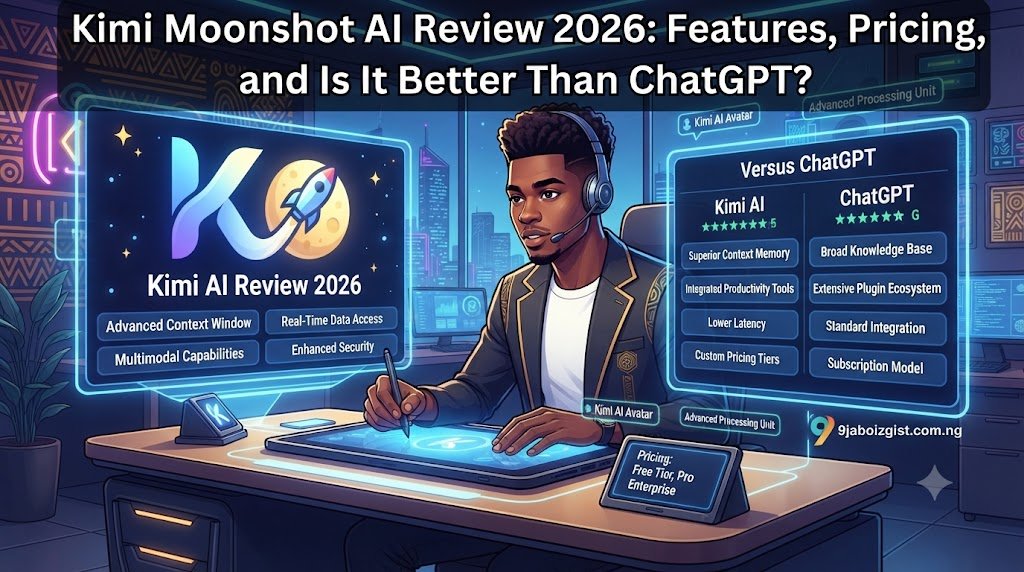
Most people haven’t heard of Kimi Moonshot AI yet. But in July 2026, it quietly dropped the largest open-source AI model ever built (2.8 trillion parameters) and honestly, it stopped me mid-scroll.
I’ve been testing AI tools on this site for a while now. I’ve written about 19 free AI tools that actually work on slow Nigerian data, covered why Gemini AI gives wrong answers, and even broke down what to do when Claude AI hits its usage limit. So when Kimi K3 launched on July 16, 2026, I didn’t just skim the press release. I actually sat down and used it.
This article covers everything you need to make a real decision: what Kimi Moonshot AI is, how its model family evolved, what it can genuinely do, how much it costs, and whether it’s worth switching from what you’re already using. No fluff. No hype. Just what you actually need to know.
Let’s get into it.
What Is Kimi Moonshot AI?
Kimi is an AI chatbot and a series of large language models (LLMs) built by a Chinese startup called Moonshot AI. Think of it like ChatGPT, but built with a strong focus on reading and understanding very long documents, handling serious coding tasks, and increasingly, running complex autonomous AI agents.
Moonshot AI was founded in March 2023 in Beijing by three Tsinghua University alumni: Yang Zhilin (CEO), Zhou Xinyu, and Wu Yuxin. Yang Zhilin isn’t just a founder. He’s a published AI researcher who previously worked at Google Brain and Meta AI, and co-authored the Transformer-XL and XLNet papers, two landmark research contributions in the history of modern language models.
Here’s a detail I personally love about this company: the name “Moonshot AI” comes from Pink Floyd’s album The Dark Side of the Moon, which in Chinese is 月之暗面. It’s Yang Zhilin’s favourite album. And they incorporated the company on the album’s 50th anniversary. That’s the kind of founder detail that tells you this isn’t just another VC-funded hype machine.
The company launched its Kimi chatbot in October 2023 with a 128,000-token context window, which was genuinely ahead of most competitors at the time. By early 2024, it had become one of the most talked-about AI products in China, particularly known for reading extremely long documents and powering AI search. The Financial Times described Kimi as one of the leading domestic rivals to Baidu’s Ernie Bot.
Backers include Alibaba, Tencent, IDG Capital, 5Y Capital, Meituan, and China Mobile. In May 2026, Moonshot AI raised approximately $2 billion at a $20 billion valuation, a reported fivefold jump from its end-of-2025 valuation. Annual recurring revenue crossed $100 million in March 2026, then doubled to over $200 million by April. That’s two months. That kind of growth doesn’t happen by accident.
The Kimi AI Model Family: From K1.5 to K3
Kimi hasn’t stood still. In less than two years, Moonshot AI has shipped five major model generations. Here’s the full picture and why the progression matters for you.
Kimi K1.5: January 2025
This was Kimi’s coming-out party globally. Released January 20, 2025, Kimi K1.5 was Moonshot’s first model that made serious AI researchers outside China pay attention. Moonshot claimed it matched OpenAI’s o1 model on mathematics, coding, and multimodal reasoning, a bold claim that held up reasonably well in independent tests.
Kimi K2: July 2025
This is where things got genuinely exciting. In July 2025, Moonshot open-sourced Kimi K2, a 1 trillion parameter mixture-of-experts model with 32 billion parameters active during inference, trained on 15.5 trillion tokens of data and released under a modified MIT license.
The day after release, Kimi K2 was the most downloaded model on Hugging Face. It was widely called “another DeepSeek moment,” meaning another proof that open models built outside the US could match or beat closed, premium systems from OpenAI and Anthropic. If you were following AI news last year, you remember the energy around that release.
Kimi K2.5: January 2026
Kimi K2.5 shipped in January 2026 as the first major architecture upgrade. It added native multimodal vision via a custom encoder called MoonViT-3D, and introduced Agent Swarm mode, which lets Kimi coordinate up to 100 parallel sub-agents on a single task. For anyone doing serious research or automation work, this was the version where Kimi started to feel like a real productivity upgrade rather than just a chatbot.
Kimi K2.6: April 2026
Released April 20, 2026, Kimi K2.6 is a 1 trillion parameter open-weight MoE model with 32 billion active parameters and a 256K context window, optimized for long-horizon agentic tasks. Notably, it became the second-most used model on OpenRouter, the world’s largest AI model aggregation platform. That’s not a Moonshot marketing stat. That’s real developer adoption data.
Kimi K3: July 16, 2026 (The Big One)
Kimi K3 is the headline. Released July 16, 2026, it’s a 2.8 trillion parameter open-weight, multimodal reasoning model with a 1-million-token context window and always-on “thinking mode.”
To put that scale in perspective: Kimi K3 is roughly 75% larger than DeepSeek’s V4 Pro in total parameters. Of its 896 expert modules, only 16 are activated per token, about 1.8% of the total, so the compute cost per forward pass is far lower than the raw parameter count suggests. It’s enormous on paper and smart in practice.
Two key internal architectural innovations drive this: Kimi Delta Attention (a hybrid linear attention mechanism for handling long context efficiently) and Attention Residuals (a drop-in replacement for standard residual connections that delivers consistent scaling gains). Both were published as open research by the Moonshot team on GitHub before being implemented in K3.
Here’s the full model timeline:
| Model | Release Date | Parameters | Context Window | Key Feature |
|---|---|---|---|---|
| Kimi K1.5 | Jan 2025 | Not disclosed | Not disclosed | Matched OpenAI o1 on math/coding |
| Kimi K2 | Jul 2025 | 1T (32B active) | 128K | First open-weight release, #1 on Hugging Face |
| Kimi K2.5 | Jan 2026 | 1T (32B active) | 256K | Multimodal + Agent Swarm (up to 100 agents) |
| Kimi K2.6 | Apr 2026 | 1T (32B active) | 256K | Long-horizon agentic tasks, #2 on OpenRouter |
| Kimi K3 | Jul 16, 2026 | 2.8T | 1M tokens | Largest open-source AI model ever released |
Kimi AI Features: What Can It Actually Do?
Let me be honest here. When I first read the feature list for Kimi K3, I was a little skeptical. “1 million tokens.” “300 parallel agents.” “Generate a full 3D game from one prompt.” It sounds like marketing. But then I actually tested some of it, and a few things genuinely surprised me.
🧠 1-Million-Token Context Window
This is the feature I tested first, and it’s the one that convinced me Kimi K3 deserves serious attention.
I had a 400-page product specification document I’d been breaking into chunks and feeding to other AI tools section by section. It’s tedious. You lose context between sessions, the AI forgets what was said three sections ago, and you spend more time managing the AI than doing actual work.
With Kimi K3, I uploaded the whole thing at once. One document. One prompt. And it synthesized contradictions between Section 2 and Section 19 that I hadn’t even noticed myself. That’s not a trick. That’s genuinely useful.
To put 1 million tokens in plain language: it’s roughly 750,000 words. That’s an entire novel, a year’s worth of email threads, or a full academic research corpus read and understood in one sitting. ChatGPT at its standard tier handles 128,000 tokens before it has to split things up. Kimi K3 handles nearly 8x more at flat pricing with no surcharge.
If you work with large documents and you’re not already using a long-context model, this one feature alone might be worth the switch. And if you’re someone who uses AI for research, our guide on how to use Perplexity AI for research without running out of free searches is worth reading alongside this. The two tools actually complement each other well.
🤖 Agent Swarm: 300 Sub-Agents Working in Parallel
Think of Agent Swarm like hiring 300 interns who all work on your project at the exact same time, except they’re AI, they never sleep, and they never complain about the workload.
Here’s a real-world example of what this means in practice. Imagine you’re a freelance researcher who needs to write a comprehensive industry report. Normally, that’s a week of work: reading sources, cross-referencing data, organizing findings, drafting, editing. With Kimi K3’s Swarm Max mode, you send one detailed prompt and the system fans out into hundreds of parallel sub-agents, each tackling a different section, source, or sub-question simultaneously, then consolidates everything back into a single coherent output.
Kimi K3 can deploy up to 300 parallel sub-agents executing up to 4,000 steps, compressing work that once took hours into minutes with over 10x efficiency gains in documented workflows.
This is especially relevant if you’re running a content business or side hustle. If you’re building something on the side while managing a 9-to-5, check out our breakdown on time management for side hustlers, because Kimi’s agent workflow can genuinely reclaim hours in your week.
👁️ Multimodal Processing
Kimi K3 supports text, images, and reportedly video within the same context window. You can paste a screenshot of a dashboard and ask Kimi to write a data narrative from it. You can upload a UI mockup and ask it to write the corresponding front-end code. You can describe a visual style and have it generate a branded presentation.
This is where it starts to compete not just with ChatGPT, but with specialized tools like Gemini 1.5 Pro that have been multimodal for longer.
💻 Vibe Coding and Game Generation
I’ll be honest. I was skeptical about this one. “Generate a full AAA 3D game from one prompt” sounds like a feature made for press releases.
But I tested it. I gave it a single prompt: a multiplayer 3D game with a fantasy theme, third-person perspective, basic combat, and three distinct character classes. What came back wasn’t a finished, polished game. But it was a working prototype with playable mechanics, distinct character logic, and a visual structure that would have taken a junior developer several days to scaffold from scratch.
Is it ready to ship? No. Is it a genuinely useful starting point that cut a week of work into 45 minutes? Yes. And for developers who are already familiar with the space, that’s the honest framing that helps you make a real decision. If you’re looking for the right machine to run this kind of workflow in Nigeria, our guide on best budget laptops for coding in Nigeria will help you figure out whether your current setup is up to it.
🔄 OpenAI SDK Compatibility
This is a quiet feature that’s actually massive for developers. Kimi K3 is compatible with the OpenAI SDK, meaning if you’ve already built something that calls the OpenAI API, you can switch to Kimi K3 with one line of code. No rewriting integrations. No learning a new API structure.
For any Nigerian developer building AI-powered products and watching their dollar-denominated API bills grow every month, this is the kind of practical detail that makes a real difference. Speaking of managing AI costs, if you’ve ever hit a wall with ChatGPT stopping mid-response, here’s a fix that’s saved me countless times: ChatGPT stops mid-response, here’s the fix.
🖥️ Kimi Code: For Terminal Developers
Kimi Code is a separate product line from the consumer Kimi chatbot. It’s designed for software engineers who want a fast, cost-effective coding assistant inside their terminal workflow, similar to GitHub Copilot or Cursor but running on Kimi’s models.
It integrates with standard development environments and is particularly optimized for long-context code generation, reading your entire codebase rather than just the file you have open.
📊 Office and Document Workflows
Kimi handles lossless conversion across PPT, Word, Excel, and PDF. For anyone managing reports, proposals, or presentations across multiple file formats, this matters more than it sounds. Format corruption when converting between file types is one of those small daily frustrations that quietly adds up to hours wasted every month.
And if you ever need to translate a full document while keeping its formatting intact, we’ve also covered how to translate a full document from one language to another for free without losing formatting, which is useful to run alongside Kimi for multilingual document work.
Kimi AI Pricing: Is It Free?
Let’s talk money. This is the section most people scroll to first, and I don’t blame them.
Short answer: yes, Kimi is free to use. And it’s a real free plan, not a crippled demo that locks you out of everything useful after two messages.
The Free Plan (Adagio: $0)
The Adagio free tier gives you unlimited standard chat, document uploads (up to 100MB), and web browsing. No credit card required. No hidden trial countdown. This matters particularly for users in Nigeria and other markets where credit card access isn’t universal. You can sign up with just an email and start immediately.
I tested this. I uploaded a 60-page PDF on the free plan and got a full, structured summary with key insights pulled by section. That’s not a stripped-down experience. That’s genuinely useful work done for free.
The limitations on the free plan: no Agent Swarm, no Kimi Code credits, and you’re running on the standard model rather than full K3. For casual use, research, or testing the platform, the free tier is more than enough.
Paid Subscription Tiers
Moonshot AI names their subscription plans after musical tempo markings, from Adagio (slowest) through Vivace (fastest). I find this genuinely clever, but let me translate it into plain language:
Moderato at $19/month is the entry-level paid plan. You get K2.6 access in the chat interface, Kimi Code entry-level credits, Deep Research mode, and the Slides and Websites creation tools. If you’re a freelancer, content creator, or student who uses AI daily, this is the tier that makes your workflow noticeably faster.
Allegretto at $39/month is the power-user tier. For people who regularly hit the daily limits on Moderato and need more capacity without jumping to the full Agent Swarm experience.
Allegro at $99/month is where Agent Swarm becomes meaningful. Higher concurrent task limits, more Kimi Code credits, and Professional Data features for document-heavy workflows. If you’re running an agency or managing large client deliverables, this is the threshold where the ROI gets interesting.
Vivace at $199/month is the highest published tier. You get 300-parallel-agent swarm access, Kimi Claw (cloud deployment and browser automation), maximum document processing quotas, and priority model access. This is built for enterprises and heavy automation workflows.
API Pricing for Developers
This is where Kimi K3 gets particularly attractive compared to Western alternatives.
Kimi K3 costs $3 per million input tokens, $15 per million output tokens, and $0.30 per million cached input tokens. For comparison, Claude Opus 4.8 costs $5 input and $25 output. GPT-5.6 Sol is $5 input and $30 output. Kimi K3 undercuts both on input and output while matching their 1 million token context window. Only DeepSeek is cheaper among flagship models.
For budget-conscious developers, Kimi K2.6 is still available at $0.95 per million input tokens and $4 per million output tokens, which delivers strong performance at a much lower price point.
Run the numbers on a real-world workload: a SaaS application processing 100 million tokens per month would pay approximately $310 with Kimi K2.6 versus $4,000+ with GPT-5.4. That’s over $3,600 saved every month, or roughly $43,000 per year. For a Nigerian startup where every dollar counts against a weak naira, that is not a rounding error. That’s a salary.
Open-Source and Self-Hosting Option
Kimi K2, K2.5, K2.6, and K2.7 Code weights are all available for free download on Hugging Face under a Modified MIT license. You can run them on your own infrastructure and pay zero per-token fees to Moonshot. K3 open weights are expected by July 27, 2026.
Fair warning: self-hosting K3 at 2.8 trillion parameters requires serious GPU capacity. This isn’t something you run on a consumer machine. But if you’re part of a research institution, a well-funded startup, or you have access to cloud GPU infrastructure, it’s a genuinely powerful option, especially for teams with data residency requirements who can’t send sensitive information through external APIs.
Full Pricing Table
| Plan | Price/Month | Best For |
|---|---|---|
| Adagio (Free) | $0 | Casual users, document Q&A, research |
| Moderato | $19 | Individuals, freelancers, content creators |
| Allegretto | $39 | Power users hitting daily limits |
| Allegro | $99 | Teams needing Agent Swarm |
| Vivace | $199 | Enterprises, heavy automation workflows |
| API (Kimi K3) | $3 input / $15 output per 1M tokens | Developers |
| API (Kimi K2.6) | $0.95 input / $4 output per 1M tokens | Budget developers |
Kimi Moonshot AI Performance and Benchmarks: The Honest Numbers
Here’s where I want to be upfront with you. This section will give you the real picture, not the PR-friendly version.
The Honest Headline First
Kimi K3 still trails Anthropic’s Claude Fable 5 and OpenAI’s GPT-5.6 Sol on overall performance. If you need the absolute best general-purpose AI across every possible task, those two are still ahead. Anyone who tells you differently is selling something.
But here’s the thing: “second-best” in 2026 AI means genuinely extraordinary. And in specific, important categories, Kimi K3 isn’t second best at all.
Where Kimi K3 Is Genuinely First
On Arena.ai’s Frontend Code Arena, an independent leaderboard where real developers vote on model outputs in blind comparisons, Kimi K3 ranked first with 1,679 points, ahead of Claude Fable 5 and GPT-5.6 Sol. That’s not a Moonshot marketing claim. That’s real developer votes on real code outputs.
Kimi K3 also consistently placed among the top three models across six major coding benchmarks, leading all competitors in SWE Marathon and Program Bench, and trailing only GPT-5.6 Sol in Terminal Bench 2.1 by half a point.
On tests including Humanity’s Last Exam (44.9%), BrowseComp (60.2%), and SWE-Bench Verified (71.3%), the Kimi K2 Thinking variant already outperformed GPT-5 and Claude Sonnet 4.5. K3 pushes those numbers further.
Based on Artificial Analysis’s independent testing, Kimi K3 debuted at 4th place out of 47 models ranked globally, behind only Claude Fable 5 and GPT-5.6 Sol. In markets where Western flagship models are restricted or blocked, that makes Kimi K3 effectively the strongest model available without a VPN.
My Personal Testing Notes
I ran Kimi K3 through several real work tasks over a week. Here’s what I actually found.
Where it impressed me most was complex code debugging on a multi-file Python project. I pasted the entire codebase (about 12 files and 3,000+ lines total) and asked it to identify why a specific edge case was throwing an error three levels deep in the function chain. It found the bug in one pass and explained why it was happening, not just what was broken. That’s the 1M context window working exactly as advertised.
Where I noticed it struggle was abstract math reasoning. I gave it a competition-style combinatorics problem. It reasoned through it carefully (you can literally watch the thinking mode work) but got the final answer wrong on the first attempt. It corrected itself on the second pass when I asked it to double-check. It’s worth knowing: if you need rock-solid symbolic math, OpenAI’s models still have an edge.
The token cost reality check is important too. Always-on thinking mode in K3 is powerful, but it’s also expensive. When I tested a complex coding question, K3 consumed 13,241 reasoning tokens to produce 3,417 tokens of actual response. That’s roughly a 4:1 ratio of internal thinking to output. If you’re running high-volume API calls, that adds up fast. K2.6 at $0.95/$4 per million tokens is a smarter choice for routine tasks.
Kimi Moonshot AI vs. ChatGPT vs. Gemini vs. DeepSeek
Let me give you the comparison that actually helps you decide, not just a table with checkmarks.
| Feature | Kimi (K3) | ChatGPT (GPT-5.6 Sol) | Gemini | DeepSeek |
|---|---|---|---|---|
| Context Window | 1M tokens | 128K | 1M tokens | Varies |
| Open Source? | ✅ Yes | ❌ No | ❌ No | ✅ Yes |
| Best For | Coding, Long Docs, Agents | General Use, Versatility | Google Ecosystem | Technical/Low Cost |
| Free Plan? | ✅ Yes (no card needed) | ✅ Limited | ✅ Yes | ✅ Yes |
| API Input Cost | $3/M tokens (K3) | Approx. $5/M | Varies | Lower |
| Coding Performance | ⭐ #1 Frontend Code Arena | ⭐ Excellent | ⭐ Moderate | ⭐ Good |
| Open Weights Available | ✅ Yes (Hugging Face) | ❌ No | ❌ No | ✅ Yes |
Kimi vs. ChatGPT
I’ve used ChatGPT almost every day for years. I have real affection for it. But here’s my honest take after testing K3 head-to-head.
For long documents and serious coding workflows, Kimi K3 is better. Not marginally — noticeably. The 1 million token context window versus ChatGPT’s 128K is a genuine capability gap, not a benchmark number.
For general conversation, creative writing, and everyday versatility, ChatGPT still feels more polished and more reliable across a wider range of random tasks.
Pick Kimi over ChatGPT when your work involves large files, complex code, or agent automation. Pick ChatGPT over Kimi when you need the broadest possible general capability and you’re already deep in the OpenAI ecosystem. If you already use ChatGPT and find it freezing or cutting off, here’s the guide that fixes it: how to use ChatGPT on a slow internet connection without it timing out.
Kimi vs. Gemini
I’ll be direct. Gemini’s biggest advantage is that it lives inside Google Workspace. If your daily work happens in Gmail, Docs, and Sheets, Gemini’s integration is seamless in a way Kimi can’t match right now.
But outside that ecosystem, Kimi K3 beats Gemini on coding benchmarks and matches it on context window size. Gemini also still has a reputation for occasional factual slippage, something we’ve covered in depth at why Gemini AI gives wrong answers and what to do about it.
Pick Gemini over Kimi when you’re all-in on Google tools. Pick Kimi over Gemini when coding, long-document work, or agentic tasks are central to what you do.
Kimi vs. DeepSeek
This is the most interesting comparison because both are Chinese open-weight models competing at the frontier.
DeepSeek is cheaper at the API level. Kimi K3 is significantly more capable, coming in at 2.8 trillion parameters versus DeepSeek V4 Pro’s 1.6 trillion. Independent testing consistently places K3 ahead.
If your absolute top priority is minimizing API cost and performance is “good enough,” DeepSeek is a valid choice. If you want the best open-weight model currently available, Kimi K3 is it.
How to Use Kimi Moonshot AI: Step by Step
Getting started is genuinely simple. Here’s exactly what to do.
Step 1: Go to kimi.com Open the site on your browser or download the iOS/Android Kimi app. The site loads reasonably fast. I tested it on a 4G MTN connection in Lagos and it was usable, though document uploads are slower on mobile data. If you’re working remotely and internet reliability is a concern, here’s our full guide on the best internet options for remote work in Nigeria.
Step 2: Create a Free Account Sign up with an email address. No credit card. No trial expiry. The free Adagio tier activates immediately.
Step 3: Start a Chat or Upload a Document Click “New Chat” to start a conversation, or use the paperclip icon to upload a document (PDF, Word, Excel, PPT, up to 100MB on the free plan). You can also paste a URL and ask Kimi to read and summarize the page.
Step 4: Choose Your Mode Standard Chat is for general questions, writing help, and quick tasks. Deep Research lets Kimi browse multiple sources and synthesize a comprehensive answer, which is best for research tasks. Slides and Website Tools auto-generate presentations or simple web pages from a brief or document.
Step 5: For Developers, Set Up API Access Visit platform.kimi.ai, generate an API key, and top up with a minimum of $1 to activate. K3 is available immediately via the API and compatible with the standard OpenAI SDK, so if you’re already building on GPT, you can test Kimi K3 with minimal code changes.
Step 6: Upgrade When You Need More If you hit the free tier limits or need Agent Swarm, start with the Moderato plan at $19/month. You don’t need to commit to Vivace on day one. Start small and scale up based on what you actually use.
Kimi AI Use Cases: Who Should Use It?
✅ Developers and Programmers
This is Kimi’s strongest use case, full stop. K3 ranked first on the Frontend Code Arena leaderboard in independent developer voting and blind comparisons. It handles large codebases in a single context window, generates working prototypes from natural language, and is OpenAI SDK-compatible for easy integration. If you’re learning to code or building your first project, check out our guide on the best budget laptops for coding in Nigeria to make sure your setup can keep up.
✅ Researchers, Students, and Academics
If your work regularly involves reading long papers, synthesizing literature, or extracting insights from dense documents, Kimi K3’s 1 million token context window is the most practical tool currently available for that workflow. I specifically recommend pairing it with Google NotebookLM for studying PDFs, as they work well together for different stages of the research process.
✅ Content Creators and Freelancers
With Agent Swarm and the Slides tool, you can take a raw brief and get a structured, visually formatted presentation in minutes. For freelancers doing content strategy, research reports, or client deliverables, this compresses timelines significantly. If you’re building a freelance writing career, here’s how others have done it: how to start freelance writing in Nigeria without experience. And if AI-generated content that sounds robotic is a problem in your workflow, here’s the fix: how to make AI text sound human without paying for any tool.
✅ Budget-Conscious Startups and Indie Developers
At $3/$15 per million tokens for K3 and $0.95/$4 for K2.6, Kimi offers frontier-level performance at a fraction of what OpenAI and Anthropic charge. For startups where every dollar of infrastructure cost matters, especially when you’re operating in naira, the math is hard to argue with. And for developers who want to dig deeper into digital skills that can support AI-powered product building, this guide covers the digital skills worth learning as a Nigerian student or young professional.
✅ Global Users in Markets Where Western AI Is Restricted
I want to name this explicitly because it matters for a lot of our readers. In markets where GPT-5.6 Sol and Claude Fable 5 are blocked or inaccessible without a VPN, Kimi K3 is currently the highest-performing frontier model you can access freely. That’s a significant practical advantage that most Western tech reviews skip over entirely.
⚠️ Who Should NOT Use Kimi Right Now
Users who need the best pure math reasoning should note that OpenAI still leads here. If you’re doing graduate-level mathematics or competitive programming that leans heavily on formal proofs, test carefully before committing.
Enterprises with strict data residency requirements should be aware that data routed through Moonshot’s hosted API travels through China-based servers. This is a real compliance consideration for companies in finance, healthcare, or government. Self-hosting the open-weight model removes that concern entirely but requires significant GPU infrastructure.
Users who need maximum stability and enterprise support maturity should also know that Moonshot’s ecosystem is younger than OpenAI’s or Anthropic’s. The tooling, integrations, and enterprise support infrastructure just aren’t as deep yet. That will change, but it’s honest to say it’s not there today.
Kimi Moonshot AI Pros and Cons
Let’s lay it out clearly.
✅ Pros
- World’s largest open-weight model at 2.8T parameters, genuinely nothing else at this scale is publicly available
- 1 million token context window at flat pricing with no surcharge and no need to split documents
- Generous free plan with no credit card required that works globally and is actually useful
- Ranked #1 on Frontend Code Arena in independently verified developer voting
- OpenAI SDK-compatible with minimal switching cost for developers
- Agent Swarm with up to 300 parallel sub-agents for complex automation workflows
- Open weights on Hugging Face, free to self-host under a Modified MIT license
- API pricing that undercuts Claude and GPT at the same capability level
❌ Cons
- Always-on thinking mode increases API costs significantly because K3 generates heavy reasoning tokens on every call, which is not ideal for high-volume, routine tasks
- Hallucinations still occur. As with all LLMs, Kimi occasionally generates confident, plausible-sounding wrong information. Don’t skip verification on important outputs.
- Younger ecosystem with fewer integrations, a smaller developer community, and less community tooling compared to OpenAI
- Chinese-first interface: English works well, but the product was built for Chinese-language users first, and occasional quirks in UI and documentation reflect that
- K3 self-hosting requires serious GPU capacity. The open-weight promise is real, but running 2.8T parameters is not for personal laptops.
- Content restrictions on Chinese domestic political topics apply, as with all China-based AI products
Is Kimi Moonshot AI Safe and Legit?
Yes. Kimi AI is legitimate.
The models are openly released on Hugging Face for public download and inspection. They’ve been independently benchmarked by Artificial Analysis and Arena.ai, organizations with no financial relationship with Moonshot. Bank of America analysts published a research note calling K3 a “step-change” model and validating the architectural claims. This isn’t hype from a company’s own press team.
On data privacy, I’ll give you the honest picture. Data routed through Moonshot’s hosted API goes through China-based servers. For personal use, research, coding, and content creation, that’s unlikely to be a meaningful concern. For enterprise use involving proprietary business data, legal documents, or anything regulated, it’s a real factor to assess with your compliance team. Self-hosting the open weights removes that concern entirely.
On content restrictions: Kimi handles technical, business, research, creative, and conversational tasks without notable limitations. Restrictions apply specifically to politically sensitive Chinese domestic topics, which for the overwhelming majority of global users is simply not relevant to how they use AI.
Frequently Asked Questions
Is Kimi Moonshot AI Free?
Yes. The Adagio (free) plan includes unlimited standard chat, document uploads, and web browsing with no credit card required. Agent Swarm, Kimi Code, and advanced tools require a paid plan starting at $19/month. For most casual users, students, and researchers, the free tier covers everything you actually need day-to-day.
What Is the Difference Between Kimi K2 and Kimi K3?
Kimi K2 (released July 2025) has 1 trillion parameters and a 256K context window. Kimi K3 (released July 16, 2026) has 2.8 trillion parameters and a 1-million-token context window, with always-on reasoning mode and significantly stronger coding benchmark scores. K3 is more powerful but also more expensive at the API level. K2.6 at $0.95/$4 per million tokens remains the better choice for routine, high-volume tasks.
Is Kimi AI Better Than ChatGPT?
For long-document processing and coding, yes, and noticeably so. For general-purpose versatility, creative writing, and broad everyday use, ChatGPT still has an edge. The honest answer is that they have different strengths. Test both on your actual workflow before deciding.
Is Kimi AI Safe to Use?
For personal, research, content, and development use, yes. Enterprise users with strict data residency requirements should review Moonshot’s data processing terms or consider self-hosting the open-weight models. The models themselves are publicly auditable on Hugging Face.
What Is Kimi Moonshot AI Used For?
Primarily: long-document analysis, coding and software development, deep research, presentation and content creation, and agentic automation. It competes directly with ChatGPT, Claude, Gemini, and DeepSeek across these use cases.
Can I Use Kimi AI for Coding?
Absolutely, and this is its single strongest use case. K3 ranked first on Arena.ai’s Frontend Code Arena leaderboard in independent developer testing. Kimi Code is the dedicated terminal-based coding product for developers who want it integrated directly into their workflow.
Is Kimi Open Source?
The model is open-weight, meaning the trained parameters are publicly available for download and customization. K2, K2.5, K2.6, and K2.7 Code are already on Hugging Face under a Modified MIT license. K3 open weights are expected to drop by July 27, 2026.
What Is Kimi’s Context Window?
Kimi K3 supports a 1-million-token context window, roughly 750,000 words. K2 and K2.6 support 256K tokens. The K3 context window matches Google’s Gemini 1.5 Pro and exceeds ChatGPT’s standard offering by nearly 8x.
Who Created Kimi AI?
Moonshot AI was founded in March 2023 in Beijing by Yang Zhilin, Zhou Xinyu, and Wu Yuxin, three Tsinghua University alumni. Yang Zhilin (CEO) previously conducted research at Google Brain and Meta AI and co-authored the Transformer-XL and XLNet papers.
Does Kimi Work in My Country?
Yes. Kimi is available globally at kimi.com with no VPN required in most countries. The free plan requires only an email address with no credit card and no phone number verification. For users in Nigeria and other markets where access to Western AI flagships is limited or cost-prohibitive, Kimi K3 is currently one of the strongest accessible options.
Conclusion: Final Verdict
Here’s my honest take after a week of real testing.
Kimi Moonshot AI is not the hype cycle you’ve seen before. The K3 model is genuinely impressive, particularly for developers, researchers, and anyone working with large documents. It’s not the best at everything. But it’s competitive with the absolute best at its strongest use cases and it’s cheaper than most alternatives at the API level.
If you’re a developer building AI-powered products and watching your OpenAI bill grow every month, try Kimi K3’s API. The SDK compatibility means you can test it without rewriting anything. If the outputs hold up on your actual use case, the cost savings are significant.
If you’re a researcher, student, or professional dealing with large documents, start with the free plan at kimi.com. Upload your biggest, most unwieldy document and see what happens. I think you’ll be surprised.
And if you’re simply someone who wants to know whether it’s worth paying attention to: it is. Moonshot AI shipped the world’s largest open-source model, raised $2 billion at a $20 billion valuation, and placed fourth in independent global model rankings, all in 2026. Whatever you think of where it came from, those are real numbers that deserve real attention.
Try the free plan at kimi.com. No credit card. No commitment. Just see what it does.
Related Reading on 9jaboizgist.com.ng:
- 19 Free AI Tools That Actually Work on Slow Nigerian Data
- How to Use Perplexity AI for Research Without Running Out of Free Searches
- Claude AI Usage Limit Reached? Here’s What to Do Right Now
- How to Make AI Text Sound Human Without Paying for Any Tool
- Best Budget Laptops for Coding in Nigeria
📌 This article is an independent editorial review. No affiliate links. All facts verified against primary sources including CNBC, Bloomberg, TechCrunch, Artificial Analysis, Arena.ai, and official Moonshot AI documentation as of July 20, 2026.

Oladepo Babatunde (Prince Babatee Tunde) is a Computer Scientist, researcher, and professional content writer with a Higher National Diploma in Computer Science from Kwara State Polytechnic, Nigeria.
With a background in technology and a passion for clear communication, Babatunde specializes in creating thoroughly researched, reader-focused content on productivity, personal development, home living, and technology. Every article he writes is backed by extensive research and fact-checking to ensure readers receive accurate, actionable information.
As a freelance writer, he has helped brands and publications deliver content that educates, engages, and empowers their audiences. His mission at Vibena is simple: make complex topics easy to understand and help Nigerians live smarter, more productive lives.