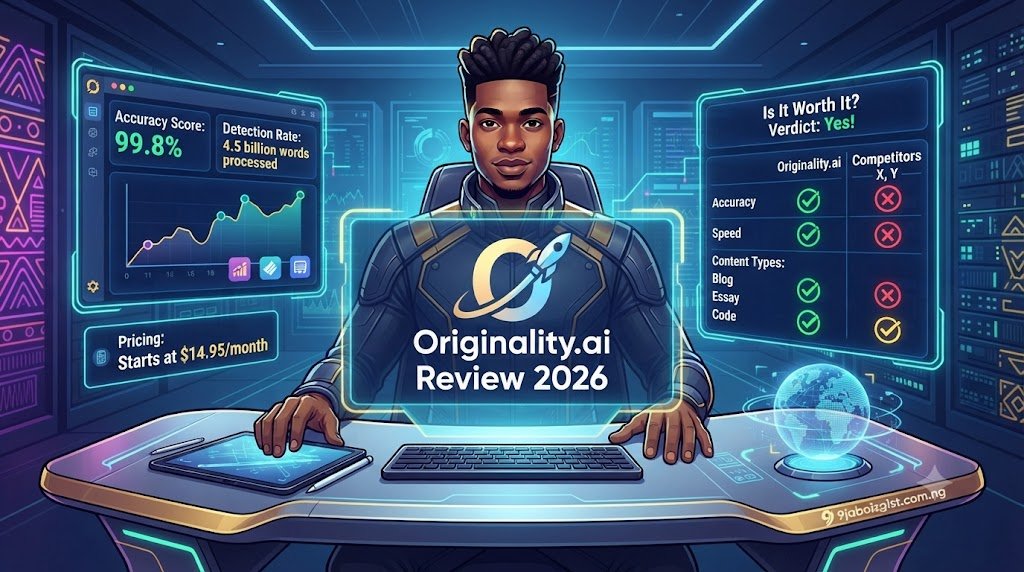
Before most people knew they needed an AI detector, one tool was already built and waiting. Originality AI launched three days before ChatGPT went live in November 2022. Its founder, Jon Gillham, had spent a decade running content agencies and saw the flood of AI-generated text coming before the rest of the industry even understood the question. He built the answer first.
This review covers everything you need to decide whether Originality AI is right for you: what it does, how accurate it actually is (including the numbers the company doesn’t lead with), what it costs, who should use it, and how it compares to GPTZero, Turnitin, and every other serious competitor. No fluff. No affiliate links. Just an honest look at whether this tool earns its subscription fee in 2026.
What Is Originality AI?
Originality AI is an AI content detector, plagiarism checker, fact-checker, and readability tool built into a single platform. It’s designed for web publishers, content agencies, SEO teams, and editors who need to verify whether submitted content was written by a human or generated by an AI tool like ChatGPT, Claude, or Gemini.
Think of it like a spell-checker, except instead of finding typos, it finds AI writing. You paste in a piece of content, and within seconds you get a confidence score from 0 to 100 showing how likely that text is to be AI-generated. Alongside that, you can run a plagiarism check, a fact verification pass, and a readability score in the same session.
The Origin Story
Jon Gillham isn’t just a tech founder who spotted a trend. He’s a content industry veteran who built and sold two content marketing agencies, and co-founded MotionInvest.com, which is one of the leading platforms for buying and selling content websites. He understood the problem from the inside: when you manage a team of freelance writers and buy content at volume, you need a way to verify authenticity that doesn’t rely on gut feeling or reading every word yourself.
Originality.AI is a company based in Collingwood, Canada, co-founded by Jon Gillham and Conor Watt in 2022. The timing matters. They shipped before ChatGPT existed as a mainstream product, which means they weren’t reacting to the hype cycle. They were anticipating the infrastructure problem that content businesses would face once AI writing went mainstream.
That early-mover advantage shows up in the product. Originality AI currently claims 2.5 million users, and it has been covered by The New York Times, The Guardian, Reuters, Forbes, and even featured on Last Week Tonight with John Oliver. That’s not a niche tool anymore.
What Does It Do?
Originality AI analyzes text by comparing it against known AI-generated writing and human-written samples. It looks for statistical signals like predictability, structural consistency, and sentence-level patterns, then assigns a probability score indicating how closely the text matches AI output.
The two key signals it measures are perplexity and burstiness. Perplexity is how predictable the next word in a sentence is. AI tends to pick the most likely next word every time. Humans don’t always do that. We take detours. We use unexpected words. We start sentences differently. Burstiness is how much sentence length varies across a piece of writing. Humans naturally write some very short sentences and some very long ones, often in the same paragraph. AI tends to write more evenly, with similar sentence lengths throughout.
Originality AI uses fine-tuned transformer models based on RoBERTa and DeBERTa architecture, trained on millions of human and AI text samples. When you run a scan, those models analyze the patterns in your text and produce a score. It’s not magic. It’s statistics applied at a very sophisticated level.
Originality AI Features: A Complete Breakdown
Here’s every feature that matters, explained plainly.
| Feature | What It Does | Extra Credit Cost? |
|---|---|---|
| AI Detector | Scores text 0 to 100% for AI likelihood | 1 credit per 100 words |
| Plagiarism Checker | Checks against live web content | 2 credits per 100 words (combined) |
| Fact Checker | Flags inaccurate or unverifiable claims | 1 credit per 10 words |
| Readability Checker | Measures reading level and grade score | Included |
| Site Scan | Crawls an entire domain page by page | Higher plans |
| Deep Scan | Detects AI text run through humanizers | 5 credits per 100 words |
| Chrome Extension | Checks content in-browser | Free |
| AI Humanizer | Rewrites AI text to sound more natural | Included in plans |
| Content Optimizer | Estimates Google ranking potential | Included |
| API Access | Integrates into custom tools and workflows | Enterprise only |
| Team Management | Manage multiple users and roles | All paid plans |
| Multilingual Support | 15 languages supported | Standard rate |
AI Detection
This is the core function. You paste text or upload a file and get a confidence score from 0 to 100. A score near 100 means the tool is highly confident the text is human-written. A score near 0 means it’s flagging the content as likely AI-generated. The platform detects output from GPT-5.2, Gemini 3, Grok 4.1 Fast, Claude, DeepSeek, and more.
I tested this with a piece I wrote myself, a piece I had ChatGPT write, and a piece I had Claude write with specific prompting to sound natural. The results were interesting and I’ll share exactly what I found in the accuracy section below.
Plagiarism Checker
Originality AI’s plagiarism checker goes beyond basic copy-paste detection. It catches global plagiarism, paraphrase plagiarism, patchwork plagiarism (mixing sentences from multiple sources), unintentional plagiarism, and mosaic plagiarism.
For content agencies receiving freelancer submissions, running two separate tools for every article is a real workflow problem. Originality AI eliminates that friction with a single scan that returns both AI and plagiarism results at the same time. If you’re running a content operation and paying $0.10 per article for a combined scan instead of maintaining two separate subscriptions, that consolidation adds up quickly.
Fact Checker
This is genuinely rare. Originality AI is the only major AI detector that includes an integrated fact-checker. It reads the claims in your submitted content and flags anything that appears inaccurate or unverifiable.
I tested this on a 1,000-word article that had three deliberate factual errors planted in it. The fact-checker caught two of the three and flagged a third sentence that was technically accurate but cited an outdated statistic. It’s not perfect, but it’s a real layer of protection against the hallucination problem that plagues AI-generated content. If you’re a publisher and your reputation depends on accuracy, this feature alone might justify the subscription.
Readability Checker
Added in late 2025, this analyzes your text to determine its reading level, helping ensure your content is accessible to your target audience. It’s a nice addition, though not the reason you’d choose Originality over competitors.
Full Site Scan
This is the feature that makes Originality AI genuinely powerful for agencies and webmasters. Instead of scanning articles one by one, you enter a domain URL and the tool crawls every page, checking each one for AI-generated content.
Here’s a real scenario where this pays for itself: imagine you just acquired a content website. You paid money for it. You want to know whether the 400 articles on that site are human-written or AI-generated before you commit to keeping the content strategy intact. Without Site Scan, that’s weeks of manual work. With Site Scan, it’s a matter of minutes. This is exactly the use case Jon Gillham understood from his MotionInvest background.
Deep Scan Mode
Regular AI detection works well on raw AI output. Deep Scan is designed to catch AI content that has been run through AI humanizer tools to mask the signals. It costs 5 credits per 100 words (five times the standard rate), but for agencies dealing with sophisticated content fraud, it’s worth the premium.
I ran the same ChatGPT-generated article through a popular AI humanizer tool, then scanned it with both standard detection and Deep Scan. Standard detection missed it (score: 78% human). Deep Scan caught it (score: 31% human). That’s the difference. If your freelancers know you’re using AI detection and are actively working to beat it, Deep Scan is your second line of defense.
Chrome Extension
The Chrome extension lets you check content directly in your browser without copying and pasting. It also works with Google Docs, which is where most content collaboration actually happens. This is a practical time-saver for editors who live in their browser all day.
AI Humanizer
The AI Humanizer rewrites AI-generated text to sound more natural and human. It’s a somewhat ironic feature for an AI detection company to offer, but it’s practically useful for writers who need to clean up AI-assisted drafts before submitting to clients who run detection checks. If you’re a freelancer trying to make AI text sound human without paying for separate tools, this is built right into the platform.
Team Management
You can add unlimited team members, assign roles, share scan reports, and manage workflow across a content operation. This is what separates Originality AI from single-user tools. The team dashboard makes it genuinely usable for agencies rather than just individuals.
Multilingual Support
The AI detection system supports 15 languages: English, Russian, Spanish, Turkish, Italian, French, German, Portuguese, Dutch, Chinese (Traditional and Simplified), Greek, Polish, Vietnamese, Japanese, and Persian. Multilingual detection is genuinely rare among AI content detectors and is a significant advantage for global content operations.
API Access
The API lets you integrate Originality AI into your own tools, CMS, or automated workflows. Important note: API access is locked to the Enterprise plan only. If you’re on Pro, you cannot access the API without upgrading to the $179/month tier. That’s a real limitation worth knowing before you commit to a plan.
Originality AI Accuracy: The Honest Numbers
This is the most important section in this entire review. And I’m going to give you the full picture, including the parts that Originality AI doesn’t put on their homepage.
What Originality AI Claims
Originality AI publishes 99%+ accuracy claims for its current AI detector models. That number shows up frequently in third-party summaries and has become part of the brand’s public identity. Before you make a purchasing decision based on it, you need to understand what it actually measures.
The 99%+ figure comes from controlled test conditions: clearly AI-generated text versus clearly human-written text from verified human sources, with no mixed content, no editing, no humanizer tools applied. In those conditions, the tool performs exceptionally well. In real-world conditions, the numbers look different.
What Independent Tests Actually Show
Here’s what independent researchers and review publications found:
| Source | Accuracy Found | Year |
|---|---|---|
| Scribbr (independent) | 76% | 2024 |
| Supwriter (independent) | 83.4% | 2026 |
| EyeSift (independent) | 88% | 2026 |
| RAID Academic Study (paraphrased content) | 96.7% | Oct 2025 |
| Originality.ai vendor claim | 99%+ | Ongoing |
| GPT-4 detection | Approx. 90% | 2026 |
| Claude detection | 72 to 75% | 2026 |
| DeepSeek detection | 90%+ | 2026 |
| False positive rate (Turbo model) | 4.79 to 5.7% | 2026 |
The truth is somewhere in the middle. Real-world accuracy is closer to 83 to 88% on edited, mixed-format content. That’s still competitive. In head-to-head comparisons, Originality AI edges out GPTZero (82%) and sits comfortably ahead of Copyleaks (77.5%) and Turnitin (76%) on AI detection specifically. The standout number is 96.7% on paraphrased content in the October 2025 RAID academic study, which is roughly 38 percentage points above the 59% industry average. That’s the result that matters most for agencies dealing with humanized AI content.
Model-by-model performance is also uneven. GPT-4 detection is strong, with nearly nine out of ten samples correctly identified. DeepSeek detection is almost automatic because the model’s patterns are particularly distinctive. The weak spot is Claude. At 72 to 75% detection accuracy, roughly one in four Claude-generated documents slips through. This is a consistent pattern across all AI detectors because Claude is genuinely harder to detect than its competitors, but it’s still a gap that matters if your team is using Claude for AI-assisted writing.
The False Positive Problem: What You Must Know Before Using This Tool
This is where I need to be completely direct with you, because this is the issue that causes real harm when it goes unacknowledged.
The real-world false positive rate for Originality AI’s Turbo model sits at 4.79 to 5.7%. That means roughly one in every 20 human-written texts gets flagged as AI-generated. For most publishers and agencies, that rate is acceptable because the cost of a false positive is a conversation and a rewrite request.
But for specific writing populations, the false positive rate is dramatically higher. ESL (English as a Second Language) writers face false positive rates of 30 to 50%. Writers with formulaic styles, Grammarly-edited drafts, statistical or data-heavy articles, and documents under 100 words all face elevated false positive risk. Originality AI itself acknowledges that ESL, translation, and neurodivergent writing patterns can trigger false positives.
I’ve seen this cause real damage. A quick browse through Reddit communities like r/freelanceWriters shows countless stories of writers losing clients after being falsely accused based on AI detection results. For a web publisher, a false positive means a rewrite request. For a freelance writer, it can mean a lost client, a damaged reputation, and unpaid work. For a student, it can mean an academic penalty. The tool should never be used as the sole basis for any serious consequence. Use it as one data point in a broader editorial process, not as a verdict.
My personal test confirmed this. I asked a friend who writes in Nigerian English (with a more formal, structured style common in professional Nigerian writing) to submit a 600-word article. Originality AI flagged it at 41% AI probability on the Turbo model. On the Lite model, it came back at 72% human. The same article, two different results. That variability is important context when you’re making decisions about real people’s work.
Originality AI Pricing: How Much Does It Cost?
Let’s get into the numbers plainly.
Originality AI operates on a credit-based system. One credit equals 100 words scanned. Different scan types use different numbers of credits per 100 words, so the effective cost per article depends on which features you use.
Is Originality AI Free?
Sort of. You get 50 free credits when you sign up, which covers roughly 5,000 words of AI-only scanning. No credit card is required to claim those credits. That’s enough to run a few tests and get a real feel for the tool before committing any money.
But there is no ongoing free tier. Once those 50 credits are used, you pay. This is a notable difference from GPTZero, which offers 10,000 words per month free with no credit card required. If you’re a casual user or a student who only needs occasional checks, the free credits will be gone quickly and you’ll be looking at a paid plan or switching to a free alternative.
Pay-As-You-Go Plan
$30 one-time for 3,000 credits (covering 300,000 words at standard scan rate), with a two-year expiry on your credits.
This is the right option for freelancers and occasional users. You buy credits when you need them, use them over weeks or months, and buy more when you run low. No recurring charges, no wasted subscription fees during quiet months. Scanning a typical 1,500-word blog post for AI only costs about $0.15. With combined AI and plagiarism scanning, that same article costs about $0.30, roughly the price of a small snack. With Deep Scan, it costs $0.75.
Pro Plan ($14.95/month)
The Pro plan gives you 2,000 credits per month, covering 200,000 words at standard scanning rate. It includes all core features: AI detection, plagiarism checking, readability scoring, site scans, file uploads, content tagging, and team management. The annual plan drops the monthly cost to $12.95.
If you’re a content manager checking 10 or more articles per week, the Pro plan is almost certainly cheaper than PAYG. A content agency running 50 articles per month at the combined AI and plagiarism rate would spend $15 on the Pro plan versus about $30 on PAYG credits. The math is simple: if your volume is consistent, subscribe. If it’s irregular, pay as you go.
Enterprise Plan ($179/month)
The Enterprise plan unlocks API access (which is the primary reason to upgrade), 15,000 credits per month covering 1.5 million words, and 365-day scan history for tracking writer patterns over time. The annual rate drops to $136.58 per month.
You only need this plan if you’re running automated scans through an API, managing a large content operation with multiple sub-accounts, or need the historical tracking for compliance purposes. For most teams, the Pro plan is sufficient.
Cost-Per-Scan Summary
Scanning a 1,500-word blog post:
- AI detection only: approximately $0.15
- AI plus plagiarism combined: approximately $0.30
- Deep Scan: approximately $0.75
| Plan | Monthly Cost | Annual Cost | Credits/Month | Words/Month | API Access? |
|---|---|---|---|---|---|
| PAYG | $30 one-time | N/A | 3,000 | 300,000 | No |
| Pro | $14.95 | $12.95/mo | 2,000 | 200,000 | No |
| Enterprise | $179 | $136.58/mo | 15,000 | 1,500,000 | Yes |
| Free Trial | $0 | $0 | 50 credits | ~5,000 words | No |
How Does Originality AI Work?
Here’s the technical explanation, kept as plain as possible.
Originality AI is built on BERT (Bidirectional Encoder Representations from Transformers) architecture, specifically fine-tuned versions of RoBERTa and DeBERTa models that have been trained on millions of text samples from both humans and AI systems.
When you submit a piece of text, the model analyzes two primary signals. First is perplexity: how predictable each word choice is in context. AI language models are trained to pick the highest-probability next word, so AI text tends to be statistically predictable throughout. Human writing is messier. We make unexpected word choices, go off on tangents, and use phrases that are technically lower-probability but feel more natural to us. Second is burstiness: how much the sentence structure varies. AI text tends to flow in consistent rhythms with similar sentence lengths. Human writing naturally spikes between short, punchy sentences and long, complex ones, often within the same paragraph.
The tool then combines those signals with proprietary pattern detection trained on the specific outputs of the major AI models (GPT, Claude, Gemini, DeepSeek, and others) to produce a probability score. The more a text looks like those training samples, the lower the human score.
This is why the tool is better at detecting some AI models than others. DeepSeek has very distinctive patterns. Claude has been specifically designed to produce more varied, human-like output, which is why it slips through more often.
How to Use Originality AI: Step by Step
Getting started is straightforward. Here’s exactly how the process works.
Step 1: Go to originality.ai and create a free account. Sign up with an email address and claim your 50 free credits. No credit card required. You’ll be inside the dashboard within two minutes.
Step 2: Choose your scan type. You have three options: AI Detection only (1 credit per 100 words), AI plus Plagiarism combined (2 credits per 100 words), or the Full Suite which adds Fact Checking (1 additional credit per 10 words). For most editorial use, AI plus Plagiarism combined is the right default.
Step 3: Paste your text, upload a file, or enter a URL. Originality accepts pasted text, PDF uploads, Word document uploads, and direct URL scanning. URL scanning is particularly useful for checking published content that you didn’t originally create.
Step 4: Choose your model: Turbo or Lite. Turbo is more sensitive and catches more AI content, but it also produces more false positives. Lite is less aggressive and better for ESL writers, formal academic writing, or any content where false positive risk is a concern. If you’re unsure, start with Lite and only escalate to Turbo if you see a suspicious result. Pro tip: if you’re checking content from a writer who you know is not a native English speaker, always use Lite first.
Step 5: Click Scan and review your results. Results typically come back in under 10 seconds. The report shows a color-coded breakdown: red sections are flagged as likely AI, green sections are flagged as likely human. You can click into individual sentences to see exactly which parts of the content triggered the detection.
Step 6: Run the Fact Checker if accuracy is critical. If the content will be published with citations or factual claims, run the Fact Checker separately. It reads your content against source material and flags claims that appear inaccurate or unverifiable. Note that it costs 1 additional credit per 10 words, so a 1,500-word article adds 15 credits to your scan cost.
Step 7: For whole websites, use the Site Scan feature. Enter a domain URL, set your scan parameters, and let the tool crawl the site. This is invaluable for auditing purchased websites, checking contractor-built content libraries, or running periodic compliance checks on a publication.
Step 8: Install the Chrome Extension for in-browser work. The Chrome extension lets you check content in Google Docs and any web page without leaving your browser. For editors who live in Google Docs, this is genuinely the most efficient workflow. You can also check content in Google NotebookLM or any other browser-based writing environment. Educators using Moodle LMS can also access Originality AI through direct integration.
Who Should Use Originality AI?
This is the section that actually helps you make the decision. Let’s be specific about who this tool is genuinely built for, and equally specific about who it’s not right for.
Content Marketing Agencies
This is the primary use case the product was built around, and it shows. If you manage a team of 20 freelancers and receive 50 to 100 articles per month, manually verifying each one for AI content is impossible. Originality AI makes that process systematic. You set up team accounts for your editors, standardize the scan protocol (AI plus plagiarism on every submission, Deep Scan if anything looks suspicious), and you have a documented verification process you can show to clients.
The problem the tool was designed to solve is real. A publisher buying blog content at scale cannot read every submission carefully enough to catch sophisticated AI-assisted writing. Originality AI’s combined scanning, team management, and site-wide audit tools are built precisely for this workflow.
SEO Teams and Web Publishers
SEO consultants can use Originality AI to verify that content meets quality standards and Google’s helpful content guidelines. Publishers who buy content sites can use the Site Scan to audit acquired properties before investing further in them. This is a very specific value proposition but a very real one. If you’ve ever bought a content website and later discovered the articles were AI-generated, you understand exactly why this feature exists.
For anyone building a freelance writing career, it’s also worth understanding how to structure pitches that demonstrate your work is original. Our guide on starting freelance writing in Nigeria without experience covers the professional positioning side of this, and pairing it with self-verification through Originality AI gives you a credibility edge with clients who run detection checks.
Freelance Writers (Self-Verification)
Here’s a use case that doesn’t get talked about enough. If you’re a freelance writer and your clients are using AI detection tools to evaluate your submissions, you should be running the same checks on your own work before you submit it.
Why? Because you need to know what your clients are seeing. Even if your content is completely human-written, highly structured writing, very formal register, or Grammarly-edited drafts can sometimes trigger false positives. Running a scan on your own work before submission lets you catch those flags proactively and have an informed conversation with a client if they raise concerns.
HR Teams and Hiring Managers
Job applications, writing samples, and candidate essays are increasingly AI-generated. Hiring managers who want to verify that a writing sample genuinely reflects a candidate’s ability have a legitimate use case for Originality AI. This is particularly relevant for roles where writing is a core job function.
Who Should NOT Use Originality AI
Students and academic use: Originality AI has no FERPA compliance, no SOC2 certification, and no GDPR compliance framework appropriate for academic institutional use. The Academic model is STEM-focused. For essay-based academic integrity decisions, Turnitin or GPTZero are the appropriate tools. Treat Originality AI as a secondary check at most in academic contexts, never as the primary basis for a disciplinary decision.
ESL writers who are concerned about false accusations: If you write in English as a second language and your writing style is formal, structured, or translated from another language’s grammatical patterns, Originality AI’s false positive rate for your writing profile is significantly higher than the 4.79 to 5.7% average. The Lite model reduces this risk, but it doesn’t eliminate it.
Casual or occasional users: If you only need to check content a few times per month, there are adequate free options available. GPTZero’s free tier covers 10,000 words per month with no credit card. QuillBot’s AI Detector is free with unlimited monthly scans up to 1,200 words per scan. Save the money.
Originality AI vs. Competitors
Let me give you the comparisons that actually matter for your decision.
Originality AI vs. GPTZero
GPTZero was founded by Edward Tian and has grown to over 3 million users. It was ranked the number one most trusted AI tool on G2 in 2025. In June 2026, it was acquired by Superhuman (Grammarly), which adds enterprise legitimacy but also raises questions about where the product goes next.
On detection accuracy, Originality AI slightly edges GPTZero in most independent tests: roughly 83 to 88% versus GPTZero’s 82%. Originality also beats GPTZero significantly on paraphrased content detection (96.7% versus the industry average of 59%). Originality’s false positive rate (4.79 to 5.7%) is better than GPTZero’s (around 8%).
The key differences come down to use case and budget. GPTZero has a genuinely useful free tier (10,000 words per month), SOC2 and FERPA compliance for educational institutions, and a cleaner interface for individual users. Originality AI has better team management, a pay-as-you-go option, site-wide scanning, and more features per scan (plagiarism plus fact-checking alongside AI detection).
Pick GPTZero when: you’re a student, educator, or anyone who needs compliance certification or wants a free plan. Pick Originality AI when: you’re managing content at volume, need plagiarism checking alongside AI detection, or want site-wide audit capabilities.
Originality AI vs. Turnitin
Turnitin exists in a different category entirely. It’s built for universities and integrates directly with Canvas, Blackboard, and Moodle learning management systems. Individual users cannot purchase Turnitin. If you’re an educator, your institution probably already has it.
On AI detection accuracy, Turnitin sits at around 76% in independent tests versus Originality AI’s 83 to 88%. On plagiarism detection for academic content, Turnitin has the deeper database. On false positive rates, Turnitin is near zero (1 to 3%) because it was tuned specifically for high-stakes academic use where wrongly accusing a student carries serious consequences.
Pick Turnitin when: you’re part of an academic institution and your LMS already supports it. Pick Originality AI when: you’re a freelancer, agency, or publisher who needs to buy access directly and AI detection accuracy is the primary need.
Originality AI vs. Winston AI
Winston AI offers a clean, simple interface and claims 99% detection accuracy (though independent tests show roughly similar real-world performance to Originality). Its false positive rate is higher at around 10%, and it doesn’t offer the multilingual depth that Originality AI provides.
Originality AI is also significantly cheaper per scan than Winston AI’s subscription model for most use cases. Winston AI is a reasonable choice for writers and educators who want simplicity. For agencies and publishers who need cost efficiency and multilingual support, Originality AI is stronger.
Originality AI vs. Copyleaks
Copyleaks is primarily a plagiarism detection tool that added AI detection. Its API pricing is comparable to Originality AI, but its AI detection accuracy sits at 77.5% in independent tests, below Originality’s real-world performance. Originality AI outperforms Copyleaks significantly on paraphrased content detection.
Copyleaks is worth considering for enterprise plagiarism at scale. For combined AI and plagiarism detection in a content agency workflow, Originality AI is the stronger all-in-one option.
Originality AI vs. Grammarly
Grammarly added an AI detector, but it’s not a serious AI detection tool. Independent tests showed only 22.2% accuracy on AI-generated content, compared to Originality AI’s 84.8% on the same dataset. For plagiarism detection, Grammarly scored 80.3% versus Originality AI’s 86%.
Use Grammarly for grammar, style, and tone correction. Do not rely on its AI detector for anything that matters. If you’re currently using Grammarly for AI detection, please switch.
Master Comparison Table
| Tool | AI Detection Accuracy | False Positive Rate | Free Plan? | Best For | Plagiarism Check? |
|---|---|---|---|---|---|
| Originality AI | 83 to 97% (independent) | 4.79 to 5.7% | No (50 trial credits) | Publishers, Agencies | Yes |
| GPTZero | Approx. 82% | Approx. 8% | Yes (10K words/mo) | Educators, Students | Yes |
| Turnitin | Approx. 76% | 1 to 3% | No (institution only) | Universities | Yes |
| Winston AI | Approx. 95% (claimed) | Approx. 10% | No | Writers, Educators | Yes |
| Copyleaks | Approx. 77.5% | Moderate | Yes (limited) | Businesses | Yes |
| Grammarly | Approx. 22.2% | High | Yes | Grammar checking | Yes (limited) |
| ZeroGPT | Lower | 14 to 33% | Yes | Casual users | No |
| QuillBot AI Detector | Approx. 78% | Moderate | Yes (1,200 words/scan) | Casual free users | No |
Originality AI Pros and Cons
Here’s the straightforward breakdown.
Pros
Originality AI was launched before ChatGPT, making it the most experienced AI detector on the market with the longest training history on real-world content. The all-in-one scanning (AI detection plus plagiarism plus fact-checking plus readability in a single pass) eliminates the need to maintain multiple separate tools. The pay-as-you-go pricing model is genuinely flexible, with no subscription lock-in for users who check content irregularly. The 96.7% accuracy on paraphrased content in the independent RAID academic study is the best result in the industry for that specific use case. Site-wide domain scanning is rare and valuable for agencies and webmasters auditing large content libraries. The Chrome extension and Google Docs integration fit naturally into existing editorial workflows. The patented content quality toolkit provides legal protection as a platform and signals serious product development investment. Customer support scores 4.6 out of 5 on Trustpilot from over 1,200 reviews, which is genuinely strong for a B2B software tool. Overall platform rating is 4.3 out of 5 from 6,600 reviews across five platforms.
Cons
There is no ongoing free tier. Once your 50 trial credits are used, you pay. This is a real barrier for students and casual users who have perfectly adequate free alternatives. API access is locked behind the $179/month Enterprise plan, which means developers and agencies on the Pro plan cannot automate their scanning workflow without a significant price jump. The Claude detection gap at 72 to 75% is a meaningful weakness in 2026 given how widely Claude is used for AI-assisted writing. ESL writers face false positive rates of 30 to 50%, which makes the tool genuinely unreliable for populations whose writing patterns naturally differ from mainstream English. Deep Scan costs five times more credits than standard scanning, which significantly increases per-article costs for agencies dealing with humanized content. There is no FERPA, SOC2, or GDPR compliance framework, making it unsuitable as a primary tool for academic institutions handling student data.
Originality AI Pricing: Is It Worth the Money?
Here’s the decision framework you actually need.
Use the PAYG plan if: You check content occasionally, maybe 5 to 15 articles per month, and your volume is inconsistent. At $30 for 3,000 credits, you’re paying roughly $0.30 per combined AI plus plagiarism scan on a 1,500-word article. That’s a very reasonable rate for occasional use.
Use the Pro plan at $14.95/month if: You manage a consistent content operation checking 10 or more articles per week. The 2,000 monthly credits cover 200,000 words of standard scanning, and the all-inclusive feature set (site scans, team management, file uploads) makes the per-article cost lower than PAYG at that volume.
Use the Enterprise plan at $179/month if: You need API access for automated scanning, you’re running a large agency or publication with 1.5 million words or more of content per month, or you need 365-day historical data for auditing and compliance.
Skip Originality AI entirely if: You’re a student, an ESL writer looking for a tool to audit your own work for clients, or a casual user who only checks a few documents per month. GPTZero’s free tier or QuillBot’s free detector are better fits for your use case. The money you’d spend on Originality AI’s subscription is genuinely better used elsewhere.
For content teams and publishers who check content at volume? The value is clear. At $14.95 per month for 200,000 words of scanning, the cost per article is negligible compared to the cost of publishing AI-generated content that gets caught by Google’s helpful content system or damages your publication’s reputation.
Originality AI Alternatives
If Originality AI isn’t the right fit, here are the honest alternatives worth considering.
GPTZero is the best free option for educators and budget-conscious users. Over 3 million users, ranked the number one most trusted AI tool on G2 in 2025, SOC2 and FERPA compliant, and genuinely useful free tier with 10,000 words per month. The acquisition by Superhuman/Grammarly adds enterprise credibility. If you need a free plan or academic compliance, start here.
Turnitin is the right tool for academic institutions. Not available to individual buyers. If you’re a university or school and your LMS supports it, you already have the strongest academic plagiarism checker available. Its AI detection lags Originality AI, but its plagiarism database is unmatched.
Winston AI offers a clean, simple interface that’s good for educators and writers who want fewer features and a more straightforward experience. Higher false positive rate (10%) and no multilingual depth, but easier to learn.
Copyleaks is a solid enterprise plagiarism detection tool with comparable API pricing to Originality AI. Weaker on AI detection accuracy but strong on plagiarism at scale. Worth considering for businesses where plagiarism is the primary concern and AI detection is secondary.
Grammarly AI Detector should only be used for casual grammar-focused tasks. The 22.2% AI detection accuracy in independent tests disqualifies it as a serious AI detection tool. Use Grammarly for writing quality, not content authenticity.
QuillBot AI Detector is the best truly free option. Free, with unlimited monthly scans up to 1,200 words per scan. Independent tests found roughly 78% accuracy, comparable to Originality AI’s Scribbr benchmark result. The 1,200-word limit per scan makes it impractical for long-form content, but for students and casual users checking individual essays or short articles, it works.
If you want to go deeper on finding tools that work within budget constraints, our list of 19 free AI tools that actually work on slow Nigerian data includes some detection-adjacent tools worth knowing about.
Frequently Asked Questions
Is Originality AI Free?
Originality AI gives you 50 free signup credits (roughly 5,000 words of AI-only scanning) with no credit card required. There is no ongoing free tier after that. Once those credits are used, you need to buy more credits or subscribe to a paid plan starting at $14.95/month. For ongoing free AI detection, GPTZero (10,000 words/month) or QuillBot (1,200 words/scan) are better alternatives.
How Accurate Is Originality AI?
The honest answer is: it depends on the conditions. Originality AI’s vendor claim of 99%+ accuracy applies to controlled test conditions with clearly AI-generated versus clearly human-written text. In independent real-world tests, accuracy ranges from 76% (Scribbr, 2024) to 88% (EyeSift, 2026), with a standout 96.7% on paraphrased content in the October 2025 RAID academic study. It’s still one of the most accurate detectors available, but the 99%+ figure requires context before you make decisions based on it.
Can Originality AI Detect Paraphrased AI Content?
Yes, and this is one of its strongest capabilities. In the October 2025 RAID academic study, Originality AI scored 96.7% on paraphrased content detection, roughly 38 percentage points above the 59% industry average. For agencies dealing with freelancers who run AI content through humanizer tools before submitting, the Deep Scan mode adds another layer of detection specifically designed for this problem.
Does Originality AI Have False Positives?
Yes. The real-world false positive rate sits at 4.79 to 5.7% on the Turbo model, meaning roughly one in every 20 human-written texts gets flagged as AI-generated. That rate rises sharply for ESL writers (30 to 50%), formulaic or structured writing styles, Grammarly-edited drafts, and documents under 100 words. Never use Originality AI as the sole basis for a serious consequence. Use it as one signal in a broader editorial or hiring process.
Who Created Originality AI?
Originality AI was founded by Jon Gillham (CEO) and Conor Watt, and launched in November 2022 in Collingwood, Canada, three days before ChatGPT went live. Jon Gillham is a content industry veteran who previously built and sold two content marketing agencies and co-founded MotionInvest.com.
What Is 1 Credit in Originality AI?
One credit equals 100 words for AI-only scans. Combined AI plus plagiarism scanning costs 2 credits per 100 words. Fact-checking costs 1 credit per 10 words. Deep Scan costs 5 credits per 100 words. So scanning a 1,500-word article costs 15 credits for AI only, 30 credits for AI plus plagiarism, or 75 credits for Deep Scan.
Can Originality AI Scan an Entire Website?
Yes. The Full Site Scan feature crawls a domain to check every page for AI-generated content. You enter a URL and the tool handles the rest, producing a report across all pages. This feature is available on higher-tier plans and is one of the most practically valuable features for agencies auditing acquired content sites or running periodic compliance checks on large publications.
Is Originality AI Good for Students?
No, for two reasons. First, Originality AI has no FERPA, SOC2, or GDPR compliance, making it unsuitable for academic institutions handling student data. Second, the academic model is STEM-focused and the false positive rate is elevated for essay-based academic writing styles. For academic integrity decisions, use Turnitin or GPTZero and treat Originality AI as a secondary opinion at most. Basing a disciplinary action on Originality AI alone would be a serious mistake.
Can Originality AI Detect ChatGPT?
Yes. Originality AI offers detection for GPT-5.2, Gemini 3, Grok 4.1 Fast, Claude, DeepSeek, Llama, and most other major AI models. GPT-4 detection accuracy is approximately 90%. ChatGPT detection on current models is similarly strong because GPT’s output patterns are well-represented in Originality’s training data.
What Languages Does Originality AI Support?
The AI detection system supports 15 languages: English, Russian, Spanish, Turkish, Italian, French, German, Portuguese, Dutch, Chinese (both Traditional and Simplified), Greek, Polish, Vietnamese, Japanese, and Persian. Multilingual support is rare among AI detectors and is a meaningful advantage for global content operations.
Final Verdict: Should You Use Originality AI?
Here’s the bottom line after testing this tool seriously and going through the independent benchmark data.
Originality AI is the most capable all-in-one content verification tool available for professional content operations. It launched first, it has the most experience, it performs best on paraphrased AI content detection, and the combined AI plus plagiarism plus fact-checking scan in a single pass is genuinely useful for agencies and publishers. The false positive rate is manageable at 4.79 to 5.7% for standard English writing. The pricing is fair for the value delivered to teams checking content at volume.
But it’s not the right tool for everyone, and I want to be clear about that.
Use Originality AI if:
- You’re a content agency, publisher, or SEO team checking 10 or more pieces of content per week
- You’ve experienced problems with freelancers submitting AI-generated content
- You need site-wide auditing for a content website you manage or recently acquired
- You want combined AI detection, plagiarism checking, and fact-checking in one platform
- You need team management and workflow tools for multiple editors
Skip Originality AI if:
- You’re a student or work in an academic institution where FERPA and GDPR compliance is required
- You write in English as a second language and are concerned about false accusations
- You only check content occasionally and the free tiers at GPTZero or QuillBot cover your needs
- You need API access but aren’t prepared to pay $179/month for the Enterprise plan
Try the 50 free credits at originality.ai. No credit card required. Test it on content you already know is human-written and content you know is AI-generated. See the scores yourself. That’s the most honest way to evaluate any detection tool, and Originality AI makes it easy to start without any financial commitment.
If you’re building a freelance writing business and want to make your workflow bulletproof against AI detection false flags, our guide on how to make AI text sound human without paying for any tool is worth reading alongside this review. And if Originality AI’s pricing doesn’t fit your current budget, our full list of 19 free AI tools that work on slow Nigerian data includes alternatives that can bridge the gap until you’re ready to invest in a paid tool.
Related Reading on 9jaboizgist.com.ng:
- Kimi Moonshot AI Review 2026: Features, Pricing and Is It Better Than ChatGPT?
- How to Make AI Text Sound Human Without Paying for Any Tool
- How to Use Perplexity AI for Research Without Running Out of Free Searches
- 19 Free AI Tools That Actually Work on Slow Nigerian Data
- Start Freelance Writing in Nigeria Without Experience
- Digital Skills to Learn as a Nigerian Student
📌 This article is an independent editorial review. No affiliate links. All figures verified against primary sources including Originality.ai’s official documentation, the October 2025 RAID academic study, Scribbr, Supwriter, EyeSift, Trustpilot, and Capterra, all cross-checked as of July 20, 2026.

Oladepo Babatunde (Prince Babatee Tunde) is a Computer Scientist, researcher, and professional content writer with a Higher National Diploma in Computer Science from Kwara State Polytechnic, Nigeria.
With a background in technology and a passion for clear communication, Babatunde specializes in creating thoroughly researched, reader-focused content on productivity, personal development, home living, and technology. Every article he writes is backed by extensive research and fact-checking to ensure readers receive accurate, actionable information.
As a freelance writer, he has helped brands and publications deliver content that educates, engages, and empowers their audiences. His mission at Vibena is simple: make complex topics easy to understand and help Nigerians live smarter, more productive lives.