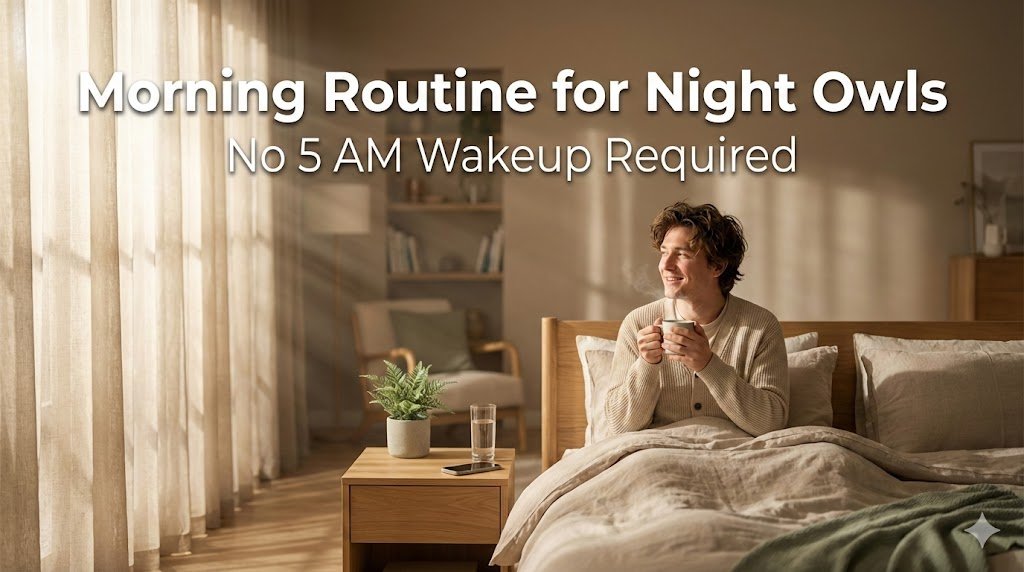
Let’s be clear: When the alarm sounds, it often feels like a direct assault on your peace. While society glorifies the early risers who are apparently hitting the gym at sunrise, you are likely hitting the snooze button for the third time in a row. It is time to drop the guilt because the problem isn’t you; it’s the schedule.
I have spent years navigating this exact frustration. For the longest time, I assumed I was simply lazy or undisciplined. I would stare at the ceiling at 1:00 AM, my brain buzzing with creative solutions and fresh ideas, only to pay the debt of that wakefulness the following morning. My partner and I frequently found ourselves engaged in deep, productive conversations well past midnight, while our friends who identified as morning people were long asleep. I eventually realized I was not broken, nor was I lacking ambition. I was simply fighting my biology.
This is not another generic article demanding that you wake up at 5 AM to achieve your dreams. If you are naturally an early riser, you might find more value in our morning routine guide for Nigerian professionals. However, if your mornings feel like a persistent battlefield, you are in the right place. Being a night owl isn’t a curse.
This is a realistic Morning Routine for Night Owls crafted to help you succeed on your own terms. It is about working with your natural rhythms instead of constantly resisting them.
In this guide, we will explore how to build a routine that supports your body. We will look at the science, practical hacks I have personally validated over the years, and effective ways to maximize your output without sacrificing your rest. For a long time, I wrongly believed that being a night owl was a sign of low willpower. That is a common limiting belief that holds far too many people back. Learn how to develop a growth mindset that drives real success instead of continuing to beat yourself up for having a unique internal clock.
Why Traditional Morning Routines Fail Night Owls
Have you ever attempted a hyped-up morning routine promoted by a millionaire only to quit by the second day? You are certainly not alone. Most productivity advice is built on the false assumption that every human possesses the exact same biological clock.
Morning person vs night person psychology is remarkably different. Dr. Michael Breus, a renowned sleep expert, notes that roughly 30% of the population are “wolves” (classic night owls), while 15% are “lions” (early risers), 40% are “bears” (those aligned with the sun), and 15% are “dolphins” (irregular sleepers prone to insomnia). Research consistently suggests that night owls often demonstrate enhanced creativity and sharp problem-solving abilities during their peak evening hours. Findings from the University of Madrid indicate that evening types frequently score higher on cognitive metrics related to creative thinking and divergent problem-solving.
The problem isn’t you; it’s the schedule. Traditional routines demand peak cognitive energy during the exact window when your body is still trying to boot up. Trying to force a 5 AM start when your physiology is screaming for sleep is a guaranteed pathway to burnout, not high performance. You deserve a system that respects your reality.
Understanding Your Night Owl Chronotype
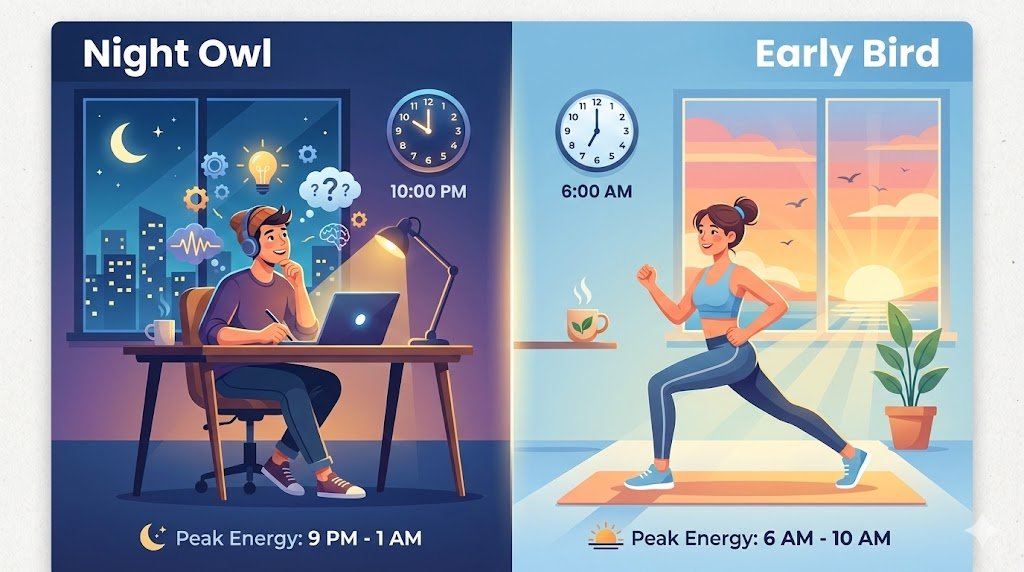
To fix your mornings, you must understand the field of chronobiology. This is the scientific study of your internal biological clock. Your chronotype is primarily genetic and dictates your natural sleep-wake cycle. According to the Sleep Foundation, if you have a delayed sleep phase, your body releases melatonin much later in the evening than a typical early bird.
UCLA Health explains that your chronotype is influenced by several factors. These include your age, as children tend to have earlier chronotypes that shift later during adolescence before shifting back in adulthood, your unique genetic makeup, and environmental factors like light exposure. The NIH reinforces this, noting that data from nearly 700,000 individuals identified hundreds of genetic variations tied to sleep timing.
Signs you are a true night owl:
- You feel most alert and creative well after 9 PM.
- You experience intense sleep inertia, that heavy, thick grogginess, if forced to wake early.
- You rely on caffeine as a crutch to function before the clock hits noon.
Studies have shown that night owls who force themselves to adopt an early bird lifestyle often suffer from social jetlag. This isn’t just about feeling a bit tired. Social jetlag occurs when your sleep schedule varies significantly between work days and free days. If you wake at 7 AM for your job but sleep until 11 AM on Saturdays, you are forcing a 4-hour internal time shift every weekend. This disrupts your circadian rhythm as severely as flying through multiple time zones every week.
The health consequences are serious. Many epidemiological studies have shown strong associations between chronic social jetlag and various pathologies, ranging from increased cardiovascular risks to metabolic dysfunction. Furthermore, a May 2024 study from Stanford Medicine highlighted that night owls who stay up late consistently are 20-40% more likely to face mental health challenges if their sleep duration is compressed. This is why fighting your biology backfires; it is not merely a matter of willpower, but a matter of your long-term health. If your current routine leaves you drained, it is time to examine why you’re always tired and have no energy.
Interestingly, some research indicates that while enforced social jetlag is damaging, voluntary sleep extension during your off-days might be protective. If you are a night owl, do not feel guilty about sleeping in when you have the chance. It allows your body to recover from the biological friction of the work week.
A Note for Teens and Parents
If you are a teenager or the parent of one, recognize that biology is a major player here. Melatonin release is naturally delayed during the adolescent years, pushing the internal clock later. When this biological reality meets the demands of school, it creates an environment ripe for chronic sleep deprivation. Acknowledging this shift can help parents reduce the friction associated with morning wake-ups.
The Best Schedule for Night Owls
The best schedule for night owls is one that prioritizes consistent sleep duration over a specific, arbitrary wake-up time. If your professional role allows for flexibility, stop apologizing for waking up at 8:30 AM or 9:00 AM. Here is a structure that aligns with your peak performance hours:
- 8:30 AM – 9:30 AM: Wake up, hydrate with a large glass of water, and seek immediate light exposure. Getting 5-10 minutes of direct sunlight helps anchor your circadian clock.
- 9:30 AM – 11:00 AM: Focus on low-energy tasks like checking emails, organizing your workspace, or basic planning.
- 11:00 AM – 1:00 PM: Tackle moderate-intensity work that requires some focus but isn’t your most creative heavy lifting.
- 1:00 PM – 2:00 PM: Take a substantial break. A short, intentional rest can act as a mid-day reset.
- 3:00 PM – 8:00 PM: Dive into your deep work. This window is your superpower time. Guard it fiercely.
Learning how to function as a night owl is entirely about matching your most demanding tasks to your highest energy levels. Do not attempt to tackle your most complex project at 8 AM. Save it for the afternoon or evening when your brain is fully awake.
How to Survive as a Night Owl in a 9 to 5 World
Since not everyone has the luxury of a flexible schedule, you may need a strategy to survive if you are stuck in a rigid 9 to 5 environment.
- Negotiate Flex Time: Simply moving your hours from 8-5 to 10-7 can drastically change your quality of life. Negotiating this requires presenting your value clearly. If you need help articulating this, why setting boundaries is important for work-life balance is a great resource to frame your conversation with leadership.
- Front-Load Easy Tasks: Reserve your peak brain power for the late afternoon hours. Use the morning for repetitive tasks, meetings, or administrative work that doesn’t require deep creative energy.
- Prepare the Night Before: Your evening self is much sharper than your groggy morning self. Pack your gear and prep your lunch the night before to reduce the decisions you have to make when you wake up. Night owls running side businesses have even more pressure. Our guide on time management for side hustlers balancing a 9-5 covers how to handle these overlapping demands.
The 3 Downs and 3 Ups Method for Night Owl Mornings
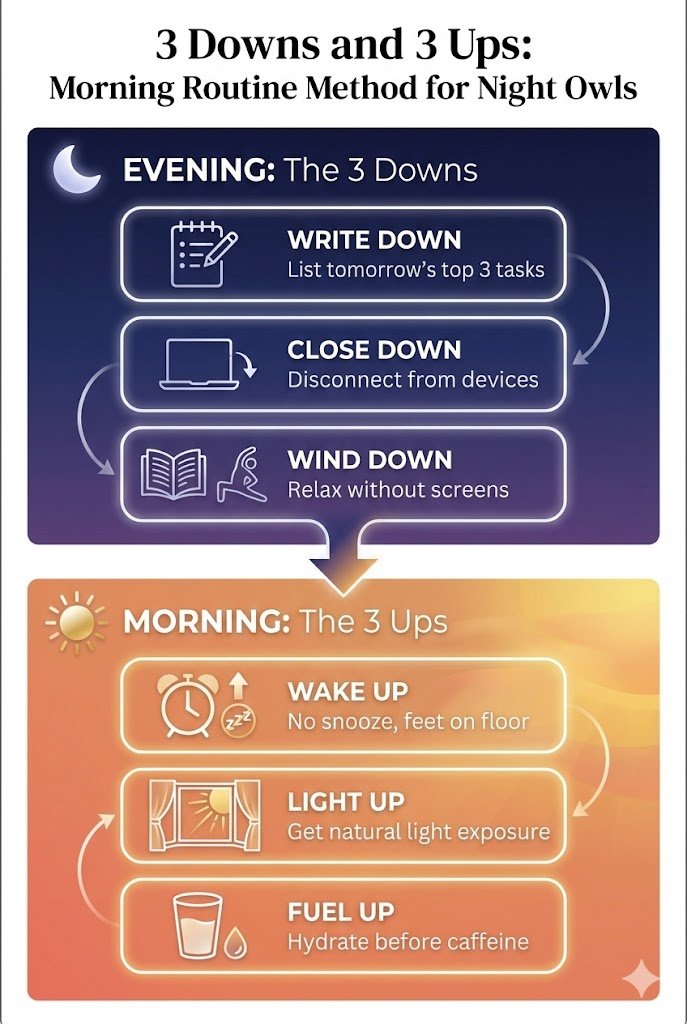
I developed this simple framework because overly complex, multi-step routines often fell apart in practice. This approach focuses on creating a reliable bridge between your evening and morning. This is far more effective when paired with a Sunday reset routine checklist that prepares you for the entire week ahead.
The 3 Downs (Evening)
- Write Down: Before you close your eyes, write down your top three tasks for the following day. This stops your brain from looping on to-do items while you try to sleep. Need quick ideas? Try these 2-minute micro-journaling prompts to calm your mind.
- Close Down: Completely power down your devices. Set a digital boundary to ensure your brain shifts from work mode to rest mode.
- Wind Down: Engage in a low-stimulation activity like reading or gentle stretching. Avoid all screens. Check out these quick stress relief techniques you can do at home for ideas during your wind down phase.
The 3 Ups (Morning)
- Wake Up: When the alarm sounds, do not hit snooze. If you find yourself struggling, place your alarm across the room so you have to physically stand up to stop it.
- Light Up: Throw open the curtains the moment you are out of bed. Exposure to bright light, or using a 10,000 lux therapy lamp if you live in a dark climate, is the single most effective way to reset your circadian clock.
- Fuel Up: Drink a full glass of water. Hydration is vital after several hours of sleep.
Popular Morning Routine Methods Explained
There is a lot of noise regarding what a perfect morning looks like. Let’s filter these methods through a night owl lens.
What Is the 5 5 5 30 Morning Routine?
The 5 5 5 30 routine consists of: 5 minutes of gratitude, 5 minutes of light movement, 5 minutes of mindfulness, and 30 minutes of deep learning. The total time is 45 minutes. For a night owl, the secret is simply doing this when you actually wake up, perhaps at 9 AM rather than 5 AM. It is an excellent, gentle way to ease into your day without immediate, high-intensity demands.
What Is the 20 20 20 Rule for Morning Routine?
This rule divides the first hour into 20 minutes of exercise, 20 minutes of reflection, and 20 minutes of learning. If 60 minutes feels daunting when you are fighting sleep inertia, try the 10/10/10 version. It provides the same benefits in a time frame that is far easier to maintain consistently.
What Is the 5 4 3 2 1 Routine?
This is a psychological tool to overcome hesitation. When you feel the urge to snooze, count backward from 5, 4, 3, 2, 1, and physically move the second you hit one. It effectively interrupts the brain’s internal negotiations. If you struggle with the snooze button, this trick is a lifesaver. For more tactics on avoiding the trap of delay, explore these science-backed strategies to stop procrastinating.
What Is the Morning 1 Hour Rule?
This is simple: no phone for the first hour of your day. Checking your inbox while in bed forces your brain into a reactive state before you are even fully awake. Staying offline for that first hour allows you to remain proactive, giving you space to set your own intentions for the day ahead.
Comparison of Morning Routine Methods
| Method | Time Required | Best For Night Owls? | Difficulty |
|---|---|---|---|
| 5 5 5 30 | 45 minutes | Yes (adjust timing) | Easy |
| 20 20 20 | 60 minutes | Moderate (try 10/10/10) | Medium |
| 5 4 3 2 1 | 5 seconds | Excellent | Easy |
| 1 Hour Rule | 60 minutes | Excellent | Medium |
| 3/2/1 Bedtime | Evening prep | Essential | Easy |
Night Preparation: The Secret to Easier Mornings
Your morning success is largely determined by the actions you take the night before. Many of us treat the evening as a frantic scramble to finish lingering tasks, which is the fastest way to sabotage your upcoming sunrise. Instead, view your evening as a intentional runway for the next day.
What Is the 3/2/1 Bedtime Rule?
The 3/2/1 bedtime rule is a structured framework that helps you anchor your evening cutoffs. I have personally relied on this rhythm to ensure my mind actually powers down when I want it to:
- 3 hours before bed: Stop all calorie intake to allow your digestion to settle, preventing internal heating that disturbs deep sleep.
- 2 hours before bed: Cease all professional or intense cognitive work to lower cortisol levels, ensuring your brain exits “alert mode.”
- 1 hour before bed: Power down all digital screens to protect natural melatonin production, which is easily suppressed by artificial blue wavelengths.
Light Hygiene: The Critical Factor
Dr. Samer Hattar from the National Institutes of Mental Health emphasizes that blue light exposure from devices between 10 p.m. and 4 a.m. actively decreases dopamine availability. This doesn’t just make you groggy; it negatively impacts your baseline resilience against feelings of depression and anxiety. Occasional late nights happen, but persistent exposure to high-intensity light at midnight creates a physiological debt that is hard to repay.
If you must have light during the night for navigation or childcare, choose amber or red spectrum bulbs rather than standard bright whites. Red wavelengths possess a lower energy state and have a minimal impact on your melatonin secretion. I replaced my bedroom hallway lamp with a cheap red LED, and it made an immediate difference in how quickly I could return to sleep. In 2026, many smart home systems allow you to automate your home lighting to cycle to a deep, warm orange hue after 9 p.m. without you ever flipping a physical switch.
What Is the Military Sleep Method?
If your mind races the moment your head hits the pillow, try this technique often categorized as a military hack. It was originally designed to help pilots achieve rest under pressure within two minutes or less, regardless of their surroundings.
- Note: This technique is widely credited to US Navy Pre-Flight School training, providing a reliable way to override physical tension.
- Lie flat on your back and consciously soften every muscle in your face, including your tongue and your jaw.
- Drop your shoulders down toward your feet as far as they will go, releasing the tension we naturally hold in our upper traps.
- Exhale fully, clearing your chest, then proceed to relax your legs, from your thighs all the way down to your toes.
- Clear your mind for 10 seconds by visualizing a completely calm, still lake under a clear sky.
- If a stray thought breaks your focus, repeat the phrase “Don’t think, don’t think” to yourself for a few seconds until the image of the lake returns.
8 Practical Morning Hacks for Night Owls

The problem isn’t you; it’s the schedule. Being a night owl isn’t a curse. I have spent years refining these evidence-based techniques to make early starts feel less like an existential crisis.
1. Hydrate Before Caffeine
You wake up in a state of mild dehydration. Water actually wakes up your brain faster than caffeine because it fuels cellular function. I keep a glass bottle on my nightstand so I can drink 500ml before my feet even touch the floor. It effectively washes away the fog of sleep.
2. Automate Your Coffee Brewing
Eliminate the manual labor of making your morning beverage. Use a programmable brewer or a smart plug set to activate the machine ten minutes before your alarm rings. Waking up to the aroma of coffee is a sensory reward that makes leaving the blankets much easier.
3. Embrace Morning Light Exposure
Neuroscientist Dr. Andrew Huberman consistently highlights the importance of getting 5-10 minutes of natural sunlight directly into your eyes within the first hour of waking. This triggers a healthy, early-morning cortisol spike, which is exactly what you need to feel alert. This signal also acts as a biological timer for melatonin release roughly 14-16 hours later. For night owls, this is the most powerful tool available to shift your circadian rhythm toward an earlier schedule without the trauma of a 5 AM wake-up call.
Dr. Huberman also suggests seeking out low-angle sunlight in the late afternoon. The unique yellow and orange wavelengths present as the sun begins to set communicate to your internal clock that it is time to prepare for sleep. This functions as a second anchor point, which is incredibly useful if you struggled to get outside during the morning hours.
- Pro Tip: If you live in an area with limited light or commute before sunrise, use a 10,000 lux light therapy lamp. I keep mine on my desk and use it for 10 minutes while I scan my calendar; it does the heavy lifting that the sun usually would.
4. Simplify Morning Decisions
Decision fatigue is a silent energy drain. When you wake up, your prefrontal cortex is still partially offline. By laying out your clothes, packing your bag, and having a standardized breakfast, you preserve your limited morning willpower for things that actually matter.
5. Use the “1-Habit” Morning Routine
Ignore the pressure to meditate, run, and journal every morning. Select exactly one habit to anchor your morning. Maybe that habit is simply making the bed or drinking your water. Start small and gain momentum. If music helps, learn how to create a morning playlist that boosts your mood, turning your commute or kitchen time into a high-energy environment.
6. Plan Breakfast Wisely (Or Skip It)
If you genuinely lack an appetite upon waking, do not force yourself to eat. Many night owls find intermittent fasting to be a natural fit for their physiology. If you do eat, focus on protein-dense meals rather than quick-burning sugar, which will only lead to an inevitable mid-morning crash.
7. Create a “Morning Basket”
Designate a physical container for your essentials, your journal, current book, hydration supplies, or planner. Having everything in one basket eliminates the frantic search for items when you are still half-asleep, keeping your morning momentum intact.
8. Match Tasks to Energy Levels
Stop fighting your internal clock by scheduling heavy analytical meetings for 8 AM. If your natural peak occurs in the afternoon, protect that time for your most difficult work. Save the early hours for low-stakes administration, cleaning, or personal reflection.
Can a Night Owl Become a Morning Person?
People often ask, “How do I stop being a night owl?” or “Can I really change my chronotype?”
The reality is that your sleep timing is largely determined by your genetics, which NIH genome-wide studies involving 700,000 participants have confirmed. Can you shift your window? Yes. By utilizing light exposure and consistent behavior, you can nudge your clock earlier. However, you will likely always possess a natural tendency to prefer late-night activity. Instead of fighting your biological identity, aim to manage your energy levels within the framework that actually suits your life.
Are High IQ People Night Owls?
You may have seen the theory that high IQ is linked to being a night owl. Researchers like Satoshi Kanazawa have proposed that nocturnal activity is an evolutionary novelty, suggesting that those who stay up late are simply engaging in modern cognitive habits. While being a night owl often correlates with higher levels of creativity, the most important takeaway is that your sleep schedule is not a moral failing or a sign of laziness.
- The Takeaway: Embrace your natural inclinations as a sign of your unique cognitive wiring rather than a burden to be corrected.
A Word of Caution: What Research Says About Late Nights
While being a night owl has its creative advantages, we must acknowledge the broader data. A significant study from Stanford Medicine published in May 2024, which analyzed health data from more than 73,000 adults, serves as a necessary reality check.
Researchers discovered that every individual tends to benefit from earlier sleep timing. Data suggests that night owls who habitually stay up late are 20% to 40% more likely to struggle with mental health, regardless of whether they feel like a “night person.”
Jamie Zeitzer, PhD, a professor at Stanford, notes that alignment with your chronotype matters less than the simple act of avoiding late-night activity. He argues that being awake during your biological night, the time your body expects you to be in deep recovery, can exacerbate stressors.
The “Mind After Midnight” effect is a real phenomenon where the brain’s frontal cortex, which manages impulse control and rational judgment, becomes significantly less efficient. If you are awake after 16 hours of daily activity, your cognitive filter weakens, making it much easier to fall into ruminative loops or anxious thoughts.
Different activities carry different weights. Socializing with friends at night is fundamentally different from being isolated while doomscrolling on a phone. The former provides human connection, while the latter can intensify feelings of loneliness. The study in Psychiatry Research identifies 1 a.m. as a practical, evidence-based threshold for lights out.
Dr. Zeitzer advises: “If you want to try going to sleep earlier, focus on morning light and avoid bright overhead lighting in the evening. Develop a wind-down routine that doesn’t involve screens and shift it earlier by 15-minute increments until you find a sustainable, healthier rhythm.”
Prioritizing Sleep Quality Over Wake Time
The exact time you wake up is secondary to the quality of your sleep. The CDC warns that one in three adults fails to secure adequate rest, which degrades everything from immune response to productivity. To optimize your sleep schedule as a night owl, focus on these environmental factors:
- Optimize temperature: A room cooled to 18°C (65°F) is biologically ideal for deep rest. If you struggle with heat, learn how to cool down a hot house without AC through strategic ventilation.
- Control light: Use heavy blackout curtains to ensure your bedroom remains pitch black, even when the sun is up.
- Invest in comfort: Your mattress and pillow are long-term health investments that define your daily recovery.
- Consistency: Aim for 7-9 hours of sleep, prioritizing a stable wake time as often as possible to anchor your internal clock.
Creating Your Personalized Night Owl Morning Routine
Are you ready to design a morning flow that actually works for you?
- Assess: Spend three days tracking your natural wake time without an alarm to find your baseline.
- Adjust: See if you can shift your creative meetings or high-focus tasks to your natural peak in the afternoon.
- Plan: Implement the 3/2/1 bedtime rule and prepare your “morning basket” the night before.
- Track: Monitor how you feel after one full week of this experimental shift.
Sample Schedule Template:
- Night Before: Apply the 3/2/1 Rule for food, work, and screens.
- Wake Up: Use the 5-4-3-2-1 method to bypass the inertia of the snooze button.
- First 10 Mins: Hydrate immediately and get outside for sunlight exposure.
- First Hour: Keep the phone in another room and focus on exactly one, low-stress habit.
Your morning routine should be a tool that serves your larger objectives. Consider using our SMART goals framework for young Nigerians to ensure your daily habits are actually moving the needle on your personal growth targets for 2026.
Frequently Asked Questions
Is it unhealthy to be a night owl? Not inherently. It only becomes an issue if your schedule results in chronic sleep deprivation or unmanageable stress. The primary risk factor is the tendency to stay up so late that your sleep quality declines, so strive for balance.
How do I fix my sleep schedule? Move your wake-up time back by 15-minute increments every few days. Leverage morning light and, if recommended by a professional, low-dose melatonin to guide your body into a new rhythm. If you are overwhelmed, remember to plan a reset day for stress relief to prevent burnout.
What if I have to wake up early for my job? Preparation is your strongest ally. Dim your environment in the evening, remove all light sources from your bedroom, and place your alarm far enough away that you are forced to physically stand up to stop it.
Is staying in bed all day okay? Occasionally, your body needs a complete recharge. Read about bed rotting as self-care to learn how to distinguish between restorative rest and unhelpful avoidance.
Conclusion
Being a night owl isn’t a curse. It is simply a different way of functioning in a world built for early birds. You do not need a 5 AM wake-up call to achieve your dreams. What you need is a schedule that respects your unique biology and fuels your potential. Start with just one small change tomorrow, such as drinking your water or stepping outside for that first golden hour of sun, and observe how your day begins to evolve.

Oladepo Babatunde (Prince Babatee Tunde) is a Computer Scientist, researcher, and professional content writer with a Higher National Diploma in Computer Science from Kwara State Polytechnic, Nigeria.
With a background in technology and a passion for clear communication, Babatunde specializes in creating thoroughly researched, reader-focused content on productivity, personal development, home living, and technology. Every article he writes is backed by extensive research and fact-checking to ensure readers receive accurate, actionable information.
As a freelance writer, he has helped brands and publications deliver content that educates, engages, and empowers their audiences. His mission at Vibena is simple: make complex topics easy to understand and help Nigerians live smarter, more productive lives.