- The reality of Boundary Theory and how it applies to our unique, high-pressure local climate.
- The specific, often hidden challenges Nigerian workers face when trying to maintain work-life balance.
- Practical, culturally-aware strategies for how to set boundaries at work in Nigeria without getting fired.
- How conscious boundary management protects your mental health and actually boosts your market value.
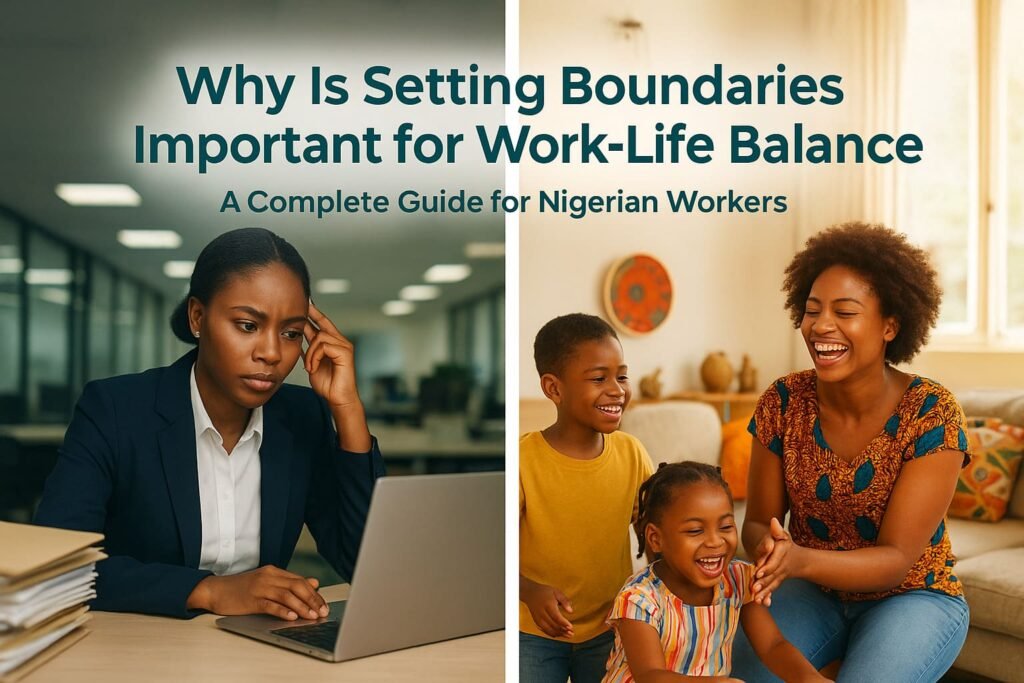
Why Is Setting Boundaries Important for Work-Life Balance?
Let me be straight with you about this. Simply put, boundaries are the invisible rules you negotiate for yourself and your team regarding how much of your personal life you will sacrifice for the job. They are like a reinforced fence protecting your family hours, your sleep, and your mental clarity from the encroaching chaos of the office. In Nigeria, where the default office culture frequently demands everything you have, setting clear limits is not selfish, E no easy, but it is absolutely essential for survival and long-term success.8 Specific Benefits of Workplace Boundaries
When you implement professional boundaries, you gain much more than just a free Sunday. You gain the respect of your peers, better physical health, and a more stable career trajectory. Here are the life-changing benefits of workplace boundaries:- Stress Reduction: Boundaries act as a filter for your workload. When you communicate that you are offline after 7 PM, the constant anxiety of always being on begins to subside, which is vital for effective stress management.
- Burnout Prevention: Burnout is characterized by a state of constant exhaustion where you feel there is nothing left to give. This remains a critical threat in sectors like Nigerian banks or the Nigerian healthcare sector. Boundaries create necessary detachment, allowing your nervous system the recovery time it requires.
- Increased Productivity: When you separate your labor from your rest, your cognitive focus sharpens. You learn to deliver your best work within the agreed hours because you know your downtime is non-negotiable. This directly leads to productivity improvement rather than just “busyness.”
- Better Mental Health: The constant work-life conflict in Nigeria is a major driver of anxiety. By setting a firm boundary, such as not reviewing emails during family meals, you protect your mental health at work and reduce the emotional toll of your job.
- Improved Relationships: Your partner and friends deserve your focus. When you put the work phone away entirely during leisure time, you are present. This strengthens your personal bonds and improves your career-family balance significantly.
- Career Advancement: Boundaries signal to your colleagues and your oga that you value your own time, which surprisingly fosters more workplace respect. People are naturally drawn to those who set clear standards for their professional conduct.
- Physical Health Benefits: Reduced cortisol levels lead to better sleep and improved long-term health. Using your personal time protection for proper self-care practices or regular exercise helps you show up as a better version of yourself the next day.
- Greater Job Satisfaction: When you feel in control of your schedule and your life, you are naturally more satisfied with your role. This increases your job satisfaction and prevents the cycle of job-hopping that often stems from resentment.
What Is the Boundary Theory of Work-Life Balance?
You might be asking why these boundaries are so hard to maintain. The answer lies in Boundary Theory. Developed by researchers like Clark (2000), it explains how humans mentally separate their professional domain from their home domain. Every individual draws lines between their job and their personal life. These lines can be thick, rigid, or entirely porous.The Integration-Segmentation Continuum
Think of your boundaries like the fence around your residential compound.- Segmentation (Strong Fences): This is the habit of keeping your worlds separate. A segmenter might leave their work laptop at the office or use a separate phone for professional duties, ensuring work domain separation.
- Integration (Weak Fences): This happens when you allow your roles to merge. An integrator might answer work calls during family dinner or handle a personal banking task during an office meeting, often leading to confusion.
Work-Family Border Theory
A related concept, the Work-Family Border Theory, focuses on the specific edges of your different identities. When you have a solid boundary, you reduce role conflict. When you are at home, you are a parent or spouse; when you are at the office, you are an employee. Weak borders lead to work-family spillover, where the stress of a bad day at the office poisons your home environment, and personal worries distract you from your work tasks.The Four Types of Work Boundaries You Must Set

- Time Boundaries (Temporal Boundaries): This focuses on when you work. Even if your company culture is demanding, you can reference the Nigerian Labour Act (2004) to understand your rights regarding standard hours.
- Example: Try the “Delayed Yes” technique. If asked for a task at 6 PM, say: “I can prioritize this for 8 AM tomorrow so I can give it my full focus.”
- Space Boundaries (Physical Boundaries at Work): This is about defining where work happens, especially for remote or hybrid workers.
- Example: “My home office is for tasks only. Once I shut that door, I am fully disconnected.”
- Emotional Boundaries: This protects your internal energy from toxic office politics.
- Example: “I am happy to listen to the team struggle with this project, but I will not take that frustration home with me.”
- Behavioral Boundaries: These are the rituals you create to enforce your rules.
- Example: Using “Transition Rituals”, like listening to a specific podcast on your commute, to mentally close the work chapter and open the home chapter of your day.
The Challenge of Work-Life Balance in Nigerian Workplaces

If you build your career in Nigeria, you know the reality: work-life balance in Nigerian companies remains a difficult, often elusive target. Setting boundaries is not selfish, E no easy, but it is absolutely essential for survival and long-term success. From what I’ve seen working with Nigerian professionals across various sectors, boundaries are frequently misread as a lack of dedication or failing to be a team player. We operate in a society where hierarchy is king and questioning your boss feels like professional suicide. This creates a painful cycle of work-life conflict in Nigeria that leaves many of us running on empty while trying to maintain a facade of peak productivity.
The “Always-On” Culture
The most persistent challenge we face is the “always-on” work culture. Employers, particularly in high-stakes corporate environments, tend to normalize behaviors that drain our mental and emotional reserves:
- Feeling forced to take calls from an oga or madam at any hour, regardless of whether you are eating, sleeping, or tending to family.
- The assumption that weekends are just extra time for the office, often without any recognition or overtime pay.
- Surprise late nights that wreck your evening schedule, or the quiet expectation that your home is simply an extension of the office.
- The dreaded WhatsApp group notification at 10 PM that expects an immediate thumbs-up or acknowledgment.
This pressure thrives on our collective fear of losing our livelihoods in a tough economy and the reality that the Nigerian Labour Act (2004) feels incredibly outdated. While the Act serves as a foundation, it lacks teeth regarding modern digital exhaustion and the blurred lines of remote or hybrid work.
When you look at the International Labour Organization (ILO) Hours of Work Convention, 1919, which suggests an eight-hour day and 48-hour week, it feels like a dream compared to the reality on the ground in Ikeja or Victoria Island. We are often working far beyond these limits, and because the legal framework doesn’t explicitly penalize the modern “always-on” digital encroachment, the burden of protection falls entirely on us.
The Critical 2026 Nigerian Workplace Reality
Entering 2026, the conversation about our professional lives is changing, but the numbers reveal how far we have to go. Nigeria currently ranks 60th globally in work-life balance, a position that highlights deep-rooted structural issues. It is not just about time; it is about the environment.
The data from recent HR studies is sobering. About 45% of Nigerian employees report a fundamental lack of trust in their management. Most importantly, research from the MIT Sloan Management Review shows that staff are 10.4 times more likely to quit due to a toxic environment than due to a thin paycheck. We are moving past the era where we stay in a miserable job just because the economy is tough. We are realizing that no salary is worth our sanity.
Harassment also remains a massive hurdle, with 35% of Nigerian employees reporting instances of workplace harassment. Furthermore, 69% of professionals have admitted to considering quitting simply because of the sheer weight of work-related stress. These aren’t just figures in a report; they represent our colleagues, our friends, and ourselves hitting a breaking point.
The Generational Divide
There is a massive cultural clash happening in our offices. Gen Z professionals are changing the script, with 70% stating they refuse to stay in a job for more than two years if it doesn’t align with their well-being. This puts them in direct conflict with older, more traditional managers who view presence in the office as the only metric for success. While 68% of younger workers are actively pushing for remote work flexibility, the availability of these roles in Nigeria remains low, forcing many into a traditional setup that drains their energy.
Economic Pressures Complicate Boundaries
We cannot discuss boundaries without acknowledging the elephant in the room: the economy. With inflation persistently high and the cost of basic survival in cities like Lagos and Abuja soaring, leaving a job is rarely a simple decision. Even with the periodic minimum wage adjustments, the reality for most remains tight. This economic pressure is why I emphasize that boundary-setting is not about being “soft” or “lazy.” It is a survival tactic. It is about learning to navigate the system so you don’t burn out before you can reach your career goals.
The Intersectional Challenge
Workplace struggles vary depending on your identity. Women often shoulder the “double shift,” managing an entire career while expected to handle the bulk of household and caregiving duties. Younger workers frequently deal with the “I did it, so you should too” mentality from older supervisors. Then there are the subtler issues of ethnic favoritism and class-based microaggressions that make it harder for some to speak up about their needs. We must recognize that our ability to set boundaries is influenced by our position in the organization, and we have to tailor our approach to fit our specific context.
When you add the four-hour commute across Lagos or the unpredictable traffic in Abuja to the mix, your personal time is already under siege. Protecting the little time you have left is not optional; it is your responsibility to yourself.
Sector-Specific Work-Life Conflict
The intensity of the struggle depends heavily on your industry:
| Sector | Common Boundary Challenges | Entity Mentions |
|---|---|---|
| Banking Sector | High-pressure targets, Saturday desk duties, and the “always-available” expectation for digital banking support. | Nigerian banks |
| Healthcare | Severe understaffing, back-to-back shifts, and the emotional toll of critical patient care. | Nigerian hospitals/healthcare sector |
| Technology/Fintech | Global team syncs at odd hours, 24/7 uptime monitoring, and the “hustle” mentality of the startup world. | Nigerian telecommunications companies / Fintech firms |
| Power Sector | Emergency grid responses, irregular shift patterns, and technical on-call duty. | NEPA/Power sector companies |
How to Set Healthy Work Boundaries in Nigerian Workplaces
You can advocate for yourself while remaining a professional. The goal is to set boundary management strategies that are firm yet diplomatically handled. You do not need to burn bridges to build boundaries; you just need to be clear about your capacity and your commitment to your health.
Start Small and Build Gradually
Drastic changes often cause friction. If you want to start protecting your peace, do it in a way that allows your team to adjust to your new working style.
| Starter Boundary | How to Implement |
|---|---|
| The Email Buffer | Stop replying to work emails after 7 PM. Wait until the next morning. This is a subtle way to set a temporal boundary. |
| The Wrap-up Ritual | Before you leave, spend 10 minutes cleaning your desk and writing tomorrow’s tasks. This signals to your brain that the workday is officially closed. |
| The Lunch Pivot | Take your full lunch break away from your screen. If interrupted, use a polite “I am on my break, let’s catch up in 15 minutes.” |
Communication Strategies That Work in Nigeria
You can be effective without being confrontational. Use these strategies to assert your needs without causing offense.
1. The “Delayed Yes” Technique: If your boss drops a new task on you late in the day, try: “I want to do this well, so I will prioritize it as the first thing on my list for tomorrow morning.” This shows dedication while protecting your evening.
2. Framing as Performance: Remind them that your rest is a business asset. “Sir/Madam, I find that taking the evening to reset allows me to come in the next morning with much better clarity and focus, which helps me avoid errors.”
3. The Professional Script: If you receive a late-night task, use this: “Good evening, Sir/Madam. I have received the request and have added it to my task list for 8 AM tomorrow so I can give it the attention it deserves. Have a great night.” This sets a clear expectation that your night is your own.
Boundary Strategies by Type
Time Boundaries (Temporal Boundaries)
- Set Specific Work Hours: Even in demanding roles, have a mental cutoff. For those managing a side business, look for ways to balance your 9-5 job with side business demands by creating distinct, non-overlapping windows of focus.
- The Batching Strategy: Communicate that you check messages or emails at set intervals, such as 10 AM and 3 PM. This protects your time management and deep work hours.
- Weekend Protection: Guard your weekends like gold. If you struggle with the transition, try establishing a morning routine that creates clear work-life separation to set the tone for your week without letting work bleed into your personal growth time.
Physical and Emotional Boundaries
- Space Control: At home, create a “work zone.” When you leave that spot, the work stays there. This supports work domain separation.
- Emotional Guarding: Do not adopt the chaos of the office. Be supportive of your colleagues, but don’t carry their stress home. Practicing mindfulness during your commute helps clear the emotional work-family spillover.
Behavioral and Tech Boundaries
- Digital Discipline: During dinner or family time, phones stay away. Your family deserves the best version of you, not the version that is still reading emails under the table.
- Tool Management: If you are struggling with power and connectivity, use productivity tools that help you manage work boundaries even during NEPA outages to ensure you aren’t stuck chasing connections during your personal time.
Dealing with Pushy Employers
Sometimes, despite your best diplomatic efforts, you hit a wall. Here is how to handle a persistent offender:
- Document Everything: Keep a running log of your hours. Data is powerful if you ever need to justify why you cannot take on more work.
- Reference Labor Guidelines: Politely referencing the International Labour Organization (ILO) Hours of Work Convention can be a neutral way to bring up the issue of fairness.
- Recognize the Red Flags: You need to feel secure in your professional identity to set these limits. If you have done the work of building the career confidence needed to set boundaries and you are still being punished for having them, you might be in a truly toxic environment. Your mental health is the foundation of your entire life. If a job is actively eroding it, you must start looking for a place that respects your humanity.
The Life-Changing Benefits of Workplace Boundaries for Nigerian Professionals
Setting boundaries is not selfish, E no easy, but it is absolutely essential for survival and long-term success. When you shift from a cycle of perpetual work overload toward a reality with firm, intentional limits, you trigger significant improvements in your physical health, family relationships, and career trajectory. While our national culture often celebrates the “hustler” mentality, the data tells a different story about our collective well-being.
According to work-family boundary research published in 2025, there is a powerful, quantifiable link between how you define your limits and how you actually feel. When your professional practices align with your personal needs, you stop drifting and start thriving. The 2025 findings underscore that work-family conflict acts as the primary barrier to high performance. By reducing this conflict through clear boundaries, you naturally lower your anxiety and increase your job satisfaction. This is critical for Nigerian professionals, especially when you consider that Nigeria currently ranks 60th globally in work-life balance metrics for 2025. When you actively choose to protect your time, you stop merely surviving the work week and start building a foundation for sustainable output.
Before and After Boundaries: A Real Change
| Without Boundaries | With Boundaries |
|---|---|
| Always tired and irritable | Better sleep quality and reduced anxiety |
| Poor focus and frequent mistakes | Increased focus and productivity |
| Missing family events or always on the phone | More time with family, deeper relationships |
| High risk of burnout and physical illness | Effective stress reduction and better physical health |
| Feeling like a servant to the job | Feeling in control and gaining workplace respect |
Professional Benefits
I have heard the same fear countless times: “If I say no, they will sack me or overlook my promotion.” In practice, I have used this for years and found the exact opposite to be true. Leaders are looking for people who can deliver quality, not people who are merely available 24/7. Boundaries are a testament to your professional maturity.
- Quality Over Quantity: When you stop multitasking or answering emails during your downtime, you develop the ability to focus intensely during your working hours. This spike in work quality is exactly what gets you noticed for the right reasons.
- Respect and Reputation: When you decline to engage in non-urgent WhatsApp chats late at night, you teach your manager that your time is a valuable commodity. This builds professional reputation and signals that you manage your priorities with precision.
- Career Longevity: With inflation rates hovering around 34.2% in mid-2024, job stability feels more fragile than ever. By prioritizing burnout prevention, you keep your mental and physical health intact so you can remain competitive, rather than crashing out of your career before you hit your prime.
Personal Benefits
Your home life is the main reason you show up to work in the first place. By enforcing personal time protection, you regain access to:
- Energy for Hobbies: You finally have the bandwidth to pursue a side venture, hit the gym, or engage in self-care practices that restore your spirit instead of draining it.
- Stronger Relationships: Your family deserves the best version of you, not the version that is physically present but mentally stuck in a meeting with your oga. Protecting your evenings strengthens your mental health and stabilizes your domestic life.
- Greater Life Satisfaction: Achieving the balance of a strong career and a happy home isn’t a myth. It is the result of intentional, daily choices to say no to work when the time is meant for your life outside the office.
These stories are based on composite scenarios I have encountered across Nigeria. Identifying with these struggles is the first step toward changing them.
Success Stories: Nigerian Professionals Who Found Balance

Many of the people I talk to believe that the Nigerian office environment makes balance impossible. While it is true that you face unique challenges, I have seen colleagues in sectors ranging from tech to education successfully carve out space for themselves.
Story 1: Chioma, Lagos-Based Marketing Manager
- The Problem: Working for a major firm in Lagos, Chioma spent every night until 11 PM tethered to her phone, battling work-family conflict and missing her children’s milestones.
- Boundaries Set: She implemented a temporal boundary, deciding that she would not touch work emails after 7 PM or on weekends.
- The Challenge: Her boss pushed back initially. Chioma responded by framing her request in terms of productivity: “I need this evening rest so I can provide my highest-quality strategic input during our morning meetings.”
- The Result: Her output increased because she stopped working while exhausted. Her boss eventually recognized that her rested work was more valuable than her late-night availability.
- Key Lesson: When you present your boundary as a benefit to the business, your manager is far more likely to accept it.
Story 2: Emeka, Senior Analyst in Abuja
- The Problem: Emeka, a high-performing analyst in Abuja, struggled with work overload because he never mentally disconnected from his office duties.
- Boundaries Set: He established a physical boundary. He created a specific workstation at home. When he stepped away from that desk, he was officially “off the clock.” He used transition rituals like a brief walk or a specific playlist to signal his brain that the shift was over.
- The Challenge: He fought his own ingrained sense of guilt, believing that rest was equal to laziness.
- The Result: His clarity of thought improved, and his side business flourished. He proved that physical separation is often the quickest path to mental recovery.
- Key Lesson: Your environment influences your mindset. If you don’t control your space, you cannot control your focus.
Story 3: Amina, Teacher in Port Harcourt
- The Problem: Amina was drowning in constant late-night messages from parents and colleagues, which destroyed her emotional boundaries and left her drained.
- Boundaries Set: She set a strict communication window of 8 AM to 5 PM and removed herself from toxic gossip loops.
- The Challenge: Peers accused her of being rigid. Her response was simple and firm: “I want to be at my best for these children, and that requires me to be fully present for myself during the night.”
- The Result: Her patience grew, her classroom management improved, and her mental health stabilized.
- Key Lesson: Protecting your energy allows you to be more generous with it when it truly counts.
Boundary-Setting Mistakes Nigerian Workers Should Avoid
You will face resistance, but avoiding these common pitfalls will keep you on track within the Nigerian workplace culture:
- Setting Too Many Boundaries at Once: Avoid trying to overhaul your entire life in one day. Focus on one recurring stressor, such as after-hours messaging, and stabilize that first.
- Not Communicating Boundaries Clearly: Do not expect people to guess why you have gone quiet. State your intent directly and politely. Tell your oga or madam, “I will be reachable for emergencies only after 7 PM.” Clarity eliminates friction.
- Being Inconsistent: If you allow exceptions to your own rules regularly, people will learn that your boundaries are negotiable. Consistency is the only way to earn true workplace respect.
- Apologizing for Your Needs: Never apologize for needing rest. Swap your “I’m sorry” for a “thank you” or a proactive solution. Instead of apologizing for a delayed reply, say, “I am offline with family, but I will prioritize this task first thing tomorrow.” Be confident in your right to disconnect.
- Ignoring Cultural Context: You must maintain respect while setting limits. Frame your needs around “high performance” or “improving output.” Because roughly 35% of Nigerian employees report workplace harassment and significant stress, it is vital to learn strategies for overcoming the limiting beliefs that make boundary-setting feel impossible. Do not let the false narrative that setting boundaries is ‘lazy’ prevent you from achieving the wellness you deserve.
Important Note on Application and Limitations
I must emphasize that every employer is unique. If you operate in a truly toxic environment, no amount of boundary setting will fix the underlying culture. If you have consistently applied these methods for 6 months and nothing changes, consider that the employer might not align with your health or professional growth. Given that employees are now 10.4 times more likely to leave a job due to toxic culture than low wages, recognize when it is time to move on.
Self-Assessment: Which Boundary Do You Need Most?
Assess your current situation by rating yourself from 1 (Never) to 5 (Always).
| Boundary Focus | Statement | Rating (1-5) |
|---|---|---|
| Time | I check or respond to work messages/emails after my official closing time. | |
| Time | I rush through personal tasks because I feel guilty about not working. | |
| Space | My work laptop/files are often visible or open in my personal living area. | |
| Space | I often use my personal phone for high-stakes work communication. | |
| Emotional | I carry the stress, drama, or negativity from my colleagues home with me. | |
| Emotional | I struggle to say ‘no’ to extra tasks, even when my plate is full. | |
| Behavioral | I interrupt family time (dinner, outings) to deal with non-emergency work issues. | |
| Behavioral | When I am finally resting, my mind is completely consumed by work problems. |
Results Interpretation
The category where you scored highest is your immediate priority. Do not tackle everything at once. Focus your energy on that single area for the next thirty days to see tangible results.
Frequently Asked Questions (FAQ)
When you start setting boundaries in Lagos or Abuja, questions are bound to arise. Let me address the ones I see most often:
1. Will boundaries hurt my chances of promotion?
That is a common fear, but the opposite is true. Effective boundaries signal leadership, self-control, and reliability. When you explain your limits through the lens of burnout prevention and quality management, you present yourself as a professional who knows how to optimize results. Leaders want team members who produce consistently, not ones who are always busy but often exhausted.
2. What if I’m the only one setting boundaries on my team?
You may feel like the odd one out, but you are actually the pioneer. By holding your ground with consistency, you set a new standard. Over time, others will notice your improved work-life balance and your increased focus, often leading them to follow your example. You are not just changing your own life; you are helping to shift the office culture.
3. How long before I start seeing real results?
Within the first 2 to 4 weeks, you should experience a noticeable dip in your immediate stress levels. Improved sleep patterns often follow shortly thereafter. However, true professional recalibration, where your colleagues and your oga fully internalize your new patterns, usually takes about three months of disciplined, unwavering adherence. Stick with it for those 90 days; the results for your mental health will be profound.
If you find yourself struggling with the technical aspect of remote work or the constant pressure of the digital age, try utilizing ‘Transition Rituals’ at the end of every day to mentally cut the cord. For those dealing with high-stress environments, consider the ‘Delayed Yes’ technique: acknowledge the work request immediately, but commit only to a timeline that protects your off-hours. Your health is the only asset that cannot be replaced.
Conclusion & Next Steps
We started by asking why is setting boundaries important for work-life balance, and the answer remains clear. Without them, you lose control of your time, health, and peace of mind. With Nigeria now ranking 60th globally in work-life balance as of 2026, the unique pressures of the local corporate environment remain intense. Between the expectation of perpetual work overload and the economic weight of 34.2% inflation, boundary management strategies are no longer optional. They are survival tactics for the modern professional.
You now grasp Boundary Theory and have accessible, culturally-smart ways to assert yourself in the office. Setting boundaries is not selfish, E no easy, but it is absolutely essential for survival and long-term success. While 45% of our colleagues report low trust in management, you can start reclaiming your agency today. Framing your limits as performance improvement or using the “Delayed Yes” technique allows you to maintain professional standing without sacrificing your sanity. You must act now to prevent the burnout that drives 69% of people to consider leaving their roles. Protect your energy, cultivate your personal life, and build a career that honors your humanity.
Taking Action: Your Next Steps
- Set Your First SMART Goal: Do not just think about boundaries, make them concrete. Use the SMART framework to set specific SMART goals for your boundary implementation, such as committing to a “Starter Boundary” where you delay all non-urgent WhatsApp responses by 12 hours starting this week.
- Plan for the Long Term: Boundaries are only one piece of your career puzzle. Think about creating a comprehensive personal development plan that balances your ambition with the reality of your mental health needs. Factor in transition rituals to separate your home life from the digital workspace, especially if you deal with the added stress of infrastructure issues.

Oladepo Babatunde (Prince Babatee Tunde) is a Computer Scientist, researcher, and professional content writer with a Higher National Diploma in Computer Science from Kwara State Polytechnic, Nigeria.
With a background in technology and a passion for clear communication, Babatunde specializes in creating thoroughly researched, reader-focused content on productivity, personal development, home living, and technology. Every article he writes is backed by extensive research and fact-checking to ensure readers receive accurate, actionable information.
As a freelance writer, he has helped brands and publications deliver content that educates, engages, and empowers their audiences. His mission at Vibena is simple: make complex topics easy to understand and help Nigerians live smarter, more productive lives.