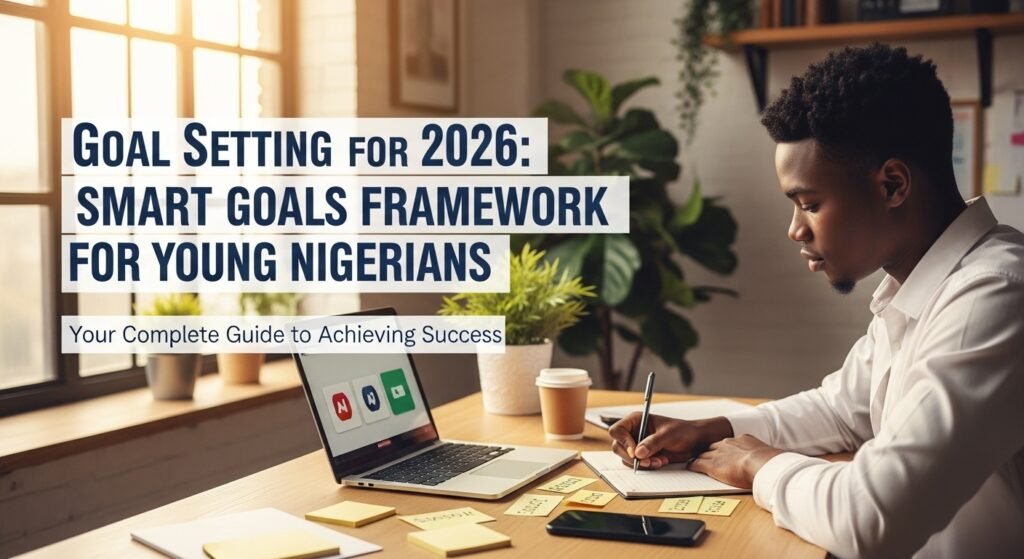
In January 2023, I wrote down 15 ambitious goals. By February, I had abandoned all of them. Sound familiar?
I wanted to save ₦500,000, learn to code, lose 15kg, start a business, and read 24 books. Instead, I ended the year having saved ₦47,000, completed zero courses, gained 3kg, and read exactly two and a half books. I never finished that third one because my focus shifted every time the wind changed.
The problem wasn’t motivation or discipline. The problem was that I was setting goals the wrong way. I was relying on generic Western frameworks that completely ignored the harsh realities of living in Nigeria. Nobody told me how to plan around the national grid failing mid-study session, or how to set financial goals when the Naira value shifts dramatically against the dollar, or how to stay committed when family obligations and the inevitable Black Tax pull you in ten different directions.
That failure taught me something vital: random goal setting is a recipe for heartbreak. You need a proven framework adapted specifically for our terrain. You need a system that accounts for power instability, economic volatility, and the deep-seated cultural expectations we carry. In 2026, the stakes are higher. Whether you are navigating the gig economy or trying to break into the tech sector through the 3MTT initiative, your approach must be as resilient as your spirit.
This guide shares everything I have learned about the SMART goals framework, specifically adapted for the Nigerian youth. Whether you are preparing for JAMB, navigating university life, completing NYSC, or searching for your first real job in Lagos, Abuja, or Port Harcourt, these strategies will help you set targets that actually stick.
Why Goal Setting Is Non-Negotiable for Nigerian Youth in 2026
You might be thinking, “Why should I bother with a plan when the economy is so unpredictable?”
That is precisely why it matters. When your environment feels like a moving target, having clear objectives serves as your anchor. Without a map, you are just reacting to every problem that hits your inbox. With a clear map, you start moving with intention, even when the road gets rocky.
The Demographic Reality We Are Working With
Nigeria remains a profoundly youth-driven nation. According to the World Bank’s latest demographic data, our median age is just 18.1 years, and nearly 58% of the population is under 30. This massive youth bulge creates immense energy but also ferocious competition for limited entry-level roles.
Recent data from Afrobarometer’s 2024 survey indicates that 60% of Nigerian youth have considered emigrating to find stability. I see the “Japa” anxiety everywhere I go. But here is the secret most people miss: the youth who successfully transition into high-growth careers, whether at home or abroad, are the ones who treat their personal growth like a professional project. They don’t just wait for the country to change; they change their strategy to fit the opportunities at hand.
The Numbers That Should Wake You Up
| Challenge | Current Data (2025/2026) |
|---|---|
| Youth actively seeking work | 23% |
| Youth out of employment | 32% |
| Annual labor market entrants | 3.5 million |
| Youth aiming for entrepreneurship | 60% |
| Informal employment rate | 93% |
According to the World Economic Forum’s latest analysis, these employment hurdles exist alongside a massive tech surge. Nigeria’s ICT sector contributed roughly 20% of real GDP growth throughout 2025, consistently outpacing agriculture and oil. We are witnessing a gold rush in digital skills, supported by programs like 3MTT that aim to equip 3 million Nigerians with technical competencies.
This reality forces us to acknowledge two truths:
- The competition for traditional, desk-based government or administrative jobs is becoming brutal.
- The demand for specific, verifiable digital skills is skyrocketing.
Goal setting helps you exploit this. If you don’t define what you are building, you will be drowned out by the noise. For advice on staying sane while managing the stress of these decisions, our guide on how to stop procrastinating with science-backed strategies offers the behavioral tools you need to stay on track.
Why This Matters for Your Specific Situation
If you are a student: Clear academic benchmarks distinguish those who graduate with a competitive edge from those who simply pass.
If you are in NYSC: This is your most dangerous and most profitable window. Financial and entrepreneurial goals set during this year can pay dividends for the next decade.
If you are job hunting: Skill acquisition goals in high-demand areas like data analysis or UI/UX design give you an advantage that a standard degree cannot provide.
Understanding the SMART Goals Framework
The SMART goals framework is a five-step system designed to ground your ambitions. It moves you away from “I wish” to “I will.”
Think of it as the logistical planning you do before a cross-country trip. You verify your transport, budget for fuel, and map your route to avoid dangerous zones. Applying SMART to your life ensures you aren’t leaving your future to chance.
The Five Components
| Letter | Meaning | The Nigerian Context |
|---|---|---|
| S | Specific | State exactly what you want to learn or earn. |
| M | Measurable | Use numbers, not feelings, to track progress. |
| A | Achievable | Ensure your plan handles NEPA and budget cuts. |
| R | Relevant | Focus on skills that actually pay in 2026. |
| T | Time-bound | A goal without a deadline is just a wish. |
While this system is a powerhouse for structured learning and saving, remember that creativity sometimes requires room to breathe. Research in Frontiers in Psychology suggests that for exploratory life paths, keeping a rigid framework can feel restrictive. Use SMART for your “must-dos” and allow flexibility for your “might-dos.”
My Personal Experience: How SMART Goals Changed My 2024
Applying this wasn’t about being perfect. It was about being disciplined with my limited energy.
In January 2024, I moved away from my 15-goal mess and focused on three:
Goal 1: “I will save ₦150,000 by December 31, 2024, by automating a transfer of ₦12,500 on the 1st of every month, ensuring this happens before the Black Tax hits my account, to build my emergency buffer.”
Goal 2: “I will complete the Google Digital Marketing Certificate by June 30, 2024, by studying from 5:00 AM to 6:00 AM every weekday, before the heat and power issues start, so I can add a verified credential to my portfolio.”
Goal 3: “I will lose 8kg by October 31, 2024, by walking during my lunch break and cutting out sugary drinks, to improve my physical stamina for the long work days ahead.”
The outcome? I hit ₦162,000 in savings, earned the certificate in May, and lost 9.5kg. The key wasn’t better weather or a better economy. It was the “I will [ACTION] by [DATE] through [METHOD]” formula. I also started using Notion to track these milestones, which kept me honest when I felt like giving up.
For more on developing the inner strength required to stick to these plans, our guide on building confidence in your career helps you tackle the internal resistance that often stops us before we even begin.
The 5 Components That Make Up SMART Goals Explained
To truly master goal setting for 2026, you need to understand each component deeply. Given that our median age in Nigeria is just 18.1 years, most of you are navigating this transition to adulthood in a high-pressure environment. Let me break them down with Nigerian-specific examples to ensure you stay on track.
Specific: Making Your Goals Clear and Focused
A goal is Specific when it answers the “W” questions: Who, What, Where, When, Which, and Why. The problem wasn’t motivation or discipline. The problem was that I was setting goals the wrong way. I used to write “I want to do better” in my journal, which is a recipe for procrastination.
Vague goal: “I want to learn coding.”
Specific goal: “I will learn Python programming for 90 minutes every morning from 5 AM to 6:30 AM before my daily routine starts, using the free 3MTT platform resources, so that I can build a functional portfolio project and qualify for remote internships by December 2026.”
Notice the clarity in this version. You aren’t just saying you will learn; you are defining the environment, the timing, and the bridge to your future career. By choosing 5 AM to 6:30 AM, you bypass the common frustration of power instability because the grid is often more reliable before the day’s peak heat and load.
My tip: Never use the phrase “be successful.” Replace it with a clear, definite action. Success means different things to different people. If you are part of the 60% of youth currently weighing the decision to relocate, your specific goals must bridge the gap between building here and being prepared anywhere.
Measurable: How to Track Progress on Your Nigerian Goals
How will you know when you’ve reached your goal? A goal is Measurable if you can put a number on it. I’ve used this for years, and it is the only way to avoid the trap of constant busywork that leads nowhere.
Bad example: “I want to save more money.”
Good example: “I will save ₦15,000 every month from my side hustle, separate from my primary expenses, to reach a total of ₦180,000 by December 2026 for a high-quality certification exam.”
The numbers tell you exactly where you stand. If you hit July and have only ₦60,000, you know you need to adjust your spending or find a way to increase your hustle income. Managing your finances in Nigeria is hard because of inflation and the weight of “Black Tax”, the cultural responsibility to support extended family. You must account for this in your math. If you don’t track it, the money will disappear into small, untracked daily expenses.
For NYSC corps members specifically, our guide on budgeting your NYSC allowance to save ₦10k monthly provides detailed strategies for hitting financial targets on limited income.
Measurement frameworks I use:
| Goal Type | Measurement Method | Tracking Frequency |
|---|---|---|
| Financial | Bank app or Spreadsheet | Weekly |
| Academic | Practice test scores | After each module |
| Health | Weekly walk count/Scale | Weekly |
| Skill | Projects completed | Monthly |
| Business | Revenue/Customer count | Weekly |
Achievable: Setting Realistic Goals Within Nigerian Context
This component requires balancing ambition with Nigeria’s economic realities. “Achievable” means setting a goal that’s possible within the context of both intense competition and emerging opportunities. We have a massive, energetic population, but 93% of the workforce operates in the informal sector. Your goals must be resilient enough to survive power outages, transport costs, and network issues.
The reality check: Nigeria’s digital economy is expanding rapidly. The ICT sector contributed 20% of real GDP growth in 2024. This is where your focus should be. Do not set a goal to get a traditional government job that has 50,000 applicants for 10 spots; set a goal to acquire a skill that is globally tradable.
Set Achievable goals by:
- Targeting high-growth sectors (tech, digital marketing, renewable energy) that are actually driving the economy forward.
- Leveraging free or low-cost skill acquisition programs like the 3MTT initiative to bypass high tuition barriers.
- Considering remote work opportunities that allow you to earn in stronger currencies while living in Nigeria.
- Accounting for infrastructure challenges in your timeline. If the light goes out, your plan should already include a backup power source or a secondary task that doesn’t require electricity.
Bad example: “I want to be a millionaire in one month from a business I just started today.”
Good example: “I will dedicate the next 6 months to building a digital marketing agency, securing my first 3 clients by June 2026, while using Notion to track my tasks and progress.”
For strategies on maintaining productivity during power outages, see our guide on how to stay focused during power outages.
Relevant: Aligning Goals with Your Nigerian Life Situation
A goal is Relevant if it truly matters to your personal development. If you are learning a skill just because everyone on X (formerly Twitter) is talking about it, you will quit when the going gets tough. That is not relevance; that is noise.
I learned this the hard way. In 2022, I spent months learning UI/UX design because it was trendy. But I hated the creative process. It had nothing to do with my natural aptitude for logical problem-solving. Those months were a distraction from my real path in financial data analysis.
Bad example: “I will learn to code because a random post said it pays well.”
Good example: “I will master data analysis using SQL and PowerBI because I want to transition into a corporate role that offers the financial stability I need to eventually start my own firm.”
Questions to test relevance:
- Does this goal solve a problem that bothers me personally?
- Will achieving this make me more independent of the volatile economic conditions around me?
- Is this a skill that will still be valuable in five years?
- Am I doing this for myself, or to impress my neighbors?
Time-bound: Creating Deadlines That Work for You
A goal without a deadline is just a wish. Time-bound means giving your goal a specific start date and end date. Without a deadline, you will convince yourself that you can start “next week,” and next week will turn into next year.
Bad example: “I will eventually save money to get a better laptop.”
Good example: “I will save ₦40,000 every month for 6 months, ending on October 31, 2026, so I can purchase a high-performance laptop to improve my freelance output.”
My personal rule: I never set goals with deadlines more than 12 months away without breaking them into quarterly milestones. Use your calendar apps. If a goal is too big, you will feel overwhelmed and retreat. By breaking a year-long goal into 90-day sprints, you only have to focus on the next step in front of you. Quarterly milestones prevent the “November Panic” where you realize you have done nothing all year.
Your Goals, Nigeria’s Future: Connecting Personal Success to National Transformation
Your commitment to setting SMART goals isn’t just about personal development, it’s directly linked to Nigeria’s economic future. With 58% of our population under the age of 30, the energy you put into your own growth is literally the fuel for the country’s development.
The Strategic Nigeria Talent Accelerator
The landscape for youth development is shifting. Following the Strategic Nigeria Talent Accelerator initiatives, there is now a clearer path for young Nigerians to gain technical skills through government-supported programs. The aim is to equip 10 million young Nigerians with industry-relevant skills. When you set a goal to complete one of these certifications, you aren’t just doing it for your CV; you are tapping into a national pipeline designed to make you employable in the global marketplace.
High-Growth Sectors Aligned with National Priorities
The World Economic Forum and local data identify several sectors where Nigeria holds a comparative advantage. You should align your goals with these areas to ensure your effort is met with opportunity.
| Sector | Opportunity | Relevant SMART Goal |
|---|---|---|
| Renewable Energy | Solar installation and maintenance | “Complete solar certification by Q2 2026” |
| Digital Services | AI implementation and coding | “Launch personal app project by Q3 2026” |
| FinTech | Payment systems and digital banking | “Earn a fintech certification by March 2026” |
| AgriTech | Supply chain and data management | “Launch pilot agribusiness project by Q4 2026” |
The 3 Million Technical Talent (3MTT) Programme
The 3MTT programme remains a cornerstone of the national strategy to prepare 3 million Nigerians for technical roles. This isn’t just about theory; it’s about practical employment. When you define your “Relevant” goal, ask: “How does this fit into the digital shift Nigeria is experiencing?” Goals that align with national priorities often have better networking opportunities and clearer paths to funding or mentorship.
Beyond SMART: Alternative Goal-Setting Approaches for Nigerian Youth
Sometimes, life in Nigeria is too unpredictable for rigid SMART goals. If you are experimenting with a new business idea, you might need a different approach. For uncertain ventures, try the “Do-Your-Best” framework. It allows you to start without the anxiety of a pass/fail deadline. If your goal is to test a product, your success is not the money you make; it is the data you gather about whether people even want the product. That is a different kind of progress.
Example: Combining Frameworks
I suggest a hybrid approach. Use SMART goals for your core, stable pillars like your health and your primary career. Use OKRs (Objectives and Key Results) for your side businesses where you want to track growth metrics like revenue or customer acquisition.
- Objective: Build a sustainable side hustle by December 2026
- Key Result 1: Secure 5 recurring clients
- Key Result 2: Achieve a 15% profit margin per service
- Key Result 3: Spend 5 hours per week on lead generation
This hybrid style gives you the discipline of structure with the room to pivot when life throws a curveball, such as a sudden change in market prices or fuel availability.
The Six Limitations of SMART Goals (And How to Overcome Them)
Even the best tools have limitations. You must be aware of them so they don’t break your momentum.
1. Tunnel Vision
Focusing only on a number can make you miss the bigger picture. If your goal is just to hit a revenue number, you might ruin your reputation by delivering poor work. Always maintain a standard of excellence, regardless of the target.
2. Short-Term Thinking
If you only focus on this month’s goals, you ignore where you need to be in three years. Use AI tools like Claude or ChatGPT to brainstorm your long-term roadmap, then use SMART goals to execute the tiny pieces of that plan each month.
3. Motivational Gaps
If your goals feel like chores, you will burn out. Ensure every goal is anchored to a deep value. Why are you doing this? To care for your parents? To secure your future in a tough economy? Let that be your fire.
4. Premature Satisfaction
Hitting a milestone is not the end of the journey. When you reach a goal, treat it as a new baseline. Set a more challenging target immediately to keep your growth trajectory moving upward.
5. All-or-Nothing Thinking
You will face setbacks. Maybe you miss a payment deadline or lose access to power for a week. That is not failure; that is a variation in your environment. Adjust the deadline and keep moving. Resilience matters more than perfection.
6. Overwhelming Ambition
If a goal makes you want to hide under the bed, it is too big. Scale it back until it feels manageable, then build up from there. Use a physical index card to write down your top 3 goals and tape them to your wall. This keeps the objective in your vision every single day.
Finally, address the psychological weight of “Japa” syndrome anxiety. It is real, and it can paralyze your efforts to build here. Focus on building assets, skills, savings, and networks, that serve you whether you stay or decide to move. That is the ultimate goal. For more on overcoming the mental barriers, our guide on overcoming limiting beliefs and developing a growth mindset addresses these deep-seated challenges.
How to Set SMART Goals for 2026: Step-by-Step Guide
Now let me walk you through the exact process I use to transform vague wishes into actionable SMART goals.
Step 1: Start with a Wish
Think about a big thing you want to achieve.
Wish: I want a good result in school.
Step 2: Apply the ‘S’ (Specific)
Make it clear: What exactly is a “good result”?
Specific: I want to finish the academic year with a GPA of 4.5 and gain admission to my preferred Federal University.
Step 3: Apply the ‘M’ (Measurable)
How will you track it?
Measurable: I want to maintain a GPA of 4.5 by scoring a minimum of 80% in all my core courses this semester.
Step 4: Apply the ‘A’ (Achievable)
Is this realistic for you? If you currently have a 2.0 GPA, jumping to 4.5 might be too ambitious.
Achievable: I will score 80% in core courses by studying for 2 hours every day after class, using a backup lamp when NEPA takes the light.
Step 5: Apply the ‘R’ (Relevant)
Does this truly matter to your future in Nigeria?
Relevant: I will score 80% in core courses because this will secure my admission, allowing me to start my career development path as a software engineer and support my family.
Step 6: Apply the ‘T’ (Time-bound)
When exactly will this happen?
Time-bound: I will score a minimum of 80% in all my core courses by the end of the semester (April 30, 2026), by studying 2 hours every evening, so that I can maintain a 4.5 GPA and secure my university admission.
This final sentence is your complete SMART goal.
The Template Formula
Use this structure for any goal:
“I will [SPECIFIC ACTION] by [DATE] through [METHOD] so that [DESIRED OUTCOME].”
12 Performance Goals Examples for Nigerian Students and Young Adults
Here are realistic examples covering different life areas. Use these as templates, adjusting the specifics to your situation.
Academic Goals
| Goal Type | SMART Goal | Timeline | Success Metric |
|---|---|---|---|
| JAMB Preparation | Score 280+ in JAMB 2026 to gain Computer Science admission at the University of Ibadan by studying 3 hours daily | 6 months (by April 2026) | JAMB result slip |
| University Performance | Maintain a 4.0 GPA by scoring 70%+ in all courses and attending every lecture | Each semester | Academic transcript |
| WAEC Preparation | Score B3 or higher in all 9 subjects by completing past questions daily for 2 hours | 8 months | WAEC result |
Financial Goals
| Goal Type | SMART Goal | Timeline | Success Metric |
|---|---|---|---|
| Emergency Fund | Save ₦100,000 by June 30, 2026, by freelancing 10 hours weekly and saving 50% of earnings | 6 months | Bank statement |
| Investment | Start investing ₦5,000 monthly into a mutual fund starting January 2026 | Ongoing | Investment app balance |
| Business Capital | Save ₦250,000 for business startup by December 2026 through side hustle income | 12 months | Dedicated savings account |
For more ideas on generating the income needed for these goals, our guide on student side hustles in Nigeria covers practical options.
Career Goals
| Goal Type | SMART Goal | Timeline | Success Metric |
|---|---|---|---|
| Certification | Complete the PMP certification by May 1, 2026, by studying 1 hour daily | 5 months | Certificate |
| Internship | Secure a paid internship at a tech company by sending 3 applications weekly starting January | 3 months | Offer letter |
| Remote Work | Land first international freelance client by March 2026 through Upwork by completing 5 profile projects | 3 months | First payment received |
Personal Development Goals
| Goal Type | SMART Goal | Timeline | Success Metric |
|---|---|---|---|
| Health | Lose 10kg by running 30 minutes daily, 5 times weekly | 6 months | Scale reading |
| Reading | Read 12 books on business and personal finance in 2026 (1 per month) | 12 months | Book list completed |
| Networking | Attend 4 professional events quarterly to collect 16 business cards | 12 months | Contact list growth |
For guidance on creating the daily structure these goals require, see our complete guide on morning routine mastery for Nigerian professionals.
Goal Setting for Different Life Stages
Your approach to goal setting should evolve with your life stage. Here’s how to adapt the framework:
For Secondary School Students (14-17 years)
Primary focus: Academic performance, foundational skill acquisition, WAEC/JAMB preparation
Strategy: Set small weekly goals that build toward larger objectives. The habit of goal achievement matters more than the size of goals at this stage.
Example SMART goal: “I will score B3 or higher in my next WAEC mock exam in Chemistry by studying 1 hour daily for the next 4 weeks, using my textbook and past questions.”
Tip: Parents and guardians should help teenagers make goals visible, written on a board in their study area, and check progress weekly.
For University Students (18-24 years)
Primary focus: Academic excellence, internship acquisition, skill development, NYSC preparation
Strategy: Use the full SMART framework to plan entire semesters. Balance academic goals with career-building activities.
Example SMART goal: “I will complete an internship at a major bank in Nigeria during the 2026 summer break by sending out 2 applications every week starting March 1, so I can gain practical experience before graduation.”
Tip: University is the best time to develop multiple income streams. See our guide on time management for side hustlers balancing 9-5 and business dreams.
For NYSC Corps Members
Primary focus: Financial foundation, skill monetization, post-service career preparation
Strategy: The NYSC year is often underutilized. Set aggressive skill acquisition and savings goals while your expenses are relatively low.
Example SMART goal: “I will save ₦10,000 monthly from my ₦33,000 allowance and earn an additional ₦30,000 monthly from freelancing, saving ₦480,000 total by the end of service year.”
For Young Professionals (25-30 years)
Primary focus: Career advancement, financial growth, Nigerian entrepreneurship, family responsibilities
Strategy: Focus on long-term target achievement and milestone planning. Goals should balance career growth with increasing family obligations.
Example SMART goal: “I will successfully manage a team of three at my tech company by attending a leadership course in Q3 2026 and receiving positive performance reviews from my supervisor, positioning myself for promotion by year-end.”
Overcoming Nigerian-Specific Challenges
Being a young Nigerian comes with unique challenges that generic goal-setting advice doesn’t address. Here’s how to navigate them:
Dealing with NEPA and Infrastructure Issues
The challenge: Power cuts interrupt your study or work schedule unpredictably.
The strategy: Plan around infrastructure realities, not against them.
- Set your most intense work for early morning (5-7 AM) or late night when power is often more stable
- Invest in reliable power banks, rechargeable lamps, and backup solutions
- Build buffer time into all deadlines, if a task needs 4 hours, plan for 6
- Use offline-capable tools and download materials in advance
Goal adjustment example: Instead of “Study 2 hours every evening,” try “Study 2 hours daily, with 6 AM sessions on days when evening power is unreliable.”
For comprehensive strategies, our guide on staying focused during power outages provides detailed solutions.
Managing Family Pressure and Expectations
The challenge: Your family might want you to pursue Law or Medicine, but you want to start a tech business. Cultural expectations around supporting extended family can also strain personal goals.
The strategy: Set goals that acknowledge family realities while protecting your core objectives.
- Communicate your action plan clearly to family members
- Find goals that meet multiple needs where possible
- Set boundaries around time for personal development
Goal example: “I will complete my degree as my parents expect AND generate ₦50,000 monthly from my side business to demonstrate that my chosen path can support the family financially.”
For more on navigating these dynamics, see our guide on setting boundaries with family as a young Nigerian adult.
Working with Limited Financial Resources
The challenge: You can’t afford expensive courses, tools, or certifications.
The strategy: Focus on free or low-cost resources first, then use earnings to invest in premium options.
Free resources available to Nigerian youth:
- Google Digital Marketing Certificate (free on Coursera)
- freeCodeCamp for programming
- Andela Learning Community
- 3MTT programme (government-sponsored)
- YouTube tutorials for almost any skill
Goal example: “I will master web development basics using freeCodeCamp by March 2026 (free), then invest my first freelance earnings into a paid React course.”
Navigating Economic Uncertainty
The challenge: The Naira’s value fluctuates, making financial goal-setting difficult.
The strategy: Adjust milestone planning quarterly. Review your budget regularly and modify targets based on economic conditions.
- Set savings goals as percentages rather than fixed amounts when possible
- Diversify income sources to protect against economic shifts
- Consider goals in USD-equivalent if pursuing international freelance work
For understanding the financial context you’re working within, our analysis of the cost of living in Lagos provides helpful benchmarks.
Tracking and Achieving Your Goals in 2026
Setting the goal is only half the battle. Goal achievement requires consistent focus and progress tracking.
Write It Down (The Commitment)
Research consistently shows that writing down goals significantly increases achievement rates. Don’t just type it on your phone, write your SMART goals on paper and place them somewhere visible.
My system: I write my top 3 goals on an index card that stays next to my bed. It’s the first thing I see when I wake up and the last thing I see before sleep.
Break It Down (The Action Planning)
A six-month goal needs monthly and weekly tasks.
Example breakdown:
| Goal | Save ₦120,000 in 6 months |
|---|---|
| Monthly target | ₦20,000 |
| Weekly target | ₦5,000 |
| Daily action | Save ₦715/day or find one way to earn extra |
Review Daily (The Progress Tracking)
Spend 5 minutes every night checking if you completed what you planned. Did you study the 2 hours? Did you save the money? If not, identify why and adjust tomorrow’s plan.
Weekly review questions:
- What did I accomplish toward my goals this week?
- What obstacles did I face?
- What will I do differently next week?
- Am I on track for my monthly milestone?
Find an Accountability Partner
Tell a trusted friend, mentor, or family member your goal. Ask them to check on you weekly. Having someone hold you accountable dramatically increases follow-through.
Accountability structure I use:
- Weekly check-in with a friend (Sunday evening)
- Monthly review with a mentor (first Saturday)
- Quarterly deep review (alone, with journaling)
Celebrate Small Wins
Did you hit your monthly savings milestone? Treat yourself to something small and affordable. Celebrating maintains motivation for the long journey.
Important: The celebration should not undermine the goal. If you’re saving money, don’t celebrate by spending extravagantly. A nice meal or small purchase is sufficient.
Establish a Powerful Morning Routine
Since goal achievement relies on consistent daily action, your morning routine matters enormously. How you start your day often determines whether you’ll make progress on your goals.
Our complete guide on morning routine mastery for Nigerian professionals provides a detailed framework for building mornings that support your goals.
Creating Your Personal Development Plan
A SMART goal works best as part of a larger personal development plan that covers all areas of your life. Without this bigger picture, individual goals can feel disconnected or even conflict with each other.
Key areas to set goals in:
- Career/Professional , Skills, certifications, job advancement
- Financial , Savings, investments, debt elimination, income growth
- Health , Physical fitness, mental wellness, medical checkups
- Relationships , Family, friendships, professional network
- Personal Growth , Learning, hobbies, spiritual development
- Contribution , How you give back to community and country
For a step-by-step guide to creating this comprehensive plan, see our detailed guide on creating a personal development plan.
Frequently Asked Questions
How many SMART goals should I set at once?
Based on my experience, 3-5 major goals at any given time is the sweet spot. When you try to do everything, you end up doing nothing. Since 58 percent of our population is under 30, many of you are feeling the pressure to succeed in multiple areas simultaneously. My advice is to pick 1-2 goals for your primary focus, like your university grades or technical training, and 1-2 for supporting areas such as your health or building an emergency savings fund. If you spread yourself too thin, you lose the depth required to actually master a skill or hit a financial target.
What if I fail to achieve my SMART goal?
Failure is just data for your next attempt. It is not a moral failing. If you miss a target, follow this process:
- Analyze why it happened. Was the goal too ambitious for your current income level? Did life get in the way? Was the plan clear enough?
- Adjust the parameters based on that feedback.
- Restart your momentum immediately. Do not wait for the next month.
The problem wasn’t motivation or discipline. The problem was that I was setting goals the wrong way. A goal without a deadline is just a wish. Also, keep perspective: ₦90,000 saved when you targeted ₦100,000 is still ₦90,000 more than you had. That is progress, not a disaster.
How often should I review my goals?
- Daily: Spend 2 minutes every morning checking your list. I suggest doing this during your early hours, perhaps 5 AM to 7 AM, to beat the heat and ensure you get focused work done before the daily chaos of traffic or power instability sets in.
- Weekly: Take 20 minutes to see if you hit your mini-milestones.
- Monthly: Conduct a deep dive. Are you still aligned with your big vision, or is it time to pivot?
- Quarterly: Assess your trajectory. Use this time to incorporate new tools, like AI platforms, to speed up your learning or financial tracking.
Can SMART goals work for spiritual goals?
Absolutely. You can quantify your commitment to your faith. For example, instead of saying you want to be more spiritual, say: “I will complete a full reading of the Bible by December 31, 2026, by reading 4 chapters daily, tracking progress with a reading plan app.” This makes the abstract tangible.
How do I stay motivated when progress is slow?
- Focus entirely on the daily actions rather than the massive end result.
- Celebrate the small wins. Every ₦5,000 you add to your savings matters.
- Keep your “why” front and center. Write it on an index card and keep it by your bed.
- Seek an accountability partner who actually pushes you.
- Ignore the “Japa” anxiety. Focus on building value right here, where the ICT sector is expanding and creating real opportunities.
Your 2026 Goal Setting Action Plan
Stop observing and start executing. Follow this 7-day sprint to set yourself up for the rest of the year:
| Day | Action |
|---|---|
| Day 1 | Brainstorm 10 things you want to achieve in 2026 without filtering. |
| Day 2 | Choose the top 3 goals that align with your long-term stability. |
| Day 3 | Apply the SMART framework to your first priority. |
| Day 4 | Apply the SMART framework to goals 2 and 3. |
| Day 5 | Map out your monthly and weekly milestones in Notion or a physical notebook. |
| Day 6 | Tell one reliable person your plans to ensure you stay honest. |
| Day 7 | Execute the first tiny step for each goal immediately. |
Start Today: Your Future Self Will Thank You
Goal setting for 2026 is about building a map for the life you want. You are living in a country where 93 percent of employment is informal, meaning you must be your own manager. The SMART framework is the most reliable system I have found to keep young Nigerians on track amid external instability. Whether you are aiming to join the 3MTT programme or saving your first ₦200,000, the principles remain the same.
You must also learn to manage the “Black Tax” as a barrier to your financial goals. Set your budget for family obligations clearly so they do not accidentally consume the funds meant for your personal development. If you provide for others, plan for it as a fixed cost rather than an emergency.
Your next step: Write down your first SMART goal right now. Do not wait for a better environment or a better economy. The best time to start was yesterday, and the second best time is today.
The discipline you cultivate today is your greatest asset. It will serve you long after this year ends. Your future self, the version of you that has secured a high-paying career or built a sustainable business, is waiting for you to take that first step. Start today.
This guide is based on the SMART goals framework adapted for our unique Nigerian context, drawing on data from the World Economic Forum and local development initiatives. These methods work because they prioritize consistency over intensity.
Beyond SMART: Alternative Goal-Setting Approaches for Nigerian Youth
For Nigerian youth navigating a complex economy that combines highly structured traditional jobs with rapidly evolving digital and entrepreneurial sectors, no single goal-setting method works for everything.
When to Use Different Frameworks
| Situation | Best Framework | Why |
|---|---|---|
| Clear, defined targets (exams, savings, certifications) | SMART Goals | Provides structure and accountability |
| Exploring new fields (entrepreneurship, creative work) | ‘Do-Your-Best’ Goals | Minimizes failure pressure while maximizing discovery |
| Ambitious goals with multiple success indicators | OKRs (Objectives and Key Results) | Common in tech startups; tracks multiple outcomes |
| Learning complex new skills | Open Goals | Allows freedom to explore without rigid deadlines |
Example: Combining Frameworks
Many successful young Nigerians combine approaches:
SMART goal (academic): “Score 280+ in JAMB 2026 by April exam date through 2 hours of daily study.”
Open goal (entrepreneurial): “Explore e-commerce business models in Q1 2026 by testing 3 different product ideas and learning from results.”
OKR (career development):
- Objective: Launch a profitable digital service by December 2026
- Key Result 1: Secure 10 paying customers
- Key Result 2: Achieve 20% profit margin
- Key Result 3: Generate ₦100,000 monthly revenue
This flexibility is crucial because the rigid all-or-nothing nature of SMART goals can sometimes backfire, if you aimed for ₦100,000 but saved ₦90,000, that’s still a massive success, not a failure.

Oladepo Babatunde (Prince Babatee Tunde) is a Computer Scientist, researcher, and professional content writer with a Higher National Diploma in Computer Science from Kwara State Polytechnic, Nigeria.
With a background in technology and a passion for clear communication, Babatunde specializes in creating thoroughly researched, reader-focused content on productivity, personal development, home living, and technology. Every article he writes is backed by extensive research and fact-checking to ensure readers receive accurate, actionable information.
As a freelance writer, he has helped brands and publications deliver content that educates, engages, and empowers their audiences. His mission at Vibena is simple: make complex topics easy to understand and help Nigerians live smarter, more productive lives.