You wake up with that familiar weight in your chest. Perhaps the Lagos hustle stress is already settling in before you even leave your bed, or your mind is spiraling through the mounting pile of bills, office deadlines, and household responsibilities. You desperately want to feel better, but the idea of traditional therapy feels like a luxury of both money and time that you simply do not possess in 2026. What if I told you that simple 5-minute rituals could begin to shift your nervous system right from your living room floor?
We get it. Life in Nigeria comes with its own wahala. Whether it is the unrelenting go-slow draining your energy on the third mainland bridge, the sudden silence when NEPA takes light while you are mid-task, or the quiet anxiety of managing rising costs, the pressure is constant. Many people mistakenly believe that safeguarding your mental health requires a premium gym membership or expensive imported wellness gadgets. That is simply not true. Consistency over perfection is the only path that actually sustains us.
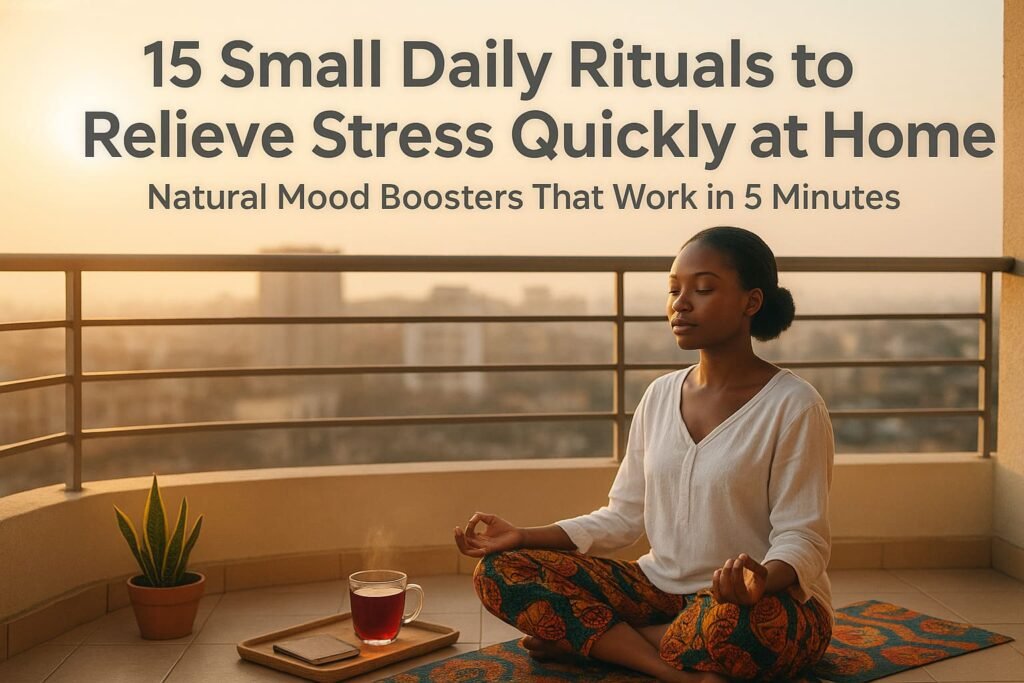
This guide shares 15 proven daily rituals that relieve stress quickly at home. Every ritual listed here takes 5 to 10 minutes at most, costs absolutely nothing, and is curated specifically for busy Nigerians who need to function at their best. By the end, you will have a toolkit of techniques to relieve stress quickly at home, boost your mood naturally, and reclaim your emotional balance without spending a single kobo. I have used these techniques during my own most challenging seasons to stay grounded.
Important Disclaimer:
While these natural rituals can significantly improve your daily outlook, the Mayo Clinic highlights that they function best as complementary wellness practices. For persistent or severe mental health conditions, professional medical care remains the foundation of your recovery.
This article provides general wellness information based on tested self-care habits. It is not a substitute for clinical medical advice, psychiatric diagnosis, or professional treatment. If you are struggling with severe anxiety, debilitating depression, or thoughts of self-harm, please reach out to a licensed professional immediately. These rituals are tools for maintenance and support, not a replacement for medical intervention when your health is at risk.
Understanding What Causes Low Mood: Common Stress Triggers
Before we learn how to relieve stress quickly at home, let us identify the specific pressures making us feel heavy. What causes low mood? Stress is a physiological process, not just a state of mind. When your body senses a threat, it releases cortisol and adrenaline. While useful for short bursts, chronic exposure to these hormones leaves your body feeling exhausted and your mind foggy. Modern research confirms that even 15 minutes of intentional movement can reduce depression risk by 26 percent, and consistent social connection lowers markers of inflammation.
For many Nigerians, these common triggers keep the body in a constant state of alert:
- Financial Pressure: The daily weight of economic uncertainty.
- Commute Stress: The sheer physical toll of navigating endless go-slows in major cities.
- Power Outages: The disruption caused when NEPA takes light, shattering your rhythm and plans.
- Work Pressure and Job Insecurity: The grind of the 9-5 paired with the necessity of a side hustle. If you are balancing your 9-5 job and side business without burnout, our time management strategies can help manage the load.
- Lack of Personal Time: The total absence of space to just breathe between family obligations and professional duties.
The solution lies in small, consistent actions. Your rituals create new pathways in the brain, helping you regulate those stress hormones naturally. If you feel stuck or keep pushing back your to-do list, these science-backed strategies to stop procrastinating are effective for regaining your focus. Remember that tracking your progress with a simple note in your phone can make a massive difference in how you perceive your growth.
Core Content: 15 Daily Rituals to Relieve Stress Quickly
Here are 15 small daily practices that are the best natural mood booster activities you can start today. They all take 5 minutes or less and are designed to give you quick relief.
1. The 4-7-8 Breathing Technique
When anxiety spikes, your heart races. You need a fast, biological way to hit the ‘reset’ button. That’s exactly what the 4-7-8 breathing technique, often called a “natural tranquilizer,” does.
Deep, slow breathing, specifically this simple counting method, activates your parasympathetic nervous system, which tells your body to relax and lowers your cortisol levels. It’s an instant way to get inner peace.
How to do it:
- Sit comfortably with your back straight.
- Exhale completely through your mouth, making a gentle “whoosh” sound.
- Close your mouth and inhale quietly through your nose for 4 counts.
- Hold your breath for 7 counts.
- Exhale completely through your mouth for 8 counts.
- Repeat this cycle only 4 times.
Nigerian context tip: This is perfect for when you’re stuck in a go-slow and your anxiety is rising. Do it quietly in the car.
Best time to practice: Right before bed, or anytime stress hits suddenly.
Bonus benefit: It also helps you sleep better!
2. Morning Sunlight Exposure

Don’t check your phone first thing. Instead, commit 10 minutes to the Morning Sunlight Exposure ritual by stepping outside without sunglasses. Morning sunlight exposure works even better when it’s part of a consistent morning routine. If you want to build a powerful morning routine that sets up your entire day for success, check out our complete morning routine for Nigerian professionals. Research shows that spending time in natural light is linked to lower rates of depression and improved mood. Natural light exposure helps regulate your circadian rhythm, signaling your brain to start producing serotonin, a major mood elevation chemical. It also helps your body get essential Vitamin D, which is directly linked to feeling positive.
How to do it:
- Wake up and step outside onto your balcony, patio, or just look out a window.
- Do this for 5 to 10 minutes.
- You don’t need to stare at the sun, just let the light hit your eyes (safely).
Nigerian context tip: The sun is strong here. Early morning sunlight (before 10 a.m.) is perfect.
Best time to practice: Immediately after waking up, before you check your phone.
Bonus benefit: It improves your focus for the whole day.
3. Power Dance Break

Feeling stiff after sitting at your desk or navigating the daily hustle? A Power Dance Break is your prescription for physical and mental release. Put on your favorite high-energy music, Afrobeats works perfectly, and move your body freely for 5 minutes. This instant physical movement helps flood your system with endorphins, your body’s natural mood boosters, doubling the stress-relieving effects by combining movement and music. Research from Harvard Medical School confirms that just 15 minutes of running or one hour of moderate activity like dancing can reduce the risk of major depression by 26%.
How to do it:
- Choose a song that makes you want to move (e.g., Burna Boy, Wizkid, or Tems).
- Put on the music at a comfortable volume.
- Move your body freely for the entire song, no judgment!
Nigerian context tip: Even during a power outage when NEPA takes light, you can play music on your phone and dance. This works perfectly when you’re feeling frustrated. For more ways to stay focused and productive during NEPA outages, we have a complete guide on managing work stress during power disruptions.
Best time to practice: Mid-afternoon when your energy dips, or after a long, stressful workday.
Bonus benefit: This activity helps you make yourself feel good instantly.
4. Gratitude Micro-Journaling
This daily practice is about instantly shifting your brain’s focus. Gratitude Micro-Journaling involves quickly writing down just three things you are genuinely thankful for today. Focusing on positive things shifts your brain away from negative worry patterns, helping train your mind toward a more positive mindset and improving your psychological wellbeing over time.
How to do it:
- Grab a small notebook or use your phone notes.
- Write down three things that happened today that you are thankful for (e.g., “I ate my favorite jollof rice,” “Traffic was light”).
- Write one sentence explaining why you are grateful for each.
Nigerian context tip: Be grateful for the small things, running water, a short queue at the ATM, or a hilarious Naija comedy skit you watched.
Best time to practice: While having a quiet moment with your evening tea.
Bonus benefit: It instantly lifts your spirit and contributes to 10 positive mental health habits.
5. Cold Water Face Splash
Feeling hot and bothered, or on the verge of panic? Head to the nearest tap and commit to a Cold Water Face Splash. Splashing ice-cold water on your face for 30 seconds activates the Diving Reflex. This is a fast, powerful biological mechanism that instantly slows your heart rate. It’s a fast, biological way to achieve a calm state and is one of the quickest ways to achieve immediate results when you feel panicky or stressed. This is how you activate your mood.
How to do it:
- Go to a sink and turn on the cold water tap.
- Splash the water onto your face and hold your breath briefly.
- Repeat 3-5 times.
Nigerian context tip: If you don’t have cold tap water, keep a small bowl of ice water in the fridge for a quick emergency reset activity.
Best time to practice: When anxiety spikes or you need to cool down and clear your head quickly.
Bonus benefit: It’s an instant mood elevation technique.
6. Herbal Tea Ritual
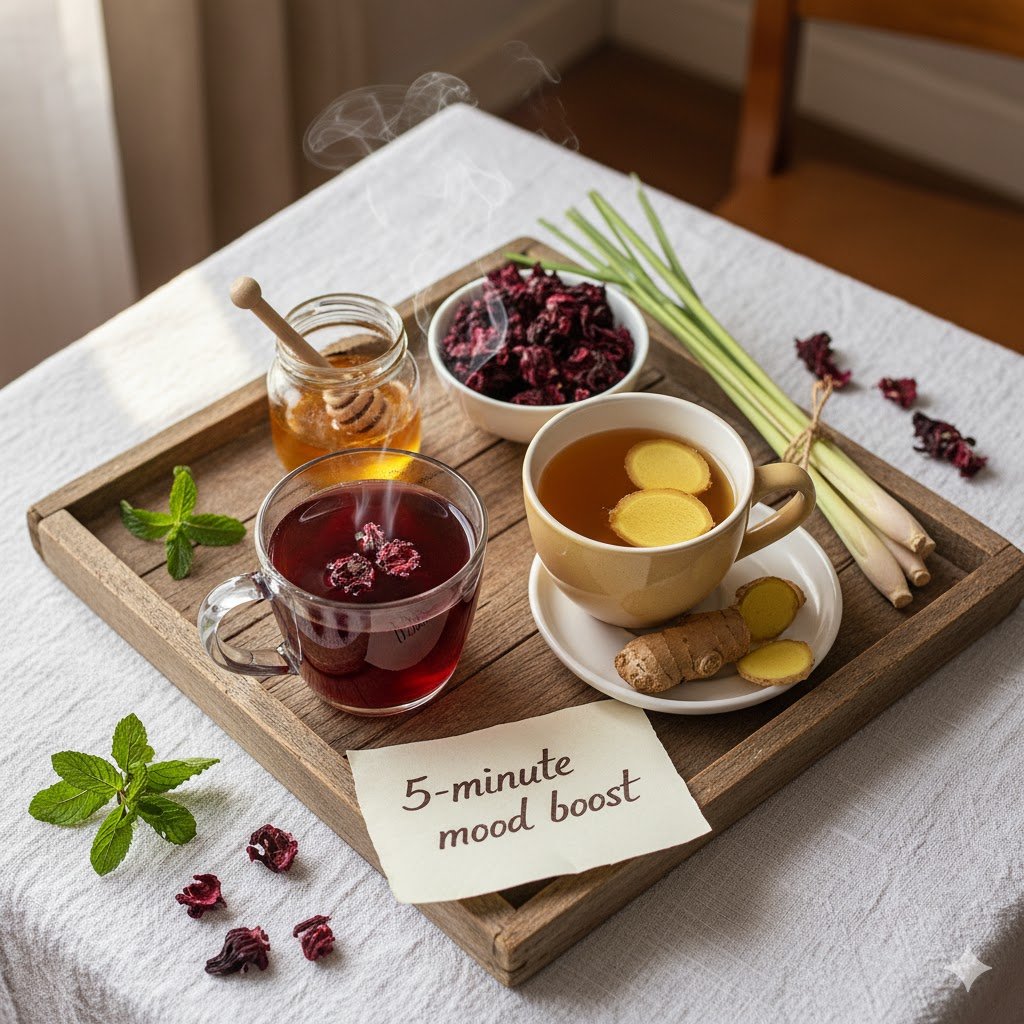
Turn your evening wind-down into a true act of self-care with a warm Herbal Tea Ritual. The simple act of holding the warm mug and sipping slowly without distractions is a powerful mindfulness exercise and provides a moment of peace. This works because warm, natural Nigerian teas offer specific health benefits and promote relaxation techniques. Studies from the National Institutes of Health show that polyphenols in hibiscus (zobo), ginger, and similar teas have powerful antioxidant properties that support brain health and mood regulation. For example, Zobo (Hibiscus) is scientifically known to help lower blood pressure, promoting a sense of calm, while Ginger tea can soothe digestion and reduce nausea, a clear link between gut comfort and mood stability.
How to do it:
- Brew a cup of zobo tea (hibiscus), ginger tea, or lemongrass. To prepare, simply steep dried leaves or grated roots in hot, boiled water for 5-10 minutes.
- Hold the mug and feel the warmth.
- Sip slowly, noticing the taste and smell. This is a practice in emotional regulation.
Nigerian context tip: These ingredients are cheapest and easiest to source in bulk from local markets (like Mile 12, Balogun, or your local Oja) rather than branded supermarket aisles. They are natural mood boosters that fit easily into a budget.
Best time to practice: The evening wind-down ritual before bed.
Bonus benefit: What to eat to increase mood? Ginger is also great for health!
7. Progressive Muscle Relaxation (PMR)
Stress often leads to unconscious muscle tension, especially in the shoulders and jaw. Progressive Muscle Relaxation (PMR) is a simple technique where you systematically tense and then completely relax different muscle groups in your body. By bringing your attention to this tension and giving yourself permission to release it, you achieve deep tension release and physical relaxation, making it a great coping strategy for anxiety relief.
How to do it:
- Clench the muscles in your feet for 5 seconds.
- Release the tension completely and let your feet feel heavy and floppy.
- Move up your body, doing the same for your calves, hands, arms, and shoulders.
- Focus on the feeling of calm that follows the release.
Nigerian context tip: Perfect for unwinding after a long day sitting at a desk or after enduring traffic stress.
Best time to practice: When you are already in bed, getting ready to sleep.
Bonus benefit: It helps you practice how to relax mind from stress.
8. The 5-Minute Nature Connection
You don’t need a huge forest to connect with the natural world. The 5-Minute Nature Connection means actively engaging your senses with nature for five minutes, even if it’s just a houseplant or looking through a window. Research from the American Psychological Association shows that exposure to nature has been linked to improved attention, lower stress, better mood, and reduced risk of psychiatric disorders. It’s a powerful reset activity that helps you gain peace of mind amid the chaos.
How to do it:
- Step outside, look at your balcony plants, or find a park nearby. If you’re in Lagos, consider visiting places like Freedom Park or the Lekki Conservation Centre on a weekend to truly disconnect.
- Focus on what you can see: the leaves, the colors, the sky.
- Listen to what you can hear: birds, wind, sounds of the city.
- Ground yourself in the moment.
Nigerian context tip: If you live in an area with little green space, focus on the sky, observe the patterns of clouds, or listen for birdsong. For low-maintenance indoor plants, try the hardy Snake Plant (Mother-in-Law’s Tongue) or Pothos (Devil’s Ivy), they thrive indoors and bring natural color to your home.
Best time to practice: Lunch break or early evening.
Bonus benefit: It reminds you that the world is bigger than your immediate stress.
9. Stretching Sequence
A quick Stretching Sequence targets the neck, shoulders, and hips, the areas where stress is most often stored physically. Gentle physical movement and stretching help loosen these knots, releasing both physical and emotional tension. This short routine is a particularly helpful stress management technique and takes just a few minutes.
How to do it:
- Start with a neck roll: slowly drop your ear to your shoulder and roll your head in a half-circle.
- Do shoulder shrugs: lift your shoulders up toward your ears, hold for 5 seconds, and then drop them heavily.
- Hug yourself tightly and rock gently side to side.
Nigerian context tip: This is a powerful quick stress relief activity for women who carry a lot of physical load from work and family.
Best time to practice: Right after waking up, or during a work break.
Bonus benefit: Improves your posture.
10. Laughter Dose
Need a mood lift right now? Pull up your favorite Nigerian comedy skit or read a hilarious chat and genuinely laugh for 5 minutes. I know it sounds too simple, but the Laughter Dose is scientifically effective because laughter creates real physical changes in your body, it increases blood flow, relaxes tense muscles, and floods your system with endorphins (your body’s natural happiness chemicals). It’s a super fun stress relief activity for adults and the best way to make yourself feel good.
How to do it:
- Keep a folder of funny videos or saved jokes on your phone.
- Set a timer for 5 minutes.
- Engage completely, letting yourself laugh freely.
Nigerian context tip: Use Nigerian comedy skits (like Mark Angel, Broda Shaggi, or Mr Macaroni) that you know will make you laugh out loud.
Best time to practice: Anytime you feel heavy, anxious, or bored.
Bonus benefit: Laughter is contagious and helps improve social connection.
11. Positive Affirmations
Your thoughts shape your reality. Positive Affirmations is the practice of speaking or thinking positive statements about yourself and your life. When you repeat phrases like, “I am capable,” you are actively building your mental resilience and changing the way your brain processes information, helping to rewire negative thought patterns. For deeper transformation, developing a growth mindset that drives real success helps you overcome limiting beliefs that cause stress and hold you back from your full potential. This is a simple but deep way to improve self esteem with daily rituals.
How to do it:
- Choose 3 phrases that counter your biggest worries (e.g., “I am capable”).
- Stand in front of a mirror or look at yourself on your phone screen.
- Say the affirmations out loud, slowly, 5 times each.
Nigerian context tip: Say it in a way that feels powerful to you. For example: “No wahala can stop my progress today!”
Best time to practice: When you’re brushing your teeth or getting dressed.
Bonus benefit: A great daily practice for overall mental health.
12. Mindful Eating Practice
In the hustle, it’s easy to eat while scrolling or rushing. The Mindful Eating Practice means taking 5 minutes to fully focus on the taste, texture, and smell of a small piece of food. This practice pulls you out of your rushing thoughts and grounds you in the present moment, which helps with emotional regulation and makes the simple act of eating a potent grounding technique.
How to do it:
- Choose a piece of fruit, a groundnut, or a piece of chin-chin.
- Look at it closely. Smell it.
- Take a bite, chew very slowly, and notice the flavors and texture.
- Do not watch TV or scroll your phone during these 5 minutes.
Nigerian context tip: Eat a piece of plantain or a small portion of beans and truly savor the taste. What to eat to increase mood? Foods rich in healthy fats and fiber are great!
Best time to practice: Anytime you have a snack.
Bonus benefit: You enjoy your food more.
13. Social Connection Check-In
When you feel isolated or lonely, fight back by initiating a Social Connection Check-In. This simple, 5-minute ritual means calling, texting, or sending a voice note to someone you care about, just to say hello. The World Health Organization’s recent 2025 report reveals that strong social connections can reduce inflammation, lower the risk of serious health problems, and foster better mental health. Simple daily check-ins with loved ones release oxytocin, the “bonding hormone,” which instantly lowers stress.
How to do it:
- Think of one person you haven’t spoken to in a while.
- Send them a quick voice note saying, “I was just thinking about you, how are you doing today?”
- Focus fully on the conversation.
Nigerian context tip: Check in on your family members or a friend dealing with the Lagos hustle stress. A simple “no wahala?” can make someone’s day.
Best time to practice: When you feel isolated or lonely.
Bonus benefit: It improves your relationships and your own sense of wellbeing.
14. Evening Gratitude Reflection
As a gentle evening ritual, the Evening Gratitude Reflection involves mentally reviewing the three best moments of your day right before you sleep. By forcing your mind to recall positive events, you end the day on a note of inner peace and gratitude. This is a powerful form of tension release that settles your mind, leading to better sleep.
How to do it:
- Lie in bed with the lights off.
- Close your eyes.
- Mentally list three small things that brought you joy or went well today.
- Thank yourself for something you did well.
- Let your mind settle on those positive feelings.
Nigerian context tip: Be thankful for running water, having fuel in your generator, or a successful food delivery order.
Best time to practice: The last thing you do before you drift off to sleep.
Bonus benefit: Excellent tension release for a long night of rest.
15. The ‘Music Reset’
Need an instant pick-me-up? The Music Reset means listening to one song that you know lifts your spirit, focusing only on the music and its beat. Music has a direct connection to your emotional center. Choosing music with a fast tempo or positive lyrics, like your favorite Afrobeats, can quickly change your brain chemistry and is one of the quickest ways to activate your mood.
How to do it:
- Put on your favorite Afrobeats song or high-energy tune.
- Use headphones to block out distractions.
- Close your eyes (if you can safely) and focus on the beat, the rhythm, and the lyrics.
Nigerian context tip: Nigerian music is globally known for its high-energy, positive vibes. Use this resource!
Best time to practice: On your commute or when waiting for something.
Bonus benefit: It immediately provides immediate results for mood elevation.
Quick Reference: Best Rituals for Different Situations
| When You Need Relief | Best Ritual | Time Required | Difficulty Level |
|---|---|---|---|
| Immediate panic or anxiety attack | Cold Water Face Splash or 4-7-8 Breathing | 1-2 minutes | Very Easy |
| Morning energy boost | Morning Sunlight + Power Dance Break | 10-15 minutes | Easy |
| Stuck in traffic stress | 4-7-8 Breathing or Music Reset | 3-5 minutes | Very Easy |
| Evening relaxation | Herbal Tea Ritual + Gratitude Reflection | 10-15 minutes | Easy |
| NEPA frustration | Power Dance (phone music) or Laughter Dose | 5 minutes | Easy |
| Building long-term resilience | Gratitude Journaling + Positive Affirmations | 5-8 minutes | Easy |
| Physical tension release | Progressive Muscle Relaxation or Stretching | 5-10 minutes | Moderate |
| Loneliness | Social Connection Check-In | 5-10 minutes | Easy |
Your Emergency Stress Toolkit: When You Need Relief NOW
When panic spikes or the day becomes overwhelming, you need a reliable, immediate protocol that bypasses the need for complex decision-making. This three-step sequence integrates physical, mental, and emotional reset rituals to anchor your nervous system back to a state of equilibrium in under 10 minutes. I suggest using a physical timer on your phone for these sessions to prevent your mind from drifting or rushing the process.
Save this sequence as a note on your phone or keep a physical index card in your bag. Life in Nigeria comes with its own wahala, and having a pre-planned exit strategy for your nervous system is a true act of self-preservation. When the pressure peaks, do not analyze the process, just execute the steps.
Step 1 (0-2 minutes): Physical Reset – Immediate Calm
This is your non-negotiable first step. By splashing cold water on your face, you trigger the Diving Reflex, a biological mechanism that signals your heart rate to slow down instantly as a survival response. It is the quickest way to pull yourself out of a state of high-alert panic.
- Go to the nearest source of cold water. If it is hot outside, even room-temperature water can help, but cooler is definitely more effective for the reflex.
- Splash your face 5 times with focus and intention.
- Immediately transition into the 4-7-8 Breathing Technique for at least 30 seconds. Focus on the exhale, as that is what signals your brain to lower cortisol levels.
Step 2 (2-5 minutes): Mental Reset – Tension Release
Once your heartbeat is steady, address the physical manifestation of stress trapped in your muscles. We hold so much tension in our shoulders and jaws during a typical Lagos workday.
- Select one high-energy track. I keep a dedicated “joy folder” on my phone with songs that guarantee an immediate shift in my mood.
- Power Dance with complete abandon. Shake your arms, jump, or move your hips. The goal is to move the stagnant energy out of your system.
- Allow the physical movement to release stored tension, flooding your body with endorphins that counteract the adrenaline of a stressful situation.
Step 3 (5-10 minutes): Emotional Reset – Re-connection
Now that the physical storm has passed, tether yourself back to your sense of self and community to ground your mental state.
- Perform Gratitude Micro-Journaling. Write down three things you are thankful for right now. Focus on small victories, like having access to a cold drink or a reliable friend.
- Social Connection Check-In: Send a voice note or make a brief call to someone who anchors you. Scientific data shows that strong social bonds lower inflammation and improve overall health, even when we are dealing with external stressors.
10 Positive Mental Health Habits: Simple Tips to Reduce Stress Long-Term
While the quick rituals offer instant relief, integrating supportive lifestyle shifts builds a foundation of long-term emotional resilience. These 10 habits represent the most effective ways to maintain balance in a demanding environment. Consistency over perfection is the only metric that matters here.
- Consistent Sleep Schedule: Constant worry about electricity and the noise of a generator can fragment your sleep cycle. According to Harvard Medical School, even minor sleep disruptions significantly increase irritability and cognitive fatigue. Beyond just keeping a schedule, establish a ‘digital sunset’ where you turn off all blue-light screens 30 minutes before bed to allow your brain to prepare for restorative sleep.
- Hydration as a Mood Regulator: The heat in Nigeria can drain your energy faster than you realize. Keep a water bottle nearby. Research indicates that even mild dehydration impairs your ability to concentrate and elevates stress responses. Staying hydrated is one of the simplest things you can do to support your brain’s basic functionality.
- Mindful Social Media Use: We all know the trap of comparing our private struggles to someone else’s curated highlights. Set hard limits on your screen time. Use focus modes on your phone to mute notifications during your deep work hours or relaxation rituals to protect your headspace from unnecessary external noise.
- Active Movement: Harvard research suggests that 15 minutes of running or one hour of moderate exercise can reduce the risk of depression by over 25 percent. If you cannot make it to a gym, simply walking briskly for 10 minutes a day is enough to help your body process cortisol more efficiently.
- Curate Your Circle: Protect your peace from those who consistently drain your energy. WHO 2025 reports emphasize that robust social connections are one of the most effective ways to lower biological inflammation and protect your long-term heart health. Choose your company wisely.
- Boundary Setting: The pressure to be everything to everyone is a major stress driver. Practice saying no to requests that exceed your bandwidth. As explored in this piece on work-life balance, boundaries are not selfish; they are essential for your ability to contribute meaningfully to your community over the long term.
- Mood-Supporting Nutrition: Incorporate local, nutrient-dense staples. Foods rich in polyphenols, such as hibiscus (the basis for zobo) and ginger, contain antioxidants that assist with mood regulation. Pairing these with consistent protein sources like eggs or fatty fish provides the amino acids necessary for neurotransmitter synthesis. Pre-prepare your tea ingredients in small bags to reduce friction for your evening ritual.
- Rest as a Radical Act: True rest is a period where you are not actively managing someone else’s expectations. Even 15 minutes of silence in a busy household is enough to reset your focus. Do not feel guilty about stepping away to reclaim your energy.
- Self-Compassion Practice: When things go wrong, our internal critic often gets loud. Treat yourself with the same grace you would offer a younger sibling or a close friend. Acknowledging your own effort is essential for building genuine internal resilience against economic or societal pressures.
- Seeking Community: A problem shared is a problem halved. Whether it is a support group or just a trusted friend, talking about your challenges prevents the isolation that turns manageable stress into long-term burnout. Use apps or simple group chats to maintain these connections even on busy days.
Frequently Asked Questions About Stress Relief at Home
How can I relieve stress quickly at home without spending money? You can use free techniques like the 4-7-8 breathing exercise, cold water face splashes to trigger the diving reflex, or a quick dance break. These methods are designed to cost nothing while providing immediate biological relief.
What is the fastest way to improve my mood in 5 minutes? The most rapid mood shift comes from combining a cold water splash with a high-energy movement break. This creates a physiological bridge from high-arousal stress to a state of release and calm.
How do I naturally boost my mood without medication? Focus on the pillars of health: morning sunlight exposure for your circadian rhythm, regular movement to release endorphins, hydration, and nurturing your social support systems. Small, consistent actions are what create lasting stability.
What Nigerian drinks or foods improve mood naturally? Zobo (hibiscus) and ginger infusions are excellent for their antioxidant properties. Keeping your diet rich in local leafy greens and stable protein sources also provides the foundation for healthy brain function.
What causes low mood and stress for Nigerians specifically? Many face stress from economic uncertainty, long commutes in Lagos traffic, and the unpredictability of power supply. Managing these stressors requires a shift toward internal stability and proactive boundary management.
How can I improve my self-esteem through daily rituals? Start by documenting your small wins in a micro-journal. Affirmations that acknowledge your resilience in the face of daily challenges help to shift your internal narrative from victimhood to agency.
Can I do these rituals during power outages? Yes. Every ritual mentioned, from breathing to physical movement, is entirely analog. In fact, these rituals are often most effective when the digital noise of the world is turned down due to lack of power.
Conclusion
There you have it. 15 practical, free ways to take charge of your mood starting today. We have examined how to move from a state of high-stress activation to calm by using simple rituals like deep breathing, physical movement, and intentional connection. You do not need a gym membership or a prescription to start caring for your nervous system right now.
The goal is never perfection. Consistency over perfection is the mindset that will serve you best. Even five minutes of intentional breathing or one song of dancing can fundamentally shift your physiological state and give you the space you need to think clearly. Life is filled with challenges that we cannot always control, but we can always control how we care for our bodies in the aftermath.
You have a complete toolbox of free, effective mood boosters at your fingertips. We are a resilient people, and by adding these practices to your daily routine, you are reinforcing your ability to navigate whatever comes your way. For a more detailed look at structuring your growth, check out this guide on creating a personal development plan that integrates wellness with your professional goals.
Which ritual will you commit to for the next 21 days? Start small, track your progress with a simple notebook, and watch how your baseline changes. You are worth the time it takes to heal.
About the Author
The Author is a Lagos-based wellness advocate who has spent over seven years refining these rituals to help navigate the realities of Nigerian life. After finding personal relief from the crushing pressure of career burnout and the daily grind of city life, they have dedicated their work to proving that mental wellbeing is not a luxury for the wealthy, but a necessary tool for the resilient. They specialize in creating accessible strategies for busy Nigerians who want to protect their peace despite economic pressures and unpredictable daily routines. Their mission is to provide the practical, no-cost tools that help our community thrive from the inside out.

Oladepo Babatunde (Prince Babatee Tunde) is a Computer Scientist, researcher, and professional content writer with a Higher National Diploma in Computer Science from Kwara State Polytechnic, Nigeria.
With a background in technology and a passion for clear communication, Babatunde specializes in creating thoroughly researched, reader-focused content on productivity, personal development, home living, and technology. Every article he writes is backed by extensive research and fact-checking to ensure readers receive accurate, actionable information.
As a freelance writer, he has helped brands and publications deliver content that educates, engages, and empowers their audiences. His mission at Vibena is simple: make complex topics easy to understand and help Nigerians live smarter, more productive lives.