Look, the reality of life in Nigeria is that we are constantly on the move. Whether you are navigating the chaotic Lagos traffic, managing the fast-paced markets in Ibadan, or handling the high-stakes pressure of the oil sector in Port Harcourt, finding a window for quiet self-reflection feels like a luxury nobody can afford. Who actually has an hour to sit down with a notebook and pour out their soul? None of us.
That is precisely why we must shift our perspective toward the Power of Micro-Journaling. This approach is not about penning lengthy memoirs or exhaustive reflections; it is about driving meaningful change through intentional, bite-sized actions. By utilizing simple 2-minute prompts, you can actively strengthen your mental health and reclaim your headspace amidst the daily grind. Micro-journaling acts as the essential building block for creating a comprehensive personal development plan that actually survives the reality of your busy schedule.
The numbers reflect a global necessity. Current data from the World Health Organization (WHO) highlights that nearly 1 in 7 individuals worldwide live with a mental disorder, with anxiety and depression leading the pack. Within the Nigerian context, this translates to roughly 40 million people managing significant mental health hurdles. Because professional help can sometimes feel out of reach, high-barrier, or stigmatized, building accessible, free self-care tools is a vital step toward better living. This reflective practice costs nothing, carries no social stigma, and is available right in your pocket on your phone whenever you need a moment of clarity.
Important Disclaimer: While micro-journaling supports mental wellness and has been shown to reduce symptoms of stress and anxiety, it is not a replacement for professional mental health treatment. If you are experiencing severe depression, anxiety, suicidal thoughts, or other serious mental health concerns, please consult a qualified healthcare provider. For additional information on mental health conditions, visit the National Institute of Mental Health (NIMH). Within Nigeria, you can connect with local mental health support through the Mentally Aware Nigeria Initiative (MANI), She Writes Woman, or the Mental Health Foundation Nigeria helpline.
I have personally stuck to a micro-journaling routine for over a year while working as a professional in Lagos, and I can tell you it changed how I handle the frustration of Third Mainland Bridge congestion. At first, I was doubtful, I wondered how a two-minute exercise could possibly make a dent in my stress levels. Yet, it evolved into a non-negotiable habit that dampened my evening anxiety and helped me drift off to sleep with a much clearer mind.
The best journaling practice is the one you will actually do! This self-care routine is your shortcut to calm. It remains fast and accessible, just jot down a few sentences regarding your current headspace or a specific win from your day. It is exactly the kind of low-friction wellness tool you need. By the time you finish this guide, you will have a clear, actionable plan to start a 2-minute journaling habit that fits into your life, no matter how demanding your career or family obligations become.
What Is Micro-Journaling?

If you have ever felt too overwhelmed to keep a formal journal, you are exactly the person this practice was designed for. What is micro journaling? It is a condensed, highly intentional writing exercise. You capture your fleeting thoughts, nagging stressors, or moments of gratitude in just a few lines. Usually, it requires only 2 to 5 minutes of your day. It is writing that respects the limited time you have.
Think about traditional long-form journaling, where you might attempt to fill pages daily. While that is a valid method, it is often unsustainable for someone juggling professional responsibilities. This reflective practice is different because it is bite-sized. Rather than a messy, hour-long stream of consciousness, you use focused reflection to answer specific, pre-defined prompts.
The standout advantage here is efficiency. For Nigerians dealing with constant challenges like power fluctuations, high data costs, and unpredictable commute times, this practice is perfectly calibrated. You do not need expensive gear; your phone’s standard notes app or a small notepad will do. You can write in Pidgin if it feels more authentic to your internal voice. Because the time commitment is so low, you are far more likely to maintain consistency, which is the primary driver of improved mental health journaling and genuine self-discovery.
The Science Behind Micro-Journaling’s Power
You might still wonder if two minutes is enough to move the needle. The science says yes.
Research consistently shows that even brief mindfulness exercises produce tangible mental health benefits. These exercises allow you to process internal noise and regulate emotions in a way that longer sessions would, but with a much lower barrier to entry. According to the University of Rochester Medical Center, writing down your experiences helps you prioritize your problems, identify emotional triggers, and reduce overall stress markers.
When you commit thoughts to text, you move chaotic mental loops from your mind onto a screen. This practice of thought organization creates a sense of space in your brain. As you build this self-awareness, you will likely notice improvements in your professional life as well, particularly when it comes to building confidence in your career. Identifying your own patterns makes it easier to leverage your strengths and navigate corporate challenges with greater clarity.
Evidence backs this up. A 2022 review published by the National Library of Medicine (NIH) noted that journaling interventions contributed to statistically significant reductions in mental health symptoms, with anxiety dropping by roughly 9% and depression by 6% compared to those who did not journal. Furthermore, data shared at the American Physiological Society conference indicated that 85% of medical students found journaling helped them hit their personal goals, while 57% noted direct improvements in their physical and mental state. Remarkably, 83% of those participants committed to the practice long-term.
This works because of emotional regulation. When you label an emotion, like frustration over a delayed project or traffic gridlock, you lessen the physiological impact it has on your body. Consistency builds an archive of your growth, making the path to mental well-being much clearer over time.
Techniques for Frictionless Entry
If you want to ensure you stick with it, try habit stacking. Open your notes app immediately after you finish your morning tea or just before you start your evening commute. Many people find using the “Message Yourself” feature on WhatsApp to be the ultimate way to record entries without needing a separate app. It keeps the barrier to entry non-existent.
Breaking the Silence: Mental Health in Nigerian Culture
Within many Nigerian communities, speaking openly about mental health remains a hurdle. Cultural expectations of toughness, combined with deep-rooted religious perspectives and a lingering fear of stigma, often keep people from seeking external support.
This reality highlights why micro-journaling is an ideal tool for us. It is 100% private. You do not need to explain your process to your parents, your partner, or your office colleagues. Your digital notes or physical book are a private fortress where you can be perfectly honest without judgment or unwanted interference. It is a quiet, personal win for your own peace of mind.
Understanding the 3-2-1 Method of Journaling
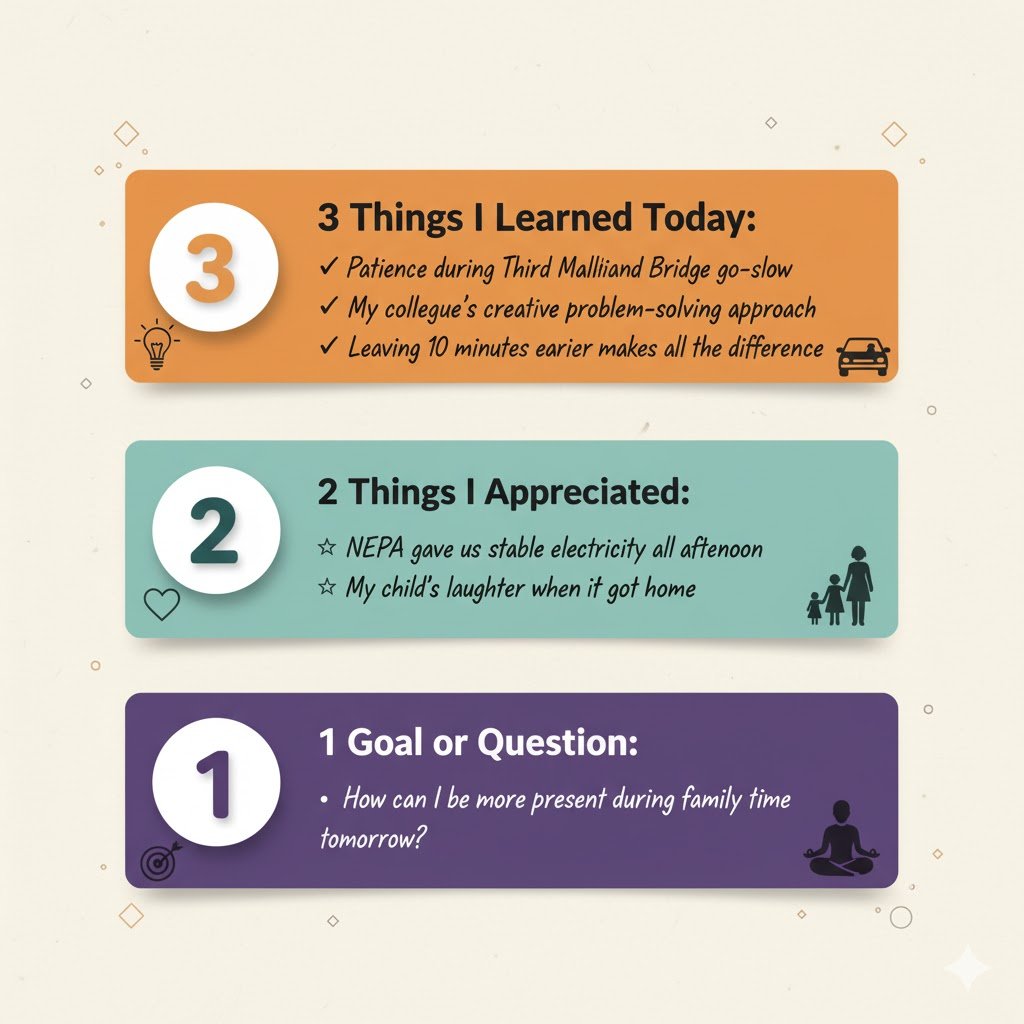
The 3-2-1 method is a pillar of the micro-journaling movement. It is effective because it forces you to categorize your day into bite-sized segments of reflection.
The 3-2-1 method of journaling asks you to identify:
- 3 Things You Learned
- 2 Things You Appreciated
- 1 Question or Goal You Have
3 Things You Learned
Do not overthink this. These do not have to be earth-shattering realizations. Focus on small, practical lessons. Maybe you learned a new shortcut to navigate traffic, a detail about how your team communicates during a meeting, or a lesson in patience while waiting for a client reply. Identifying these builds your pattern-recognition skills over time.
2 Things You Appreciated
This is your daily gratitude practice. Small wins are essential. Did you have access to steady electricity for an extra two hours today? Did you enjoy a particularly good lunch? Did a friend send an encouraging message? Acknowledging two small positives helps rewire your brain to scan for goodness rather than just focusing on the stress of the day.
1 Question or Goal
This is about setting your sights on tomorrow. What is the one thing you need to focus on? If you are planning for the long haul, consider aligning this daily goal with the framework for setting SMART goals for 2026. It is a simple way to maintain focus on your development while keeping your daily tasks manageable.
How to Implement the 3-2-1 Method
This method is quick, prevents that dreaded blank page anxiety, and reinforces habit formation. Try doing it in the evening as you wind down. If the power goes out, your phone screen light is all the illumination you need to get these thoughts down before sleep.
Nigerian Adaptation: If you are struggling with a particularly high-pressure work week, focus your 3-2-1 entries on “professional boundaries” to help manage feelings of burnout. It helps create a mental barrier between your office life and your home peace.
Pros and Cons:
- Pros: Extremely efficient, structured, eliminates mental friction, and builds consistent momentum.
- Cons: If your emotions are very complex or heavy, you might feel like you need more space than three bullets provide.
I will be real with you, sometimes the 3-2-1 structure feels a bit tight. Maybe you had a day where you learned five things, or maybe you had a rough one where finding two things to appreciate feels like a struggle. That is perfectly fine. The structure is there to serve you, not to dictate your life. Use it as a loose guideline, and feel free to pivot if your day requires more emotional space.
Quick Summary: The 3-2-1 Method
This remains one of the most efficient ways to close out a day:
- Time: Strictly 2-3 minutes.
- Best For: Beginners who want a simple, repeatable framework.
- Format: 3 learnings, 2 appreciations, 1 goal.
- Best Time: Right before bed to clear your mental cache.
The 5-Minute Journal Method Explained
Another classic technique that works well for those who prefer a bit more guidance is the 5-Minute Journal. What are the 5 minute journal prompts?
This method uses distinct morning and evening questions to create a clear container for your day. It is a fantastic practice to integrate while building a powerful morning routine for Nigerian professionals. Using these prompts as soon as you wake up helps you set your intentions before the morning rush of Lagos traffic or email pings begins to dictate your energy.
Morning Prompts (Setting Intention)
Answer these three simple items right when you sit up.
- “I am grateful for…” (3 things)
- Nigerian Example: Steady power this morning, the fact that I woke up energized, or a supportive call from a family member.
- “What would make today great?” (3 things)
- Nigerian Example: Finish the Q1 budget draft, have a calm commute, finally call that friend I have been ignoring.
- “Daily affirmation: I am…” (1 statement)
- Nigerian Example: “I am patient with myself even when things are unpredictable,” or “I am capable of delivering excellence.”
Evening Prompts (Self-Reflection)
Answer these two questions before you turn off the light.
Imagine the day is finally done. You are in your bed, maybe the fan is on, and the noise of the day has faded. You pull out your phone and, in the dim light, you type: “Today, catching that sunset on the way home made me feel so grounded.” That single moment of reflection is what shifts your relationship with stress. It bookends your day with intent.
- “Highlights of the day” (3 things)
- Nigerian Example: The client loved my presentation, I avoided the worst of the traffic, we had a really good laugh in the office.
- “What I learned today” (2 things)
- Nigerian Example: I learned that taking a 5-minute break actually helps me think faster; I learned that I shouldn’t take work feedback personally.
How to Adapt to 2-3 Minutes
If five minutes feels like too much, strip it back. Choose one morning prompt and one evening prompt. Use bullet points. Do this on the bus, while waiting for your laptop to load, or while you wait for your tea to cool down. Consistency over duration is the secret sauce here. Whether you are using Notion, Day One, or just your simple phone notes, the habit is what creates the change. Start small, keep it authentic, and keep going.
How Journaling for 10 Minutes a Day Transforms Your Emotional Wellness
Now, if you can stretch to just a little bit more time, say, Journaling for 10 minutes a day, the benefits for your emotional wellness are profound. As we look at the reality of 2026, where the pace of life in major hubs like Lagos, Abuja, and Port Harcourt continues to accelerate, carving out this dedicated headspace is not just self-indulgence; it is a vital survival strategy for the modern Nigerian professional.
Current data suggests that maintaining this self-care routine for just 10 minutes daily can help reduce anxiety, improve your mood, and support stress management, though individual results naturally vary. It is all about maximizing the mental health benefits of consistent, intentional reflection. When you provide your mind with a structured space to exhale, you find that the noise of the day starts to lose its grip on your internal peace.
Here are the specific ways it helps your mind:
Reducing Stress and Anxiety
According to the University of Rochester Medical Center, journaling helps manage anxiety, reduce stress, and cope with depression by helping you prioritize problems and identify triggers. When you feel stressed about job security, the rising cost of living, or demanding family expectations, your worries can get stuck on a loop in your head (worrying on repeat). Brief journaling helps get those worries out of your system and onto the page. While micro-journaling provides significant stress reduction benefits, combining it with 15 quick ways to relieve stress at home creates a comprehensive wellness approach for busy Nigerians.
You write down the fear, and suddenly it exists outside of you, no longer trapped in the dark corners of your subconscious. This movement immediately supports stress reduction and anxiety reduction. Recent research from Positive Psychology confirms that journaling helps us move toward accepting rather than judging our own mental experiences, which reliably results in fewer negative emotions when we face inevitable daily stressors.
Managing Depression Symptoms
This reflective practice can provide a helpful way to process heavy emotions, but keep in mind that it supports, it does not replace, professional treatment for depression. When you write about your feelings, it helps break through emotional numbness and grants you a renewed sense of control and self-awareness. It is worth remembering that building the muscle of consistency is far more important than the intensity or literary quality of your writing. The best journaling practice is the one you will actually do!
Disclaimer: While journaling supports mental wellness, it is not a replacement for professional mental health treatment. If you are struggling with severe depression, please seek professional help from a qualified clinic or psychologist. We must avoid making unverified medical claims regarding self-guided practices.
Processing Trauma and Grief
Writing for just a few minutes can provide a safe, private outlet for difficult emotions that you might not feel ready to speak aloud. This is particularly relevant in our culture, where discussing certain feelings can be difficult or stigmatized in traditional Nigerian settings. Writing offers a private sanctuary to process painful experiences at your own speed. Always remember, this tool complements, it does not replace, traditional therapy or grief counseling.
Improving Emotional Regulation
Over time, looking back at your entries helps you spot patterns you might otherwise miss. You start to see exactly what triggers your frustration, anger, or deep sadness. For example, you might notice that traffic on the Third Mainland Bridge always makes you short-tempered with your colleagues later in the day. Once you identify these triggers, you can develop healthier, more mindful responses. According to experts at the University of Rochester Medical Center, journaling helps you prioritize problems and track symptoms, providing the clarity needed for effective management. As you develop pattern recognition through daily micro-journaling, you will notice recurring thoughts that hold you back. This self-awareness is the first step in overcoming limiting beliefs and developing a growth mindset that drives real success. This process is the absolute core of healthy emotional processing.
The 10-Minute Framework
If you have 10 minutes, try this specific flow:
- 3 minutes: Brain dump or free writing (just get it all out, ignore grammar and spelling).
- 4 minutes: Structured prompts (use the 3-2-1 method or specific daily questions).
- 3 minutes: Action planning for tomorrow or a gratitude list to anchor your mood.
Realistic expectations: Most studies show that significant shifts in mood often appear within the first month of consistent practice, with symptoms of low-level depression showing measurable improvement after 30 days of daily engagement. Keep going, even when you feel like you have nothing to say!
Medical Disclaimer: The information in this article is for educational purposes only and is not intended as medical advice, diagnosis, or treatment. Mental health conditions require professional evaluation and treatment. Micro-journaling is a complementary wellness practice, not a substitute for therapy, medication, or professional mental health care. If you are experiencing symptoms that interfere with your daily life, please consult a qualified healthcare provider.
Practical 2-Minute Micro-Journaling Prompts You Can Start Today (The Action Section)

This is the most practical part! These 2-minute prompts are designed for the busy individual who needs quick, effective reflection techniques right now. For each one, aim for 1-3 sentences. Don’t overthink it.
Morning Prompts for Nigerians (2 minutes each)
These set your intention for a productive day. Start your morning by asking, “What is one thing I am truly grateful for this morning?” This could be as simple as having water to bathe, stable electricity, or a good night’s sleep. Then identify your absolute top priority by asking, “What is the one task I must finish today to feel successful?” Following that, set an emotional intention with the prompt, “How do I want to feel by the time I reach bedtime?” Finally, build resilience by considering, “What challenge might I face today, and how will I handle it with grace?” When you write this and notice procrastination appearing repeatedly, it is time to implement science-backed strategies to stop procrastinating that work specifically for the Nigerian professional environment. This simple exercise frames your entire day around feeling prepared and in control rather than reactive.
Afternoon Check-in Prompts (2 minutes)
Use these during your lunch break or while waiting for a meeting to start. Focus on assessing your energy and managing mid-day stress. Begin by checking in with, “How am I feeling right now in this exact moment?” to help with immediate emotional regulation. Next, focus on the positive with, “What is one win from this morning?” to stop your brain from dwelling on negatives. Finally, practice stress reduction by asking, “What do I need to let go of to have a better, more peaceful afternoon?” to drop any lingering frustration from the morning hours.
Evening Reflection Prompts (2 minutes)
These bring closure to your day.
Picture this: You are lying in bed, the fan humming, the day’s chaos finally quiet. You pull out your phone, and in the glow of the screen, you type: “Today, my friend’s visit made everything worth it.” That is it. That is your journal entry. Two seconds of reflection that bookends your day with gratitude.
Start your evening closure by reflecting on, “What made me smile today?” to focus on positivity. Boost your self-compassion next with, “What did I do well today, even if it was small?” Then, use gentle self-correction for personal growth with, “What could I have done better?” to identify one actionable lesson for tomorrow. Finally, end the day on a positive note with, “What am I looking forward to tomorrow?”
Special Situation Prompts
During stressful moments, ask yourself: “What is the one thing I can control right now?” When you are facing a difficult professional decision, your prompt could be: “What does my gut tell me is the right path?” And when celebrating success, reflect on: “How will I recognize this success tomorrow and keep this momentum going?”
Different Micro-Journaling Methods Compared
It is great to know your options! You do not have to stick to just one style. Here is a comparison of common journaling methods:
| Method | Time Required | Best For | Structure | Nigerian Context |
|---|---|---|---|---|
| 3-2-1 Method | 2-3 minutes | Structured thinkers, beginners | 3 learnings, 2 appreciations, 1 goal | Perfect for a quick evening routine before power cuts. |
| 5-Minute Journal | 5 minutes | Morning/evening routine lovers | Morning + Evening prompts | Great for a mindful break during your morning commute. |
| One-Line-A-Day | 1 minute | Extreme time constraints | Single sentence daily | Ideal for super busy professionals needing simplicity. |
| Stream of Consciousness | 2-5 minutes | Emotional processors | Unstructured writing | Best when you need to vent stress or clear your head. |
This comparison table shows that consistency building matters more than perfection. The best journaling practice is the one you will actually do! It is okay to mix structured vs. unstructured methods depending on how you feel on a particular day. If typing is difficult, remember that audio-journaling, recording yourself speaking for two minutes, is an equally valid way to clear your mind.
Which Method Should YOU Choose?
If you are completely new to journaling, start with One-Line-A-Day for one week, then progress to the 3-2-1 method. If you want morning motivation, use the 5-Minute Journal’s morning prompts only. If you need stress relief, Stream of Consciousness is your best friend. If you want structure, the 3-2-1 method provides the perfect, low-friction framework.
Remember: The best method is the one you will actually do consistently. Start with the easiest, not the “best” or most complex.
Setting Up Your Micro-Journaling Practice in Nigeria
The beauty of a sustainable self-care routine is its simplicity. Let us make your micro-journaling practice actionable and location-specific.
Tools and Apps That Work in Nigeria
Micro-journaling is one of the most accessible self-care routines available to us in 2026.
Unlike professional therapy, which can be an expensive, multi-stage commitment, expenses many Nigerians find challenging in this economy, micro-journaling is genuinely free. Your phone’s native notes app or a simple notebook from your local market is all you need to get started. You do not need expensive subscriptions or fancy hardware.
For Nigerians managing expensive data plans, this reflective practice is highly data-conscious. It does not require a constant internet connection. Your phone’s built-in notes app works completely offline, making the practice free and functional even when data is scarce or the network is down.
- Phone notes app: Always accessible, zero data needed, and perfect for writing on the go.
- WhatsApp “Message Yourself”: A familiar tool for all Nigerians. Create a chat with yourself and send your prompts there; it feels like texting a friend.
- Small notebook: Essential! Works perfectly during power cuts when your phone battery is drained.
- Digital Habit Trackers: Apps like Notion or Habitica can sync across devices when you have data, keeping your entries safe and organized.
Finding Your 2-Minute Window
You can find two minutes anywhere!
- During your morning routine. This is a great place to integrate micro-journaling into your morning routine before the day begins.
- On your commute (if you aren’t driving).
- During a short lunch break or at your desk before a meeting.
- While waiting for an appointment or standing in a queue.
- Before bed, even if it is humid, it is only two minutes.
Building the Habit
Habit formation is the secret to unlocking the Power of Micro-Journaling.
- Start small: Commit to just one prompt daily for the first week.
- Habit stacking: Do it at the same time each day, tied to another habit (e.g., *after* you finish your morning tea/coffee, or *before* you brush your teeth at night).
- Set a digital nudge: Use your phone’s calendar or alarm to remind you until it becomes automatic.
- No guilt: If you miss a day, just restart, no wahala! The goal is cumulative practice, not perfection.
Addressing specific challenges:
- What if the power goes out? Use your phone notes or your pocket-sized notebook.
- What if I miss a day? Just restart the next morning. Do not let one missed day become a missed week.
- What if family interrupts? That is normal life in a Nigerian household. Two minutes can wait, or just step outside or into another room briefly.
- Can I write in Pidgin? Absolutely! Writing in the language that feels most authentic and expressive to you will always yield the best mental results.
Common Mistakes to Avoid in Micro-Journaling
To ensure you maintain steady momentum as we navigate the demands of 2026, steer clear of these common pitfalls that often derail even the best intentions:
- Writing too much: The magic is in the brevity. If you find yourself drafting three long pages, you have wandered away from the micro-journaling intent. Keep it to a few punchy sentences.
- Judging your writing: Perfectionism is the enemy of progress. Your journal is a private sanctuary. Grammar, spelling, and whether your handwriting looks like a doctor’s prescription are irrelevant.
- Skipping during chaos: When life in Lagos or Abuja feels overwhelming, that is exactly when you need these two minutes the most. Treating this as a grounding exercise helps you find calm amidst the daily grind.
- Expecting instant relief: Significant shifts in perspective usually manifest after two or three weeks of consistent practice. Stay the course even when you do not see fireworks on day two.
- Making it a chore: Avoid complex systems or fancy prompts that feel like homework. If it feels hard, you will stop doing it. Keep the barrier to entry low.
- Forcing forced positivity: Emotional honesty is the goal. Use this space to document the hard, gritty, or frustrating days just as much as the wins. It is about awareness, not just curation.
- Comparing your path: Your reality is your own. Do not look at how others maintain their practice. Your journey in your specific Nigerian context is entirely unique.
When to Expand Beyond Micro-Journaling
Micro-journaling provides a solid foundation, but there will be seasons when you crave more depth. Consider leveling up if you notice these signs:
- You find yourself writing for five or ten minutes without even trying.
- You feel restless because you have more to say than three sentences allow.
- You are processing major life decisions or complex emotional hurdles that require a bird’s-eye view.
Next steps to consider:
- Morning Pages: Committing to three full pages of stream-of-consciousness writing to clear your mental desk for the day.
- Targeted goal mapping: Moving from reflection to strategy. If you are refining your long-term plans, look into an effective goal-setting framework for young Nigerians or learn to develop a growth mindset that drives real success.
- The 3-2-1 Method: A powerful structured approach where you write down 3 things you are grateful for, 2 things you need to finish today, and 1 thought on how you felt.
Remember that adding length does not mean abandoning your micro-habit. I often keep my micro-practice alongside these deeper sessions to stay anchored daily.
Start Your Micro-Journaling Practice Right Now (Yes, Right Now!)
Do not wait for a new notebook or a quieter morning. Start exactly where you are sitting, with whatever tools are within reach. The best journaling practice is the one you will actually do!
Your First 2-Minute Journal Entry (Do This Now):
- Open your phone notes, a scrap of paper, or a dedicated chat with yourself on WhatsApp.
- Set a timer for 120 seconds.
- Ask yourself: “What is one thing I am grateful for in this exact moment, and one thing I want to change tomorrow?”
- Write your response. No editing allowed.
That is it. You have officially started. By prioritizing these small moments, you are actively building the resilience needed for the challenges of 2026.
Frequently Asked Questions About Micro-Journaling
Is this brief reflection as effective as longer journaling?
Yes. Data from 2022 research indicates that consistent, brief interventions significantly improve mood and anxiety levels. The best journaling practice is the one you will actually do!
Can I do short-form journaling on my phone?
Using your phone is often the most practical choice for those of us on the go. Apps like Notion, Day One, or even a private WhatsApp group called “My Thoughts” are perfect for offline access and quick entries during transit or power outages.
What if I miss several days?
Life happens. If you miss a week because of work pressure, simply restart without carrying the weight of guilt. It is a cumulative practice, not a test of endurance.
Should I journal in English or Pidgin?
Use the language that reflects your inner voice. Writing in Pidgin can often feel more raw and authentic if that is how you naturally think. The goal is raw expression, not polished prose.
How long before I see benefits?
Recent studies suggest users often notice a shift in their ability to identify stressors within thirty days. If you are struggling with professional burnout in the corporate sector, you might find that tracking your triggers for one month helps you regain a sense of agency.
Can micro-journaling help with anxiety?
It acts as a powerful tool to externalize spiraling thoughts. By moving anxious energy onto paper or a screen, you gain the distance needed to see the patterns. While it is not a replacement for therapy, it serves as a helpful companion in your mental health toolkit.

Oladepo Babatunde (Prince Babatee Tunde) is a Computer Scientist, researcher, and professional content writer with a Higher National Diploma in Computer Science from Kwara State Polytechnic, Nigeria.
With a background in technology and a passion for clear communication, Babatunde specializes in creating thoroughly researched, reader-focused content on productivity, personal development, home living, and technology. Every article he writes is backed by extensive research and fact-checking to ensure readers receive accurate, actionable information.
As a freelance writer, he has helped brands and publications deliver content that educates, engages, and empowers their audiences. His mission at Vibena is simple: make complex topics easy to understand and help Nigerians live smarter, more productive lives.