Moving to a new apartment in Lagos, Abuja, or any Nigerian city becomes significantly easier when you declutter properly beforehand. According to MoveMe.com.ng, one of the more consistent moving companies currently operating across Nigeria, customers who properly organize and purge their belongings before the transport team arrives can secure local relocation quotes as low as ₦50,000, while unorganized moves filled with excess weight often trigger higher labor and fuel surcharges (MoveMe.com.ng). For Nigerian renters navigating the high-pressure environment of the 2026 rental market, particularly during the primary moving window of January through March, learning how to declutter quickly before moving is not just a benefit, it is a survival skill for your wallet.
how to keep a house clean with a busy schedule
This guide serves as a detailed room-by-room roadmap for clearing out a Nigerian apartment. Regardless of whether you are downsizing from a family house to a self-contain or upgrading to a modern one-bedroom flat, you will find actionable frameworks here. As established by Worldwide Movers Africa, a group with decades of relocation expertise, high-quality inventory management and thoughtful packing reduce transit damage by nearly 80%, meaning your prep work directly influences the physical state of your furniture upon arrival (Worldwide Movers Africa).
Understanding the Nigerian Moving Context
Before you commit to a moving date, you must recognize the unique rhythm of the Nigerian housing market. Unlike global markets where moving happens sporadically, our culture adheres to rigid “moving seasons.” With most residential agreements locked into the January-December calendar, the market experiences a massive surge between January and March, right after rent renewal deadlines expire. A secondary, slightly smaller surge happens in August and September as parents prepare for the new academic session. If you try to schedule a truck during these peak times without having your inventory pruned, you will face inflated prices and limited availability.
Recent data from the 2023 National Bureau of Statistics Migration Survey highlights that millions of citizens move annually in pursuit of economic stability, with Lagos, Abuja, and Port Harcourt acting as the primary hubs for these shifts (National Bureau of Statistics). This high volume of movement makes logistics infrastructure unpredictable, which is exactly why reducing your item volume is the smartest play.
The financial reality of moving changes based on geography. A move on the Lagos Mainland is usually cheaper than a cross-bridge transfer to the Island, where bridge tolls and restrictive transit windows for large trucks inflate the hourly rate. Companies like Conote Services base their final invoices on total cubic volume and distance, meaning that long-haul moves from Lagos to Port Harcourt become exponentially cheaper once you cut out the dead weight of unused household items (Conote Services). Even in Abuja, where gridlock is less intense than in Lagos, you still pay for the time the truck spends idling at security gates in estates like Gwarinpa or Asokoro. Fewer boxes mean faster offloading and lower service costs.
Use the 10-10-10 rule if you feel stuck: will this item matter in 10 minutes, 10 months, or 10 years? If the answer is no, it stays behind. By stripping away these burdens, you ensure your moving crew spends less time loading and more time settling you into your new life.
Understanding Quick Decluttering for Nigerian Moves
Why Decluttering Before Moving Saves Money in Nigeria
Let us look at the current costs of relocation. With the ongoing fluctuations in fuel prices impacting transportation, every extra kilogram on the truck adds to your bottom line. Typical professional moving services now range from ₦50,000 to well over ₦500,000 based on the volume and destination distance (VisCorner). If you are moving from a suburb like Ikeja to a luxury spot in Lekki, or navigating an interstate shift, hauling items you have not touched in months is essentially burning money. I have personally seen families spend an extra ₦80,000 just to transport old kitchen cabinets and broken electronics that were destined for the trash heap anyway.
I recall helping a friend move from a duplex in Magodo to a smaller unit in Gbagada. She insisted on packing three heavy, non-functional window-unit air conditioners just in case she found a technician to fix them. We had to hire a larger truck to accommodate those dead machines. Two years later, those units are still sitting in her store, rusted and useless. That wasted money could have been redirected toward buying fresh curtains or new lighting for her living room. By shedding these items, you optimize your logistics and save significant capital.
Whether you are moving into a compact self-contain or upgrading to a spacious apartment, decluttering creates the mental and physical space needed to thrive. Once you have cleared the clutter, you can focus on designing your one-bedroom apartment in Nigeria to maximize both style and functional flow.
How Long Does Decluttering Actually Take?
For most Nigerian urban apartments, a disciplined decluttering project takes about two weeks if you manage it in focused 60-to-90-minute blocks. The trap many people fall into is trying to finish the entire house in a single Saturday. This approach usually leads to exhaustion and regret. Professional relocation experts often suggest starting the entire move cycle at least 4 to 6 weeks out, which gives you ample time for documentation and inventory management. If you live in a smaller space like a studio or a boys’ quarters, you can realistically clear it out over one dedicated weekend.
The secret is pacing. Break your home into zones and tackle one shelf or one corner per day to keep your energy high. You should also create a “First Night Box” during this phase, which includes essential toiletries, clean bedsheets, a few snacks, and a basic toolset, so you do not have to rip open every carton the second you arrive at your new place.
The Psychological Benefits of Starting Fresh
Moving is inherently taxing, especially with the added weight of securing the right property and managing landlord agreements. Carrying old baggage into a new environment only adds to your stress. Research in the Personality and Social Psychology Bulletin shows a clear link between cluttered environments and elevated cortisol levels, suggesting that clearing your physical space acts as a natural buffer against anxiety (Personality and Social Psychology Bulletin). When you sort through your things, you are essentially curating your future environment.
Moving gives you a rare, clean slate. Use this time to digitize your paper records and sentimental photos using apps on your smartphone, which saves precious space. You might even consider planning a dedicated reset day once you reach your new home, allowing you to settle in with intention rather than chaos.
What Should I Remove First When Decluttering
The Priority System for Nigerian Apartments
Start with the items that carry no emotional weight, such as trash, expired goods, and empty cartons. When you look at a room, the sheer volume can be overwhelming, so focusing on “low-stakes” items allows you to build momentum. According to findings in Psychology Today, the human brain functions much better when you practice decision-making on easy items before trying to sort through keepsakes or memories (Psychology Today).
Here is your starting point:
- Obvious Trash: Scour your corners for empty product containers, discarded receipts, and broken hangers.
- Expired Items: Audit your medicine cabinet and your pantry. According to safety standards from sources like the USDA, dried spices and opened pantry goods should be discarded if they have been sitting for more than six months to prevent contamination.
- Duplicates: Nobody needs four different pressing irons or three mismatched sets of serving spoons. Pick the best one and donate the rest.
Items That Never Make the Move
Some items are simply not worth the cost of the tape used to seal the box. In the Nigerian context, watch for these common culprits:
- Broken Electronics: If it hasn’t been fixed in a year, it likely never will be.
- Legacy Documents: Old school handouts and outdated textbooks take up massive amounts of space. Digitize or recycle them.
- Takeaway Plastic: If the plastic container is missing a lid or is heavily stained, it belongs in the trash, not the moving box.
I learned this lesson the hard way. I once spent money to move a box of “miscellaneous” items that were basically just old charging cables and broken phones from my family home in Festac to my first flat in Yaba. I moved that same box twice more before I finally opened it. It was full of obsolete tech that I had no use for, and I had effectively paid thousands of naira to move trash around the city. Don’t fall into the trap of thinking everything has long-term value.
Before you move your heavy furniture, such as glass-top dining tables or heavy wooden bed frames, consider whether they will even fit the layout of your new apartment. If they don’t, sell them locally before the move. Furthermore, remember to update your address on essential documents like your NIN, BVN, and voter’s card, as well as your bank records, as soon as you settle into the new location. You can also use your old, worn-out towels as padding for fragile items instead of buying bubble wrap, giving those items one last purpose before they are finally retired.
Quick Decision Framework
If you find yourself paralyzed by an item, run these three tests:
- Have I used this in the last 12 months?
- Is the item broken or damaged?
- Would I spend money to buy this item right now if I saw it in a shop?
If you say “No” to the first or third, or “Yes” to the second, it is time for that item to leave your life. By being ruthless, you save space, money, and sanity.
Proven Decluttering Rules and Frameworks
What is the 10-10-10 Rule for Decluttering?
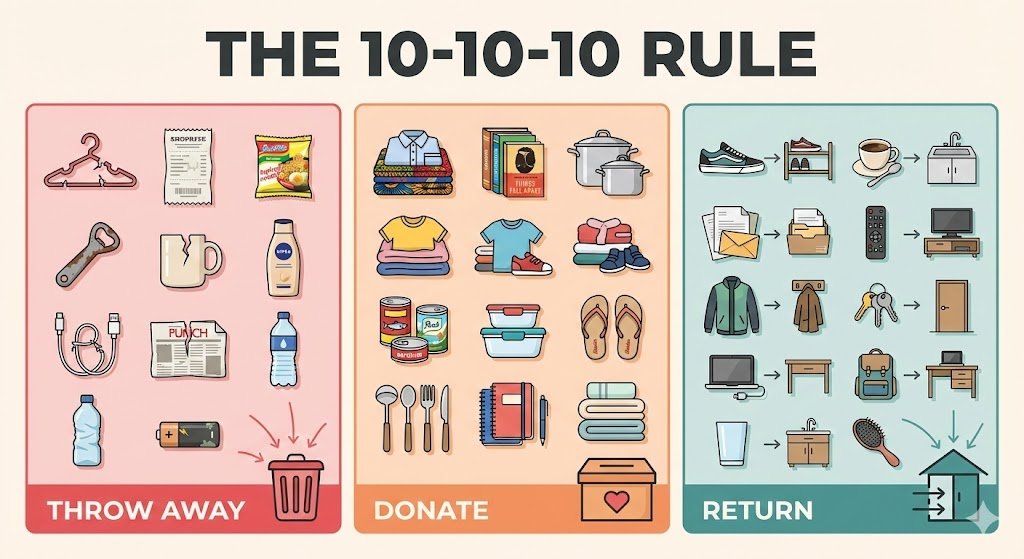
Definition: The 10-10-10 rule is a simple game where you must locate 10 items to throw away, 10 items to donate, and 10 items to return to their proper place.
Why it Works: Psychologically, this method breaks the “paralysis of analysis.” When you look at a messy room, your brain sees one giant, overwhelming task. By focusing on finding just 10 specific things, you switch your brain into “scavenger hunt” mode, which feels like a game rather than a chore. It provides an immediate dopamine hit of accomplishment.
Nigerian Application: This is perfect for getting the whole family involved. If you have kids or younger siblings helping with the move, challenge them to a “10-10-10 race.” In a typical Nigerian home, this works wonders in the “Boys’ Quarters” or the guest room, where random items often accumulate.
Example Scenario: Stand in your kitchen. Find 10 expired spice sachets (throw), 10 duplicate plastic containers (donate), and 10 mugs or spoons that wandered into the living room (return).
Pros/Cons:
- Pros: Fast, easy, and builds momentum.
- Cons: It only handles 30 items at a time, so it might be too slow for a massive hoard.
The 4 C’s of Decluttering Explained
Definition: This systematic approach divides the process into four distinct steps: Clear out the trash, Categorize similar items, Cut out the excess, and Contain what remains.
Why it Works: It provides a logical structure. Instead of picking up one shoe and wondering what to do with it, you are following a workflow. It prevents the mess from spreading because you finish one category before moving to the next.
Nigerian Application: This is the best method for tackling the dreaded “Store” or pantry found in many Nigerian flats. These rooms often become dumping grounds for bags of rice, old suitcases, and broken appliances. By clearing the floor first, you create space to work.
Example Scenario: In your wardrobe:
- Clear: Remove dry-cleaning plastic and broken hangers.
- Categorize: Put all Ankara together, all work shirts together, all jeans together.
- Cut: You have 15 white shirts but only wear 5? Donate 10.
- Contain: Fold the keepers neatly into your suitcase or box.
Pros/Cons:
- Pros: Very thorough and organized.
- Cons: It takes time and requires you to pull everything out, which can look messier before it gets better.
Understanding the 333 Rule for Decluttering
Definition: Originally a minimalist fashion challenge called “Project 333,” this rule challenges you to select only 33 items of clothing, shoes, and accessories to wear for 3 months. For moving, we adapt this to: “What 33 items do I need for my first month in the new house?”
Why it Works: It highlights excess by proving how little you actually need to function. When you are forced to pick your “top 33,” you instantly identify your favorites and realize that the other 100 items are just taking up space (Project 333).
Nigerian Application: This is tricky for Nigerians because our social lives require diverse wardrobes (church wear, work wear, wedding Aso-ebi, casual home wear). You cannot wear jeans to a traditional wedding.
- Adaptation: Create a “First Month” capsule. Pack 33 core items (work clothes, house clothes, 2 church outfits, 1 pair of everyday shoes) in your suitcase. Pack everything else in deep storage boxes.
Example Scenario: You are moving from Surulere to a temporary flat in Lekki while renovating. Instead of moving your entire wardrobe, pick 33 essential items. If you don’t miss the rest after 3 months, you know what to donate.
Pros/Cons:
- Pros: Drastically reduces decision fatigue.
- Cons: Difficult for fashion-conscious Nigerians with heavy social calendars.
What is the 20/20/20 Rule for Decluttering?
Definition: This rule states that if you can replace an item for less than $20 (approx. ₦30,000), in less than 20 minutes, from less than 20 miles away, you should let it go rather than packing it “just in case.”
Why it Works: It directly attacks the fear of scarcity. We hold onto things like old charging cables or rusted curtain hooks because we think, “What if I need this next year?” This rule uses logic to silence that fear (The Minimalists).
Nigerian Application: Warning: This requires careful adaptation in Nigeria. With inflation and traffic, replacing something isn’t always cheap or fast. A 20-minute drive in Lagos can turn into 2 hours.
- Adaptation: Only apply this to truly common items like plastic bowls, hangers, or generic nails. Do not apply this to imported electronics or specific spare parts that are hard to find in Alaba International Market.
Example Scenario: You have a box of random screws and bolts. Unless you know exactly what they fit, toss them. You can buy a new pack at the local hardware store for ₦500 if you ever need them.
Pros/Cons:
- Pros: Frees up space taken by “junk” items.
- Cons: Risky in the Nigerian economy; prices can triple overnight, making replacement painful.
The 12-12-12 Rule for Decluttering
Definition: Similar to the 10-10-10 rule but slightly more aggressive, this framework tasks you with identifying 12 items to throw away, 12 items to donate, and 12 items to return to their proper homes.
Why it Works: It scales up the decluttering effort. Processing 36 items in one session creates a visible dent in the clutter, which is highly motivating. Research on the 12-12-12 decluttering method shows it helps organize small spaces without feeling overwhelmed by tackling manageable chunks of clutter (Becoming Minimalist).
Nigerian Application: This is excellent for high-traffic communal areas like the Living Room (Parlor). In Nigerian homes, the parlor often collects shoes, school bags, prayer books, and toys. This method is quick enough to do during a commercial break while watching TV or before a Saturday morning cleaning.
Example Scenario: You stand in your living room.
- 12 to Throw: Old newspapers, sweet wrappers, broken pens, dried-up marker, old church bulletin, torn receipt…
- 12 to Donate: Old DVDs, shoes that are too tight, a decorative vase you hate, books you’ve read…
- 12 to Return: Shoes to the rack, cups to the kitchen, school bags to the bedroom…
Pros/Cons:
- Pros: Clears surface clutter very quickly (approx. 15-20 minutes).
- Cons: Can be tiring if you have a very large house; best done one room at a time.
What is the 5-7 Rule for Quick Decluttering?
For many Lagosians dealing with traffic and long work hours, finding huge blocks of time to pack is impossible. This rule is the solution: spend just 5 to 7 minutes decluttering one specific spot, like that “everything drawer” in the kitchen or your car’s glove box. It prevents the task from feeling like a burden and fits perfectly into a busy schedule.
Understanding the 1/3/5 Decluttering Rule for Busy Nigerians
If you prefer tackling things on weekends, this rule keeps you focused. The goal is to achieve one big task (like the generator house or store), three medium tasks (like sorting your Ankara fabrics or bookshelves), and five small tasks (like wiping down a mirror or sorting mail) in a single day. This structure keeps you moving without the burnout that comes from trying to do “everything at once.”
Which Framework Works Best for Nigerian Movers?
Here is the truth: Rigid rules don’t always work here. The best framework for Nigerians is a mix. Use the 10-10-10 rule for daily clearing and trust your gut on the valuable cultural items.
What to Throw Away Before Moving
Category-by-Category Disposal Guide
- Paper: Old newspapers, completed school work, manuals for appliances you no longer own.
- Kitchen: Mismatched mugs, rusted graters, expired spices. Food safety guidelines recommend discarding any opened dry goods or spices older than six months to prevent pest attraction during moves (USDA Food Safety).
- Bathroom: Dried-up nail polish, old toothbrushes, nearly empty lotion bottles.
Items That Don’t Survive Nigerian Moves Well
Some furniture, especially the cheaper particle board (MDF) wardrobes, often breaks when you take it apart. If your wardrobe is shaky, it might be better to sell it to the incoming tenant or a local carpenter rather than trying to move it to the new house.
Dealing with Sentimental Items
In Nigeria, letting go of items is often harder because of the deep cultural meaning attached to them. We struggle to discard things like family heirlooms, wedding souvenirs (which we seem to collect by the dozens every Saturday), or NYSC memorabilia like your old jungle boots or khaki jacket. We often keep these things out of respect for ancestors or because we believe “I might need this for a traditional ceremony one day.”
To handle this without guilt, adopt the “Museum Curator” approach. A curator in a museum has thousands of artifacts, but they only display the very best ones to tell a story. If they displayed everything, it would look like a pile of junk. Treat your home like a museum. You don’t need to keep every piece of Asho-ebi from every wedding you attended in 2015. Keep the one that is most beautiful or holds the fondest memory, and let the others go.
For specific items like Chieftaincy title certificates, heavy traditional beads, or fragile family photos, use digitization. Physical photos fade and can be damaged by humidity in Lagos or Port Harcourt. Scan these photos or use an app like Google PhotoScan to create high-quality digital copies. Store them in the cloud. For bulky items like old awards or trophies that are gathering dust, take a high-quality photo of them, create a digital “Memory Folder,” and then donate or discard the physical object. Experts in hoarding behaviors suggest that digitizing memories through photography satisfies the emotional need to ‘keep’ an item without the physical burden (Mayo Clinic).
Sorting through sentimental items triggers emotional responses that can derail your decluttering progress. When you feel overwhelmed by memories or difficult decisions, take breaks using quick stress relief techniques to maintain clarity and avoid burnout during the moving process.
Where to Donate or Sell in Nigeria (Comprehensive Guide)

Moving to a new apartment in Lagos, Abuja, or any Nigerian city becomes significantly easier when you declutter properly beforehand. Clearing your home isn’t just about filling up local landfills. Your pre-loved items often hold immense value for others and can serve as a vital source of income to help cover your moving expenses. I’ve found that by circulating these goods back into the community, I feel less burdened by the weight of physical clutter, which research suggests directly correlates with lower stress and cortisol levels.
Donation Centers by City
- Lagos:
- Little Saints Orphanage: With trusted locations in Palmgrove, Abule Egba, and Ogudu, they are highly reliable for donations of clean clothing, non-perishable food, and essential household items.
- The Nigerian Red Cross Society: Their main Yaba branch remains a standard destination for emergency relief items and quality linens.
- Modupe Cole Memorial Child Care: Located in Yaba, this facility supports children with special needs and consistently requires functional home goods and mobility aids.
- Abuja:
- Abuja Children’s Home (Karu): This government-run facility is a great place to drop off extra clothing, footwear, and dried pantry staples.
- City of Refuge (Durumi): They often accept larger donations like sturdy furniture pieces or mattresses that are still in decent shape.
- Port Harcourt:
- Priesthood Orphanage: A well-known organization that welcomes donations of toys, children’s clothes, and general kitchenware.
- Lifetime Caring Foundation: Based in Woji, they are appreciative of diverse household contributions to support their local outreach.
How to Sell Successfully on Jiji.ng
If your items are high-value, selling them on platforms like Jiji or Facebook Marketplace is a smart way to generate quick cash. Over the years, I have learned that the quality of your listing is the difference between a quick sale and a long wait.
- Clean It Up: Before you snap a single photo, ensure your item is spotless. A dusty generator or a stained rug looks neglected. A quick scrub can increase your asking price by a significant margin.
- Take Honest Photos: Always shoot in natural morning light. Avoid blurry shots or heavy filters. If there is a minor scratch or a missing screw, be upfront. Transparency builds the reputation you need to close deals quickly.
- Pricing Strategy: Ignore the sentimental value you attach to your items. Browse Jiji to see what others are currently asking for similar listings. If a used washing machine is listed for ₦80,000, pricing yours at ₦75,000 creates an immediate incentive for serious buyers to choose your ad over others.
- Description: Be incredibly specific. Phrases like “Working perfectly, just needs gas” are far more helpful to potential buyers than “Good condition,” which is too vague.
Safety Tips for Marketplaces
While Jiji.ng is a top-tier choice for rapid sales, you must treat your safety as the highest priority during the transaction process. I always stick to these Jiji Safety Tips to ensure that my decluttering efforts never compromise my security.
- Meet in Public: Coordinate your hand-overs at high-traffic, public locations like popular fast-food joints or bustling petrol stations. Never invite a stranger into your residence, especially if you are home alone.
- Cashless is King: Always insist on bank transfers to avoid the risk of fake currency. Wait until the alert hits your own banking app, not just the notification on the buyer’s phone, before releasing the item.
Room-by-Room Decluttering Checklist
Kitchen and Pantry Decluttering
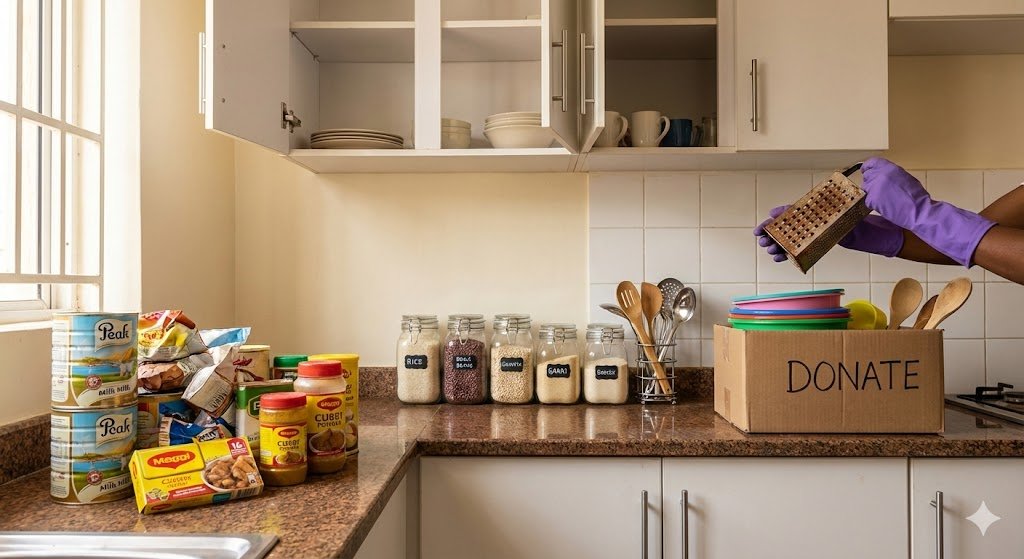
Professional organizers often suggest tackling spaces with low emotional stakes, such as kitchens or utility areas, before moving into your bedroom. Building this early momentum is vital, especially since cluttered environments have been shown to elevate cortisol levels significantly. According to the USDA Food Safety guidelines, opened dry goods or spices held for over six months should be discarded as they lose potency and safety. Moving to a new apartment in Lagos, Abuja, or any Nigerian city becomes significantly easier when you declutter properly beforehand.
Nigerian kitchens are magnets for items that accumulate over several years. Start by auditing your pantry. That stash of bouillon cubes, dried spices, and grains often harbors expired items. Check every sealed packet. If you find a bag of rice or flour that has been open for months, it might already be compromised. Those Peak Milk tins or beverage containers? If they show signs of swelling or are past their expiration date, dispose of them rather than moving them. Clearing this space creates less weight for your movers and, per data from MoveMe.com.ng, keeps your relocation quote from inflating due to excess volume.
Evaluate your kitchen utensils with a ruthless eye. How many wooden stirring spoons do you genuinely use? Most home cooks have a singular favorite, yet we hold onto a dozen redundant ones. Keep your most reliable tools and gift the excess to a friend or someone moving into their first apartment. When looking at your cooking pots, consider the frequency of use. If you have five different sizes but consistently rely on the same two pots for your daily stew or jollof, determine if those other three are truly pulling their weight. Heavy aluminum pots add substantial weight to your moving cartons.
Appliances demand the most logical approach. That blender with the faulty motor from a 2024 power surge? Do not pack it. Moving broken electronics only clutters your new kitchen shelf. In markets like Ikeja Computer Village or Alaba, you can source replacements easily for ₦12,000 to ₦20,000. Packing “fix-me-later” items almost never results in a successful repair. After purging your kitchen, you will want to set up your new space with intention. Explore these practical strategies for organizing your Nigerian kitchen efficiently so you can prepare meals comfortably the moment you arrive.
What is the Hardest Room to Pack When Moving (Bedroom Solutions)

The bedroom remains the most difficult room to pack, especially when dealing with hidden storage like under-bed compartments or the dark corners of a wardrobe. Unlike the kitchen, which follows strict utility rules, the bedroom contains items tied to our identity and memories. In the typical Nigerian household, the bedroom acts as a vault for “Ghana-must-go” bags containing fabrics from years ago, shoes that have suffered from the humid climate, and tech gadgets we intend to fix but never do. Research shows that proper packing by professionals, such as Worldwide Movers Africa, can reduce potential damage to these delicate items by as much as 80 percent, but you must only pack what is worth keeping.
For those managing a remote workspace, the bedroom-office hybrid needs specific attention. Moving is the perfect catalyst for rethinking your ergonomics. Once you are settled in your new location, it is beneficial to look at how to set up a home office in a bedroom to ensure your workspace remains a zone of productivity rather than a place where clutter goes to grow.
We often struggle to let go of high-value traditional attire. You might have layers of expensive Aso-ebi lace that cost ₦70,000 per set, old Gele headgear, and vintage accessories. Because these items feel like capital investments, we hesitate to discard them, even if the fabric has yellowed or the leather has degraded due to heat. I have found that the best approach is to treat the bedroom like an archaeological site. Do not try to pack the entire room in one afternoon. Work in categories. Focus on “dead storage” like the top of the wardrobe or beneath the bed first. If you have not touched an item in two years, it is time for that item to stay behind.
Living Room and Entertainment Items
The parlor is the showcase of your home, but it often conceals piles of outdated media and paper. Consider your collection of DVDs and VCDs. With streaming services like Netflix and YouTube being so accessible today, physical discs are often just taking up space. Unless they hold deep sentimental value, consider donating them. The same applies to obsolete decoders or ancient satellite receivers that have been replaced by newer versions. If they do not work with your current service provider, let them go.
Address the “paper mountain” found on coffee tables and consoles. Old newspapers and magazines pile up silently. While staying informed is vital, back issues from 2024 are merely clutter. Use these old papers to wrap fragile items like glassware or ceramic bowls, then recycle the rest. When dealing with large furniture like a center rug or a heavy glass-top dining table, check your new floor plan first. A massive furniture piece can make a smaller apartment feel suffocating. If the dimensions do not work, selling it now is better than paying for it to be moved twice.
Moving into a smaller flat or a self-contained unit requires extreme intentionality. Every square meter of space has a cost. Once you reach your destination, you can optimize your limited footprint by following my tips on how to decorate a one-room apartment in Nigeria to ensure it feels expansive and functional.
Bathroom and Personal Care Products
Bathrooms are often small in Nigeria, yet we cram them with half-used lotions, expired soaps, and dated toiletries. Before you move, empty your cabinets. Check expiration dates on medications and sunscreens. If you have several nearly empty bottles of shampoo or lotion, combine them or finish them off before the move. Packing half-empty bottles is a recipe for leaks during transit.
Examine your linens closely. If your towels have become frayed, stained, or thin, do not waste space packing them. Instead, keep two or three of the most worn-out towels to serve as cleaning rags during your move. Use them to wipe down dusty furniture or scrub the bathroom floors in your new apartment before moving in your boxes. After you are done cleaning, you can discard them, which saves you from hauling unnecessary laundry.
Wardrobe and Clothing Decisions
Clothing is deeply personal. In Nigeria, we manage complex wardrobes filled with heavy, structured traditional outfits. The “pile everything on the bed” method works wonders here. By seeing the total volume of your clothes, you realize what is truly necessary. If a dress or shirt has not been worn since a wedding in 2020, and the fit or style no longer aligns with your life, it is time to donate it. Don’t let guilt over the original price of the garment keep you anchored to items you no longer enjoy.
Be honest about your body and your goals. Many people keep a full wardrobe of clothing that no longer fits, hoping to lose weight. Keep a singular, favorite outfit for motivation, but let go of the rest. Our climate is tough on textiles. If a favorite shirt has yellowed pits or a frayed collar from humidity, accept that its lifespan is over. Your new space deserves a refreshed wardrobe that reflects your current style, not a collection of clothes you feel obligated to store.
Documents, Papers, and Important Records
Paperwork is heavy and critical. In Nigeria, physical documentation remains essential for many official tasks. I suggest using a dedicated, waterproof, and fire-resistant folder for your “Vital Records.” This should contain your birth certificates, international passport, academic credentials, and current tenancy agreements. Do not entrust this folder to the moving company or the back of a van. Keep it in your personal bag at all times. Use this time to update your records, such as your NIN, BVN, or voter’s card, if your move involves a change in state or jurisdiction.
For secondary paperwork, such as utility bills from years ago or manuals for long-broken appliances, shred them. There is no reason to hold onto a 2019 NEPA bill. Keep only the last three to six months of vital utility records. If you are worried about losing information, consider digitizing these documents using a scanner or a smartphone app. This saves physical space and ensures you always have a backup.
Outdoor and Balcony Items
The outdoor area or generator house is often neglected until the last minute, leading to a messy move. If you maintain a balcony with dusty plastic furniture, give it a thorough scrub before packing. Inspect your generator housing for hidden clutter like old oil containers, greasy rags, or rusted spare parts, which can present fire hazards. Once in your new residence, look into organizing your generator room properly to keep your outdoor area orderly. Wipe down the generator unit completely so you do not transfer grime onto your other belongings or the movers’ equipment.
Identify “dead” outdoor equipment. That chair with the cracked leg that poses a safety risk? Leave it behind. A leaky mop bucket? Dispose of it. Since outdoor gear collects harmattan dust and environmental soot, take the time to clean what you keep. You want your new balcony to be a clean, welcoming space. Starting fresh in a new home means letting go of the accumulated dirt and clutter from the previous one, and a clean, organized move sets the tone for your life in your new location.
What to Organize Before Moving
Moving to a new apartment in Lagos, Abuja, or any Nigerian city becomes significantly easier when you declutter properly beforehand. Organization serves as the primary bridge between a chaotic, high-stress transition and a smooth, efficient relocation. It is not just about moving boxes; it is about synchronizing your physical goods, essential services, critical digital data, and access permissions into a unified, actionable plan.
Creating Your Moving Inventory
While I used to rely solely on a notebook, you can now combine that with digital tools for better tracking. A simple physical notebook still works wonders, but keeping a digital backup in a note-taking app like Notion or Google Keep ensures you never lose track of your inventory. Write down the contents of every container: “Box 1: Kitchen – Plates.” For high-value assets such as flat-screen televisions, large generators, or solar inverters, document the Serial Number and take a clear photo of the device. If a police officer or a local task force stops your moving truck at a checkpoint, which is a common occurrence on Nigerian highways, having this documented list and visual evidence proves you are the legitimate owner rather than a suspected thief. Research from Worldwide Movers Africa suggests that taking the time to properly catalog and pack items reduces damage rates during transit by up to 80 percent.
Labeling System for Nigerian Moves
Purchase a high-quality, thick permanent marker. Write the specific room name or box destination on the side of the box, never just the top. When the moving crew stacks your boxes three or four levels high in the back of a truck, the top labels become completely invisible. Marking the sides ensures that even when the boxes are stacked, you or the movers can easily identify exactly where each item belongs.
- Tip: Utilize colored stickers or heavy-duty painter’s tape. Assign red for the kitchen, blue for the bedroom, and green for common areas. Give your movers clear, simple instructions: “All red boxes must go directly into the kitchen area with the window.” This strategy bridges potential language gaps if the moving crew is not fluent in your primary language, preventing confusion at the drop-off point.
Essential Documents Organization
Keep your “Important Documents” folder in your personal carry-on bag at all times. This file must house your original Tenancy Agreement, the Receipt of Payment for the new apartment, and the Gate Pass or Move-In Permit required for entry into your new estate. You absolutely do not want to reach your new residence after a long, tiring trip only to be denied entry by security because your documentation is buried deep inside a sealed carton at the bottom of the truck.
Coordinating Service Providers
Navigating the Nigerian service sector requires proactive coordination to ensure your transition is not stalled by logistical failures.
- Fumigation: Always fumigate your new space before moving your belongings in. Pests are frequently left behind by previous tenants. Book a professional service to clear the premises at least three days before your move-in date.
- Deep Cleaning: Do not rely on the assumption that the landlord or agent has cleaned the apartment to your standards. Hire a professional cleaning service to scrub the floors, bathrooms, and kitchen cupboards 48 hours before you arrive with your load.
- AC Technicians: If you are relocating split-unit air conditioners, hire a certified technician to uninstall them properly. They must “trap the gas” in the compressor, which prevents you from wasting funds on expensive refrigerant refills at the new house.
- Utility Pre-payment (PHCN): Ensure your prepaid meter token is loaded at the new house before you arrive. Spending your first night in total darkness because the credit ran out is a stressor you can easily avoid with a little foresight.
Updating Your Digital Life
Modern relocation extends to your digital profile. Update your contact information across all critical platforms to ensure mail and services follow you to your new neighborhood.
- Banking Institutions: Visit your local bank branch or update your profile via your banking app (GTBank, Zenith, Access, etc.). Keeping your residential address current is vital for the delivery of new debit cards and official correspondence. You should also ensure your BVN and NIN information is reflected accurately if you have relocated to a different state.
- e-Commerce Platforms: Log into your Jumia, Konga, or food delivery apps immediately. Delete outdated addresses to prevent future orders from being dispatched to your former apartment.
- Utilities and Internet: If you subscribe to providers like FiberOne or Starlink, notify them of your move well in advance. Installation queues in many Nigerian estates are often lengthy, and you do not want to be without connectivity for weeks.
Moving Checklist and Timeline
Creating Your Moving Timeline Gantt Chart
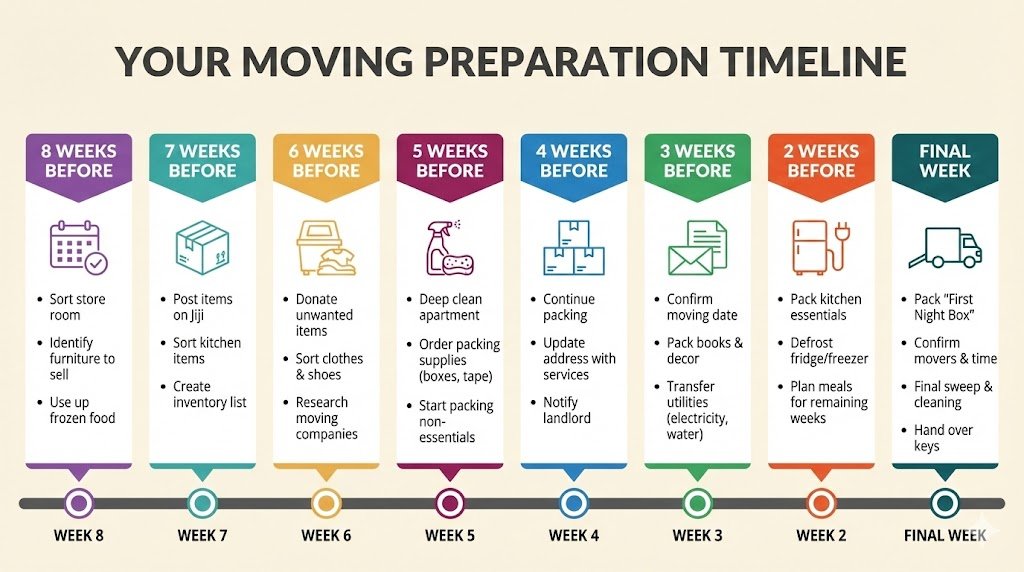
A Gantt chart serves as the visual roadmap for your move. You do not need expensive project management software to achieve this. Grab a large sheet of cardboard or a notebook and draw a grid covering the eight weeks leading up to your move. Assign specific tasks to each week. For example, dedicate Week 1 to the store room, and Week 2 to selling your furniture. This method, borrowed from large-scale project management, helps you identify task overlaps, ensuring you never face a massive, unmanageable workload during your final week. For Nigerians managing full-time careers while prepping for a move, this structured chart is essential. It helps you schedule help from friends, pin down your moving company’s availability, and process necessary gate pass documentation long before the pressure sets in.
8 Weeks Before Moving
- Strategically deplete the food items in your freezer.
- Catalog all furniture you intend to sell.
- Begin the systematic purge of your store room or guest bedroom.
- If you are juggling a side business alongside your professional career, these time management strategies for busy Nigerians will help you find dedicated hours for decluttering without jeopardizing your income.
4 Weeks Before Moving
- List furniture and household items for sale on Jiji.
- Start packing non-essential items, such as books, off-season clothing, and decorative pieces.
- Procure packing materials, including large heavy-duty sacks and double-walled cartons.
2 Weeks Before Moving
- Donate all unsold items to local orphanages or religious organizations.
- Complete the packing of your kitchen, keeping only basic utensils for final meals.
- Confirm your moving date and finalize the contract with your chosen logistics company.
Final Week Checklist
- Prepare your “First Night Box” containing bedding, toiletries, phone chargers, and a change of clothes to avoid digging through boxes upon arrival.
- Complete all pending laundry so you pack clean clothes.
- Fully defrost and empty your refrigerator.
Moving Day Organization
- Rise early to ensure you are ready before the truck arrives.
- Keep sufficient cash on hand for incidentals or tips.
- Perform a thorough final sweep of every empty room. Do not forget to check inside closets, behind doors, and in the storage areas.
Common Nigerian Moving Mistakes to Avoid
Even with an ironclad plan, reality can intrude. Avoiding common pitfalls will ensure you reach your new home without losing your nerves.
1. Waiting Until the Last Minute During Peak Season
In Nigeria, the annual rental cycle often concludes in December. Consequently, late December and early January represent the highest demand period for moving trucks. If you wait until one week before your move to book a truck, you will likely pay a premium rate or find no available transport at all. Secure your moving service at least three weeks before your target date during these months.
2. Not Accounting for Regional Traffic Patterns
If you are relocating across a city like Lagos or Abuja, congestion is an expensive reality. When I helped a family member move across Lagos in 2024, we overlooked the impact of peak-hour traffic. We booked a truck for 8 AM, but the driver struggled through gridlock until well past noon, effectively doubling our costs and physical strain. My advice is to target a 6 AM departure or wait until after 10 AM to avoid the worst of the commuter surge.
3. Failing to Negotiate Moving Prices
Never accept the initial quote without negotiation. In the local market, pricing is often flexible. I learned a difficult lesson in Port Harcourt when a driver agreed to a low price but refused to carry items up to my third-floor flat without significant additional “settlement.” Always ask explicitly: “Does this quote cover full loading, offloading, and climbing the stairs?” Lock in the total final price before any item is lifted.
4. Ignoring Estate Gate Pass Requirements
Secure estates in major cities strictly regulate exit procedures. Most require a signed “Gate Pass” or “Exit Permit” to allow a moving truck to leave the premises. Attempting to move on a weekend without this signed document will inevitably result in being turned back by security. Secure your paperwork at least 48 hours in advance to guarantee a smooth exit.
5. Not Weatherproofing Your Load
During the rainy season, from May to September, do not trust a sunny morning. A sudden, intense downpour can ruin your mattress and upholstered furniture in minutes. During my own relocation from Abuja to Lagos, I opted for an open-back truck that had compromised tarps. A rainstorm near Lokoja soaked my belongings, forcing me to spend several nights on a damp mattress. Insist on a closed-body truck or ensure your belongings are wrapped in heavy-duty, waterproof plastic sheeting.
Nigerian-Specific Moving Considerations
Dealing with Harmattan and Rainy Season Moves
Climate data confirms that Nigeria experiences distinct weather patterns that affect logistics. The rainy season, peaking between May and September in coastal cities like Lagos, requires careful protection from moisture. Conversely, the Harmattan season introduces heavy dust, which can settle inside your belongings. Wipe down furniture thoroughly before packing it. If you do not, you will inevitably transport layers of dust into your brand-new home. Always seal your boxes with high-quality packing tape to block out environmental elements.
Working with Nigerian Moving Companies

Professional movers in Nigeria are generally diligent, but maintaining clear supervision over the process is vital.
- Price Transparency: As noted earlier, confirm that your fee includes full labor for loading and offloading. Clarify these expectations before work begins to avoid unpleasant surprises at your destination.
- Hospitality: Providing water and light snacks for the loading team is a common gesture of goodwill in Nigeria. It fosters a cooperative atmosphere and frequently leads to the crew handling your fragile items with much greater care.
Final Apartment Cleaning Requirements
In most Nigerian rental agreements, it is expected that you leave your vacated apartment in a “broom clean” state. According to protocols emphasized by agencies like the Lagos Waste Management Authority (LAWMA), responsible waste management is essential for environmental health. Always bag all debris and coordinate with your estate’s waste management team to ensure a clean departure.
Once you are settled, maintaining a clean home becomes much easier when you use sustainable, small-batch habits. For busy professionals, I highly recommend learning how to keep a house clean with a busy schedule to ensure your new living environment stays a comfortable, organized sanctuary.
Measuring Your Decluttering Success
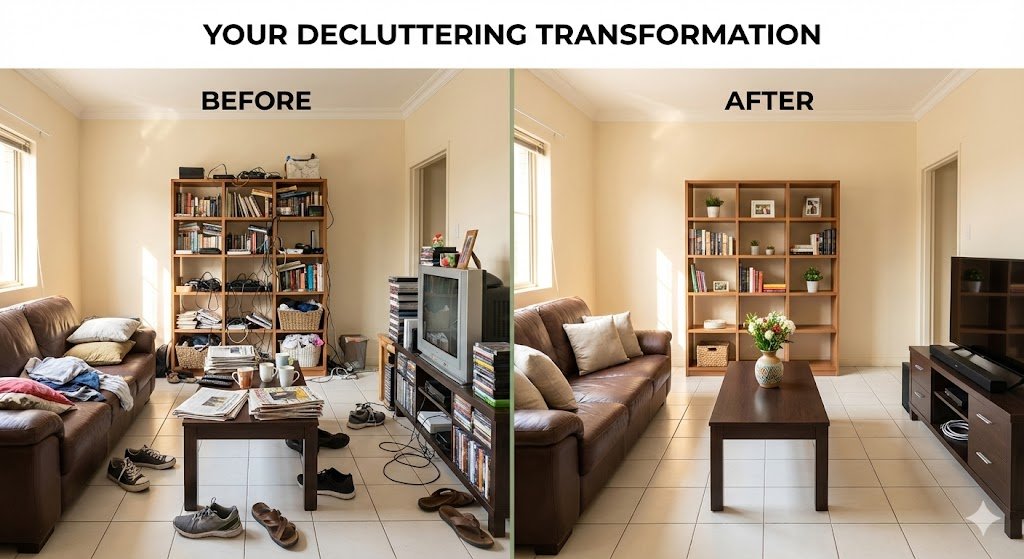
How do you identify when your decluttering work is complete? It is not merely about clearing a room; it is about the palpable shift in the space’s energy. You know you have succeeded when you can open a storage drawer and see the bottom, or when your closet allows airflow between your garments. In Nigerian homes, a clear sign of success is noticing a slight echo in your rooms, indicating that you have successfully removed the “soft clutter” of unused items that usually absorb sound.
You can also track your success through simple logistics. For every 10 large boxes you purge, you effectively save thousands of Naira in transport fees and storage rental. Eliminating 50 redundant items can save you from hiring extra hands or renting a larger, more expensive truck. This is not just cleaning; it is a financial strategy.
Most importantly, evaluate your psychological state. The true reward of a thorough decluttering session is the confidence that follows. When you understand exactly what you own and where it is located, you lose the anxiety that typically accompanies a move. If you can move into your new living room without feeling the immediate, nagging urge to reorganize a pile of junk, you have truly mastered the process.
Once you are moved into your fresh, decluttered environment, establishing new daily habits becomes far easier without the distraction of unnecessary possessions. A clean slate provides the perfect opportunity to implement morning routine mastery, which helps you set a productive, intentional, and calm tone for every day in your new residence.
Frequently Asked Questions About Nigerian Moving
Can I declutter my apartment in one weekend? It depends entirely on the size of your space. If you reside in a self-contain or a compact mini-flat, a focused weekend is sufficient. However, for a 2-bedroom or 3-bedroom flat often occupied by families in cities like Lagos or Abuja, trying to finish in 48 hours is unrealistic and invites burnout. Be honest with your schedule. If you have a family, plan for at least two weekends or dedicate consistent evenings over a two-week period. Research shows that cluttered environments correlate with higher cortisol levels, so taking the time to purge is actually a health investment.
What if my landlord wants to buy my furniture? This is a standard occurrence in the Nigerian rental market, particularly for bulky items like wardrobes, fitted kitchen cabinets, or split AC units that are difficult to transport. It is an excellent strategy to lower your moving load. However, get the agreement in writing and finalize the price before the relocation team arrives. I suggest requesting payment via bank transfer for clear record-keeping. Do not accept a vague verbal promise to deduct costs from future utility bills unless you trust the landlord entirely.
Should I pack my generator? Absolutely, provided you prioritize safety. You must drain all petrol or diesel and empty the engine oil before loading it onto the truck. Moving a generator containing fuel is a severe fire risk, and reputable moving companies like those cited by MoveMe.com.ng will often refuse to transport it if it remains filled. Additionally, remember to disconnect the battery if it is a key-start unit.
How do I handle “dash” for the movers? In Nigeria, small tips are customary for service providers. While not mandatory, it is standard practice to set aside ₦2,000 to ₦5,000 per worker, depending on the intensity of the work, such as moving a heavy fridge up several flights of stairs. I usually provide water and a simple meal during the move to keep their energy levels stable, followed by a cash tip at the end for careful handling of my property.
Conclusion: Embrace Your Fresh Start
Moving to a new apartment in Lagos, Abuja, or any Nigerian city becomes significantly easier when you declutter properly beforehand. Managing a move in Nigeria is no small feat. Between securing a reliable truck, navigating unpredictable traffic patterns, and settling into a new neighborhood, the process tests your endurance. By following these steps and purging before you pack, you reclaim control of the situation. You are not simply hauling boxes; you are carefully selecting what accompanies you into your next chapter.
Consider that every item you donate or sell helps fund your transition. Every box you eliminate reduces your transport costs, as move pricing is often determined by total volume. According to data from Worldwide Movers Africa, proper packing and preparation can reduce damage rates by up to 80 percent. Beyond the logistics, arriving at your new residence without the burden of unused items allows you to establish a peaceful sanctuary. Instead of fighting through stacks of boxes, maintain a ‘First Night Box’ with your essentials. Use your old towels as cleaning rags before you finally dispose of them to save money on supplies.
Take this opportunity to digitize your old photos and important documents, clearing physical space while protecting your history. Do not forget to start your change of address notifications for critical platforms like your NIN, BVN, and Voter’s Card. Whether you are moving to a spacious duplex or downsizing to a modern flat, keep your focus on creating a home, not a storage unit. Start small, apply the 10-10-10 rule, and keep moving forward. You have the skills to pull this off!
Disclaimer: This guide is provided for educational purposes. Every moving situation is unique, so rely on your personal judgment. Good luck with your successful relocation!
Room-by-Room Decluttering Checklist
Kitchen and Pantry Decluttering
Professional organizers recommend starting decluttering in spaces with minimal emotional attachment, such as kitchens and laundries, saving sentimental areas for later when you’ve built confidence with easier decisions (Becoming Minimalist).
Nigerian kitchens accumulate items at an alarming rate, especially if you cook regularly. Start with your food storage, that collection of Maggi, curry powder, and dried ingredients probably includes items you bought years ago. Check every container. Expired spices lose potency and aren’t worth moving. Your stockpile of Peak Milk tins? If they’re bulging or past date, toss them.
Utensils present another challenge. How many wooden spoons do you actually use? Most Nigerian cooks have a favorite they reach for repeatedly while others gather dust. Keep your best three, donate the rest to a neighbor who just moved in. That collection of cooking pots, if you have six different pot sizes but only use the same two repeatedly, consider whether you need all six in your new kitchen.
Appliances require tough decisions. That blender that stopped working after last year’s voltage surge? Don’t waste box space on broken items hoping you’ll “fix it later.” In Lagos, you can replace a basic blender at Ikeja Computer Village for ₦8,000-₦15,000. It’s not worth hauling a broken one across the city. After decluttering your kitchen items, you’ll want to set up your new space properly. Learn practical strategies for organizing your Nigerian kitchen efficiently to maximize your cooking space from day one.
What is the Hardest Room to Pack When Moving (Bedroom Solutions)
The hardest room to pack when moving is undoubtedly the bedroom, specifically the hidden storage areas like under the bed, top of the wardrobe, and the attached “store.” Unlike the kitchen, where items have obvious keep-or-discard decisions, bedrooms contain emotionally charged belongings that require difficult choices. In the typical Nigerian apartment, the bedroom is not just for sleeping; it is a vault. We store “Ghana-must-go” bags filled with dry cleaning from two years ago, boxes of shoes that have succumbed to humidity, and old electronics we promise to fix at Alaba market but never do.
If you work from home, decluttering your office supplies and tech equipment requires special attention. Moving presents an ideal time to rethink your workspace setup. After settling into your new apartment, learn how to set up a home office in a bedroom that maximizes productivity even in limited space.
The challenge is compounded by our cultural tendency to hold onto high-value fabrics and accessories. You likely have layers of expensive Aso-ebi lace that cost ₦50,000 a yard, old Gele headgears, and shoes stored in bags under the bed. Because these items were expensive, we feel guilty throwing them away, even if the lace is faded or the shoe leather has peeled in the heat.
The most practical solution is to treat the bedroom like an archeological dig. Do not attempt to pack “the bedroom” all at once. Break it down by category. Start with the “dead storage”, the top of the wardrobe and under the bed. Pull everything out into the center of the room. If an item has been in a suitcase under your bed for two years and you haven’t missed it, do not transfer it to your new home. Tackle clothes next, and leave sentimental items (photos, letters) for last, so they don’t derail your momentum.
Living Room and Entertainment Items
The living room, or “parlor,” is the face of your home, but it often hides deep clutter. Look critically at your media collection. In the age of Netflix and YouTube, do you really need that stack of 50 dusty DVDs or VCDs? Be honest with yourself. If you haven’t watched them since 2018, donate them to a library or someone who might appreciate them. The same goes for old decoders, if you have switched from GOTV to DSTV, or if you have old Startimes hardware sitting around, it’s time to let it go.
Don’t ignore the “paper mountain” on your coffee table or shelf. Old newspapers like The Punch or The Guardian pile up quickly. While it’s good to be informed, news from six months ago is just recycling. Keep one or two purely for wrapping fragile items like glasses, and recycle the rest. Finally, check your decorative items. That giant center rug or heavy glass table might not fit into the layout of your new, potentially smaller apartment. Measure your new space before you pay movers to drag heavy furniture across town.
For those moving into smaller spaces like self-contains, decluttering becomes even more critical. Limited square footage demands intentional choices about what makes the move. Once settled, you can transform your compact space by learning how to decorate a one-room apartment in Nigeria on any budget.
Bathroom and Personal Care Products
Bathrooms in Nigeria are often small, yet we pack them full of half-used bottles. Start by emptying your medicine cabinet and shelves. Check the expiration dates on everything, medications, sunscreens, and creams expire and lose effectiveness. If you have three different bottles of lotion that are all nearly empty, combine them if they are the same, or use them up quickly before moving day. Don’t pack trash.
Turn a critical eye to your linens. Towels that are frayed, stained, or thin make excellent cleaning rags for the move itself. Set aside two or three of the worst ones to use for wiping down dusty furniture or cleaning the floors of your new place before you unpack. The rest of the worn-out towels should be discarded. Keep only the fresh, fluffy towels that you actually enjoy using. This instantly reduces the volume of linens you need to box up.
Wardrobe and Clothing Decisions
This is often the most emotional part of the process because our clothes are tied to our identity. In Nigeria, we have specific challenges like heavy Aso-ebi laces and bulky traditional wears. Start by putting all your clothes on the bed. Seeing the mountain of fabric is shocking but necessary. Pick up each item. If you haven’t worn that dress since your cousin’s wedding in 2019, and it doesn’t fit your style anymore, why are you paying to move it?
Be realistic about size. Many of us hold onto “goal clothes” for when we lose weight. Keep one favorite item as motivation if you must, but don’t move an entire wardrobe that doesn’t fit your current body. Check the condition of your everyday wear, too. Lagos water and humidity can be harsh on fabrics. If a shirt has permanent yellow stains under the arms or if the collar is frayed, turn it into a rag or throw it away. Your new home deserves a wardrobe that makes you feel confident, not cluttered.
Documents, Papers, and Important Records
Paperwork is dangerous because it is heavy and easy to lose. In Nigeria, hard copies are still king for many official transactions. Create a designated “Vital Documents” plastic file folder or a waterproof bag. This should hold your birth certificates, international passport, academic credentials, and most importantly, your new tenancy agreement and payment receipts. Do not pack this folder in a box. Keep it in your personal bag or backpack that stays with you in the car or Uber.
For the rest of the paper, old utility bills from three years ago, manuals for irons you broke in 2020, and random flyers, shred or recycle them. You do not need to keep a NEPA bill from 2018 to prove you paid it. Keep the last 3-6 months of utility records if you want to be safe, but everything older is just dead weight.
Outdoor and Balcony Items (for Nigerian apartments with these)
If you have a balcony or a “generator house,” this is likely the dirtiest part of your move. If you have a balcony with a generator or dusty plastic chairs, clean them off. Check your generator cage, sometimes it collects oil cans and rags that are a fire hazard. After moving, set up your generator space correctly by organizing your generator room properly to prevent clutter accumulation. Dispose of empty oil cans properly and throw away the greasy rags. Wipe down the generator itself so you don’t transfer black grease onto the movers’ uniforms or your other belongings.
Check for “dead” outdoor items. That plastic chair with the cracked leg that pinches anyone who sits on it? Don’t move it. The mop bucket with the leak? Leave it behind. Dust off any items you plan to keep, like drying racks or shoe stands, because they have likely been collecting harmattan dust or soot from the street. You want your new balcony to be a fresh start, not a transfer of old dirt.
Common Nigerian Moving Mistakes to Avoid
Even with a plan, things can go wrong if you ignore local realities. Avoid these common pitfalls to keep your sanity intact.
1. Waiting Until the Last Minute During Peak Season
In Nigeria, rent often runs annually from January to December. This means late December and early January are the absolute peak times for moving. If you wait until a week before your move to book a truck, you will pay double the price, if you can find one at all. Book your movers at least three weeks in advance during this season.
2. Not Accounting for Lagos Traffic
If you are moving from the Mainland to the Island (or vice versa), “African time” will cost you money. When I helped my sister move from Surulere to Ajah in 2024, we learned the hard way that timing matters. We scheduled movers for 8 AM on a Friday, not accounting for Lagos rush hour traffic. The truck didn’t arrive until 11:30 AM, costing us half the day. That experience taught me that for Lagos moves, either go very early (6 AM) or wait until after 10 AM when traffic eases.
3. Failing to Negotiate Moving Prices
Never accept the first price a mover gives you. In the Nigerian market, negotiation is expected. I remember when I moved within Port Harcourt; I negotiated a great “truck price” with the driver, thinking I had scored a deal. But when we arrived at the new house, he refused to offload until I “settled” his three assistants. I hadn’t budgeted for that extra ₦15,000 cash. Now, I always ask upfront: “Does this price cover the boys carrying the load up the stairs?” Agree on a fixed final price before they touch a single box.
4. Ignoring Compound Gate Pass Requirements
This is the most frustrating mistake because it is completely avoidable. Most secure estates in Abuja and Lagos require a signed “Gate Pass” or “Exit Permit” before a truck can leave the premises. If you try to leave on a Sunday without this paper, the security guards will turn you back, and the estate manager might not be in the office to sign it. Sort this out 48 hours before moving day.
5. Not Weatherproofing During Rainy Season
If you are moving between May and September, do not trust the morning sun. The weather can change in minutes. During my own move from Abuja to Lagos in July, I thought I could save money with an open-back truck. Big mistake. A sudden downpour near Lokoja soaked my mattress because the driver’s tarp had holes. I spent the first three nights in my new apartment sleeping on a damp mattress on the floor. Always insist on a closed-body truck or heavy-duty waterproof tarps.
Common Nigerian Moving Mistakes to Avoid
1. Waiting Until the Last Minute During Peak Season
2. Not Accounting for Lagos Traffic
3. Failing to Negotiate Moving Prices
4. Ignoring Compound Gate Pass Requirements
5. Not Weatherproofing During Rainy Season

Oladepo Babatunde (Prince Babatee Tunde) is a Computer Scientist, researcher, and professional content writer with a Higher National Diploma in Computer Science from Kwara State Polytechnic, Nigeria.
With a background in technology and a passion for clear communication, Babatunde specializes in creating thoroughly researched, reader-focused content on productivity, personal development, home living, and technology. Every article he writes is backed by extensive research and fact-checking to ensure readers receive accurate, actionable information.
As a freelance writer, he has helped brands and publications deliver content that educates, engages, and empowers their audiences. His mission at Vibena is simple: make complex topics easy to understand and help Nigerians live smarter, more productive lives.