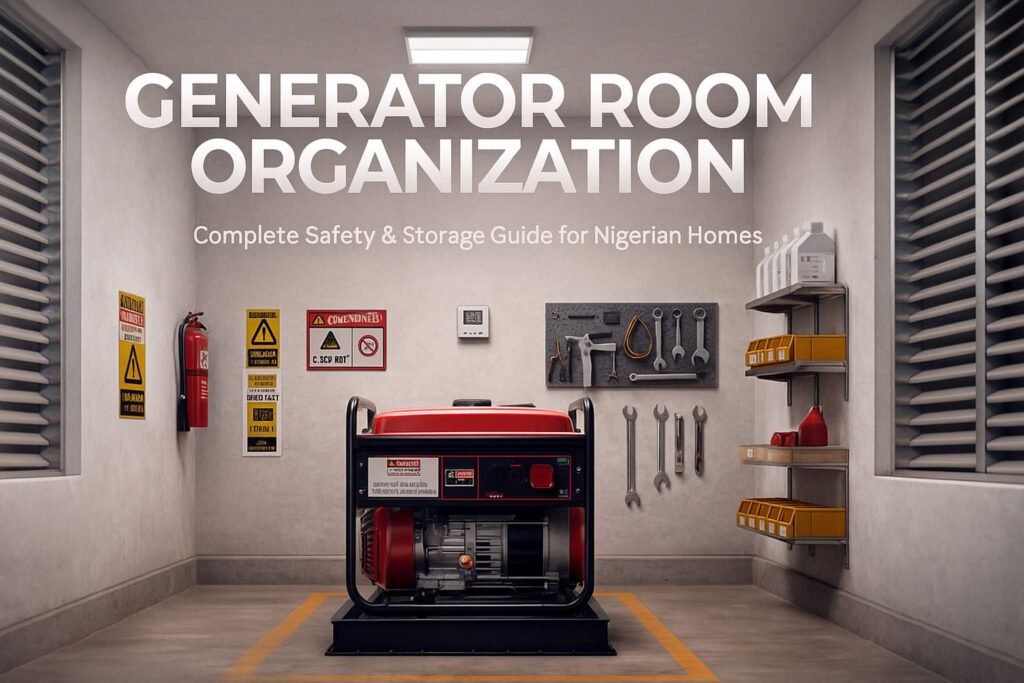
If you’re tired of your generator giving you trouble, whether it is constant overheating, causing noise disputes with neighbors, or leaving your compound smelling like diesel, it is time to reorganize that space properly. You know how during PHCN power fluctuations, your generator often becomes more valuable than your landlord. That is exactly why generator room organization is a vital part of managing a home in Nigeria.
one-bedroom apartment design considerations
With most Nigerian homes relying on generators for electricity in 2026, a well-organized generator setup, combined with strict safety measures and organized storage, can prevent fires, carbon monoxide poisoning, and equipment damage worth millions of Naira. Proper generator setup is crucial for every Nigerian homeowner who depends on backup power during frequent outages. Learning how to stay focused during power outages becomes easier when your generator system is managed efficiently and maintained with a schedule. This guide covers everything you need to know, from navigating local building permit requirements to choosing the right KVA capacity for your 3-bedroom house in Lagos or Abuja.
What Are the Requirements for a Generator Room?
Before you begin constructing or reorganizing your setup, you must understand the basic technical requirements. A generator room is not merely a shed. It is a specialized technical space that must be engineered to handle intense heat, noise pollution, and hazardous exhaust fumes.
Space Requirements and Clearances
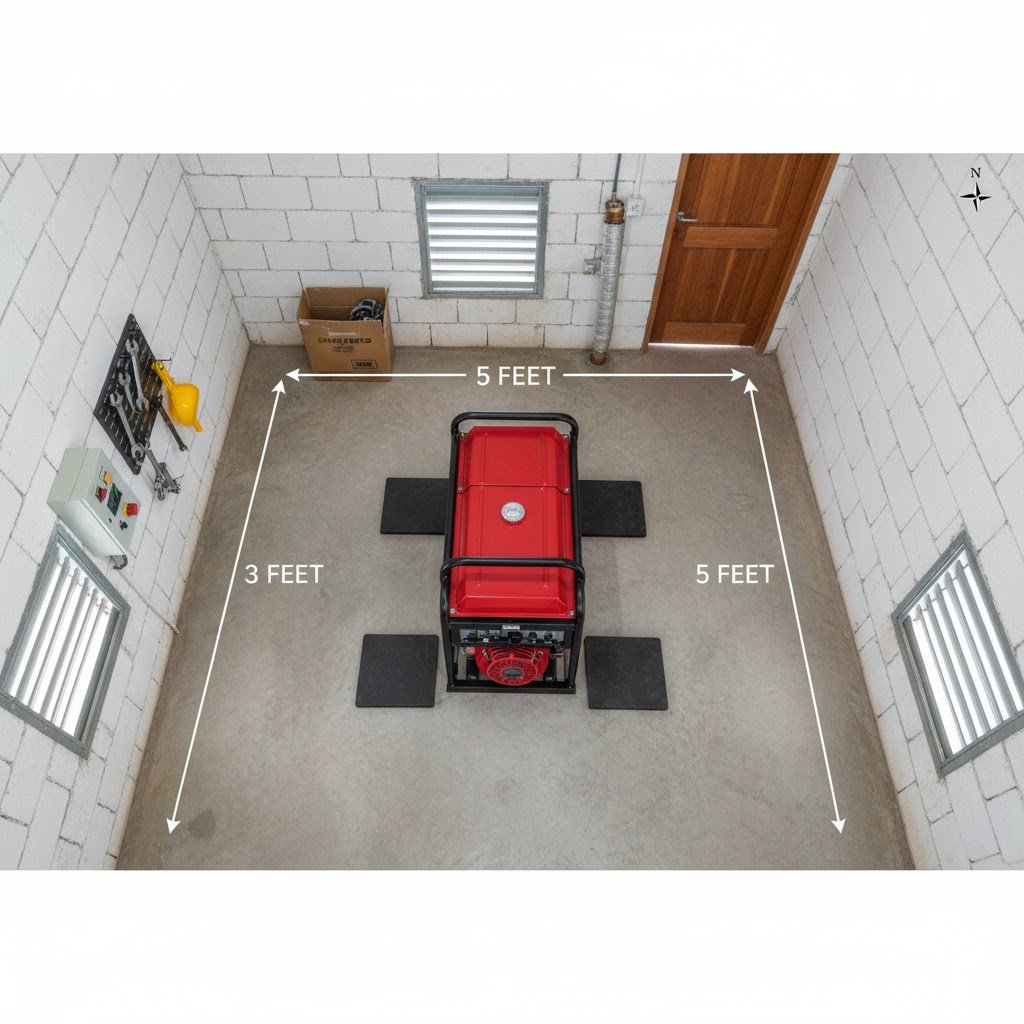
Space is the absolute first factor to consider. You cannot simply squeeze a generator into a cramped corner and hope for the best. According to NFPA 110, the internationally recognized standard for emergency power systems, indoor generator rooms require 2-hour fire-rated enclosures for Level 1 installations. I’ve found that ignoring these clearances leads to premature engine failure.
For Nigerian homes, especially if you are using a diesel generator, you need enough physical space to walk completely around the machine for routine maintenance. If a technician arrives to change your oil or filters, they need room to work without brushing against hot, exposed metal. NFPA 37 specifically calls for five feet (1.5 meters) of clearance from all combustible walls to minimize fire risk.
Building Walls That Won’t Burn
Your generator room must be capable of containing a fire if one sparks. This is what safety engineers call “fire-rated construction.”
- Walls: These should be constructed from solid concrete or blocks that are certified to resist fire for at least 2 hours.
- Roofing: Use non-flammable materials like aluminum sheets. Avoid wood frames or ceilings anywhere near the unit.
- Floor: A high-grade concrete slab is best because it does not absorb fuel spills and is easy to clean with a degreaser.
Minimum Room Dimensions by Generator Size
How big should the room be to allow for proper airflow?
- Small Petrol Generators (2.5 – 5.5 KVA): A space of at least 6 feet by 6 feet (1.8m by 1.8m) provides enough room for heat dissipation.
- Diesel Generators (10 KVA – 20 KVA): You need a minimum of 10 feet by 8 feet (3m by 2.4m) to allow for service access and ventilation.
Research from CS Diesel Generators indicates that your room temperature must ideally stay between 18 to 27 degrees Celsius. During the intense Nigerian dry season, implementing effective cooling strategies for hot Nigerian homes becomes essential not just for your comfort, but for the health of your generator room. If the room is too small or lacks cross-ventilation, it traps heat, causing the generator to overheat and trigger an automatic shutdown.
Budget Planning for Generator Room Setup in Nigeria
Before diving deeper into safety protocols, let’s look at the financial aspect. Costs fluctuate in this economy, but here are the baseline estimates for 2026 planning to help you organize your budget:
- Generator (5.5 KVA Petrol): ₦750,000 – ₦1,200,000.
- Generator (15 KVA Diesel): ₦3,500,000 – ₦6,500,000.
- Room Construction (Concrete): ₦500,000 – ₦900,000 depending on finishing and ventilation setup.
- Soundproofing Materials: ₦100,000 – ₦250,000 for acoustic foam and heavy-duty rubber mats.
- Cables and Changeover Switch: ₦150,000 – ₦400,000 including industrial-grade copper wiring.
Note on Pricing: Costs vary significantly based on brand reputation, engine type, and whether you are opting for a manual or an automatic transfer system.
Price Disclaimer: Prices listed are approximate 2026 estimates based on current market trends and vary based on your specific location and vendor. Always secure multiple quotes from reputable local hardware stores. This guide does not promote any specific supplier.
Popular Generator Brands in Nigeria
Choosing a reliable brand is as critical as choosing the right KVA. Here is an unbiased look at the common names you will encounter in the major markets.
- Mikano: The most recognizable name in the Nigerian industrial space. They assemble sets locally, usually using Perkins or similar engines. Pros: A deep support network, available spare parts, and mechanics who know the system inside out. Cons: A higher initial price point compared to generic imports.
- Sumec Firman: The undisputed leader for small to medium petrol units. If you need a reliable 2.5 KVA to 8 KVA unit for an apartment, this is the industry benchmark. Pros: Very affordable, decent longevity, and parts are sold in almost every neighborhood. Cons: Much noisier than diesel sets and requires frequent maintenance.
- Jubaili Bros: A premium choice known for high-quality Marapco sets. Pros: Excellent build quality and top-tier professional support. Cons: Significant investment required.
- Perkins: This is an engine manufacturer, but many sets are sold under this label. Pros: The gold standard for fuel efficiency and sheer lifespan. Cons: Extremely expensive; you must be careful to avoid counterfeit engines sold as “Perkins-type.”
Generator Room Options Comparison
Not everyone requires a full, bunker-style concrete room. Effective generator room organization starts by choosing a structure that fits your property and your wallet. Here is how various housing options compare across key performance factors:
| Feature | Concrete Room | Vented Metal Shed | Open Canopy |
|---|---|---|---|
| Cost | ₦500k – ₦900k | ₦200k – ₦500k | ₦80k – ₦200k |
| Security | Excellent | Good | Poor |
| Fire Safety | Excellent | Moderate | Low |
| Noise Reduction | High | Moderate | Minimal |
| Ventilation | Requires active fans | Natural + forced | High |
| Weather Proofing | Superior | Good | Low |
| Permit | Required (LASPPDA) | Maybe | No |
| Best For | Permanent homes | Rented homes | Temporary use |
Generator Hazards and Safety Control Measures
Identifying and mitigating generator hazards is the only way to protect your family and investment. Both diesel and petrol generators present specific risks that require intentional control. These are the essential diesel generator safety precautions every homeowner must implement.
Physical Hazards
Moving parts like cooling fans and drive belts pose a real risk of injury. According to safety protocols from Jubaili Bros Nigeria, all protective guards must be checked for integrity before operation. I always keep my hands far away from the engine block while the machine is running.
Electrical Hazards
Direct contact with electrical components can be fatal. Always hire a certified electrician to install your manual or automatic changeover switch. For Nigerian homes using 230V systems, poorly insulated wiring can easily lead to a fire or destroy your appliances.
Chemical Hazards
Diesel fuel contains harsh chemicals that cause skin irritation and respiratory distress. When handling fuel, I follow these rules:
- Use high-quality nitrile rubber gloves.
- Use a steady, specialized funnel to prevent splashing.
- Always wash hands immediately after refueling.
- Store your spare fuel in approved, airtight containers away from heat sources.
Heat and Burn Hazards
Exhaust systems reach extreme temperatures, often between 450°C and 550°C. Even after you turn off the generator, the pipe remains hot enough to cause severe burns for over 30 minutes. I highly recommend wrapping pipes in heat-resistant lagging to mitigate this.
If you have children in the house, place bold, multilingual warning signs near the room. A simple “NO TOUCH – E DEY HOT” sign can prevent a serious accident in a busy compound.
Noise-Induced Hearing Damage
Uncontrolled generator noise frequently exceeds 100 dBA, which can cause permanent hearing damage. Lagos state regulations mandate noise levels below 70 dBA at the fence line. I suggest installing rubber anti-vibration pads under the machine base to dampen the transmission of sound into your home structure.
Essential Safety Rules for Generator Rooms in Nigerian Homes
Generator room safety is non-negotiable. Every year, tragic incidents occur across Nigeria because of simple lapses in ventilation or fuel storage. Adhering to these strict generator room safety rules is the only reliable way to keep your household safe.
Real-Life Generator Tragedies in Nigeria
Carbon Monoxide Deaths: A single generator emits as much carbon monoxide as hundreds of idling vehicles. The Occupational Safety and Health Administration (OSHA) provides detailed guidance on how quickly this colorless, odorless gas can become fatal in poorly ventilated spaces.
Recent reports from HSE Nations detail how easily these tragedies happen when generators are placed too close to living quarters. They usually stem from three critical failures: inadequate airflow, placing the exhaust outlet near a window, and the total lack of a carbon monoxide detector.
Symptoms of Carbon Monoxide Poisoning:
- Intense headaches and sudden dizziness
- Persistent nausea or vomiting
- Sudden confusion, lethargy, or extreme drowsiness
- Unconsciousness
If you or your family members feel these symptoms, immediately get everyone into the fresh air, shut down the generator from a safe distance, and contact emergency services. Never re-enter the space until it has been thoroughly ventilated.
The 20-Foot Rule: Always keep your generator at least 20 feet away from any door, window, or ventilation vent. In cramped Lagos compounds, you must aim the exhaust vent away from your neighbors to prevent accidental poisoning in adjacent homes.
Fire Triangle Prevention
To prevent a fire, you must ensure the three elements of the “Fire Triangle” never meet: fuel, oxygen, and heat. Never store extra drums of petrol or diesel inside the same room as the engine. A tiny spark from a loose wire or a hot exhaust manifold is all it takes to turn stored fuel into an inferno.
Emergency Shutdown Procedures
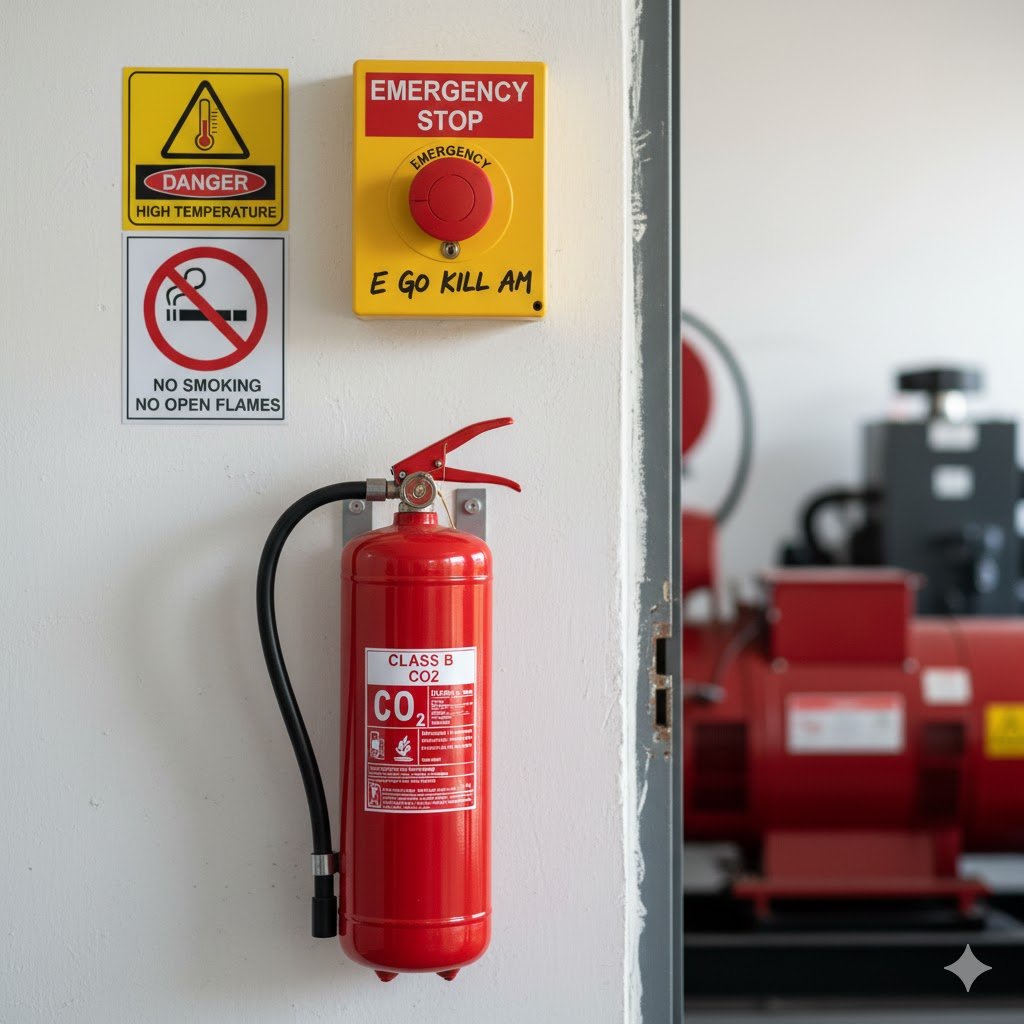
Beyond basic prevention, you need effective response systems. According to Jubaili Bros compliance documentation, integrating thermal-activated fuel shutoff valves is a smart practice. If the room temperature spikes dangerously, the valve automatically cuts off the fuel supply.
Also, I recommend installing an emergency stop button on the exterior wall of the room. This allows you to cut the power and fuel without needing to enter the room if a fire breaks out. Keep a dedicated Class B fire extinguisher right next to that exit button at all times. I have personally used this for years, and it provides a level of peace of mind that is worth every kobo spent on the installation.
Generator Room Design Guide for Nigerian Homeowners
Generator room design depends entirely on your specific living environment. A house in a crowded, high-density Lagos compound has vastly different requirements than a detached duplex in an Abuja estate. Generator room organization is a vital part of managing a home in Nigeria. Beyond simple aesthetics, your layout dictates how long your machine survives the harsh tropical environment and how well you protect your family from carbon monoxide exposure and fire risks.
Indoor vs Outdoor Placement Considerations
If you are in the planning phase of building a dedicated structure, remember that segregation is your best friend.
- It must be detached from the primary living quarters whenever possible to eliminate noise and fumes.
- If you must attach the structure, perhaps as an extension of a boys’ quarters, the shared wall must be fire-proofed with solid concrete or fire-rated boards. Crucially, that wall must have no windows or gaps, as NFPA 37 standards mandate at least 5 feet (1.5 meters) of clearance from any combustible openings to prevent heat transfer and fume leakage.
For those of us living in tight urban quarters, specifically one-room apartments where space is at a premium, creativity is mandatory. You might be forced to utilize a shared corridor or a small corner of the compound. If you find yourself in this situation, ensure the generator is never tucked into a “dead zone” where air cannot circulate. I have seen many neighbors suffer from engine seizures simply because they thought a tiny closet was a good home for their generator. Airflow is non-negotiable.
Vented Generator Shed Options
When you lack the physical space for a masonry room, a vented shed is a brilliant, cost-effective solution.
What is a Vented Generator Shed? Essentially, it is a specialized, secure box designed for high airflow. It uses fixed louvers to allow for constant heat exchange while acting as a barrier against our unpredictable rainy season. In many gated estates, these structures are preferred because they are modular and usually do not trigger the rigid building permit processes associated with permanent brick structures.
Key Features for Nigerian Climate:
- Corrosion Control: Our humidity in cities like Port Harcourt or Lagos is a metal-killer. Insist on galvanized steel or powder-coated aluminum. I have learned the hard way that cheap iron sheets rust through within a single rainy season if they aren’t treated correctly.
- Strategic Louvers: Ensure the louvers are angled downward. This prevents driving rain from splashing onto the engine block while allowing hot air to escape naturally.
- Reinforced Security: Generator theft remains a reality in many parts of the country. A heavy-duty padlock bracket is not an accessory, it is a requirement.
- Mobility: I personally prefer designs that can be unbolted. If you decide to pack up and move to a new flat next year, your expensive shed should come with you.
Local Procurement: While international advice often points toward “Home Depot” kits, we have to look toward local artisans. Visit the metal fabricators at Alaba International Market or Nnewi hub centers. They can build a custom shed based on your machine’s dimensions for between ₦200,000 and ₦500,000 in the current market. Do not skimp on the gauge of the steel, as a flimsy shed will rattle itself to pieces when the generator kicks in.
DIY Alternative: If you are handy with a welding machine or have a local welder you trust, building your own can save you a significant margin. You will need:
- 2-inch angle iron for the structural frame (approx. ₦70,000 – ₦100,000).
- Heavy-duty corrugated aluminum roofing sheets (₦40,000 – ₦70,000).
- Custom metal louvers (₦30,000 – ₦50,000).
- A solid cement screed base to stop moisture rising (₦50,000 – ₦80,000).
Total DIY investment usually lands between ₦190,000 and ₦300,000, depending on your material choices.
Generator Shed Plans for Nigerian Homes
Don’t be tempted by foreign PDF blueprints. Our climate is uniquely hot and humid, meaning we need higher volume of air movement than someone living in a temperate climate. Here is a modified, high-airflow design.
Simple Vented Shed Design (DIY-Friendly)
Dimensions for 5-10 KVA Generator:
- Footprint: 9 feet × 7 feet (2.7m × 2.1m) to allow space for maintenance tasks.
- Clearance Height: 7 feet (2.1m) – this prevents trapped heat pockets near the ceiling.
- Access Door: 3.5 feet wide (1.0m) to allow for easy maneuverability of the machine during oil changes.
Refined Materials List:
- Foundation: 15 bags of cement, sharp sand, and stone base. Do not skip the damp-proof membrane (polythene sheet) underneath the concrete to stop rising damp.
- Frame: 2.5-inch angle iron for increased structural rigidity against high-vibration diesel engines.
- Roofing: Aluzinc or thick aluminum sheets with high-quality heat-reflective paint on the underside.
- Ventilation: 6 custom-fabricated louvers, 2ft × 1.5ft, fitted with wire mesh to keep rodents out.
- Finishing: Two coats of high-grade automotive primer followed by weather-resistant outdoor paint.
Construction Steps:
- Foundation: Level the ground and pour a 6-inch reinforced concrete slab.
- Frame: Weld the structure square. Check every angle twice before finishing your welds.
- Ventilation Strategy: Place intake louvers near the bottom of the wall, and exhaust fans near the roof peak. This utilizes the natural tendency of hot air to rise.
- Exhaust: Use a high-temperature flexible connector to pass the muffler output through the wall into the open air.
- Door: Mount a heavy-duty steel door with a high-quality padlock hasp.
Investment Estimate: Self-managed construction costs ₦200,000 – ₦350,000. Engaging a professional contractor will set you back ₦450,000 – ₦750,000.
This design is superior for the Nigerian environment because:
- It avoids the common overheating pitfalls by maximizing passive airflow.
- Steel is resistant to the termite infestations that destroy wooden storage structures here.
- The elevated roof design acts as a thermal chimney.
- It provides a theft-deterrent that keeps your investment safe overnight.
Noise Control Solutions
Be a good neighbor by managing the decibels.
- Acoustic Lining: Line your inner walls with high-density, fire-rated acoustic foam. Do not use standard home sponge, as it is a major fire hazard.
- Exhaust Management: Upgrade your muffler if you are using a standard factory model. Many local mechanics can fit a larger car-style muffler that significantly quiets the exhaust note.
- Decoupling: Use rubber anti-vibration mounts under the engine frame. If the generator vibrates the floor, it transmits sound directly to your neighbor’s walls through the foundation.
In dense neighborhoods, keeping noise under 65 dBA is a gold standard. Your neighbors will appreciate the peace.
How to Ventilate a Generator Room Properly
Generator ventilation requirements are the most overlooked aspect of generator ownership in Nigeria. We often build the room to hide the machine, only to find the machine fails prematurely because it cannot breathe. Our ambient temperatures often exceed 35°C in the afternoon, which means the engine has no buffer for cooling unless you force air through the room.
Picture This: Proper Ventilation Setup
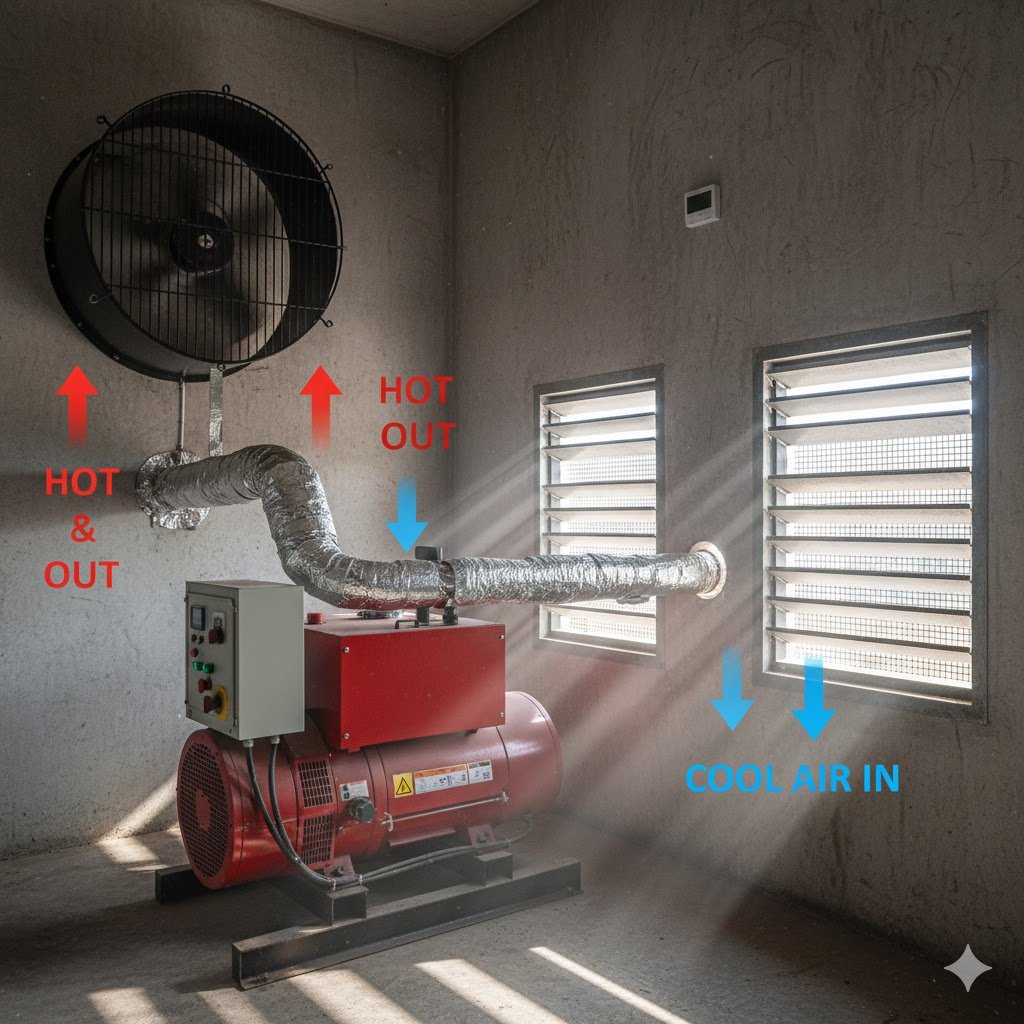
To grasp these generator ventilation requirements, visualize a “wind highway” inside your generator house. Your goal is to keep the room temperature between 18°C and 27°C, which is the sweet spot for peak engine performance.
On the wall facing the wind, you install large intake louvers near the floor. These bring in fresh, cooler air. On the opposite wall, at the highest point near the roof, you install a thermostat-controlled exhaust fan. When the internal room temperature crosses your set threshold, the fan kicks in and forces the hot air out, creating a vacuum that sucks fresh air through the intake. This is far more effective than just having a simple window.
Furthermore, ensure the engine exhaust pipe is wrapped in silver heat-resistant lagging. This does two things: it reduces the radiant heat output inside the room, and it protects you from severe burns if you brush against the hot pipe during a midnight fuel top-up.
Natural vs Mechanical Ventilation
- Natural Airflow: This relies on windows and louvers. It is acceptable for very small portable generators, but in our heat, it rarely keeps the engine cool enough during a long PHCN blackout.
- Mechanical Airflow: If you run a diesel engine, you need fans. Mechanical ventilation is non-negotiable for large engines because they output massive amounts of thermal energy.
The latest international standards are becoming stricter regarding emissions and heat management. Modern Tier 4 compliant engines, which are slowly becoming more common in Nigeria, require specific airflow volumes to meet their cooling efficiency targets. Ignoring this leads to derating, where the engine loses power because it is running too hot.
Air Intake and Exhaust Placement
Stick to the rule: Cold air in low, hot air out high. The exhaust pipe must exit through a thimble, which is a protective sleeve that keeps the hot pipe from touching your concrete or metal walls. If you leave a gap around that pipe, your generator room will quickly fill with exhaust fumes, which is incredibly dangerous for anyone walking past the area.
Calculating Required Ventilation Area
Referencing the technical specifications from major Nigerian generator suppliers, you should aim for at least 0.15 square meters of effective louver area per 100 kW of output. For our standard residential units:
- A 5 KVA generator (approx. 4 kW) requires roughly 0.006 m² of free airflow area.
- A 10 KVA generator (approx. 8 kW) needs about 0.012 m² of net louver space.
In reality, you should aim for double these minimums to account for dust buildup on the meshes over time. If you use a fine mesh to stop insects, it reduces airflow significantly, so compensate by making your louver openings larger.
Air Velocity Requirements
Maintain your air speed to prevent massive noise spikes. When air moves too fast through small gaps, it whistles and creates unnecessary noise pollution. Aim for a speed below 4 m/s at the intake. This keeps the room quiet while ensuring the engine remains cool enough to avoid thermal shutdown.
Ventilation System Types for Nigerian Climate
Avoid any system that allows dust to accumulate. I have found that louver designs with vertical slats are problematic because they collect more debris. Stick with downward-angled, horizontal slats. Always maintain a mesh screen, and clean that screen once a month during your regular maintenance cycle.
How Many KVA Generators to Run a House in Nigeria?
Sizing is the difference between an efficient home and constant maintenance headaches. If you constantly run your generator at 90% load, you will burn through oil and fuel twice as fast as someone running it at 60% capacity.
Load Calculation Method
A simple, safe estimate for a standard 3-bedroom house is to list every appliance’s wattage, add them up, and divide by 800. This keeps your generator load around 80%, giving you a healthy margin for surge loads when your fridge or AC compressor kicks in.
Wetin You Fit Use Different KVA Generator Do:
- 2.5 KVA: This is the “basic survival” unit. It handles fans, lights, your TV, and maybe a laptop. If you try to run an AC, expect the breaker to trip immediately.
- 5.5 KVA: The reliable workhorse. This will handle an AC unit, your freezer, TV, and basic lighting without breaking a sweat. It is the perfect middle-ground for most families.
- 10 KVA Diesel: This is the king of the home setup. It handles large AC units in every room, water pumping systems, and heavy-duty irons. It is a long-term investment that rewards you with reliability.
Smart Storage Solutions for Generator Rooms
Organization is a safety feature. A clean generator room is much less likely to become an inferno. Think of your generator room like a mini-workshop. Just as you would organize your kitchen for Nigerian cooking, your generator room requires a dedicated home for every funnel, oil jug, and tool. If you keep these things strewn about on the floor, they become trip hazards in the dark and potential fire fuel if a leak occurs.
Fuel Storage Best Practices
Store fuel in a cool area far from the engine. Use a dedicated concrete raised platform for your fuel drums to prevent moisture from causing the bottom of the drum to rust out, which is a common disaster I see in many compounds. Keep your petrol supply in approved, airtight containers. Never, ever store more than a few days’ worth of fuel inside the generator room itself.
- Diesel: Keep containers elevated and protected from direct sunlight to preserve fuel quality.
- Petrol: Keep this extremely limited. It is volatile and should be treated with utmost caution.
Tool and Maintenance Equipment Storage
- Wall-Mounted Pegboards: Hang your wrenches, oil filters, and funnels. It looks tidy, but more importantly, it makes it easy to spot if a tool has gone missing.
- Maintenance Logbook: Keep a physical notebook inside a plastic sleeve attached to the wall. Note every oil change and part replacement. It helps you anticipate when your engine needs service.
- Essential Safety Gear: Mount a dry-powder fire extinguisher near the exit path. Make sure everyone in the house knows how to use it, because when a generator catches fire, you have seconds to act.
Safety & Smart Integration
For the modern Nigerian homeowner, smart integration is now a reality. You can install an IoT sensor to monitor fuel levels and receive a notification on your phone when your diesel is running low. Grounding is also critical. Ensure you have a proper copper earth rod driven into the ground outside your room, connected to the generator frame, to prevent dangerous electrical surges or static shocks.
Frequently Asked Questions (FAQ)
- Q: How often should I service my generator? A: Every 50 to 100 hours of runtime is standard for most residential units in Nigeria due to the dust and heat.
- Q: Can I put my generator in the garage? A: Never. The carbon monoxide accumulation is fatal. Even a well-ventilated garage is dangerous.
- Q: Why does my generator floor get oily? A: You have a gasket leak or a loose oil plug. Address this immediately, as the mixture of leaked oil and hot engine heat is a major fire hazard.
Complete Guide to Generator Room Building Permits in Lagos
According to Lagos State building regulations, specifically under the updated 2026 protocols from the Lagos State Physical Planning Permit Authority (LASPPPA), generator houses must be positioned within strict setbacks. These rules prioritize fire safety, public health, and urban sanitation, ensuring that noise pollution and exhaust fumes do not compromise the welfare of surrounding neighbors.
When You Need a Permit
You definitely need official LASPPPA approval if you are planning to undertake the following activities:
- Constructing a permanent, walled generator room using concrete blocks or reinforced cement.
- Erecting any structure on the rooftop of a building to house a generator, as this changes the load-bearing requirements of your roof.
- Installing high-capacity generator units for commercial business premises within residential zones.
- Significant alterations to your property that involve moving major electrical distribution boards or heavy-duty mechanical fuel storage systems.
As per the Jubaili Bros Nigeria’s compliance documentation, oversight for power generation equipment is shared. Permits often require secondary clearance from the State Ministry of Environment regarding noise compliance, and in some industrial instances, the Nigerian Electricity Regulatory Commission (NERC) guidelines come into play for power distribution safety.
Required Documents for Lagos Residents
Building safely in Lagos demands that you adhere to structural integrity standards set by LASBCA. As highlighted by Safefellow’s Lagos building guide, failing to use a licensed engineer for electrical and structural design is a recipe for disaster. Generator rooms carry heavy vibration and fire risk, so you cannot cut corners here.
Based on current 2026 LASPPPA submission requirements, prepare the following documentation file:
- Site Survey Plan: Clearly showing the proposed generator room location, ensuring it maintains the legally required setback from fence lines and windows.
- Architectural Layout: Providing detailed dimensions and, most importantly, the specific placement of louvers or vents.
- Certified Structural Drawing: Must be signed by a COREN-registered engineer, as the weight of large diesel generators requires specific foundation reinforcement.
- Electrical Layout: Detailing the path of your changeover switch, earthing rods, and cable conduits.
- Mechanical Design: Showing exhaust routing, which must direct fumes away from living areas.
- Fire Safety Certification: Essential for commercial units or larger residential setups.
- Land Title Documentation: Copies of your Certificate of Occupancy or registered title deeds.
- Lagos State Development Levy Receipt: Proof of current tax compliance.
Application Process
Navigating the LASPPPA application process is less daunting if you follow these steps systematically:
- Phase 1: Retain a professional architect or structural engineer. Budget between ₦300,000 and ₦800,000 for professional fees and documentation preparation in 2026.
- Phase 2: Submit via the official LASPPPA digital portal. Doing this online is faster than manual submission at the Ikeja or district offices.
- Phase 3: Pay your processing fees through the state payment platform. Expect costs between ₦100,000 and ₦350,000 for residential applications.
- Phase 4: Coordinate a site inspection. Officials will verify that your room isn’t located directly beneath bedroom windows and that ventilation is adequate.
- Phase 5: If approved, you receive the building permit. Expect a window of 6 to 10 weeks for processing time.
- Phase 6: Settlement of the mandatory Development Levy completes the legal process.
Penalties for Non-Compliance
The Lagos State Building Control Agency (LASBCA) is increasingly aggressive regarding unapproved construction. Risks include:
- Immediate issuance of “stop work” or demolition orders for illegal generator structures.
- Administrative fines ranging from ₦1,000,000 to over ₦3,000,000 based on the scale of the violation.
- Prosecution in the Special Offences Court for environmental and planning violations.
- Complications during property transfer, as irregular structures can stall your “deed of assignment” process.
Other States
While Lagos is strict, Abuja through the FCDA and Port Harcourt via their respective Urban Development Authorities have tightened their oversight as well. Always visit your local council office to confirm if specific bylaws apply to your estate.
Insurance Coverage for Generator Owners
Your generator represents a significant capital outlay. Protecting this investment requires more than just a sturdy padlock. Homeowners often find themselves exposed during a fire incident because they failed to disclose their high-risk equipment to their insurance provider.
- Comprehensive Home Insurance: Standard policies often contain a “hazardous equipment” clause. If your generator is placed in a non-compliant, unventilated room, the insurance company may reject a fire claim entirely. Ensure your policy specifically lists the generator installation.
- Fuel Storage Endorsements: If your compound stores more than 500 liters of diesel in bulk tanks, standard home insurance will not suffice. You need a commercial-grade endorsement to cover the extreme fire risk associated with stored hydrocarbons.
- Third-Party Liability: In densely populated areas, a fire or explosion in your generator room could quickly destroy a neighbor’s property. Public liability insurance protects your finances if you are sued for neighboring damages following a generator-related incident.
Regular Maintenance for Generator Room Organization and Safety
Maintenance is the heartbeat of a functional generator. Generator room organization is a vital part of managing a home in Nigeria. A chaotic room leads to poor serviceability, which eventually ruins the engine. By applying the same habits you use to keep a house clean with a busy schedule, you can ensure your generator remains in peak condition through brief, consistent weekly check-ins.
Daily Safety Inspections
Based on the latest safety standards from Genesal Energy, ensure you perform these visual checks before switching the power on:
- Check the floor for any sheen, which indicates a fuel or oil leak requiring immediate repair.
- Ensure the ventilation louvers are free of debris, as a single blocked vent can cause engine overheating within minutes.
- Confirm the battery terminals are tight and free of the blue-green crust caused by acid corrosion.
Record Keeping Requirements
Consistency is key. Whether you use a physical logbook or productivity apps that work offline, recording every event is non-negotiable. Modern tech allows you to track fuel consumption metrics, which helps detect engine inefficiency before it turns into a major breakdown. Your log should include:
- Actual hour-meter readings at the time of each service.
- Volume and date of each diesel purchase to spot potential engine consumption issues.
- Any unusual vibrations or high-pitched noises noted during operation.
Detailed records provide a clear history for your maintenance technicians, allowing them to diagnose issues faster and cheaper.
Seasonal Maintenance Tips
The Nigerian climate is notoriously hard on machinery. Your room must be optimized to handle the extreme variance between the dusty Harmattan and the humid rainy season.
Generator Room Maintenance by Season
Dry Season (November – March):
- Dust Control: The Harmattan dust can kill a generator air filter in days. Consider installing a dust-mesh screen over your intake vents. Inspect air filters weekly.
- Temperature Management: Ambient temperatures often exceed 35°C. Your generator room should ideally remain between 18°C and 27°C. If your room is too hot, install a thermostat-controlled exhaust fan to pull hot air out.
Rainy Season (April – October):
- Waterproofing: Verify that your roof slope directs water away from vents. Use high-quality sealant on all wall-to-roof joints.
- Anti-Corrosion: The high humidity in the south causes rapid oxidation. Apply a light coat of protective oil on exposed metal exhaust joints to stop rust.
- Fuel Integrity: Water infiltration is common during heavy rains. Always keep your diesel drums raised on pallets and ensure the caps are hermetically sealed.
- Electrical Protection: Ensure your earth rods are buried deep enough and that moisture isn’t pooling around the base of the generator control panel.
Year-Round Best Practices:
- Maintain your fire extinguisher by shaking the canister every month to prevent the powder from caking.
- Check for carbon monoxide buildup. Install an inexpensive CO detector, it is a life-saving addition for any indoor or semi-enclosed generator setup.
- Install silver heat-resistant lagging on all exposed exhaust pipes to prevent accidental burns to family or staff.
Generator Room Organization Mistakes Nigerian Homeowners Make
Avoiding these common errors will significantly improve your safety profile and equipment longevity:
- Restricting Air Intake: Placing the generator too close to a wall. You must maintain at least 1.5 meters (5 feet) of clearance from any combustible wall to prevent fire hazards and ensure proper intake.
- Creating a “Storehouse”: Storing paints, solvents, or old car tires in the generator room is a guaranteed recipe for a house fire. The room must remain sterile and clear.
- Neglecting Grounding: A loose or nonexistent grounding rod for your generator is a shock hazard. Ensure a copper-clad rod is driven into the earth near the generator.
- Inadequate Lighting: Working in the dark is how mistakes happen. Install a bright, battery-operated LED light that automatically turns on when the room is accessed.
Generator Room Troubleshooting
Even with strict generator room organization, unexpected issues occur. Below is a diagnostic approach for the most frequent headaches.
Common Generator Room Problems and Solutions
Problem: The Engine Shuts Down Unexpectedly
- Causes: High ambient heat, blocked intake vents, or radiator fouling.
- Solution: Apply the ventilation rule: you need 0.15 m² of louvered area per 100 kW of generator output. If you fall short, you must enlarge your vents or add motorized fans.
Problem: Persistent Diesel Odor
- Causes: Small, invisible leaks in fuel hoses or porous containers sitting in the room.
- Solution: Replace all rubber fuel lines every two years, even if they look fine. Use secondary containment trays under the generator to catch any drips.
Problem: Neighborhood Noise Complaints
- Solutions:
- Place the unit on high-density rubber anti-vibration pads to stop sound from traveling through the concrete slab into the foundation of your house.
- Use acoustic baffles in the ventilation ducts to absorb sound waves without restricting airflow.
- If the noise is excessive, install a residential-grade hospital muffler.
Finding Generator Installation Services Near You
Whether you need a full redesign of your generator space or just a professional to install a new unit, always prioritize credentials.
Lagos and Abuja Professional Networks
In high-demand areas, look for service providers who offer a holistic approach. It is not just about mounting the generator; it is about the electrical integration, the earthing system, and the ventilation design.
Top Service Providers:
- Jubaili Bros Nigeria – Industry leaders for large-scale and complex residential installations.
- Certified Electrical Contractors: Use only those verified as COREN-registered. Never accept a “guy with a toolkit” for a setup involving high-voltage changeover switches.
- Estate Maintenance Firms: These firms often specialize in soundproofing and modular generator housing that is already compliant with estate bylaws.
Questions for Your Contractor
- Are you currently COREN registered?
- Do you guarantee that the installation complies with local LASPPPA ventilation standards?
- Will you issue a signed commissioning report after installation?
- Can you show me a recent installation that uses the same ventilation design you are proposing for my home?
Does a Generator Room Add Value to Your Property?
In the luxury real estate segments of Lagos and Abuja, a purpose-built generator enclosure is a major asset. It signals to prospective tenants or buyers that the home is a self-sustaining facility, prepared for the realities of the national grid. It is no longer just a “room”; it is a value-adding component of the home’s infrastructure.
Reducing Costs with Solar Integration
Integrating solar energy into your power strategy is the smartest financial move you can make in 2026. High-capacity solar-hybrid systems allow your generator to remain dormant during the day, significantly extending its service life and reducing your recurring diesel costs by up to 60 percent. When the sun sets or the battery bank reaches a certain threshold, the system intelligently kicks in, providing a smooth, noise-free transition that protects your generator from heavy startup loads.
Frequently Asked Questions
How far should the generator be from the house?
Following NFPA 37 guidelines, you should maintain at least 1.5 meters (5 feet) from any combustible walls or windows to ensure safe operation and airflow.
Can I store extra diesel inside the generator room?
Only if the room is explicitly designed with fire-rated walls and containment systems. Storing large quantities of diesel in an ordinary room is a major fire safety violation.
How often should I check the exhaust system?
Check for leaks and rust every time you service the generator. If you see signs of soot on the walls of your room, you have an exhaust leak that must be repaired immediately to prevent carbon monoxide poisoning.
Conclusion
Generator room organization is a vital part of managing a home in Nigeria. It is the boundary between a well-functioning, reliable home and a constant source of stress, noise, and expense. By taking the time to properly design, permit, and maintain this space, you aren’t just saving a machine; you are protecting your family’s safety and ensuring your property remains a comfortable, efficient oasis despite external power challenges.
Start with the basics. Look at your setup today. Is the area clean? Are the vents clear? Do you have a logbook ready? Implementing these standards now will save you countless headaches in the future, providing true peace of mind whenever the national grid fails you.
Finding Generator Installation Services Near You
For Nigerian homeowners in major cities searching for “generator room organization safety and storage solutions near me,” several options exist.
Lagos Area Services
In Lagos neighborhoods like Ikeja, Lekki, Surulere, and Victoria Island, numerous certified electricians and generator technicians offer installation services. Look for COREN (Council for the Regulation of Engineering in Nigeria) registered professionals.
Recommended Service Providers:
- Jubaili Bros Nigeria – Authorized dealers with installation services.
- Local electrical contractors in Alaba International Market.
- Estate-based generator technicians (ask your estate manager for recommendations).
Abuja Services
Federal Capital Territory residents can find qualified installers through:
- Licensed electrical contractors registered with FCDA.
- Generator dealers in Wuse, Garki, and Maitama.
- Abuja Electricity Distribution Company (AEDC) approved contractors.
What to Ask Service Providers:
- Are you COREN registered?
- Do you provide warranty on installation work?
- Will you handle LASPPDA permit applications?
- What’s your experience with my generator brand?
- Can you provide references from nearby installations?
Cost of Professional Installation:
- Basic installation (residential, 5-10 KVA): ₦100,000 – ₦250,000.
- Complete room construction + installation: ₦500,000 – ₦1,500,000.
- Commercial installation (20+ KVA): ₦1,000,000 – ₦5,000,000.
Finding Generator Installation Services Near You
Lagos Area Services
- Jubaili Bros Nigeria – Authorized dealers with installation services.
- Local electrical contractors in Alaba International Market.
- Estate-based generator technicians (ask your estate manager for recommendations).
Abuja Services
- Licensed electrical contractors registered with FCDA.
- Generator dealers in Wuse, Garki, and Maitama.
- Abuja Electricity Distribution Company (AEDC) approved contractors.
What to Ask Service Providers:
- Are you COREN registered?
- Do you provide warranty on installation work?
- Will you handle LASPPDA permit applications?
- What’s your experience with my generator brand?
- Can you provide references from nearby installations?
Cost of Professional Installation:
- Basic installation (residential, 5-10 KVA): ₦100,000 – ₦250,000.
- Complete room construction + installation: ₦500,000 – ₦1,500,000.
- Commercial installation (20+ KVA): ₦1,000,000 – ₦5,000,000.
Finding Generator Installation Services Near You
Lagos Area Services
- Jubaili Bros Nigeria – Authorized dealers with installation services.
- Local electrical contractors in Alaba International Market.
- Estate-based generator technicians (ask your estate manager for recommendations).
Abuja Services
- Licensed electrical contractors registered with FCDA.
- Generator dealers in Wuse, Garki, and Maitama.
- Abuja Electricity Distribution Company (AEDC) approved contractors.
What to Ask Service Providers:
- Are you COREN registered?
- Do you provide warranty on installation work?
- Will you handle LASPPDA permit applications?
- What’s your experience with my generator brand?
- Can you provide references from nearby installations?
Cost of Professional Installation:
- Basic installation (residential, 5-10 KVA): ₦100,000 – ₦250,000.
- Complete room construction + installation: ₦500,000 – ₦1,500,000.
- Commercial installation (20+ KVA): ₦1,000,000 – ₦5,000,000.
Finding Generator Installation Services Near You
Lagos Area Services
- Jubaili Bros Nigeria – Authorized dealers with installation services.
- Local electrical contractors in Alaba International Market.
- Estate-based generator technicians (ask your estate manager for recommendations).
Abuja Services
- Licensed electrical contractors registered with FCDA.
- Generator dealers in Wuse, Garki, and Maitama.
- Abuja Electricity Distribution Company (AEDC) approved contractors.
What to Ask Service Providers:
- Are you COREN registered?
- Do you provide warranty on installation work?
- Will you handle LASPPDA permit applications?
- What’s your experience with my generator brand?
- Can you provide references from nearby installations?
Cost of Professional Installation:
- Basic installation (residential, 5-10 KVA): ₦100,000 – ₦250,000.
- Complete room construction + installation: ₦500,000 – ₦1,500,000.
- Commercial installation (20+ KVA): ₦1,000,000 – ₦5,000,000.

Oladepo Babatunde (Prince Babatee Tunde) is a Computer Scientist, researcher, and professional content writer with a Higher National Diploma in Computer Science from Kwara State Polytechnic, Nigeria.
With a background in technology and a passion for clear communication, Babatunde specializes in creating thoroughly researched, reader-focused content on productivity, personal development, home living, and technology. Every article he writes is backed by extensive research and fact-checking to ensure readers receive accurate, actionable information.
As a freelance writer, he has helped brands and publications deliver content that educates, engages, and empowers their audiences. His mission at Vibena is simple: make complex topics easy to understand and help Nigerians live smarter, more productive lives.