
After navigating Lagos traffic for two hours on a Friday evening, or rushing home from a high-pressure meeting in Abuja, the final thing you want to see is a messy living room and a sink filled with dirty dishes. If you are a busy Nigerian professional wondering how to keep a house clean with a busy schedule, you are certainly not alone. Between intense work hours, family commitments, church programs, and essential social obligations, finding the time for deep house cleaning often feels like a fantasy. The secret isn’t working harder, it’s working smarter.
For many working mothers returning home well past 9 PM after collecting children from school and sitting in endless gridlock, the thought of facing a dusty living space can be draining. I have been there many times myself. It feels like a constant cycle. But what if there was a more intentional, strategic way to manage your environment without losing your peace of mind?
For many of us, the weekend is our only window for recovery. Yet, who wants to spend their entire Saturday afternoon scrubbing tiles when they could be resting or catching up with loved ones? The internal conflict is very real. You crave a clean, inviting home, but you also need to protect your sanity and energy levels for the week ahead.
The good news is that you do not need to spend your entire weekend bent over a bucket. According to efficiency experts at Clean Corp Atlanta, just 20 percent of your focused cleaning efforts can deliver 80 percent of visible, satisfying results. This refreshed guide for 2026 reveals practical, time-efficient strategies specifically crafted for busy Nigerians who want spotless homes without sacrificing their precious downtime.
Whether you reside in a compact self-contain in Yaba, a modern duplex in Lekki, or are currently navigating small apartment living in Nigeria, these methods adapt to your specific space and personal schedule to help you reclaim your time.
Why You Can’t Keep Up With Traditional Cleaning Methods
Many of us grew up with the deep-seated belief that Saturday morning belongs strictly to environmental sanitation. You know the drill: wake up before dawn, move all the furniture to the balcony, and scrub every tile with heavy detergents until midday. While that approach functioned when our parents perhaps had more household support or less complex schedules, it does not suit the realities of the modern Nigerian lifestyle in 2026.
The Myth of the “Perfect” Weekend Clean
Attempting to perform a total deep clean of your entire residence every single weekend is a guaranteed path to burnout. When you set an ambitious goal to scrub every single surface, you often feel defeated before you even pick up a broom. This naturally leads to procrastination. Before you know it, several weekends have vanished, and the dust has settled into every crevice.
First Bank of Nigeria’s recent consumer research highlights that most Nigerian professionals struggle with maintaining a sustainable work-life balance, frequently abandoning their cleaning routines entirely once they start feeling overwhelmed by the sheer volume of tasks.
Nigerian-Specific Challenges
We must acknowledge the unique obstacles we face in our local environment:
- The Environment: If you live in an area prone to red dust or if we are currently in the thick of the Harmattan season, dust accumulates mere hours after you finish cleaning. Using a high-quality microfiber cloth instead of an old cotton rag is essential, as microfiber captures microscopic particles rather than simply pushing them around.
- Infrastructure: Unreliable power supply can leave you without your vacuum or electronic gadgets right when you need them. Planning your cleaning for when you expect light or having a reliable manual backup is a necessity.
- Water Supply: In regions where water is a luxury or requires manual hauling, mopping becomes a physically heavy task. Prioritizing dry cleaning or using low-water methods is key to conserving your strength.
According to professional cleaning protocols documented by JDI Cleaning Systems, attempting to clean every surface with the same intensity leads to inconsistent results, as people inevitably get tired and quit. The secret isn’t working harder, it’s working smarter by focusing your energy on high-impact areas.
What is the 80/20 Rule for Cleaning? (And Why It Changes Everything)
You might have heard of the Pareto Principle, which is widely cited in business management. Interestingly, it applies perfectly to your household management. The concept suggests that 80 percent of your visual results originate from just 20 percent of your focused efforts.
How the 80/20 Rule Works in Nigerian Homes
Regarding domestic work, this means that concentrating on a few specific zones makes your living space appear 80 percent cleaner. You do not need to scrub the grout behind the kitchen cabinets every week. You only need to manage the visible clutter. Research shows that allocating consistent 20-minute windows for these tasks significantly reduces the accumulation of dirt over time.
Think about it like this: If a friend from church calls to announce they are arriving in 15 minutes, what is your immediate reaction? You do not start reorganizing your wardrobe. You immediately focus on the areas they will see and where they will sit.
- Living Room: Clearing the center table and arranging the throw pillows.
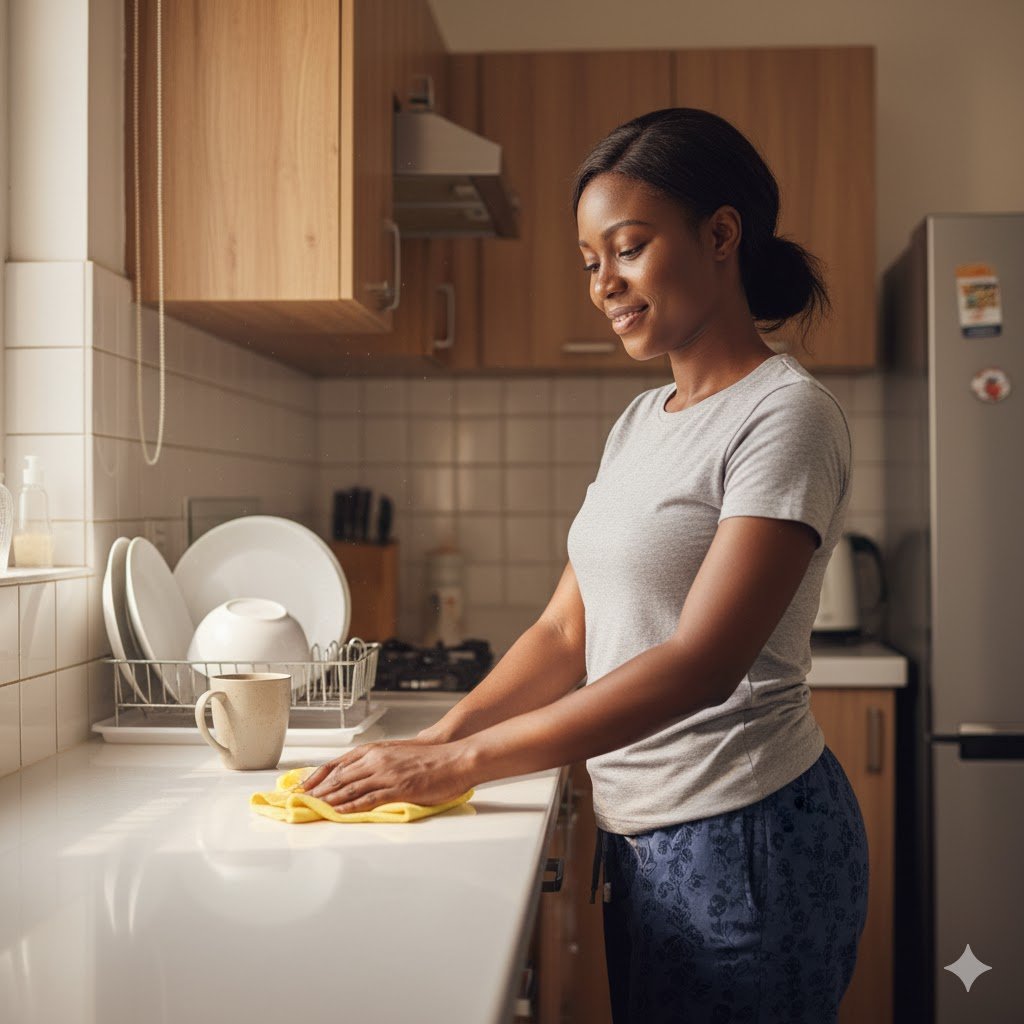
- Kitchen: Wiping the primary counters and clearing the sink of dirty dishes.
- Bathroom: Wiping the toilet rim and the main mirror.
- Bedroom: Making the bed, which instantly makes the room feel orderly.
These specific tasks take about 30 minutes total but make your home feel fresh to anyone walking through the front door. According to efficiency studies by Clean Corp, focusing on high-traffic areas first creates an instant perception of cleanliness, even when deeper maintenance has been pushed to a later date.
Identifying Your 20% High-Impact Tasks
To make this system work for your specific floor plan, you need to define your “20 percent” zone. Use this simple sequence:
- Inventory every room in your home.
- Identify the spaces a visitor notices the second they walk through your door.
- Focus on large flat surfaces like tables, beds, and kitchen islands.
- Select tasks that can be completed in under 10 minutes.
Your 80/20 High-Impact Cleaning Table:
| Room | 20% High-Impact Tasks | Time Required | Frequency |
|---|---|---|---|
| Kitchen | Wipe counters, sweep floor, wash dishes | 15 minutes | Daily |
| Living Room | Clear clutter, arrange cushions, quick dust | 10 minutes | Daily |
| Guest Toilet | Wipe sink, toilet rim, mirror | 5 minutes | Daily |
| Bedroom | Make bed, hang up visible clothes | 5 minutes | Daily |
| Floors | Sweep main walkways and high-traffic areas | 10 minutes | Daily |
These tasks represent the “must-do” items that First Bank of Nigeria’s resources categorize as urgent, which should be protected from postponement, unlike deep cleaning projects which can be handled as a monthly event.
What are the 7 Stages of Cleaning? (Professional Method Simplified)
If you desire to perform a deeper clean during your weekend, do not move around randomly. Professional cleaners follow a strict sequence to maintain speed and quality. This is commonly known as the 7 Stages of Cleaning, a method used in professional and healthcare maintenance protocols.
I recall trying this methodology in my own Surulere apartment years ago. At first, I was quite skeptical, thinking that seven distinct stages sounded far too complicated for a home environment. However, once I committed to the specific order, I found myself finished in half the time I previously spent running around in circles. The secret is to never skip the sequence, as each stage sets the foundation for the next.
According to professional cleaning protocols documented by commercial cleaning organizations, following these stages sequentially prevents cross-contamination and ensures you are not cleaning the same area twice.
Stage 1: Remove Rubbish
Walk through every room with one large trash bag. Empty every small bin from your bathrooms, bedrooms, and the kitchen. Removing the clutter first clears your mental space as well as your physical space.
- Nigerian Context: If you are separating plastics or recyclables, do that now. Do not start dusting or wiping surfaces yet. Your only goal at this stage is to get the trash out of your home.
- Time: 10 minutes.
Stage 2: Dust High Surfaces First
Physics is always working. Dust falls downward. If you mop the floor first and then clean your ceiling fan, you have effectively ruined your hard work. Always work from the ceiling down to the floor.
- Nigerian Challenge: Ceiling fans and air conditioning units are magnets for dust here. Use a damp microfiber cloth or a dedicated duster to trap the particles. If you use a dry rag, you are simply shifting the dust into the air where it will settle on your furniture again.
- Time: 15-20 minutes per room.
Stage 3: Clean High-Touch Surfaces
These are the areas everyone contacts daily but rarely thinks to disinfect: light switches, door handles, the TV remote, fridge door handles, and even the area around your front door keyhole.
Healthcare cleaning research from the Centers for Disease Control and Prevention emphasizes that sanitizing high-touch points is critical for preventing the spread of germs. This principle is vital in Nigerian homes where family members and visitors are constantly touching shared surfaces.
- Time: 10 minutes.
Stage 4: Restock Supplies
Move through the home and replenish anything that has run low. Put out a fresh roll of toilet paper, refill the liquid soap dispensers, and ensure there is a new liner in the bin. This small step ensures your home remains functional for the rest of the week.
- Nigerian Reality: It is always wise to check your home storage or cupboard to verify you have sufficient backup supplies before the Sunday rush, especially when local shops might be closed or inconvenient to reach.
- Time: 5 minutes.
Stage 5: Clean Glass and Mirrors
Wipe down all mirrors, glass-top tables, and interior windows to remove fingerprints and smudges.
- Best Technique: You do not need an expensive imported cleaner. A mixture of water and a small amount of white vinegar, paired with a clean old newspaper, remains a highly effective, low-cost Nigerian method for achieving a streak-free shine on glass.
- Time: 10 minutes.
Stage 6: Dust-Mop or Vacuum Floors
Now that the dust from your fans, surfaces, and shelves has migrated to the floor, it is time to remove it for good.
- Nigerian Floors: Most homes here feature tiles, terrazzo, or concrete floors. A high-quality, soft broom is often superior to a vacuum for collecting fine dust particles in our climate. Sweep every room systematically, moving furniture to ensure you hit the hidden corners.
- Time: 15 minutes.
Stage 7: Damp-Mop Floor Surfaces
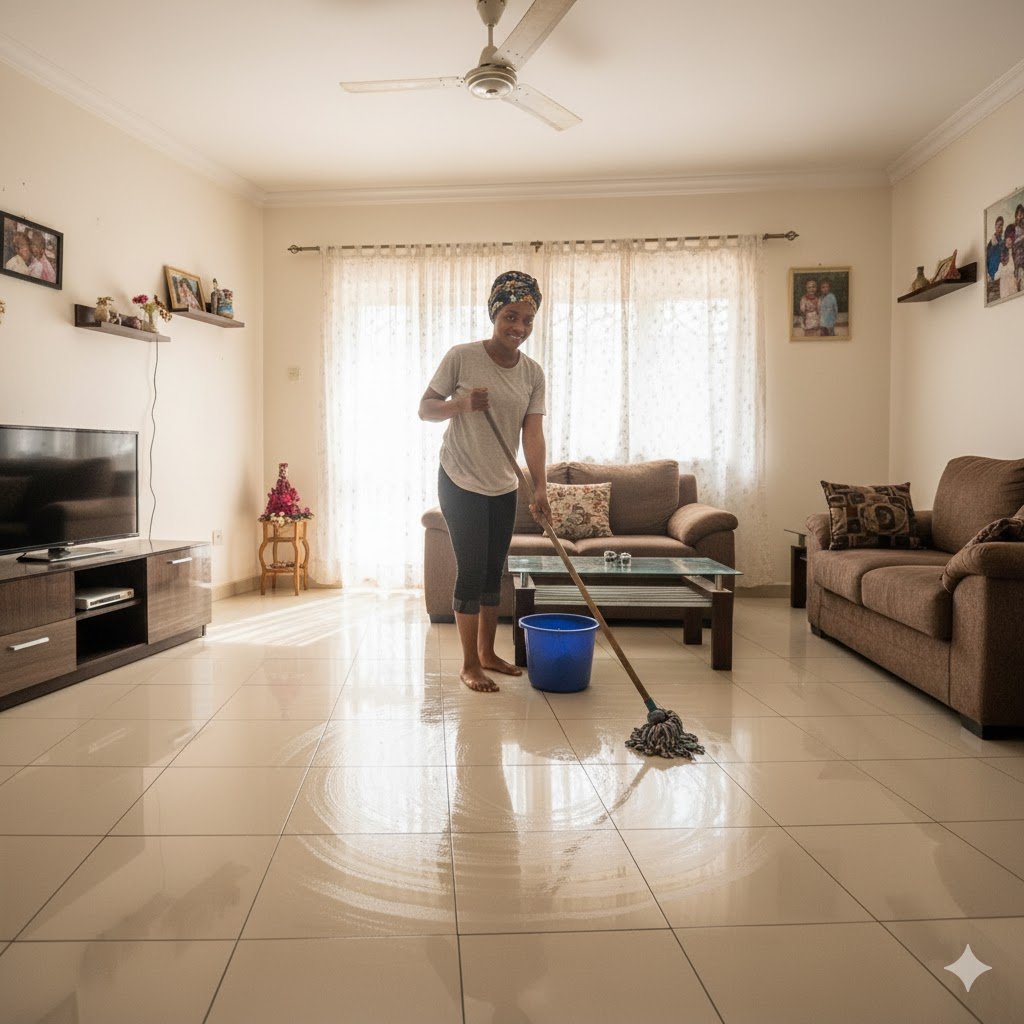
Finally, finish with a light damp mop.
- Technique: Dip your mop, wring it out until it is barely damp to avoid flooding the floor, and use a figure-eight motion while slowly moving toward the room exit.
- Tip: If water access is restricted, use the two-bucket method. One bucket contains your water and disinfectant, while the other is strictly for rinsing the dirty mop head. This ensures you are always using clean water on your floors.
- Time: 15-20 minutes.
Time-Saving Cleaning Rules Every Busy Nigerian Should Know
When you are trying to figure out how to keep a house clean with a busy schedule, you need rules that prevent thinking. Decisions take energy, and after a long day, you have very little to spare. Rules provide the autopilot mode you need to maintain order without constant internal negotiation. The secret isn’t working harder, it’s working smarter.
What is the 20 Minute Rule in Cleaning?
This is a tactical approach for preventing weekend exhaustion. By curbing the urge to do everything at once, you protect your limited downtime.
- The Rule: You dedicate exactly 20 minutes a day to maintenance or organizing, no more, no less.
- Why it works: It is short enough to bypass your procrastination, but focused enough to make a visible impact on your living space.
- How to use it: Set a visual timer on your phone. Pick one specific area, like the kitchen counters or your home office desk. Move quickly. When the alarm rings, stop immediately. Your brain will appreciate the clear start and end point.
- Citation: According to efficiency experts at Sophia’s Cleaning Service, consistent short sessions prevent the massive backlog that makes Saturday cleaning feel like a second job. Their data shows clients who commit to 20-minute daily bursts report 80% higher satisfaction with their living environment compared to those who only engage in irregular deep cleans.
The 12-12-12 Rule for Decluttering
Use this when your space feels crowded or heavy, as it forces quick, decisive action.
- Find 12 items to trash: Old store receipts, empty plastic sachets, or dried-out pens that no longer write.
- Find 12 items to donate: Clothes that no longer fit, duplicate kitchen gadgets that have been sitting idle, or household items you genuinely do not use.
- Find 12 items to return: Objects that have migrated to the wrong room, like books left on the dining table or shoes abandoned in the parlor.
- Nigerian Context: We often hold onto items “just in case.” Be intentional. Use your donation pile to support those in your immediate community or church, ensuring that your decluttering also serves a social purpose.
What is the 1% Rule of Cleaning?
This is about the power of marginal gains. If you improve the state of your home by just 1% every day, the compound effect by the end of the month is profound.
- Today: Wipe down one window sill or clean one mirror.
- Tomorrow: Organize one small drawer in the kitchen.
- The Result: You build a sustainable habit without the mental weight of a “big clean.” Think of it as a savings account for your environment; small, daily deposits yield significant long-term dividends.
The 10-10-10 Rule for Decluttering
This is a faster, low-pressure version of the 12-12-12 rule designed for high-stress days.
- 10 items to trash.
- 10 items to donate.
- 10 items to put away to their permanent home.
- Use this whenever you have exactly 10 minutes to spare before heading out for work, school runs, or church. It clears the visual noise quickly.
What is the 6-10 Rule?
Note: While various cleaning rules exist online, the “6-10 rule” isn’t widely documented in professional cleaning research with a specific definition. However, you can adapt this concept for your home:
- The Concept: Focus on 6 non-negotiable tasks that must be done daily, and aim to complete them before 10 AM if your schedule permits. Alternatively, pick 6 days of light maintenance and 10 minutes of targeted deep cleaning each day. Find a rhythm that accommodates your unique life in Lagos or Abuja.
The 1/3/5 Decluttering Rule
If you cannot find a strict source for this, here is a practical adaptation tailored for Nigerian living:
- 1 Major Task: Once a week (e.g., Deep scrub the bathroom tiles).
- 3 Medium Tasks: Once a week (e.g., Laundry, mopping the entire house, changing bed sheets).
- 5 Quick Tasks: Daily (e.g., Making your bed, washing the dinner dishes, wiping kitchen counters, sweeping the parlor, clearing the trash bin).
Your Practical Weekend Cleaning Schedule (Total Time: 3-4 Hours)
According to property management specialists at Private Property Nigeria, creating structured cleaning schedules and tackling one zone at a time is the most effective way to prevent the feeling of being overwhelmed, which is a common hurdle for busy professionals.
This schedule aligns with the methodologies recommended by local professional services like Squeaky Clean Nigeria, which recognizes that Sunday should be reserved for rest and family, not household chores.
Saturday Morning Routine (90 Minutes)

- 7:00 AM – 7:30 AM: The 80/20 Quick Clean
- Open windows to allow cross-ventilation and fresh air.
- Make all beds immediately to anchor the room’s appearance.
- Clear all surface clutter from the living room and dining area.
- Result: The house feels ordered before the real work begins.
- 7:30 AM – 9:00 AM: The 7-Stage Deep Clean (Focus Area)
- Focus on one zone to maximize impact (e.g., deep cleaning the kitchen and bathrooms).
- Follow the 7-stage protocol: Trash removal, Dusting, High-touch surfaces, Restocking supplies, Glass/Mirrors, Sweeping, and Mopping.
Saturday Afternoon Options
- Option A (High Energy): Tackle laundry in the background while listening to podcasts or your favorite music.
- Option B (Low Energy): Set a 20-minute timer for a single drawer or cabinet, then step away to enjoy the rest of your day.
Sunday Routine (Minimal – 30 Minutes)
Sunday is for recharge and connection. Keep your tasks minimal to maintain that sense of peace.
- Evening: A quick 20-minute tidy to reset the living area. Put away church shoes and school bags.
- Prep: Iron your work clothes for the upcoming week so Monday morning feels calm and controlled.
Weekly Rotation Calendar: To prevent the dreaded “whole house” cleaning day, rotate your deep cleaning focus throughout the month:
| Week | Saturday Deep Clean Focus | Sunday Prep Focus |
|---|---|---|
| Week 1 | Master Bedroom + En-suite | Iron work clothes |
| Week 2 | Kitchen + Dining Area | Meal prep + Fridge wipe-down |
| Week 3 | Living Room + Guest Areas | Organize school bags + Stationery |
| Week 4 | Guest Rooms + Storage Areas | 12-12-12 Declutter session |
How Can I Keep My House Clean If I Work Full Time? (Realistic Strategies for Nigerian Professionals)
Working a demanding 9-to-5 that often extends into a 6-to-8 commute makes domestic maintenance feel like an uphill battle. Balancing career growth with home responsibilities requires effective time management strategies that prioritize your energy while keeping the house functional.
Research regarding personal financial health and home maintenance from First Bank suggests that distributing chores incrementally throughout the week is essential for preserving work-life balance and ensuring you actually get enough rest.
Daily Micro-Habits That Prevent Weekend Chaos
- Make the Bed: It takes under 120 seconds but establishes an immediate sense of accomplishment. Learn how to incorporate cleaning habits into your morning routine so order becomes your default setting.
- The One-Touch Rule: When you arrive home, handle your items exactly once. Hang the jacket, put the bag in the closet, and place shoes in the rack. Never let them touch a chair or table surface as a “temporary” spot.
- Evening Reset: Spend 10 minutes before bed resetting the common areas. Fluff cushions, organize magazines, and clear the center table. It makes your coffee much better the next morning.
The Clean As You Go Nigerian Method
This is non-negotiable for anyone who cooks regularly. According to the cleaning specialists at Palm Cedar Cleaning, managing the kitchen space while you work prevents the buildup of grease and stuck-on messes. Our style of cooking, which involves intense frying, heavy soups, and pepper grinding, demands an organized kitchen system to keep the ‘clean as you go’ workflow functional.
- Wash the blender immediately after prepping your pepper mix.
- Wash prep pots and bowls while the main soup is simmering.
- Wipe down oil splashes the moment they occur before they harden on the tiles or stove.
- By the time the meal is plated, your sink should already be clear, leaving only the serving dishes.
Time-Saving Tools for Nigerian Homes
You don’t need expensive gadgets to see a change in your efficiency.
- Microfiber Cloths: Palm Cedar Cleaning notes that microfiber cloths are scientifically superior for trapping microscopic dust and oils, which is a major time-saver compared to using old towels or rags.
- Spray Bottles: Keep a diluted all-purpose cleaner in the bathroom and the kitchen for instant access.
- Squeegee: If you have a glass shower door, a quick pass with a squeegee post-shower prevents the buildup of stubborn hard water stains.
Getting Help: The Nigerian Reality
Outsourcing is a valid strategy for the busy professional. It supports local employment and reclaims your personal time.
Platforms like VisCorner provide flexible professional options, including one-off deep cleans or recurring maintenance visits. This allows you to offload the labor-intensive scrubbing tasks while you manage the light daily upkeep yourself.
- Part-time Help: Hiring help for high-intensity tasks like floor scrubbing or bathroom deep-cleans once every fortnight allows you to keep the house presentable with minimal effort.
- Tech-Enabled Help: Services like Hibil Maid allow you to book laundry services or cleaning slots directly, effectively using your phone to manage your home maintenance schedule.
- Pro Tip: Apply the Pareto Principle (80/20) when directing your cleaner. Identify the 20% of the house that provides 80% of the visual “cleanliness” and ask them to prioritize those spots first.
5 Cleaning Mistakes That Waste Your Weekend Time
1. Attempting a Total Deep Clean Every Weekend This is the fastest way to burn out. Stick to the rotation schedule to keep your weekends manageable.
2. Buying Excessive Cleaning Products You rarely need 15 different chemicals. A basic set consisting of high-quality bleach for sanitation, reliable dish soap for surfaces, and a standard glass cleaner covers almost everything.
3. Cleaning Without a Logical System Hopping between rooms creates inefficiency. Use the 7-stage protocol: complete one specific action across the entire house before starting the next. It saves physical steps and mental energy.
4. Giving in to Perfectionism Waiting for the perfect day to tackle your house ensures you never will. A 10-minute clean beats a zero-minute clean every single time. Learn how to overcome the urge to procrastinate and get started with a simple five-minute task.
5. Neglecting Daily Maintenance Pushing every task to Saturday is a recipe for a 6-hour chore marathon. Spend 15 minutes daily to prevent the weekend from becoming a place for work rather than rest.
Special Cleaning Considerations for Nigerian Homes
Cleaning professionals at Kleenol Nigeria emphasize that maintaining focus, removing distractions like phones or loud television during your cleaning block, is the key to finishing in record time.
Dealing with Harmattan Dust: Between November and March, dust management is critical.
- Strategy: Keep windows and curtains closed during the peak wind hours to minimize the influx of particles.
- Tip: Always use a damp cloth. Dry dusting merely moves the particles into the air, where they will eventually settle on your clean surfaces again.
Rainy Season Challenges: Mud and excess moisture are your primary concerns here.
- Strategy: Use two heavy-duty mats at the entrance: one outside to scrape the debris, and one inside to absorb moisture.
- Tip: Enforce a “no shoes inside” policy immediately. It reduces the need for frequent mopping by over half.
Power Outage Adaptations: When the grid is unreliable, rely on natural light. Experts at Kleenol suggest performing your most detail-oriented cleaning tasks during the brightest afternoon hours when natural light makes it impossible to miss hidden dust or stains.
Affordable DIY Solutions:
- General Cleaner: A 50/50 mix of water and white vinegar works wonders on surfaces.
- Sanitation: Diluted bleach for toilet bowls and bathroom floors (always wear gloves and keep the area well-ventilated).
- Abrasive Cleaning: Baking soda is an excellent, non-toxic scouring agent for sinks and bathtubs.
Once you are finished, you might want to look into natural ways to keep your home smelling fresh without relying on expensive, chemical-heavy air fresheners.
How to Stay Consistent (The Real Secret)
Consistency is always superior to intensity. It is far more effective to spend 20 minutes daily on your home than to dedicate an entire Sunday to cleaning.
Build Habits Gradually: Pick just one habit to implement this week. Perhaps start with the 20-minute rule. Once that feels natural, add in the morning bed-making routine. You are building a system, not just completing a list.
Create Accountability: Share your cleaning schedule with your spouse, partner, or housemates. A shared timer creates a sense of team accountability, making the task feel lighter when everyone participates.
Nigerian Motivation: Your home is your sanctuary from the high-pressure nature of our daily work life. A clean, organized environment is one of the most effective ways to reduce stress at home. You have worked hard all week; you deserve to come home to a space that allows you to truly rest.
Frequently Asked Questions
Q: Can the 80/20 rule work in a small one-room self-contain? A: Absolutely. In fact, it shines in smaller spaces because your high-impact 20 percent is concentrated. Keep your bed made, floors clear of clutter, and the kitchenette counters wiped down. These small wins create a massive difference in how the room feels when you walk in.
Q: What if I don’t have help and work until 8 PM daily? A: This exact situation is why I designed this system. The 20-minute evening window and the rotation schedule prevent those exhausting, day-long Sunday marathons that leave you burnt out before Monday morning.
Q: Is it okay to skip cleaning during very busy work weeks? A: Yes, give yourself grace. The power of the rotation system is that if you miss a deep clean, you just pick up the 80/20 quick maintenance tasks. You can always tackle the deeper kitchen scrub the following month.
Q: How do I handle rainy season mud and Harmattan dust? A: For the rains, use dual doormats and a strict no-shoes policy. For Harmattan, switch to using high-quality microfiber cloths. They are scientifically superior at trapping fine dust particles rather than just spreading them around. Always dampen the cloth slightly to ensure dust stays on the fabric instead of floating back into the air.
Q: What if my spouse or roommate doesn’t follow the cleaning routine? A: Focus on shared areas first. Lead by example for a few weeks. When they see that the house remains peaceful and orderly without constant friction, suggest they take ownership of just one simple task, like managing the trash. Consistency is much more contagious than nagging.
Q: How much should I budget for cleaning help in Nigeria as of 2026? A: Rates fluctuate based on your specific city and the scope of work. In Lagos, expect to pay between ₦35,000 and ₦50,000 monthly for a reliable part-time helper visiting twice a week. In Abuja, budgets often range from ₦30,000 to ₦45,000. Always provide clear instructions and high-quality supplies to ensure they use their time efficiently.
Conclusion: Your Action Plan Starting This Weekend
You don’t need to be a superhero to maintain a tidy home. You simply need a reliable plan.
Whether you reside in a busy Lagos flat, an Abuja duplex, or a home in Port Harcourt, keeping a house clean with a busy schedule is absolutely achievable. The secret isn’t working harder, it’s working smarter.
Your Immediate Action Steps:
- Choose ONE rule to start with this evening. I strongly suggest the 20-minute timer method.
- Identify your 20 percent high-impact zones, which usually involve the living room surfaces and the kitchen sink area.
- Commit to the 7-Stage cleaning method (Trash, Dust, High-touch surfaces, Restock, Glass, Sweep, Mop) this Saturday. It will take you less than 90 minutes.
Which rule will you test first? Try the 20-minute reset tonight after you get home. Set a phone timer, pick one zone, and see how much you accomplish when you eliminate the mental load of deciding where to start. Then, block out 90 minutes on Saturday morning for the full 7-stage protocol. You will be surprised at how your home environment shifts without requiring your entire weekend.
Remember that a clean home is not about achieving perfection. It is about creating a calm, restorative environment where you can truly recover after managing Lagos traffic, intense work deadlines, and the various pressures of daily life. You deserve that peace of mind.
Prioritize progress over perfection. Start small and remain consistent. Your future self, coming home to a calm sanctuary, will thank you for the effort you put in today.

Oladepo Babatunde (Prince Babatee Tunde) is a Computer Scientist, researcher, and professional content writer with a Higher National Diploma in Computer Science from Kwara State Polytechnic, Nigeria.
With a background in technology and a passion for clear communication, Babatunde specializes in creating thoroughly researched, reader-focused content on productivity, personal development, home living, and technology. Every article he writes is backed by extensive research and fact-checking to ensure readers receive accurate, actionable information.
As a freelance writer, he has helped brands and publications deliver content that educates, engages, and empowers their audiences. His mission at Vibena is simple: make complex topics easy to understand and help Nigerians live smarter, more productive lives.