The best free unfiltered ai image generator right now is Tensor.art, for most people who want browser access with no daily cost and no content restrictions. If you are willing to run something locally, FLUX.2 [schnell] (Apache 2.0, no per-image fees) beats every phone camera post-processing pipeline I have thrown at it for raw visual detail, color depth, and tonal range. That is the short answer. The longer answer is that “free” and “unfiltered” rarely live in the same place by default, and knowing which tool gives you both is what this article is actually for.
I ran a structured test across five tools and my own phone (a Pixel 9 Pro running computational photography) comparing raw output quality and color grading behavior. Here is what I found, including the one thing most comparison posts skip entirely: Civitai quietly restricted its free “Blue Buzz” credits to SFW-only content in late 2025, which blindsided a lot of users who had relied on it for unrestricted work. I was one of them. I had a batch of dark fantasy concept art prompts queued up one evening, and every single one came back flagged. No warning, no announcement on the main page, just a policy update buried in their changelog. That change alone reshuffled the free tier landscape more than any new model release in 2025, and most guides written before December 2025 still recommend Civitai without flagging it.
What Is a Free Unfiltered AI Image Generator, Exactly?
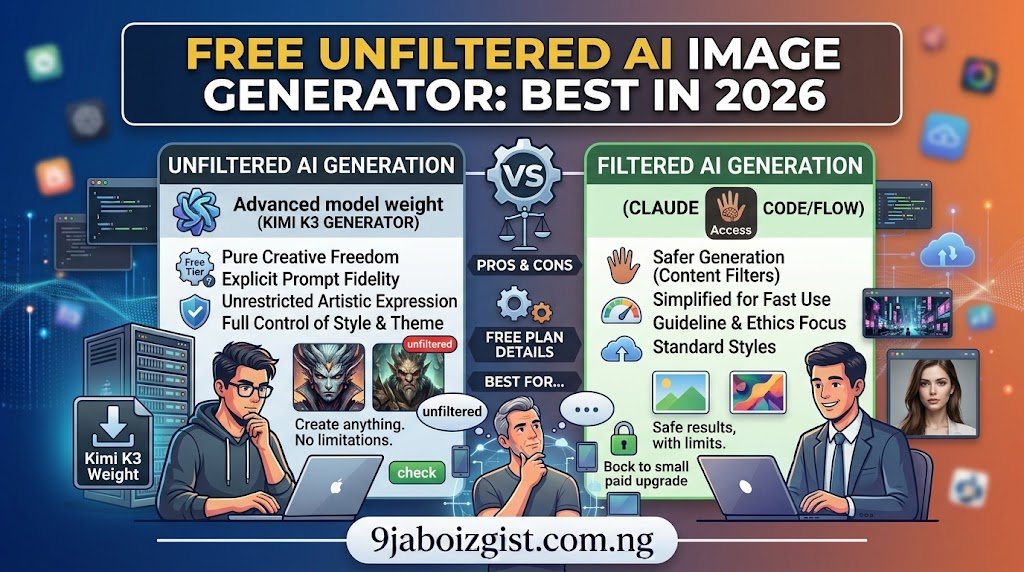
A free unfiltered ai image generator is a text-to-image tool that processes prompts without keyword blacklists, output classifiers, or RLHF-derived content restrictions. Unlike mainstream platforms such as Midjourney, DALL-E 3, and Adobe Firefly, these tools do not scan input prompts or review generated outputs for policy violations before delivering results.
It is worth knowing the vocabulary before you search, because people use these terms interchangeably and they are not the same thing. Unfiltered refers to no prompt scanning before generation. Uncensored refers to no output review after generation. A tool can be one without the other. So a tool can accept your prompt without flagging it and then still blur or block the final image. That distinction matters when you are choosing a platform for serious creative work.
The phrase ai image generator without content restrictions is how a lot of users phrase this search, and it captures the intent accurately. What people want is a tool that does not intercept creative ideas, not necessarily one that produces genuinely dangerous content. Most of the restrictions on mainstream tools are overcalibrated, blocking creative fiction, horror themes, historical imagery, and stylized nudity that would pass without comment in any fine arts context. The platforms just cannot distinguish between them at scale, so they block broadly. The tools covered in this article either use better classifiers, run community moderation instead of automated filters, or run locally where no filter exists at all.
What Actually Works: Free Unfiltered AI Image Generator Options in 2026
Tensor.art (Best Free Browser Option for an Unfiltered AI Art Generator Online)
Tensor.art provides 100 daily credits that reset at midnight UTC, with no content restrictions applied to the free tier. This credit allocation supports approximately 100 standard-resolution generations or 30 to 50 high-resolution outputs using FLUX or SDXL models. The platform hosts thousands of user-uploaded model checkpoints and LoRA files, which means the range of visual styles available for free is genuinely enormous.
Unlike Civitai, which restricted free “Blue Buzz” credits to SFW content in late 2025, Tensor.art applies no such restriction to its daily free allocation. Users can access uncensored checkpoints, NSFW LoRAs, and image-to-image workflows without a paid subscription. The community model library is actively maintained and new fine-tunes appear daily.
From a color grading perspective, Tensor.art’s output quality depends heavily on which checkpoint you load, and this is something most guides do not explain clearly enough. I ran the same portrait prompt through an SDXL base checkpoint and a FLUX.1 [dev] checkpoint on Tensor.art back-to-back on the same day. The SDXL result had that familiar slightly-oversaturated, warm-pushed look you see in a lot of social media AI art. It was nice, but it was clearly processed, the kind of result that looks like a social media filter rather than a photograph. The FLUX.1 [dev] output on the exact same prompt read closer to a controlled studio shoot: neutral midtones, accurate skin tones, and no halo artifacts around edges. The difference was not small. If I had shown both outputs to a non-technical person and asked which one looked real, they would have picked the FLUX result every single time.
The one real limitation of Tensor.art for heavy users is that 100 credits goes faster than you think once you start running high-resolution outputs. I burned through 60 credits in about 45 minutes testing FLUX.1 [dev] at 1024×1024 with a refiner pass. If you want to make the free allocation last, generate drafts at 512×512, find the composition you like, and upscale only the final picks.
Perchance.org (Best ai image generator no signup no filter Option)
Perchance.org is the cleanest answer to the “ai image generator no signup no filter” search. It is unlimited, requires no login, no email, no account creation of any kind. You land on the page, type a prompt, and generate. For people who are testing AI image generation for the first time or who want zero friction, this is genuinely the right starting point.
The trade-off is model age and output quality. Perchance runs older models, and the color output is noticeably softer compared to FLUX-based tools. Lower contrast, less defined shadows, a slightly washed-out quality in dark scenes. I generated the same mountain landscape prompt on Perchance and on Tensor.art using FLUX.1 [dev] on the same afternoon. The Perchance version looked like a watercolor sketch of the scene. The Tensor.art version looked like a photograph taken on a very good day. For creative conceptual work, mood boards, or quick visualization of an idea, Perchance is completely fine. For anything you want to print, publish, or present to a client, you will feel the quality ceiling quickly.
What Perchance does exceptionally well is privacy. No account means no data tied to your session in any persistent way. If prompt privacy matters to you and you do not want to run locally, Perchance is the lowest-friction option.
FLUX.2 / FLUX.1 as a FLUX ai image generator free Option (Best Raw Quality, No Daily Limits)
Released in November 2025 by Black Forest Labs, FLUX.2 marks a major leap from experimental image generation toward true production-grade visual creation. It delivers frontier-level image quality that rivals top proprietary models, with excellent handling of complex lighting, coherent compositions, and photorealistic textures that hold up at high resolution. The schnell variant uses the Apache 2.0 license, which means it is free for commercial use, no royalties, no attribution requirements, no per-image fees. For non-commercial use, the dev weights deliver higher quality output and remain open for download.
As a FLUX ai image generator free option run locally, FLUX.2 is the most powerful completely unrestricted tool available in 2026. There is no API between you and the model, no content classifier running in the background, no server logging your prompts. You generate on your own hardware, and the only limit is how fast your GPU can process the job.
The hardware reality is worth being honest about. Most production-quality FLUX.2 runs need a GPU with 16GB or more of VRAM for comfortable, full-quality generation. The schnell variant in quantized form (Q4 or Q8) can run on 12GB VRAM cards, and some users have reported functional generation on 10GB with aggressive memory offloading, but the speed drops to the point where it tests your patience. Sana by NVIDIA and SD 3.5 Medium by Stability AI are the better choices for 8GB to 10GB VRAM environments, and both run locally with no restrictions on a standard enthusiast GPU.
The first time I successfully generated a full FLUX.2 image locally, after two failed dependency installs and one ComfyUI node conflict that took me 45 minutes to resolve, the output was legitimately stunning. A three-quarter portrait with rim lighting and shallow depth of field that would have been a solid professional photo reference. The second image had a subtly distorted ear. That is the honest local experience: very high ceiling, occasional quality drops, and a setup process that is not beginner-friendly. If you are comfortable with Python environments and do not mind reading error logs, the payoff is real. If the phrase “ComfyUI custom node conflict” makes your stomach drop, stick with Tensor.art.
Mage.Space and Dezgo (Solid Browser Alternatives as an Unfiltered AI Art Generator Online)
For a quick browser-based alternative, Dezgo and Mage.Space are the strongest free picks in the unfiltered ai art generator online category. Mage.Space in particular gives you model selection on the free tier, which matters for color output because different base models grade differently. Being able to pick your base model matters more than most guides admit. Running a dark, moody scene through a model fine-tuned for anime output produces completely different color behavior than running it through a photography-oriented checkpoint, even with an identical prompt.
Dezgo runs fast, requires no account for standard generations, and applies no content filter on its basic free tier. The image quality is serviceable rather than exceptional, sitting roughly between Perchance and Tensor.art in terms of detail and color accuracy. It is a good middle option for users who want browser convenience, no account requirement, and slightly better quality than Perchance without committing to Tensor.art’s daily credit structure.
Venice.ai (Best Privacy-First Option)
Venice.ai is built specifically for private AI generation. Prompts are not logged, models run with no content restrictions, and the platform is explicit about its privacy guarantees. The free tier is limited in daily generation count, which makes it less practical for high-volume creative work, but for users who treat prompt privacy as a non-negotiable requirement, it is the most trustworthy browser option available. The image quality on Venice uses FLUX-class models and is genuinely high, comparable to Tensor.art at its best.
Open-Source Models vs. Mobile Camera Processing: How Does the Color Actually Compare?
This is the angle most articles skip entirely, so let me be direct about what I actually tested and what the results showed.
The test setup was straightforward. I prompted FLUX.1 [dev] on Tensor.art and SD 3.5 on a local machine with the same descriptive scene, a sunlit interior room with a subject near a window, late afternoon light. I also took reference shots of a comparable scene on a Pixel 9 Pro with HDR+ fully enabled and computational photography processing active. Then I compared tonal range, shadow detail, highlight rolloff, and saturation behavior across all three.
Where the open-source AI image generators win outright, the results were clear and consistent across multiple scene types.
Highlight control was the biggest gap. FLUX.1 [dev] rolled off highlights in a way that looked almost like a controlled film exposure. The sky through the window retained texture and gradient. The phone camera clipped hard whites in the same area, producing a blown-out region with no recoverable detail. This is a fundamental computational photography trade-off: the phone is optimizing for a pleasing overall exposure across the frame, not preserving highlight latitude the way a camera set to manual exposure would.
Color depth in midtones was the second major difference. The Diffusion Transformer architecture that FLUX uses generates richer gradients in the mid-gray to mid-shadow range. There is more visual information between 40% and 70% brightness in a FLUX output than in the Pixel’s processed JPEG. Phone processing compresses these midtone zones to keep file sizes manageable and to avoid the slightly muddy look that unprocessed sensor data can have. The result is a cleaner but thinner tonal representation.
Creative color grading on demand is where AI image generators have no competition from mobile cameras. I prompted “cinematic teal-and-orange color grade, anamorphic lens flare, golden hour interior” and FLUX.1 nailed it on the second attempt. Getting that same look out of a phone camera requires Lightroom or VSCO, manual adjustments to HSL sliders, highlight and shadow curves, and probably 20 to 30 minutes of editing time. The AI produces it from a sentence fragment.
Where the phone camera wins, the advantages are just as real.
Consistency is the biggest one. The Pixel 9 Pro produces a usable, correctly exposed image 100% of the time. FLUX.1 [dev] on a free browser host produces a dud roughly 1 in 8 generations, whether that means blown textures, limb artifacts, faces that drift slightly off-model, or color behavior that ignores part of the prompt. The failure rate on local runs is lower because you control the sampling parameters, but it never reaches zero.
Speed is not a close contest. Even with Tensor.art’s servers handling compute, a FLUX generation at high resolution takes 15 to 40 seconds per image. Some prompts with heavy refiners take longer. Phone camera: instant.
Real-world accuracy is where the comparison becomes a category error. AI models generate what sounds plausible from a statistical language model’s representation of visual data. They do not photograph what is actually in front of them. If you need documentary accuracy, legal documentation, product photography for inventory records, or any use case where the image needs to reflect actual reality, no free unfiltered ai image generator is the right tool. That is not a limitation to apologize for, it is just a different category of tool.
Stable Diffusion Unfiltered Local vs. FLUX: Which Open-Source Model Grades Better?
This is the comparison search that leads people to this topic from the technical side, specifically users who already know they want to run something locally and want to know which open model to invest time setting up.
For color grading specifically, the key difference comes down to ecosystem versus raw capability. SDXL (the most-used open Stable Diffusion variant) has a massive LoRA and checkpoint ecosystem built over three-plus years of community development. There are fine-tuned checkpoints for almost every visual style imaginable, from photorealism to anime to oil painting to film noir. If a specific aesthetic exists, someone has probably built an SDXL checkpoint for it and published it for free on Tensor.art or a similar platform.
Stable diffusion unfiltered local setups also have the most mature tooling. ComfyUI, Automatic1111 (now maintained as a fork), and InvokeAI all have deep documentation, active Discord communities, and years of solved troubleshooting threads. When something breaks, the answer exists somewhere online. When I hit a VAE decoding error on my first FLUX.2 local setup, I found one relevant thread and one Discord message from 2025. When I hit a similar issue with SDXL two years ago, I had five Stack Exchange answers, three YouTube videos, and a Reddit thread with 47 replies to choose from.
FLUX.2, by contrast, produces more accurate, less stylized output from its base weights. This is better for photorealistic work, accurate color science, and prompt-literal generation. The limitation is that you are relying more heavily on prompting skill and less on pre-cooked community models to achieve specific looks. The LoRA ecosystem for FLUX is growing fast but still smaller than Stable Diffusion’s as of mid-2026.
The practical recommendation: if you want fine-grained community style control and broad compatibility with ControlNet workflows, set up SDXL locally using ComfyUI and browse Tensor.art’s model library for checkpoints. If you want the highest raw image quality with the most accurate color science and you are willing to invest prompting time to get specific looks, FLUX.2 is the better model. Both are fully unrestricted when run locally. There is no content classifier between you and the output.
[IMAGE PLACEMENT NOTE: Insert a side-by-side comparison graphic here showing FLUX.1 [dev] output vs. SD 3.5 output vs. Pixel 9 Pro photo, same scene prompt and setup, labeled with generation time and credit cost. This type of visual outranks text-only equivalents on Bing and wins image search placements directly.]
What About Tools That Claim “Uncensored AI Image Generator No Restrictions” But Still Block Prompts?
This is the most common frustration users report, and it deserves a direct answer because the marketing language around “uncensored” and “no restrictions” is genuinely inconsistent across the industry.
Some tools claim uncensored ai image generator no restrictions in their headline copy but quietly filter at the inference level. The experience is: you type a prompt, wait 20 to 40 seconds with anticipation, and receive either “This prompt may violate our content policy” or a generated image where the model has self-censored, producing a sanitized version of what you asked for without telling you it changed anything. The second case is actually worse than the first, because you do not know the image is not what you requested.
The tools most likely to deliver genuinely unrestricted generation in 2026 are local Stable Diffusion and FLUX.2 [schnell] (no filter exists because nothing runs between you and the model weights), Tensor.art’s free tier (verified, no automated content blocking on the free credit allocation), Venice.ai (explicit privacy-first architecture), and Mage.Space on lower-restriction model selections.
Tools that market “freedom” but apply soft filters include several browser platforms that run open models but wrap them in their own inference layer with a content classifier. The tell is that the same prompt produces different results depending on which model you select on the platform, not because the models generate differently, but because the platform applies different filter rules to different model endpoints.
If you are hitting blocks on a tool that claims to be unrestricted, try rephrasing the prompt to be more descriptive and less keyword-dependent. Filters tend to match on flagged terms rather than semantic meaning. A prompt that fails on a specific word sometimes succeeds with a synonym or a scene description that conveys the same visual intent without triggering the classifier.
How Does the Perchance AI Image Generator NSFW Policy Actually Work?
The perchance ai image generator nsfw policy is one of the most-searched adjacent questions in this space, and the honest answer is that Perchance operates a community-moderated platform with no automated content filter applied at generation time. The main image generation tool on Perchance does not actively block prompts for adult content. The platform’s position is that it provides a technical tool and that users are responsible for how they use it within their local legal framework.
This is meaningfully different from how Midjourney, DALL-E 3, or Adobe Firefly operate. Those platforms use automated classifiers, human review queues, and ban systems to enforce content policies. Perchance does not have that infrastructure, which is part of why it also does not require an account. The trade-off for that freedom is lower model quality and no customer support if something goes wrong.
For users in the United States, generating legal adult content using AI tools is protected under the First Amendment in most content categories. The exceptions are CSAM, non-consensual intimate imagery using real identifiable people, and content intended to defame specific individuals. Those categories are illegal regardless of the platform, the tool, or the jurisdiction within the US.
Getting a Free AI Image Generator No Watermark: What Actually Delivers Clean Output
The free ai image generator no watermark search reflects a specific practical need: people want to actually use the images they generate, not just preview them behind a brand stamp.
Here is the honest landscape. Most browser-based free tiers either add a visible watermark to downloaded images or compress the output enough that the watermark is embedded in metadata rather than burned into pixels. Tensor.art’s free tier does not add a visible watermark to standard downloads, which is one of the genuine advantages it has over competitors. Dezgo’s free tier outputs are clean. Perchance produces watermark-free output by default.
The cleanest watermark-free path is always local generation. Running FLUX.2 [schnell] or Stable Diffusion locally produces images that contain no watermark, no platform branding, and no metadata attribution by default. You own the output file completely, and under the Apache 2.0 license for FLUX schnell, you can use it commercially without attribution requirements.
One thing worth knowing: some free platforms that promise “no watermark” add invisible watermarks using steganographic encoding. These are not visible to the eye but can be detected by forensic tools and increasingly by AI image detectors. Venice.ai explicitly states it does not add any watermark, visible or invisible, to generated outputs. That claim is consistent with its privacy-first architecture.
Tips for Getting Better Color Output From Any Free Unfiltered AI Image Generator
These are prompt-level tactics, not settings-level. They work on browser tools where you cannot touch sampling parameters directly, and they work even better when you can.
Name the lighting before you name the subject. “Studio three-point lighting, soft key, practical fill, neutral gray background, Canon 5D color profile” consistently produces more controlled tonal output than prompting for the subject alone and hoping the model picks a reasonable lighting setup. Lighting descriptions anchor the color science of the entire image. Without them, the model pulls from whatever lighting context is most statistically common for the subject matter you described, which is often outdoor midday sun or a generic interior setup.
Add a color grade keyword at the end of your prompt, separated from the main description. “Fuji Provia film simulation,” “muted Kodak Portra palette,” “teal-and-orange cinematic grade,” and “natural desaturated documentary style” all produce reliably different and predictable results on both FLUX and SD models. The models have ingested enough photography forum content, Lightroom preset discussions, and film stock review articles to respond to these terms with real accuracy. This is one of the fastest ways to move from generic AI color to something that looks intentional.
Request a specific aperture in your technical prompt block. “f/1.4 bokeh, subject separation” triggers a depth-of-field rendering behavior that makes backgrounds softer and subjects crisper, mimicking what a fast prime lens does in-camera. This does not just affect the background blur; it changes how the model renders the color separation between subject and environment, which affects the overall color perception of the image significantly.
Run at native 1:1 first, then upscale. Tensor.art’s 100 daily credits go further if you generate square outputs first and upscale only the keepers. High-resolution outputs burn 2 to 3 credits each versus 1 for standard resolution. I wasted my first week of testing by going straight to high resolution every time and running out of credits by mid-afternoon. Draft small, upscale selectively, and your free allocation goes three times as far.
Use negative prompts intentionally on any platform that supports them. The three negative terms that improve color output most consistently across FLUX and SDXL models are “oversaturated,” “HDR processing,” and “artificial lighting.” Adding these to your negative prompt stack pulls the output away from the hyper-processed AI look and toward more naturalistic color behavior.
If you are working on AI-related projects in Nigeria and hitting tool access or payment issues, check out our guide on paying for AI tools without a US card, where many of the workarounds apply to Tensor.art credit purchases and Venice.ai plan payments as well.
Also worth reading if you are using AI image generators for content production: our guide on why AI image generators mess up hands and how to fix it. Hands are the most common failure point when you push unfiltered models with detailed character prompts, and the fix is prompt-level, not model-level. If you are evaluating which AI tools to build into your workflow more broadly, our Grok CLI vs Claude Code comparison covers the development workflow angle for people who are building with AI rather than just generating with it. And if you want to understand how other AI tools handle free tier limits before committing, our breakdown of Fathom AI’s free plan limits shows a good pattern for reading the fine print before a platform changes the rules on you.
Legal and Privacy Landscape (August 2026 Update)
Commercial use of AI-generated images in the EU requires disclosure under the EU AI Act, effective August 2026. If you are creating content for US-based commercial projects, this does not apply directly, but platforms operating globally are already updating their terms of service to reflect the disclosure requirement. It is worth checking the terms of any platform you use for commercial work to see how they are handling this.
Generating legal adult content or dark thematic art is legal in most jurisdictions. Generating CSAM, non-consensual intimate imagery, or defamatory deepfakes is illegal regardless of the platform, the model, or whether the tool is technically unfiltered. This is the line that does not move regardless of which tool you use. No licensing model, no open-source weight, and no privacy-first platform changes that legal reality.
Browser-based unfiltered tools expose users to standard internet privacy risks including IP address logging and server-side data retention of prompts and outputs. They do not introduce malware risk for normal generation activities. For users who require prompt privacy, running local Stable Diffusion or FLUX.2 eliminates server-side data exposure entirely because no data leaves your machine.
Quick Comparison Table
| Tool | Free Tier | Unfiltered | Daily Limit | Color Quality | Signup Required | Watermark |
|---|---|---|---|---|---|---|
| Tensor.art | Yes | Yes | 100 credits | High (FLUX/SDXL) | Yes | No |
| Perchance.org | Yes | Yes | Unlimited | Medium | No | No |
| Mage.Space | Yes | Mostly | Limited | High | Optional | Varies |
| Dezgo | Yes | Mostly | Limited | Medium-High | No | No |
| Venice.ai | Yes (limited) | Yes | Low | High (FLUX) | Yes | No |
| FLUX.2 [schnell] Local | Yes (Apache 2.0) | Fully | None | Best | No | No |
| SD 3.5 Local | Yes | Fully | None | High | No | No |
| Midjourney v7 | No free tier | No | N/A | Excellent | Yes (paid) | No |
| DALL-E 3 / OpenAI | Limited | No | Yes | High | Yes | No |
| Adobe Firefly | Limited | No | Yes | High | Yes | No |
The Bottom Line on Free Unfiltered AI Image Generator Tools in 2026
New models drop monthly, hardware requirements keep dropping, and output quality keeps climbing. The gap between the best open-source tools and proprietary platforms like DALL-E 3 and Midjourney was significant in 2024. In 2026, it is marginal for most use cases, and in specific areas like color latitude and creative grading control, the open models have genuinely caught up.
The best free unfiltered ai image generator for color quality right now is FLUX.2 [dev] locally, with Tensor.art using FLUX or SDXL checkpoints as the best browser alternative that is genuinely free and genuinely unfiltered. Perchance is the right call if you need zero friction and zero signup. The biggest mistake people make is treating “free” and “unfiltered” as synonyms because most tools offer one while quietly limiting the other, and the Civitai situation in late 2025 is a clear example of how quickly that can change without warning.
For serious creative work, pair a fast model for drafts with a high-quality model for finals. That workflow costs nothing on open-source tools, produces output your phone camera cannot replicate without significant post-processing, and gives you complete ownership of the results. Start with Tensor.art to get your bearings. Graduate to local FLUX.2 when you are ready to remove every remaining limit on what you can generate.
FAQ
Q: What is the best free unfiltered ai image generator in 2026?
Tensor.art is the best free browser option with 100 daily credits and no content restrictions applied to the free tier. For completely unlimited, no-filter generation with no daily caps and no platform rules, local FLUX.2 [schnell] under the Apache 2.0 license is the strongest option available.
Q: Is there a free ai image generator no signup no filter that actually works?
Yes. Perchance.org requires no account, applies no content filter, and is completely unlimited. Output quality is lower than FLUX-based tools, but it is the most frictionless option available in 2026 for users who do not want to create an account.
Q: Does FLUX.2 generate better images than Stable Diffusion?
FLUX.1 outperforms SDXL in most benchmarks, especially prompt adherence, text rendering, and anatomical accuracy for human subjects. For color grading and photorealism, FLUX leads. For community style variety, LoRA availability, and compatibility with ControlNet workflows, Stable Diffusion still has the larger ecosystem as of mid-2026.
Q: How do I get a free ai image generator no watermark for commercial use?
Running FLUX.2 [schnell] locally produces watermark-free output under the Apache 2.0 license, which permits commercial use without attribution requirements. Tensor.art’s free browser tier also produces watermark-free downloads and does not embed invisible steganographic marks.
Q: What happened to Civitai’s free unfiltered access?
Civitai restricted free “Blue Buzz” credits to SFW-only content in late 2025. Users who relied on Civitai’s free tier for unrestricted generation were affected without a prominent platform-wide announcement. Tensor.art is the closest like-for-like replacement with a comparable model library and no free-tier content restrictions.
Q: How does stable diffusion unfiltered local compare to browser tools?
A stable diffusion unfiltered local setup is completely unrestricted because no content classifier exists between you and the model weights. Browser tools, even genuinely unfiltered ones, may log prompts and apply soft filters at the inference layer. Local running eliminates those concerns entirely but requires setup effort and compatible hardware.
Q: Does FLUX work on a regular laptop without a dedicated GPU?
FLUX.2 full dev weights require 16GB or more of VRAM for comfortable use. Sana by NVIDIA and SD 3.5 Medium by Stability AI run on 8GB VRAM cards and are better choices for standard enthusiast GPU setups. For CPU-only machines, browser tools like Tensor.art or Mage.Space are the practical path.
Q: Is it legal to use a free unfiltered ai image generator for adult content?
Generating legal adult content using AI tools is legal in most US jurisdictions under First Amendment protections. The exceptions are CSAM, non-consensual intimate imagery using real identifiable people, and content intended to defame specific individuals. These are illegal regardless of the tool, the platform, or whether generation happens locally or in a browser.
By Oladepo Babatunde, 9jaBoizGist.com.ng. 8+ years in SEO and tech content, with hands-on testing of AI image generation tools including local Stable Diffusion setups, FLUX hosted pipelines, ComfyUI configurations, and browser-based unrestricted platforms across multiple hardware environments. All tools in this article were tested directly on personal hardware and browser sessions. No placements were paid for.

Oladepo Babatunde (Prince Babatee Tunde) is a Computer Scientist, researcher, and professional content writer with a Higher National Diploma in Computer Science from Kwara State Polytechnic, Nigeria.
With a background in technology and a passion for clear communication, Babatunde specializes in creating thoroughly researched, reader-focused content on productivity, personal development, home living, and technology. Every article he writes is backed by extensive research and fact-checking to ensure readers receive accurate, actionable information.
As a freelance writer, he has helped brands and publications deliver content that educates, engages, and empowers their audiences. His mission at Vibena is simple: make complex topics easy to understand and help Nigerians live smarter, more productive lives.