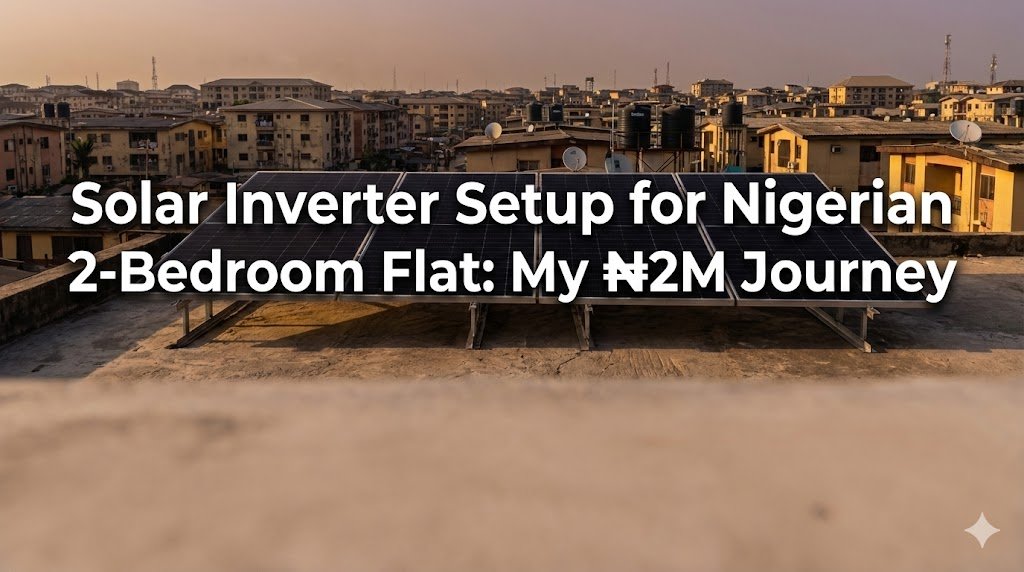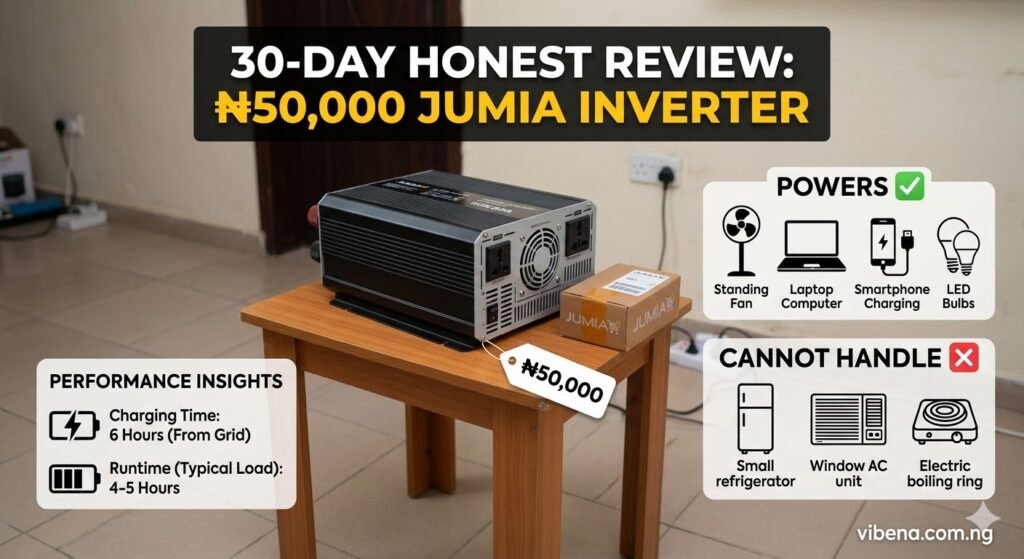
Solar panel prices in Nigeria depend on more than wattage. Buying a panel is not just about choosing the highest rating or the cheapest price. A panel must match your inverter’s solar input limits, fit the available roof space and come with specifications and warranty documents you can verify. A 550W panel that looks like a bargain can become an expensive mistake if its label is misleading or its voltage is unsuitable for your inverter.
This guide explains current Nigerian price indications, panel technologies, brands and model specifications, how to compare panels, and what to check before paying. Prices are market observations, not fixed national prices; confirm stock, exact model and delivery cost with the seller before making payment.
Solar panel prices in Nigeria in 2026
Solar panel prices vary by wattage, cell technology, brand, model, seller, stock and warranty support. A recent Nigerian market survey checked retailer websites and marketplace listings in November 2026. It reported these typical asking-price ranges for new panels:
| Panel rating | Indicative asking-price range |
|---|---|
| 100W | ₦25,000–₦35,000 |
| 200W | ₦50,000–₦55,000 |
| 300W | ₦55,000–₦65,000 |
| 400W | ₦75,000–₦90,000 |
| 450W | ₦80,000–₦110,000 |
| 500W | ₦100,000–₦125,000 |
| 550W | ₦105,000–₦140,000 |
| 600W | ₦115,000–₦140,000 |
| 620W | ₦125,000–₦140,000 |
| 650W | ₦120,000–₦140,000 |
| 700W | ₦130,000–₦145,000 |
These are indicative market-survey ranges, not guaranteed shop prices or quotes. The survey describes checking 13 Nigerian solar retailers and marketplace listings and rechecking prices on 9 November 2026. See the November 2026 solar panel price survey.
The figures above are a broad market snapshot, not a promise that every brand or model in that wattage range sells for the same amount. Model-specific listings checked on 26 November 2026 show why buyers should compare like with like:
| Listed panel | Advertised price | Listing source |
|---|---|---|
| Jinko Tiger Pro 550W mono | ₦125,000 | Betapawa 550W listings |
| Canadian Solar HiKu6 550W mono | ₦162,000 | Betapawa 550W listings |
| LONGi Hi-MO 5 550W mono | ₦165,000 | Betapawa 550W listings |
| Jinko 620W bifacial N-type | ₦130,000 | Betapawa Jinko listings |
| Jinko Tiger Neo 620W bifacial (JKM620N-66HL4M-BDV) | ₦134,000 | Solepower model listing |
| Trina Solar 715W bifacial | ₦158,000 | PVPRO November Lagos price list |
These are seller-advertised prices, not independently verified completed-sale prices. They may exclude delivery, installation or other charges, and stock can change. A market tracker that aggregates Nigerian shop listings also shows that prices per watt vary by seller and listing date; see the Suny Nigeria solar price tracker. The November market survey above sampled a wider range of retailers and marketplaces, so use it as a guide to typical asking prices rather than a fixed national tariff.
For a fair comparison, request written quotes for the same manufacturer, model code, wattage, technology and warranty. Do not compare a generic 550W panel with a named N-type bifacial module as though they were identical products.
Before paying, ask whether the quoted amount includes delivery, mounting accessories, installation, VAT where applicable and any warranty registration. A panel price alone is not the total cost of putting a working solar array on your roof.
How to compare solar panel prices fairly
Compare the cost per rated watt, not only the total price of each panel.
Price per watt = panel price ÷ rated panel wattage.
For example, a 450W panel selling for ₦95,000 costs about ₦211 per watt. A 550W panel selling for ₦120,000 costs about ₦218 per watt. A 620W panel selling for ₦130,000 costs about ₦210 per watt.
This calculation helps compare different panel sizes, but it does not prove that one panel is better. Check the model, electrical specifications, physical dimensions, warranty and seller support as well. A very low price can reflect a clearance sale, older stock, a different technology, a used panel or an inaccurate listing. Ask questions before concluding that it is a bargain.
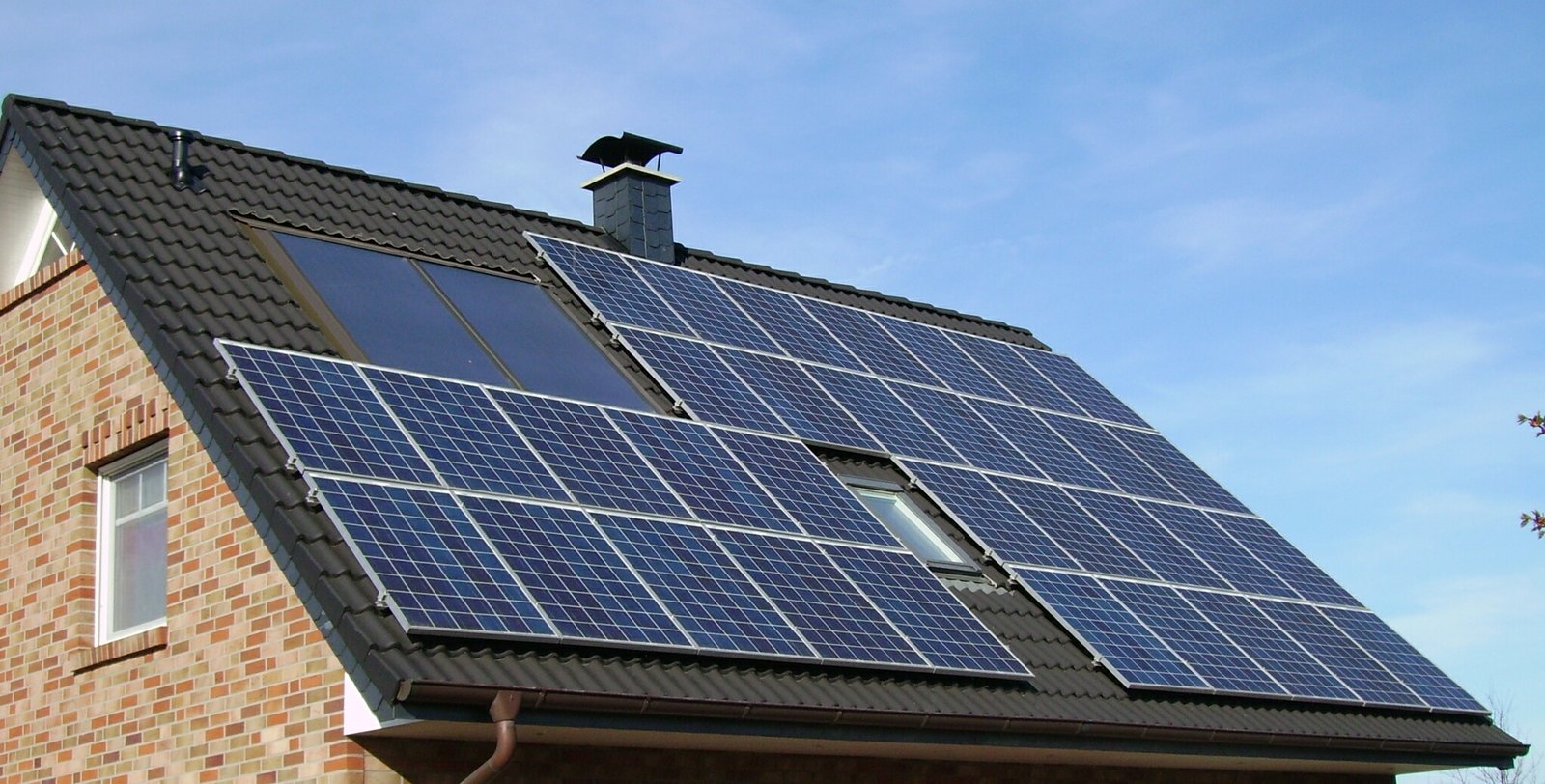
Solar panel technologies: PERC, TOPCon and bifacial explained
Panel wattage is only one part of the buying decision. The cell technology and module design also matter.
Monocrystalline PERC
PERC means Passivated Emitter and Rear Cell. It is an established monocrystalline cell design used in many solar modules. PERC panels can be a sensible option when the price is competitive and the exact model has suitable specifications and a verifiable warranty. Do not reject a panel only because it is PERC; compare its efficiency, temperature coefficient, price and datasheet with the alternatives.
N-type TOPCon
TOPCon means Tunnel Oxide Passivated Contact. It is a newer cell architecture used in many current high-efficiency modules. N-type TOPCon panels can offer high module efficiency and favourable degradation and temperature characteristics, depending on the model. Jinko’s official Tiger Neo product range describes its N-type TOPCon technology and publishes product-specific efficiency, temperature-coefficient and warranty information.
Do not assume every panel carrying the words “N-type” or “TOPCon” has identical performance. Ask for the exact model datasheet and check its figures.
Bifacial panels
A bifacial panel can generate electricity from its front and rear surfaces. The additional rear-side energy depends on how much useful light reaches the back of the panel. Roof colour, ground reflectivity, mounting height, tilt, spacing and rear-side shading all affect the result.
A bifacial panel mounted close to a dark roof may receive little useful reflected light. Therefore, do not pay a large premium because a seller promises a fixed 20% or 30% extra output. Ask how the proposed mounting arrangement will expose the rear surface and whether the manufacturer’s bifaciality data applies to the exact model.
Polycrystalline panels
Polycrystalline panels are an older technology and are still encountered in some markets. Compare their price per watt, efficiency, physical size and warranty with current monocrystalline options. For a new installation with limited roof space, a modern higher-efficiency panel may make better use of the available area.
Solar panel brands to compare in Nigeria
There is no single brand that is automatically best for every Nigerian buyer. The exact model, genuine product documentation, seller, warranty and compatibility with your inverter matter more than a brand name printed on the frame.
Jinko Solar
Jinko’s Tiger Neo range includes N-type TOPCon modules. Its published product information lists high-efficiency options and a 30-year linear power warranty for specified products. Warranty terms differ by model and market, so request the warranty document that applies to the exact panel being sold. A Jinko Tiger Neo 605–630W datasheet provides model-level electrical and mechanical specifications.
LONGi Solar
LONGi’s Hi-MO product families include high-power modules. Its official Hi-MO 7 datasheet identifies the relevant module range, certifications and warranty terms. Check that the model code on the seller’s panel matches the document.
Trina Solar
Trina’s Vertex N family includes high-power N-type modules. Compare the exact module’s Pmax, Voc, Vmp, Isc, Imp, dimensions and temperature coefficients with your inverter and installation design. Do not use a specification sheet for a different Vertex model as proof of the panel being offered.
Canadian Solar
Canadian Solar offers several module families, including TOPCon products. Product specifications and warranty terms vary between series. Ask for the manufacturer’s datasheet and applicable warranty rather than relying on a seller’s generic “30-year warranty” claim.
Other brands and locally distributed products may suit a buyer’s budget. The same checks still apply: exact model number, datasheet, serial number, certification documents, warranty provider and local after-sales support.
How to read a solar panel specification label
The label on the back of a panel contains information an installer needs to design a safe and compatible array. Learn these six specifications before buying:
| Label term | What it means | Why it matters |
|---|---|---|
| Pmax | Maximum rated power in watts | The panel’s rated output under the stated test conditions. |
| Voc | Open-circuit voltage | Important when calculating maximum string voltage. |
| Vmp | Voltage at maximum power | Must fit the inverter’s MPPT operating range. |
| Isc | Short-circuit current | Used when checking current and protection limits. |
| Imp | Current at maximum power | Helps check the operating current of a string. |
| Temperature coefficient | How output changes with cell temperature | Helps estimate performance in hot conditions. |
Also check the maximum system voltage, maximum series fuse rating, module dimensions, weight, connector type and power tolerance. These details affect installation, mounting and electrical design.
Example: a Jinko Tiger Neo 620W module
The referenced Jinko Tiger Neo 605–630W datasheet includes model-specific electrical ratings. For the 620W variant used in this example, the published figures are approximately 620W Pmax, 40.74V Vmp, 15.22A Imp, 49.08V Voc and 16.08A Isc. These figures belong to that particular model variant; another 620W panel can have different voltage, current and dimensions.
Always compare the model code and the complete datasheet, not only the wattage printed in an online advert.
Why a 550W solar panel may not produce 550W all day
Manufacturers rate panel power under Standard Test Conditions (STC): irradiance of 1,000W/m², cell temperature of 25°C and an air-mass value of 1.5. These are controlled test conditions, not a promise of constant rooftop output in Nigeria.
Actual power changes with sunlight intensity, cell temperature, cloud, dust, shading, orientation, wiring and conversion losses. A panel can briefly approach its rated output in suitable conditions, but it will not produce its nameplate wattage continuously from morning to evening.
Illustrative temperature calculation
Suppose a 550W panel has a maximum-power temperature coefficient of -0.29% per °C. If its cell temperature is 60°C, that is 35°C above the 25°C STC reference. The simplified temperature-related reduction is 35 × 0.29% = 10.15%.
550W × (1 − 0.1015) gives approximately 494W. This is a temperature-only illustration. It assumes the same irradiance and does not account for clouds, shading, dirt, wiring or inverter losses. Actual output can be higher or lower.
How much electricity can one solar panel generate daily?
A useful preliminary estimate is:
Daily energy (kWh) = panel capacity (kW) × peak-sun-hours × performance ratio.
For example, a 550W panel is 0.55kW. If you assume 4.5 peak-sun-hours and a 75% performance ratio, the estimate is 0.55 × 4.5 × 0.75 = about 1.86kWh per day.
This is an illustration, not a guaranteed daily yield for every Nigerian state or season. Solar resource differs by location and weather. Use the World Bank and ESMAP Global Solar Atlas to examine solar resource and photovoltaic output estimates for the actual installation location. A qualified designer should also account for orientation, shading, system losses and seasonal variation.
How many solar panels should you buy?
The number depends on the energy you need, the available sunlight, battery charging requirements, roof space and the inverter’s PV input limits. A simple capacity comparison is:
Number of panels = required array capacity ÷ rated wattage of one panel.
For an illustrative 3,300W array, six 550W panels give 3,300W of nameplate capacity. Six 620W panels give 3,720W. Eight 450W panels give 3,600W. These totals compare rated capacity only; they do not prove that the panels can be connected safely to a particular inverter.
Array sizing also needs a daily energy estimate and a decision about how much energy must be stored in the battery. Panel wattage alone cannot tell you whether a system will run an air conditioner, refrigerator or other appliance for the required hours. Do not choose panel quantity from the inverter’s kVA rating alone. Check the inverter’s maximum PV power, MPPT voltage range, maximum PV open-circuit voltage, input current, short-circuit current and number of MPPT trackers. For a household load and battery calculation, see our guide to choosing a solar inverter size for a home in Nigeria.
How to check solar panel and inverter compatibility
Ask for the exact inverter model and its manual before buying panels. Then have the installer check:
- Maximum PV open-circuit voltage: the calculated string Voc, including the effect of the lowest expected cell temperature, must stay below the inverter’s limit.
- MPPT operating range: the string’s operating voltage must fall within the inverter’s tracking range.
- Maximum PV input current: the panel or parallel-string current must not exceed the input limit.
- Maximum short-circuit current: the array’s Isc must remain within the inverter’s permitted limit.
- Maximum PV power: check the manufacturer’s permitted array size and any oversizing rules.
- MPPT trackers: separate roof orientations or strings may need separate trackers, depending on the inverter design.
Series and parallel connections
When identical panels are connected in series, their voltages add while the string current remains approximately the same. Three panels with a 41V Vmp each would have about 123V Vmp at STC. Their Voc values also add, and the cold-weather voltage calculation is essential.
When strings are connected in parallel, voltage stays approximately the same while current adds. That can exceed an inverter’s PV input-current limit if the array is not designed correctly.
Do not connect panels based on wattage alone or copy a wiring arrangement from another installation. Panel strings, cable sizes, connectors, fuses, isolators, earthing and surge protection must be designed for the actual equipment. Use a qualified solar installer for system design and electrical work.
For a broader household setup and cost discussion, read our guide to solar inverter setup costs for Nigerian homes. If your installed array is not charging the battery, see our troubleshooting guide on solar inverter charging problems.
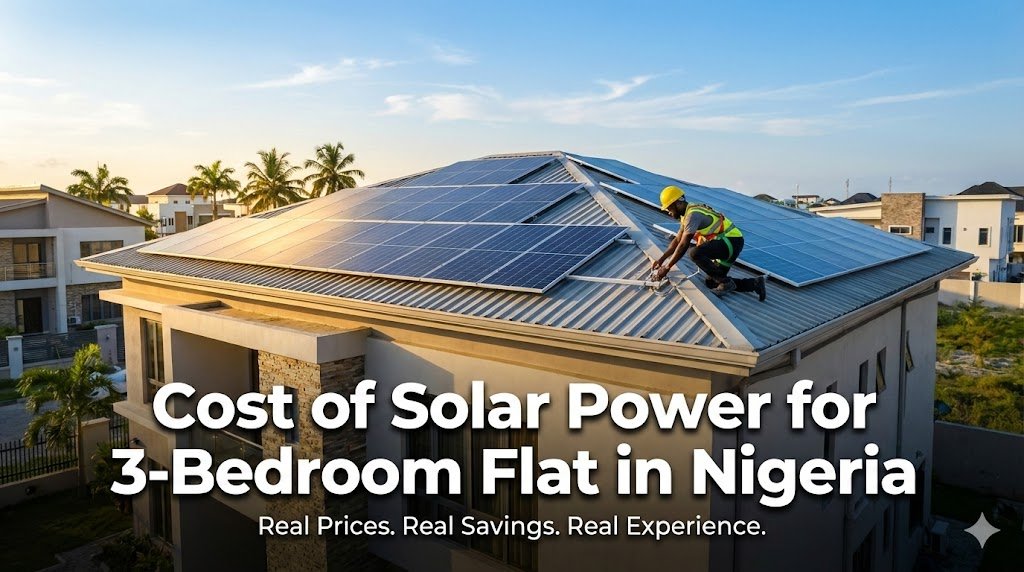
Roof space, direction and shading
A panel’s rated power is not the only thing that determines energy production. The installation location matters.
- Direction: Nigeria is north of the equator, so a fixed array facing generally towards true south is often a useful starting point. The best orientation depends on the location, roof and when electricity is needed.
- Tilt: the installer should choose a suitable angle for the location and mounting structure. A single tilt is not ideal for every roof or use case.
- Shading: trees, water tanks, parapets, neighbouring buildings and satellite dishes can reduce output. Inspect the roof at different times of day.
- Roof strength: check the roof structure, waterproofing, wind exposure and mounting points before installation.
- Access: leave a safe route for inspection and cleaning without walking on the panels.
Partial shading can affect a string more than buyers expect. The effect depends on the module’s cell layout, bypass diodes and how the panels are wired. Ask the installer to assess recurring shade before deciding where to mount the array.
What do IEC 61215 and IEC 61730 mean?
IEC 61215 covers design qualification and type-approval testing for terrestrial photovoltaic modules. It subjects modules to defined environmental and electrical tests. Passing the tests does not guarantee a specific service life or prove that a panel will produce a fixed amount of electricity for 25 or 30 years.
IEC 61730 covers photovoltaic module safety qualification, including construction and protection against electrical shock, fire and mechanical hazards. Ask the seller for documentation that identifies the exact model or applicable product family. Do not accept a certificate for an unrelated model as proof for the panel being offered.
For commercial imports, check current Nigerian conformity and import requirements with the Standards Organisation of Nigeria or a qualified clearing agent. Do not assume a generic certificate or logo automatically proves that a particular shipment has met every applicable requirement.
Solar panel warranties: what should you check?
Solar panel warranties commonly have two different parts:
- Product warranty: covers specified manufacturing, material or workmanship defects for the stated period and subject to the warranty conditions.
- Performance warranty: promises that the module will retain at least a stated percentage of its rated power over time, subject to the manufacturer’s terms and measurement conditions.
A 30-year performance warranty is not the same as a 30-year free replacement warranty. The product warranty may be shorter. For example, the referenced LONGi Hi-MO 7 datasheet lists a 12-year materials and processing warranty and a 30-year extra linear power warranty for that product series. Always check the current document for the exact model.
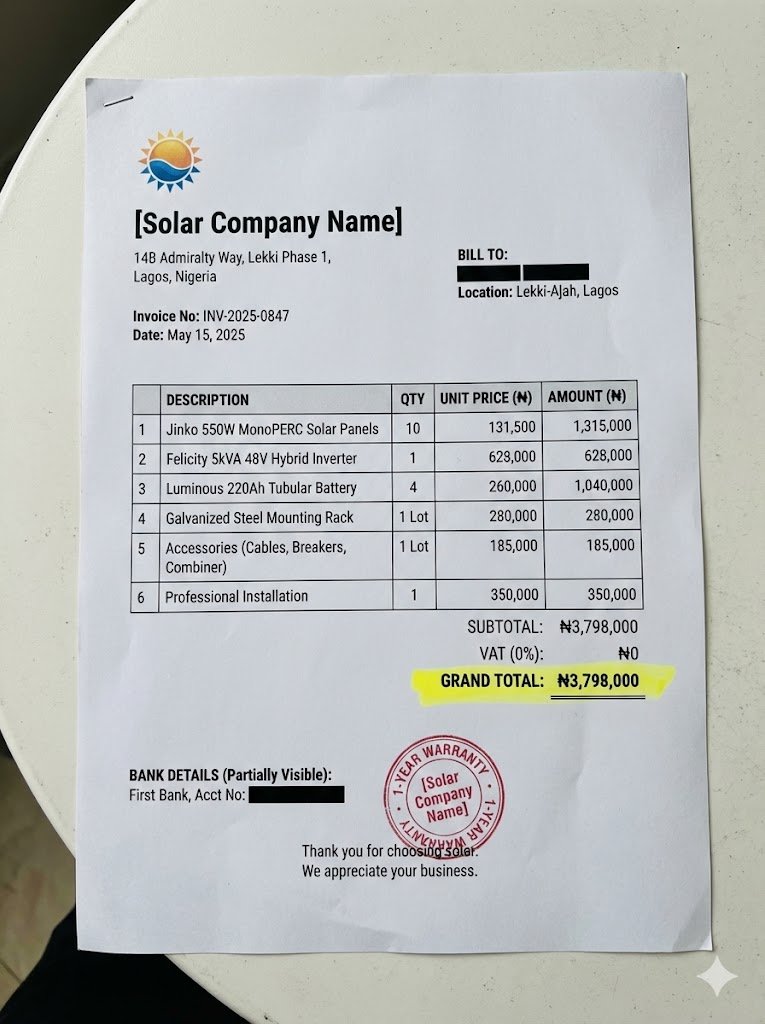
Before paying, ask who handles claims in Nigeria, what proof of purchase is required, whether the serial number is recorded, who pays transport costs and whether the seller will still support the product if the original salesperson leaves the business. Keep the invoice, model number, serial number, datasheet and warranty document.
How to inspect a solar panel before paying
Inspect the actual panel, not only the product photograph in an online listing.
- Check the manufacturer name and exact model code on the rear label.
- Photograph the serial number and barcode.
- Compare the label’s Pmax, Voc, Vmp, Isc and Imp with the manufacturer’s datasheet.
- Inspect the front glass for cracks, chips and deep scratches.
- Check the frame for bends, dents and signs of poor handling.
- Inspect the junction box, cable insulation and connectors for damage or corrosion.
- Ask whether the panel is new, used, refurbished, old stock or a clearance item.
- Request the invoice and written warranty terms before making payment.
- Ask the manufacturer or authorised distributor how to verify the serial number where that service is available.
- For bulk purchases, arrange a suitable professional inspection or electrical test before accepting the delivery.
A multimeter reading taken in uncontrolled sunlight does not prove that a panel delivers its full rated wattage. Proper output testing requires suitable measurement equipment and known irradiance and temperature conditions. Do not attempt unsafe electrical tests yourself.
Common mistakes when buying solar panels
- Choosing the panel with the highest wattage without checking its voltage and current.
- Assuming every 550W panel has the same electrical specifications.
- Paying extra for bifacial panels without considering rear-side light.
- Believing that a 30-year performance warranty means 30 years of free replacement.
- Buying from a seller who cannot provide a model number, invoice or warranty terms.
- Ignoring roof shading and structural condition.
- Mixing different panel models in one string without a proper electrical design.
- Assuming a panel will produce its rated wattage throughout the day.
- Choosing the number of panels based only on the inverter’s kVA rating.
- Forgetting delivery, mounting, cabling and protection costs when comparing quotes.
Frequently asked questions
How much is a 550W solar panel in Nigeria?
A November 2026 market survey reported a typical range of about ₦105,000–₦140,000 for 550W panels. However, model-specific listings checked on 26 November ranged from ₦125,000 for a Jinko Tiger Pro mono panel to ₦162,000–₦165,000 for listed Canadian Solar and LONGi models. Confirm the exact model, stock, warranty and delivery charge before paying.
How much is a 620W solar panel in Nigeria?
The November market survey reported about ₦125,000–₦140,000 as a typical range. A Jinko 620W bifacial model was listed at ₦130,000 by one retailer and a specific Tiger Neo 620W model at ₦134,000 by another seller on 26 November 2026. Check the model code and obtain a current written quote.
Which solar panel brand is best in Nigeria?
Jinko, LONGi, Trina and Canadian Solar are established manufacturers worth comparing. There is no universal winner. Compare exact model specifications, genuine serial numbers, warranty terms, price and local support.
Is TOPCon better than PERC?
TOPCon modules can offer higher efficiency and favourable degradation and temperature characteristics, depending on the product. PERC can still be a sensible purchase when its price, specifications and warranty make sense. Compare actual datasheets rather than technology labels alone.
Are bifacial solar panels worth buying?
They can be worthwhile when the rear side receives useful reflected light. The benefit depends on the mounting height, surface below the panels, spacing, tilt and shading. A bifacial panel installed close to a dark roof may deliver little extra rear-side energy.
Can a 550W solar panel charge a 48V battery?
It may be part of a system that charges a 48V battery, but the panel does not connect directly to the battery in a typical properly designed setup. The charge controller or hybrid inverter must support the panel’s voltage and current, and the battery charging settings must match the battery manufacturer’s requirements.
How many 550W panels do I need for a 5kVA inverter?
There is no safe universal number. A 5kVA inverter’s PV input power, MPPT voltage range, maximum PV voltage and input-current limits vary by model. Check the exact inverter manual and have the array designed around those limits and your energy needs.
Do solar panels work on cloudy days?
Yes. Panels can generate electricity from diffuse daylight, but output is usually lower than under strong direct sunlight. Heavy cloud, rain, shading and dirt can reduce production.
How long do solar panels last?
Many modern modules carry performance warranties of 25 or 30 years, but the warranty is not a promise that the panel will suddenly stop working when it ends. Output gradually declines, and actual service life depends on product quality, installation, weather and maintenance.
How can I identify an original solar panel?
Check the model code, serial number, label and datasheet against the manufacturer’s documentation. Ask the manufacturer or authorised distributor about serial verification and buy from a seller who provides an invoice and written warranty. No single sticker or logo proves authenticity by itself.
Conclusion
The right solar panel is not necessarily the biggest or cheapest one. It is the panel with genuine, verifiable specifications that fits your inverter, roof and energy requirements, backed by warranty support you can actually use.
Before paying, compare the price per watt, read the datasheet, check the panel label and get the inverter compatibility confirmed. If the seller cannot identify the exact model or explain the warranty, pause the purchase and compare another supplier. A careful check before payment can save you from expensive replacement and installation problems later.

Oladepo Babatunde (also known as Prince Babatee Tunde) is a Computer Scientist, researcher, professional content writer and SEO content strategist with more than eight years of experience. He holds a Higher National Diploma (HND) in Computer Science from Kwara State Polytechnic, Nigeria, and is based in Ilorin, Kwara State. As a freelance writer, he creates research-led, practical content on technology, Nigerian internet services, AI tools, gadgets and solar power. His work combines research, source checking, technical understanding and SEO strategy. Where an article includes hands-on testing, the product, method and relevant conditions are described in the article; research-based guides are identified as such.