Buying a USB-C charger sounds straightforward, but the USB-C connector alone does not tell you how fast it will charge. Two adapters marked 45W can behave differently because they support different charging standards, voltage profiles and cables. In Nigeria, buyers must also check the exact model, UK or EU plug version, seller and warranty.
This guide compares practical USB-C charger options, explains 20W to 65W charging, and shows what to check for iPhones, Samsung, TECNO, Infinix, Xiaomi phones, tablets and laptops. Price figures are historical seller-listing snapshots captured during topic research; they are not live quotes and may no longer be available. Confirm the current price and stock with the seller before paying.
Quick buying recommendations
- Basic phone charging: a genuine 20W USB-C PD charger is enough for many compatible phones.
- Everyday phone and tablet use: consider a 30W PD charger.
- Compatible premium phones and tablets: a 45W charger may offer more flexibility, but check PPS and the device’s protocol.
- Compatible laptops: consider 65W USB-C PD or the laptop maker’s specified wattage.
- Several devices: check the charger’s power-sharing table; total wattage is not available to every port simultaneously.
USB-C chargers available in Nigeria
These are examples to compare, not a laboratory ranking. We have not independently tested their speed, temperature or long-term reliability. Specifications come from manufacturer information; prices are observed listing snapshots and can change.
| Model | Output | Oraimo Nigeria listing snapshot | Best use |
|---|---|---|---|
| Oraimo PowerCube 202 UK Type | 20W | About ₦6,000 | Basic phone charging |
| Oraimo PowerCube 201 UK Type | 20W | About ₦7,500 | Everyday phone charging |
| Oraimo PowerGaN 251 | 25W GaN | About ₦9,000 | Compatible phones |
| Oraimo PowerGaN 351 | 35W GaN | About ₦10,500 | Compatible phones and some tablets |
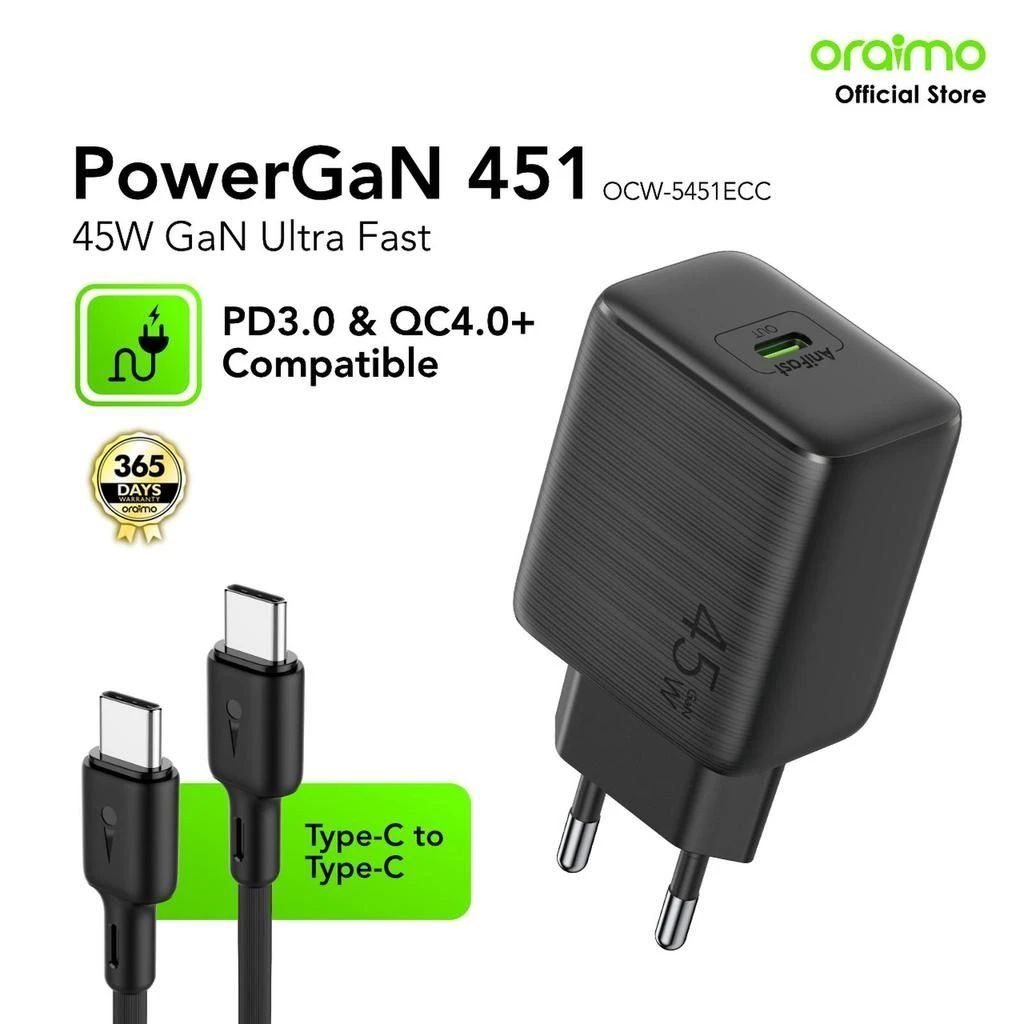
| Oraimo PowerGaN 451 (OCW-5451U) | 45W, PD 3.0, QC 4.0+ | About ₦14,000 | Compatible phones, tablets and selected low-power laptops |
| Oraimo HyperGaN 65 | 65W GaN kit with 100W USB-C cable | About ₦42,900 | Compatible USB-C laptops, tablets and phones |
Prices are snapshots displayed on Oraimo Nigeria’s wall-charger store when checked on 26 November 2026. They can change and do not guarantee stock. The official PowerGaN 451 product page provides model-specific output details. Confirm the exact variant and plug before ordering.
1. Oraimo PowerCube 201: a basic 20W option
A 20W adapter may be enough if you mainly charge one compatible phone. Oraimo’s Nigerian store has listed the PowerCube 201 UK-plug charger kit at around ₦7,500. Check the current product page for the exact connector, bundle and output details.
A 20W charger can suit compatible iPhones and many phones that support USB Power Delivery. It will not necessarily activate the maximum fast-charging mode on Android phones that rely on a proprietary protocol.
2. Oraimo PowerGaN 451: a 45W everyday option
The PowerGaN 451 model OCW-5451U is listed with a UK Type G plug, 100–240V input, one USB-C output and up to 45W. Its listed profiles include 5V/3A, 9V/3A, 12V/3A, 15V/3A and 20V/2.25A. Oraimo specifies PD 3.0 and QC 4.0+ support and a USB-C-to-USB-C cable.
Oraimo’s Nigeria store has shown a price around ₦14,000, while third-party listings differ. Confirm that the seller is offering OCW-5451U and that the box includes the cable. A 45W maximum does not mean every phone will draw 45W. A laptop may also need more power or a different charging profile.
Check Oraimo’s official PowerGaN 451 specifications.
3. Oraimo HyperGaN 65: for compatible laptops
A 65W charger can be more flexible if you want one adapter for a compatible laptop, tablet and phone. Oraimo’s Nigeria store has listed the HyperGaN 65 kit at about ₦42,900. Check the product page for its exact port layout, included cable and current price.
Confirm that your laptop supports charging through USB-C. Some USB-C ports transfer data but do not accept power. If the laptop normally uses a 90W or 100W adapter, a 65W charger may charge more slowly or struggle under heavy use. Connecting another device can also reduce the power available to the laptop.
4. Oraimo PowerGaN 351: a 35W middle-ground option
Oraimo’s Nigeria store lists the PowerGaN 351 at around ₦10,500. Its 35W rating sits between basic 20W phone adapters and higher-output 45W or 65W models. It may suit compatible phones and some tablets, but check the exact device’s charging protocol and the charger’s output label rather than assuming every device will draw 35W.
Check the current Oraimo Nigeria wall-charger listing for availability and exact kit contents.
5. Oraimo PowerGaN 251: compact 25W charging
The PowerGaN 251 is listed by Oraimo Nigeria at around ₦9,000 and is advertised as a 25W GaN charger with PD 3.0 and QC 3.0 compatibility. It is worth comparing if your phone supports 25W charging and you do not need laptop-level output. Confirm the connector, included cable and exact model variant before purchase.
See Oraimo’s current official charger range.
What do 20W, 25W, 30W, 35W, 45W and 65W mean?
Wattage measures the rate of power delivery. The basic formula is Watts = Volts × Amps. For example, 9V × 3A equals 27W, while 20V × 3.25A equals 65W. These are possible power combinations, not a guarantee that a connected device will use them.
A charger offers one or more voltage and current combinations. The connected device negotiates a supported level. A 65W adapter does not force 65W into a phone that only accepts a lower rate.
| Rating | Typical use | Check first |
|---|---|---|
| 20W | Many phones and accessories | USB-PD and phone input limit |
| 25W–30W | Phones and some tablets | PD/PPS profiles and device limit |
| 35W–45W | Some premium phones, tablets and selected small laptops | Protocol, cable and device limit |
| 65W | Many USB-C laptops, tablets and phones | PD support and port output |
USB-C, USB Power Delivery and PPS are different
USB-C is the connector
USB-C describes the shape of the port and plug. It does not guarantee a particular charging speed, data speed or protocol.
USB Power Delivery
USB-PD is a charging standard used by many phones, tablets and laptops. The charger and device negotiate an appropriate power level. It is important when choosing an adapter for an iPhone, iPad or USB-C laptop.
Programmable Power Supply
PPS is an optional USB-PD feature that allows compatible devices to request adjustments to voltage and current. Some Samsung Galaxy models use USB-PD PPS for Super Fast Charging. A charger with enough wattage but no required PPS support may charge the phone without enabling the expected charging mode.
Choosing a charger for your phone
iPhone
Apple says iPhone 12 and later models that support fast charging can use a 20W or higher USB-C power adapter with a suitable cable. The actual rate depends on the iPhone model, battery level, temperature and use. Read Apple’s fast-charge guidance.
Samsung Galaxy
Check whether your exact Galaxy supports 25W or 45W charging and whether it needs USB-PD PPS for the relevant Super Fast Charging mode. Samsung’s cable requirements depend on the phone generation: some earlier 45W Super Fast Charging 2.0 setups specify a 5A cable, while Samsung’s updated guidance notes that Galaxy S25 and later models can use the 3A cable supplied with the device. Check the instructions for your exact model. Read Samsung’s charging guidance.
TECNO and Infinix
Do not assume a generic 45W PD charger will reproduce the maximum speed advertised for every model. Some phones use brand-specific charging technologies. Check the exact model, original adapter rating and supported protocol. A universal USB-C charger may still work, but at a lower rate.
Xiaomi, Redmi and POCO
Charging speeds vary by model. Some use Xiaomi-specific fast-charging modes and suitable cables. Confirm the exact model’s input and protocol before buying a third-party adapter.
Choosing a USB-C charger for a laptop
First confirm that the laptop accepts charging through USB-C. Then check its recommended adapter wattage. A USB-C port does not necessarily support power input just because it transfers data. For a laptop expecting 65W USB-PD, choose a charger that can provide the required power from the port you will use.
For charging above 60W, use a cable explicitly rated for the required wattage; USB-C cables designed for higher-power USB-PD use need the appropriate electronic marking. USB-IF guidance distinguishes 60W and 240W cable ratings. See the USB-IF USB charging and Power Delivery resources and its USB-C cable power-rating guidance. Our guide to laptop power banks in Nigeria explains why USB-C output matters as much as battery capacity.
Why the cable matters
- Use a USB-C-to-USB-C cable for a USB-C PD charger and compatible device.
- For laptop charging above 60W, check the cable’s power rating and electronic marking requirements.
- For Samsung 45W charging, follow the model-specific cable requirement; some supported setups need a 5A cable.
- Do not assume a thick or expensive cable supports 100W or 240W. Check its rating and certification.
- Replace cables with damaged connectors, exposed wires or loose plugs.
Are GaN chargers worth it?
GaN means gallium nitride, a semiconductor material used in power electronics. It allows manufacturers to build relatively compact chargers with substantial output. This is useful for travel or when you carry a laptop and phone. However, GaN is not a charging protocol and does not guarantee better safety or faster charging. Compare the actual output, safety information, warranty and independent reviews.
How to avoid unsuitable or counterfeit chargers in Nigeria
- Check the model number: compare the code on the charger, box and manufacturer’s website.
- Use a traceable seller: prefer the manufacturer or an authorised retailer. Marketplace ratings alone do not prove authenticity.
- Read the output label: check voltage, current and power profiles, not just the headline wattage.
- Confirm the plug: a UK Type G plug is convenient for many Nigerian sockets. Do not assume an EU two-pin version is interchangeable without a safe, suitable adapter.
- Check the input range: 100–240V, 50/60Hz indicates a wide input range, but the charger must still be genuine and undamaged.
- Check the cable and box contents: confirm whether a cable is included and whether it supports the required power.
- Ask about warranty: keep your receipt and confirm where a faulty unit can be serviced.
- Be cautious with suspiciously cheap products: missing specifications, unclear branding and no seller details are warning signs.
Stop using a charger that sparks, smells burnt, makes unusual noises, has a damaged casing or becomes abnormally hot. Do not open or repair a mains charger yourself.
Charging during power fluctuations
Use a sound wall socket and avoid loose, burnt or damaged extensions. A genuine charger with a wide input range is designed for the range printed on its label, but it is not a substitute for correcting unsafe wiring or a faulty socket. If your supply regularly behaves abnormally, ask a qualified electrician to inspect the installation.
For broader home backup planning, see our guide to power and internet backup for remote work in Nigeria.
Frequently asked questions
Is a 65W USB-C charger safe for a 20W phone?
Generally, yes, if it is genuine and compliant. The phone negotiates a supported charging level; 65W is the adapter’s maximum capability, not power forced into every device.
Can I use an iPhone USB-C charger for Samsung?
A USB-C PD charger may charge a compatible Samsung phone, but it may not enable Samsung’s fastest charging mode. Check the phone’s PPS requirement and the adapter’s specifications.
Does every USB-C charger support fast charging?
No. Fast charging depends on the charger’s output profiles, the device’s supported protocol and the cable.
Is 45W better than 25W?
Only if your device can use the extra power or you need the adapter for another device. A phone limited to 25W will not charge at 45W just because you connect a more powerful adapter.
Can a 65W charger charge every laptop?
No. The laptop must accept USB-C charging and the adapter must meet its power requirements. Some laptops need more than 65W.
Why does my phone show normal charging instead of fast charging?
Possible causes include an incompatible protocol, unsuitable cable, dirty or damaged port, high device temperature, a phone setting or a charger that cannot provide the required profile. Check the phone maker’s guidance before replacing accessories.
Do I need GaN?
No. GaN can make higher-power chargers smaller, but a well-made conventional charger can also work. Choose based on compatibility, safety, size, price and warranty.
Can one multi-port charger power a laptop and phone together?
Yes, if both devices are supported and the shared-output arrangement provides enough power. Connecting a second device can reduce the wattage available to the laptop.
Conclusion: buy for compatibility, not the biggest number
The best USB-C charger is the one that supports your device’s charging standard, provides enough power, works with the right cable and comes from a seller you can trace. For many phones, 20W to 30W is sufficient. A 45W option can suit compatible premium phones and tablets, while a 65W PD charger is more useful if you also need to power a compatible laptop.
Before paying, compare the exact model number, output profiles, plug type, cable rating, warranty and current seller price. That check is more valuable than buying the adapter with the highest wattage printed on its box.
Sources and specifications
- Oraimo Nigeria: wall chargers and listed prices
- Oraimo PowerGaN 451 specifications
- Apple fast-charge guidance
- Samsung charging guidance
- USB-IF USB charging and Power Delivery resources
- USB-IF USB-C cable power-rating guidance

Oladepo Babatunde (also known as Prince Babatee Tunde) is a Computer Scientist, researcher, professional content writer and SEO content strategist with more than eight years of experience. He holds a Higher National Diploma (HND) in Computer Science from Kwara State Polytechnic, Nigeria, and is based in Ilorin, Kwara State. As a freelance writer, he creates research-led, practical content on technology, Nigerian internet services, AI tools, gadgets and solar power. His work combines research, source checking, technical understanding and SEO strategy. Where an article includes hands-on testing, the product, method and relevant conditions are described in the article; research-based guides are identified as such.