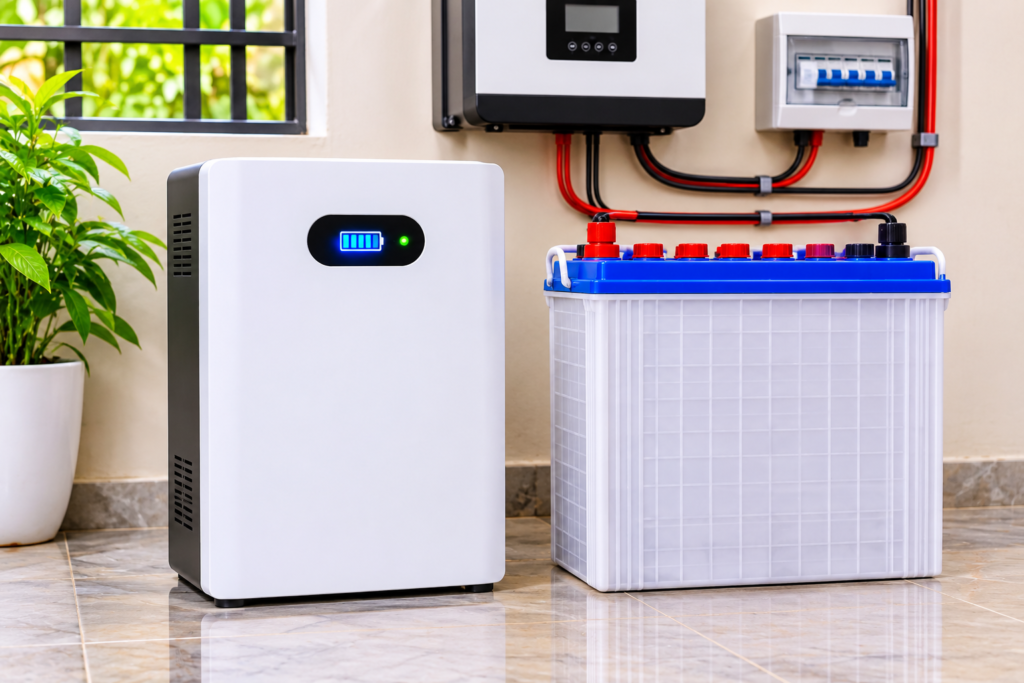
If you are buying an inverter battery in Nigeria, the lithium vs tubular battery decision can affect your upfront cost, backup time and long-term maintenance. You will likely compare lithium with tubular lead-acid. Lithium usually costs more upfront, while tubular batteries often look cheaper. But the price tag alone does not tell you which gives better value. Compare usable energy, charging, cycle life, maintenance, warranty and inverter compatibility.
Quick answer: A good LiFePO₄ lithium battery is often the stronger choice for a home that cycles its battery daily and can afford the upfront cost. A quality tubular battery can still make sense when the budget is tight, usage is less demanding and the owner can maintain it properly.
This comparison focuses on lithium iron phosphate (LiFePO₄) and deep-cycle tubular lead-acid batteries used with home inverters. Not every product sold under either label has the same performance.
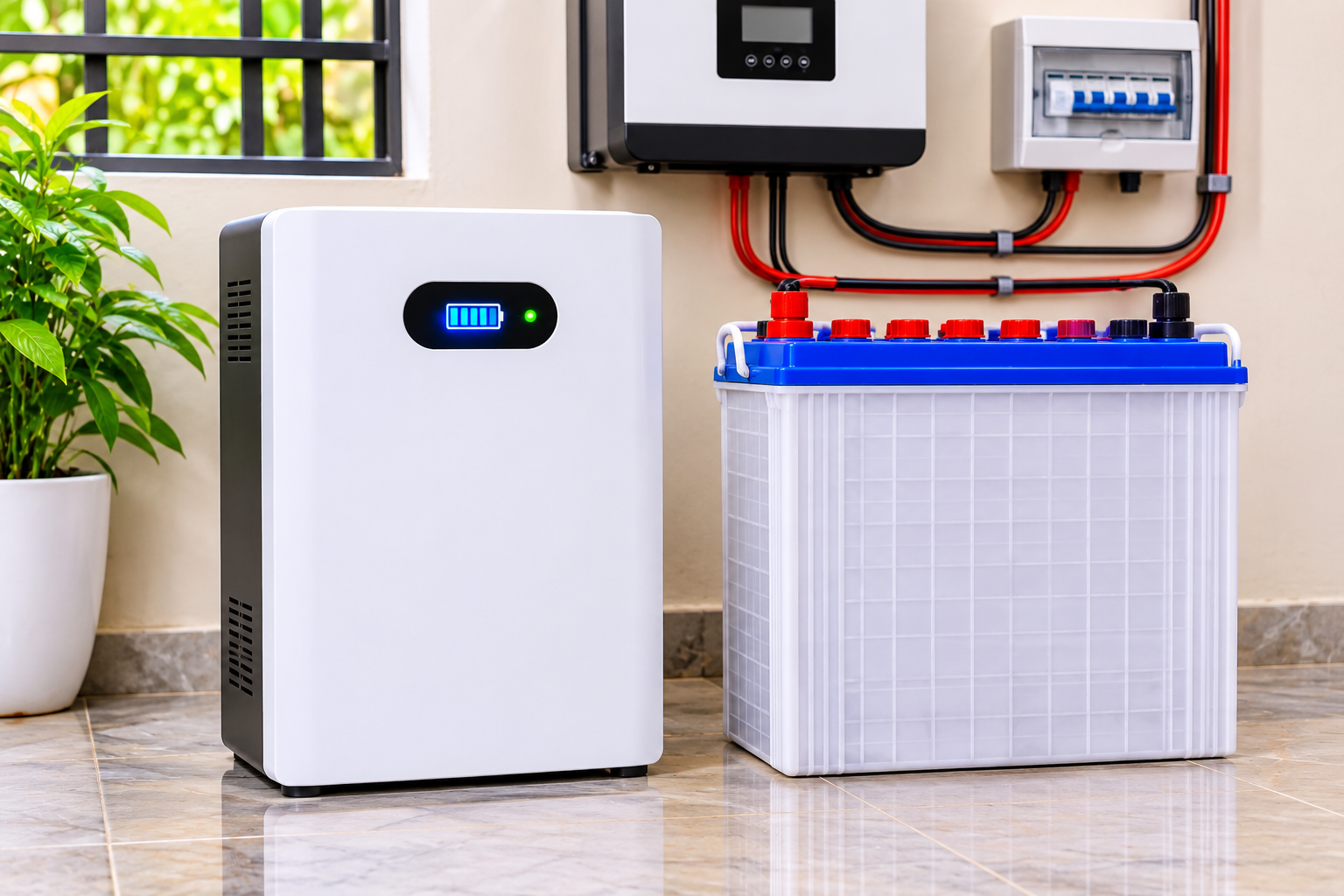
Lithium vs tubular battery: the main differences
LiFePO₄ is a rechargeable lithium chemistry used in solar storage. A tubular battery is a deep-cycle lead-acid design with tubular positive plates.
| Feature | LiFePO₄ lithium | Tubular lead-acid |
|---|---|---|
| Upfront price | Usually higher per unit | Usually lower per unit |
| Usable capacity | Often higher share of rated energy | Plan for a more conservative discharge depth |
| Charging | Can accept relatively high current within BMS limits | Usually takes longer; follow the charging profile |
| Maintenance | Low routine maintenance | Flooded models may need electrolyte checks |
| Weight | Generally lighter | Heavy |
| Cycle life | Often rated for more cycles | Usually fewer cycles, especially with deep discharge |
| Protection | Usually has a battery management system (BMS) | Needs correct inverter settings and external protection |
| Typical fit | Frequent cycling and lower maintenance | Lower upfront budget and less demanding use |
These are general differences. The exact model, temperature, charging settings, depth of discharge and installation quality matter.
Current lithium and tubular battery prices in Nigeria
Battery prices change with stock, exchange rates, brand and warranty. The examples below combine Nigerian listings checked in October 2026 with a Felicity Nigeria product-page price visible in November 2026. They are snapshots, not fixed national prices or guaranteed checkout quotations. Confirm the exact model, stock, delivery cost and written warranty before paying.
| Battery type/model | Rated capacity | Observed price |
|---|---|---|
| Felicity tall tubular | 12V, 220Ah | ₦385,000–₦423,500 |
| Luminous tall tubular | 12V, 220Ah | ₦396,800–₦435,000 |
| Felicity LiFePO₄ (October listings) | 51.2V, 100Ah (5.12kWh) | ₦1.36m–₦1.38m |
| Felicity LPBF48100 (Felicity Nigeria page, November listing) | 51.2V, 100Ah (5.12kWh) | ₦1,149,000 displayed |
| Felicity 5.12kWh (Jumia listing) | 51.2V, 100Ah | ₦1,873,500 displayed |
| Dyness LiFePO₄ (October listings) | 51.2V, 100Ah (5.12kWh) | ₦1.48m–₦1.718m |
Prices vary widely by brand and seller. A Nigerian listing sample published on 27 October 2026 put many 12V 220Ah tubular batteries around ₦250,000–₦290,000, while premium branded examples in the table were higher. For lithium, the Felicity Nigeria LPBF48100 product page displayed ₦1,149,000 when checked, while a Jumia listing for a 5.12kWh Felicity battery displayed ₦1,873,500. These are different sellers’ advertised prices, not proof of a single market rate. Check whether the exact model, warranty and seller are genuine before ordering.
Do not compare a 12V tubular battery with a 48V lithium battery as if they were equivalent. A 48V tubular bank may require four 12V batteries connected in series. Ask for the model number, voltage, capacity, warranty, manufacturing date, return policy and whether installation and protection equipment are included.
Why Ah ratings can mislead buyers
Ah alone does not tell you how much energy a battery stores. Voltage matters too. Nominal energy (Wh) = voltage × amp-hours.
A 12V 220Ah battery stores about 2,640Wh or 2.64kWh nominally. Four connected in series make a 48V bank with 220Ah and about 10.56kWh nominal energy. Series connection increases voltage; it does not add the Ah rating.
A 51.2V 100Ah lithium battery stores about 5.12kWh. That is why “200Ah versus 100Ah” is not a fair comparison unless voltage is also stated.
Usable capacity: four tubular batteries vs one 5kWh lithium battery
Not all the energy on a battery label should be treated as available for daily use. The usable share depends on the manufacturer’s recommended depth of discharge (DoD), battery condition and system losses.
Four 12V 220Ah tubular batteries
- Nominal bank: 48V, 220Ah
- Nominal energy: 48V × 220Ah = 10.56kWh
- Illustrative planning DoD: 50%
- Usable energy before inverter losses: about 5.28kWh
One 51.2V 100Ah lithium battery
- Nominal energy: 51.2V × 100Ah = 5.12kWh
- Illustrative usable DoD: 90%
- Usable energy before inverter losses: about 4.61kWh
In this example, the tubular bank has slightly more planned usable energy, but it uses four heavy batteries and has a larger nominal capacity. The lithium pack is a compact single unit with a higher assumed usable percentage. These are illustrative calculations, not a sizing recommendation; check the exact datasheet and allow for inverter losses.
To estimate backup time, divide usable energy by average load in kilowatts. For example, 4kWh supplying an average 500W load would theoretically last eight hours before inverter losses, load variation and reserve. Refrigerators, pumps and air conditioners do not draw constant power.
List the appliances you intend to run, their actual watts and realistic operating hours. Our solar inverter setup for a Nigerian two-bedroom flat explains why household usage—not bedroom count—determines system size.
Which battery costs less over its lifetime?
The cheapest battery to buy is not always the cheapest to own. Compare the complete bank cost, usable energy, rated cycle life, warranty, maintenance and likely replacement cost.
Using the higher-priced branded tubular listings above, four Felicity 220Ah batteries would cost roughly ₦1.54m–₦1.69m before cables, installation and protection. Four Luminous 220Ah units would cost roughly ₦1.59m–₦1.74m. Lower-priced 220Ah listings also exist, so this is not the cheapest possible tubular-bank estimate. The November Felicity Nigeria listing displayed ₦1,149,000 for one LPBF48100 battery, while other sellers displayed much higher prices for similar advertised capacity. These are individual listing calculations, not package quotations; verify model codes and warranty directly with the seller.
This does not prove lithium is always cheaper or supplies exactly the same energy. The tubular bank has higher nominal capacity in this example, while the lithium pack has a different usable-capacity profile and may have a much higher rated cycle life.
Read the conditions attached to cycle-life claims. A manufacturer may state a cycle count at a particular DoD, temperature and end-of-life capacity. Do not turn a laboratory cycle figure into a guaranteed number of years in every Nigerian home.
Ask for the cycle rating, test depth of discharge, temperature conditions, warranty length, guaranteed end-of-warranty capacity and local warranty-claim process. A cycle rating and a warranty are not the same thing.
Charging speed during Nigerian power outages
Lithium batteries can often accept a higher charging current than comparable lead-acid batteries, which can help when grid power or sunlight is available for a short time. But the battery’s maximum charging current is not necessarily what your inverter can deliver.
Check the inverter’s grid and solar charging current, the battery’s recommended current, charge-controller limits, temperature limits and communication requirements. A large battery connected to a small charger may take many hours to recharge. Never exceed the manufacturer’s charging limits to save time.
For example, the Felicity LPBF48100-A official user manual specifies a recommended charge/discharge current of up to 80A for that model and lists its operating limits. Its manufacturer datasheet states at least 6,000 cycles under 0.2C charge/discharge at 25°C and 80% DoD. Obtain the manual for the exact model revision and do not copy settings from another battery.
Battery lifespan and cycle ratings
LiFePO₄ batteries are commonly marketed with cycle-life ratings in the thousands. The published manual for one Felicity 51.2V 100Ah model specifies at least 6,000 cycles under stated test conditions and a five-year warranty for that product. This is model-specific, not a promise that every lithium battery will achieve the same result.
Tubular battery life depends on discharge depth, frequency, whether it is fully recharged, temperature and maintenance. Repeatedly taking a battery to a very low state of charge can shorten its service life.
Ask for the exact datasheet and warranty. Check what the cycle rating means, what capacity remains at end of life, and who handles warranty claims in Nigeria. Avoid blanket claims such as “all lithium lasts 15 years” or “all tubular batteries last three years.”
Maintenance: what owners need to do
Tubular lead-acid batteries
Flooded tubular batteries may need electrolyte-level checks and topping up with distilled or deionised water as directed by the manufacturer. Keep terminals clean, check for corrosion, secure connections and use correct charging settings. Provide suitable ventilation because lead-acid batteries can release gas during charging.
Not every lead-acid battery is flooded. Sealed AGM and gel batteries must not be opened or topped up. Follow the manual for the exact battery. For a documented example, Luminous Nigeria’s Inverlast product page describes its 220Ah, 12V tubular model and its electrolyte and maintenance features.
LiFePO₄ batteries
Lithium batteries generally need less routine maintenance, but still require inspection. Keep cables and terminals secure, check the inverter and BMS for warnings, maintain the specified temperature range and use compatible charging settings. Do not open the battery pack or attempt a DIY BMS repair.
Can you replace a tubular battery with lithium?
Sometimes, but not automatically. Both products being called “48V” does not guarantee compatibility. Confirm that the inverter supports the lithium battery’s nominal voltage and voltage range, approved charging profile, current limits and BMS communication. Check CAN or RS485 support and firmware requirements for the exact models.
Some lithium batteries can operate with voltage-based settings when communication is unavailable, but use that method only if both manufacturers document it. Do not simply select “lithium” in the inverter menu and assume the system is compatible. An older inverter may need replacement or an approved configuration change. Ask the inverter or battery manufacturer or a qualified installer before purchasing.
Safety considerations for Nigerian homes
- Use correctly rated cables, fuses, breakers and isolators.
- Keep terminals covered and away from children and loose metal objects.
- Provide required ventilation for flooded lead-acid batteries. Nigeria’s Electricity Supply and Installation Standards Regulations include battery-bank ventilation and maintenance provisions; have a qualified installer apply the relevant safety requirements to your installation.
- Keep batteries away from flames, sparks, water leaks and excessive heat.
- Do not mix batteries of different ages, capacities or chemistries unless the manufacturer explicitly permits it.
- Have the system installed and inspected by a competent professional.
LiFePO₄ is generally more thermally stable than some other lithium-ion chemistries, but it is not fireproof. A BMS is a protection layer, not a substitute for correct wiring, fusing and installation.
Which battery should you buy?
Choose LiFePO₄ lithium if:
- You charge and discharge the battery most days.
- You want a higher usable share of rated capacity.
- You can afford a reputable battery and compatible inverter.
- You want less routine maintenance and a lighter installation.
Choose tubular if:
- Your upfront budget is limited.
- Your system is used less frequently or for shorter backup periods.
- Your inverter is designed for lead-acid and you do not want to replace it.
- You can provide ventilation and maintenance and avoid routine deep discharge.
Neither battery can compensate for an undersized system. If your battery drains quickly, check the load, battery health, inverter settings and charging source. See our guide to why an inverter battery drains fast before buying a replacement.
Common mistakes when buying an inverter battery
- Comparing Ah without voltage: 100Ah at 48V stores much more energy than 100Ah at 12V.
- Buying by price alone: Check model, usable capacity, warranty and local support.
- Assuming every lithium battery is LiFePO₄: Confirm the chemistry on the datasheet.
- Ignoring inverter compatibility: Check voltage, charging current, communication and firmware.
- Believing an unqualified lifespan claim: Ask for cycle-test conditions and warranty terms.
- Mixing old and new batteries: Follow the manufacturer’s rules for battery banks and expansion.
- Ignoring installation protection: Correct cables, breakers, fuses and ventilation matter.
Frequently asked questions
Is lithium better than tubular battery in Nigeria?
For many homes that cycle their battery daily, a quality LiFePO₄ battery is often the stronger long-term option because of usable capacity, low routine maintenance and cycle-life potential. Tubular can still suit a tighter budget when used and maintained correctly.
How much is a 5kWh lithium battery in Nigeria?
Prices vary by seller and model. In November 2026, the Felicity Nigeria LPBF48100 product page displayed ₦1,149,000, while another marketplace listing for a 5.12kWh Felicity battery displayed ₦1,873,500. Treat these as seller-specific advertised prices, not a guaranteed market range. Confirm stock, model code, warranty and seller support before paying.
How much is a 220Ah tubular battery in Nigeria?
Selected 12V 220Ah tubular listings observed in October 2026 were around ₦385,000–₦435,000. Other brands and sellers may be cheaper or more expensive.
How many tubular batteries equal one 5kWh lithium battery?
There is no exact answer without voltage and usable DoD. Four 12V 220Ah tubular batteries in a 48V series bank have about 10.56kWh nominal energy. At an illustrative 50% DoD, that is about 5.28kWh before inverter losses. A 51.2V 100Ah lithium battery has 5.12kWh nominal energy and may allow a higher usable percentage, depending on its datasheet.
Can I replace my tubular battery with lithium?
Only if the inverter supports the lithium battery’s voltage range, charging profile and current limits. Check BMS communication and firmware requirements for the exact models before changing batteries.
Can a lithium battery work with an ordinary inverter?
Some lithium batteries work with selected inverters using approved voltage-based settings, while others require communication or a compatible lithium profile. Check both manufacturers’ compatibility information.
Which battery is better for daily power outages?
A correctly sized LiFePO₄ battery is often a better fit for frequent cycling if the inverter and charging source are compatible. Tubular can work, but repeated deep discharge may shorten its life.
Can solar panels charge lithium batteries?
Yes, if the inverter or charge controller supports the battery’s voltage and charging requirements. Use the correct charging limits and manufacturer settings.
Does a lithium battery last 10 years?
Some products are designed for long service, but no fixed lifespan applies to every battery. Check cycle rating, test conditions, warranty, temperature limits and daily usage.
Final recommendation
If your household depends on an inverter every day, a reputable LiFePO₄ battery is usually worth considering because of its usable capacity, lower maintenance and cycle-life potential. If you cannot afford a suitable lithium battery and compatible inverter, a quality tubular battery can still provide dependable backup when correctly sized, charged and maintained.
Compare the complete system, not just the battery price. Confirm usable kWh, inverter compatibility, charging current, warranty, local support and installation protection. A correctly sized battery bank will serve you better than an expensive battery chosen from its label alone.

Oladepo Babatunde (also known as Prince Babatee Tunde) is a Computer Scientist, researcher, professional content writer and SEO content strategist with more than eight years of experience. He holds a Higher National Diploma (HND) in Computer Science from Kwara State Polytechnic, Nigeria, and is based in Ilorin, Kwara State. As a freelance writer, he creates research-led, practical content on technology, Nigerian internet services, AI tools, gadgets and solar power. His work combines research, source checking, technical understanding and SEO strategy. Where an article includes hands-on testing, the product, method and relevant conditions are described in the article; research-based guides are identified as such.