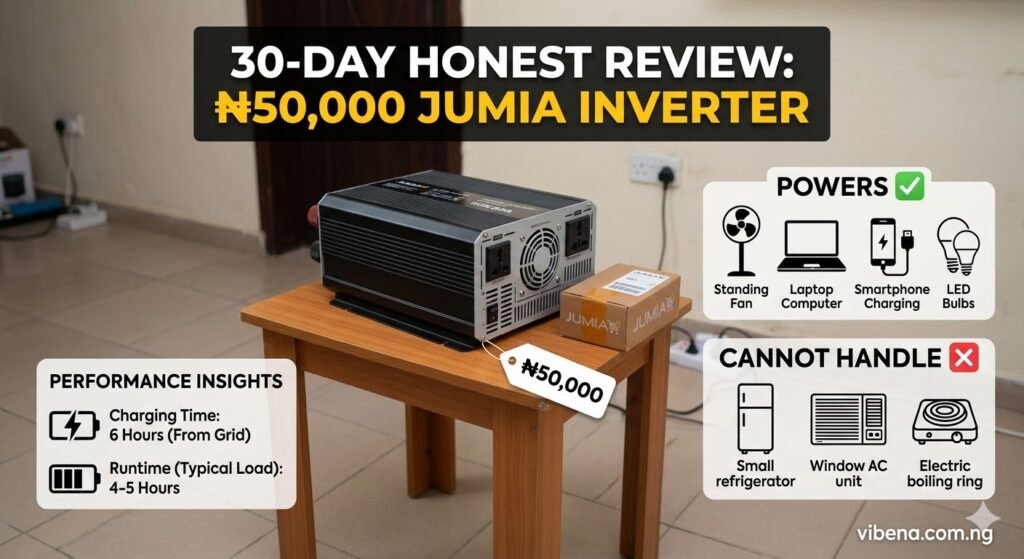
I bought this budget SUOER inverter from Jumia in February 2026 while I was living in Lagos. The inverter was listed for ₦48,500, and I bought a separate 12V 100Ah sealed lead-acid battery from a shop on Balogun Street for ₦42,000. My recorded purchase cost was ₦90,500 for the inverter and battery together. I am now based in Ilorin; the purchase and usage experience described in this review took place in Lagos.
I used the setup for everyday backup during power cuts and recorded observations about charging, noise, runtime and the appliances I tried. This is a personal-use review, not a laboratory test. I did not retain calibrated power-meter readings, a battery capacity test, or a complete repeatable test log. I have separated what I observed from what the manufacturer’s documentation says, and corrected an important specification issue in the earlier version.
Quick verdict: who should consider this budget inverter?
A low-cost 12V modified-sine-wave inverter may be useful for simple, modest loads if its actual continuous output rating is sufficient and it is paired with a suitable battery. It is not automatically a 1,000W continuous-power inverter just because “1000W” appears in the product name or listing. Check the model label and datasheet before buying.
| Question | What this review found |
|---|---|
| Purchase price in this review | ₦48,500 for the inverter in February 2026; historical purchase price, not today’s quote |
| Battery bought separately | 12V 100Ah sealed lead-acid battery, ₦42,000 at the time |
| Waveform | Modified sine wave, according to the product listing and matching SUOER product information |
| Built-in charger | 10A stated for the matching SUOER SAA-1000C model; verify the exact model on your unit |
| Best suited to | Carefully selected low-power loads, subject to the real continuous watt rating |
| Not recommended for | Loads that exceed its continuous or surge limits, or equipment whose manufacturer requires a pure sine-wave supply |
What I bought and what the specifications actually say
The unit I purchased was advertised as a SUOER 1,000W, 12V modified sine-wave inverter with a built-in 10A charger. The product page did not give me a sufficiently clear, independently verified model number in my retained purchase notes. That matters because SUOER sells several visually similar models with different rated and peak outputs.
There is an important correction to the previous version of this review: it described the inverter as delivering 1,000W continuously and 2,000W peak. That claim should not be relied on. SUOER’s published catalogue for the SAA-1000C lists 550W rated output and 1,000W peak output, not 1,000W continuous and 2,000W peak. A Nigerian Konga listing for the SAA-1000C also identifies a 12V input, modified sine-wave output and built-in 10A charger. If the label on your inverter says SAA-1000C, use the 550W rated/1,000W peak figures unless the manufacturer supplies a newer datasheet for that exact revision. If your label shows another model, check that model’s own manual.
Sources: SUOER’s inverter/charger catalogue (SAA-series specifications) and Konga’s SUOER 1000W 12V inverter listing. Retailer descriptions are useful for identifying a product but do not replace the rating plate or the manufacturer’s manual.
My Lagos setup and everyday use
I paired the inverter with a separate 12V 100Ah sealed lead-acid battery. I used it for basic home-office needs, including a fan, LED lighting, laptop charging, a MiFi router and phone charging. In my notes, the combined load was estimated at about 158W. That was an appliance-label estimate, not a calibrated measurement at the inverter output.
| Device in my recorded setup | Estimated power used in the original notes |
|---|---|
| Standing fan (speed 2) | 55W |
| Two LED bulbs | 20W |
| Laptop adapter | 65W |
| MiFi router | 8W |
| Phone charging | 10W |
| Estimated combined load | 158W |
Actual consumption changes with the fan speed, laptop workload, battery charge state and charger behaviour. A device’s adapter rating is its maximum output rating, not necessarily the power it draws continuously. Use a suitable plug-in watt meter or DC clamp meter, operated safely, if you need an accurate load figure.
What the inverter powered during my use
In my use, the fan, LED bulbs, phone charger and MiFi router worked. I also used the inverter to charge an HP EliteBook through its 65W adapter. The laptop adapter felt warmer than I expected, but I did not measure its temperature with an instrument or compare it under controlled conditions. I therefore cannot conclude that the inverter caused a specific temperature increase or shortened the adapter’s life.
I also noticed audible buzzing from the fan motor and hum from a small radio. Those are observations from the particular devices I used, not a guarantee that every fan or radio will behave the same way. Modified sine-wave compatibility varies by appliance and power-supply design. If a device’s manufacturer specifies pure sine-wave input, follow that requirement. For expensive electronics, medical equipment, compressors, refrigerators and other motor-driven appliances, choose a correctly sized pure sine-wave inverter unless the appliance manufacturer confirms compatibility.
I stopped trying the small refrigerator after inconsistent starting behaviour. The iron and hair dryer also exceeded the practical capacity of this small setup. I would not repeat those tests on another low-cost inverter: a motor that repeatedly struggles to start or an inverter that trips is a reason to stop, not to keep trying.
A key limitation: “1,000W” may be peak power, not continuous power
This is the specification buyers should check before connecting appliances. Continuous (rated) output is the power an inverter is designed to supply during normal operation. Peak or surge output is a short-duration allowance for starting loads, and it is not a second continuous rating.
For the SUOER SAA-1000C shown in the manufacturer’s catalogue, the listed rated output is 550W and peak output is 1,000W. That means a buyer should not plan to run a 900W appliance continuously on that model. The 1,000W peak figure also does not guarantee that it will start every motor: starting current and surge duration matter. Check the exact model number printed on your inverter before applying these figures.
How long can a 12V 100Ah battery last?
A 12V 100Ah battery has a nominal energy rating of about 1,200Wh (12V × 100Ah). That is not all available as useful AC energy. The usable amount depends on battery chemistry, age, discharge rate, temperature, the manufacturer’s recommended depth of discharge and inverter losses. A lead-acid battery used conservatively may provide roughly half its nominal capacity as a planning allowance, but the exact usable energy must come from the battery maker’s guidance and the battery’s condition.
For illustration only, if a battery provides 600Wh of usable DC energy and the inverter/load path delivers 85% of that energy as usable AC energy, that is about 510Wh. At a steady 158W load, 510Wh ÷ 158W is approximately 3.2 hours. This is a calculation, not a guaranteed runtime or a measured result for every 100Ah battery. Actual runtime may be shorter because of inverter idle consumption, battery age, temperature, discharge rate and load variation.
Do not estimate battery charge from voltage while it is charging
The earlier version of this article treated readings such as 11.8V and 13.2V as exact battery percentages and described 13.2V during charging as proof that the battery was full. That is not a reliable way to calculate state of charge. Voltage changes while a battery is charging or under load, and a reading taken during those conditions should not be converted directly into a percentage.
For lead-acid batteries, a resting/open-circuit voltage can provide an approximate state-of-charge indication only when the battery has been disconnected from charging and loads and allowed to rest. Samlex’s battery guidance describes measuring standing voltage after the battery has rested for several hours. Use the chart and test method supplied by your own battery manufacturer; battery type, temperature and condition affect the reading. See the Samlex battery manual section on standing voltage.
Charging time: what the 10A charger means
The product listing for the matching SAA-1000C specifies a built-in 10A charger. A 10A rating is the charger’s stated current capability; it does not mean the battery receives 10A continuously from empty to full. Charging current changes as the battery approaches full charge, and the battery’s condition, charger algorithm, temperature and AC supply also matter.
My original notes recorded a long charging session, but the voltage readings were taken while charging and I did not use a battery monitor or capacity tester to verify the exact starting and ending state of charge. I have therefore removed the earlier claim that the battery went from exactly 40% to 100% in 9 hours 15 minutes. Treat the 10A figure as a product specification to verify, not as a promise of a fixed charging time.
Modified sine wave versus pure sine wave
A modified sine-wave inverter produces a stepped AC waveform rather than the smoother waveform supplied by a pure sine-wave inverter. Some simple loads may work normally, while certain motors, transformers and electronic power supplies can hum, run hotter, behave unpredictably or be incompatible. The result depends on the device design; waveform alone does not prove that every laptop charger will be damaged.
Powerstream’s technical explanation discusses why some motors can run less efficiently on modified sine-wave power and why switch-mode power supplies can behave differently depending on their design: modified sine-wave inverter and power-supply compatibility. If you rely on a laptop, desktop computer, audio equipment or other valuable electronics every day, a properly rated pure sine-wave inverter is the more cautious choice. Confirm compatibility with the device manufacturer rather than relying on a blanket claim that a particular waveform is always safe or always harmful.
Safety: battery connections are not a seven-minute beginner job
The previous version described connecting the battery with supplied alligator clips as a simple seven-minute setup. That wording made a high-current DC connection sound safer and easier than it is. A 12V battery can deliver very high fault current if a tool, cable or terminal is accidentally shorted. Incorrect polarity, loose connections, undersized cables or missing protection can cause burns, fire, battery damage or equipment failure.
Have a qualified installer confirm the cable size, connection method, correctly rated DC fuse or breaker, battery isolation, ventilation and the inverter manufacturer’s installation instructions. Do not copy a fuse rating or cable size from another inverter. Keep the battery away from heat and ignition sources, and follow the battery manufacturer’s ventilation and handling requirements. Do not connect or disconnect battery leads while the inverter is operating.
What I would check before buying this inverter
- Ask for a clear photo of the inverter’s model/rating label and the matching manual.
- Confirm continuous rated output in watts separately from peak/surge output.
- Confirm the battery input voltage and whether the built-in charger is suitable for your battery type and capacity.
- Check the waveform and confirm that your intended appliances are compatible.
- Ask the seller for written warranty terms, return conditions and local service contact details.
- Check whether the battery cables and required DC protection are included; do not assume all listings contain the same accessories.
- Compare the total cost of inverter, battery, cables, fuse/breaker, installation and delivery—not just the inverter price.
Is a ₦50,000-class inverter worth buying?
It may be worth considering if your needs are modest, the exact model’s continuous output is enough for your load, you understand the limits of modified sine-wave output and you can verify the seller’s warranty. It is not a bargain if the advertised “1,000W” is mistaken for 1,000W continuous output, if the battery is unsuitable, or if the appliances you need require pure sine-wave power.
The ₦48,500 inverter and ₦42,000 battery prices in my account are what I paid in February 2026. They are historical personal purchase prices, not a current market survey. Retail listings change and similar-looking SUOER models can have different specifications. For a current buying decision, compare exact model numbers and get a written quotation from the seller. See our broader solar inverter prices in Nigeria guide for a separate market overview.
Frequently asked questions
Can this SUOER inverter run a laptop?
I used my HP EliteBook charger with the inverter, but I did not measure adapter temperature or conduct a controlled long-term safety test. Compatibility varies by charger. Check the laptop manufacturer’s power requirements and, if you want the more cautious option for regular use, choose a correctly sized pure sine-wave inverter.
Does a 1,000W inverter deliver 1,000W continuously?
Not necessarily. Some listings use the peak figure in the product name. The SUOER catalogue lists the SAA-1000C at 550W rated output and 1,000W peak. Check the exact model’s label and datasheet before selecting appliances.
How long will a 100Ah battery run a fan and laptop?
It depends on the actual combined wattage, battery condition, battery chemistry, usable depth of discharge and inverter losses. Use the runtime calculation in this article as a planning estimate only; it is not a guarantee for every 100Ah battery.
Is a modified sine-wave inverter safe for every appliance?
No. Some loads work, while some motors, transformers and electronic devices may hum, heat up, operate poorly or be incompatible. Follow the appliance manufacturer’s power requirements. Use pure sine wave for equipment that requires it.
Is the ₦48,500 price still current?
No current-price claim is being made here. ₦48,500 was the price I paid on Jumia in February 2026. Check today’s listing, seller, stock, warranty and exact model before buying.
Related guides and sources
- Solar inverter prices in Nigeria
- Solar generator vs inverter vs complete solar system
- Essential gadgets for remote work in Nigeria
- 50,000mAh power bank guide
- SUOER inverter/charger catalogue
- Konga product listing for SUOER SAA-1000C
- Samlex battery manual: standing-voltage state-of-charge guidance
- Powerstream: modified sine-wave compatibility considerations
Review disclosure: This article describes one budget inverter and battery setup purchased and used by the author in Lagos in February 2026. The recorded experience is personal and should not be treated as a controlled laboratory test. Specifications quoted from the SUOER catalogue apply to the SAA-1000C model; confirm your own unit’s model number before relying on those figures. Prices paid are historical, and current availability, warranty and specifications should be confirmed with the seller.

Oladepo Babatunde (also known as Prince Babatee Tunde) is a Computer Scientist, researcher, professional content writer and SEO content strategist with more than eight years of experience. He holds a Higher National Diploma (HND) in Computer Science from Kwara State Polytechnic, Nigeria, and is based in Ilorin, Kwara State. As a freelance writer, he creates research-led, practical content on technology, Nigerian internet services, AI tools, gadgets and solar power. His work combines research, source checking, technical understanding and SEO strategy. Where an article includes hands-on testing, the product, method and relevant conditions are described in the article; research-based guides are identified as such.