Electricity supply in Nigeria can be unpredictable, and running a generator adds fuel, maintenance and noise to household expenses. A properly sized solar inverter system can help keep essential appliances running during power outages while reducing dependence on the grid and generators.
However, the cost of a solar inverter setup for a Nigerian flat depends on more than the number of bedrooms. Your appliances, daily electricity consumption, battery capacity, solar panel output and expected backup time all influence the final price.
A two-bedroom flat that uses lights, fans, a television and a refrigerator may need a much smaller system than a three-bedroom flat with multiple freezers, water pumps and air conditioners.
This guide explains the estimated 2026 cost of solar inverter systems for both two- and three-bedroom flats in Nigeria, the components you need, how to choose the right capacity, and what to check before paying an installer.
Quick Answer: How Much Does a Solar Inverter Setup Cost in Nigeria?
For budgeting purposes, a modest solar setup for essential household appliances may cost approximately ₦2.1 million to ₦4 million, while a larger system designed for heavier household use can cost considerably more. Systems with substantial lithium battery storage and enough solar panels to support air conditioning may reach ₦5 million to ₦10 million or beyond.
The following figures are broad planning estimates for 2026, not confirmed quotations from individual installers.
| Household setup | Indicative budget | Typical use |
|---|---|---|
| Small two-bedroom flat | ₦2.1M–₦4M | Lights, fans, TV, router and a refrigerator |
| Two-bedroom flat with heavier usage | ₦4M–₦7M+ | More appliances, larger battery storage or limited air-conditioning use |
| Three-bedroom flat with moderate usage | ₦4.5M–₦7M+ | Family essentials, refrigerator, freezer and selected additional loads |
| Three-bedroom flat with heavy usage | ₦7.5M–₦12.5M+ | Larger inverter, more solar panels, substantial storage and air-conditioning loads |
These ranges overlap because household energy requirements vary significantly. A carefully designed three-bedroom setup with limited appliance use may cost less than a two-bedroom setup that runs an air conditioner for several hours every night.
Prices also depend on component brands, installation requirements, battery chemistry, exchange-rate changes and what the supplier includes in the package. Always obtain a current, itemised quotation before making a purchase.
1. What Determines the Cost of a Solar Inverter Setup?
Before choosing a package, understand the five main factors that determine how much you will spend.
Inverter capacity
The inverter converts the direct current (DC) electricity supplied by the batteries or solar system into alternating current (AC) electricity for household appliances.
Its capacity determines how much power it can supply at a given time. A larger inverter may be necessary if you want to run several high-power appliances simultaneously.
Inverter ratings are commonly expressed in kVA. The actual usable power in watts depends on the unit’s power factor and rated output, so do not assume that a 3.5kVA inverter can always supply 3,500 watts.
Battery capacity
Battery capacity determines how much stored electricity is available when solar generation is low or the grid is unavailable.
A system intended to run lights, fans and a television for a few hours needs less storage than one expected to power a refrigerator, freezer and air conditioner throughout the night.
Lithium batteries generally offer more usable energy per rated kWh and can support more charge cycles than many lead-acid batteries. However, their initial purchase price is usually higher.
Solar panel capacity
Solar panels generate electricity during daylight. Their combined rated output, measured in kilowatts-peak (kWp), affects how much energy the system can generate and how effectively it can recharge the batteries.
A system with insufficient panel capacity may struggle to recharge a large battery bank, especially during periods of poor weather or heavy household consumption.
Installation and protection equipment
A complete installation may include panel mounting rails, DC and AC protection devices, surge protection, suitable cables, earthing, battery connections and labour.
These items should not be treated as optional extras simply because a cheaper package excludes them.
Appliance usage
Your daily energy consumption is one of the most important factors. A refrigerator that operates throughout the day, for example, contributes to ongoing energy use, while an electric iron may consume substantial power during a short period.
The installer should size the system around your actual appliances and usage patterns rather than selecting a package based on bedroom count alone.
2. Recommended Solar Inverter Setup for a Two-Bedroom Flat
A two-bedroom flat can use a relatively modest solar setup if the household prioritises essential appliances and avoids running several high-power devices simultaneously.
What can a small system power?
Depending on the inverter’s specifications, battery capacity and appliance loads, a suitable setup may support:
- LED lights
- Ceiling or standing fans
- Television and decoder
- Wi-Fi router
- Phone and laptop charging
- A refrigerator
- Selected additional appliances within the system’s capacity
A freezer, water pump, electric iron, microwave or air conditioner requires a closer assessment. These appliances can increase the required inverter capacity, battery storage or both.
Suggested configurations for a two-bedroom flat
| Usage level | Possible starting configuration | Important consideration |
|---|---|---|
| Essential appliances only | 2.5–3.5kVA inverter, appropriately sized battery and solar array | Suitable only if the combined loads and startup surges remain within the inverter’s limits |
| Essentials plus more appliances | Around 3.5–5kVA, with greater battery and panel capacity as needed | Check simultaneous demand and daily energy use |
| Regular air-conditioning use | A larger system selected after a load assessment | Air-conditioner consumption and overnight runtime can substantially increase costs |
These are starting points for assessment, not universal specifications. Two households with the same number of rooms may need very different systems.
How much should you budget?
For a two-bedroom flat, an initial budget of approximately ₦2.1 million to ₦4 million may be reasonable for a modest system supporting essential appliances. A larger setup with more storage, additional panels or air-conditioning support can cost considerably more.
Before accepting a quote, check whether the price includes the batteries, all solar panels, mounting equipment, protection devices, installation and commissioning. A low advertised price may cover only the inverter and battery rather than a complete solar system.
3. Solar Inverter Setup Cost for a Three-Bedroom Flat in Nigeria
A three-bedroom flat does not automatically need a large inverter. However, it may have more occupants, more lighting points, additional televisions, a larger refrigerator, a freezer, a washing machine, a water pump or multiple air conditioners.
The best system depends on which of these appliances you intend to power and for how long.
Three-bedroom solar system options
| Usage level | Possible system direction | Indicative 2026 budget |
|---|---|---|
| Light usage, no air conditioning | Approximately 3.5–4kVA with appropriately sized batteries and panels | ₦2.5M–₦4.5M |
| Moderate household usage | Approximately 5–6kVA with a suitably sized battery bank and solar array | ₦4.5M–₦7M+ |
| Heavy usage or regular air conditioning | Approximately 8–10kVA or a professionally designed alternative | ₦7.5M–₦12.5M+ |
These are broad planning ranges rather than fixed market prices. A particular package may fall outside them depending on its battery size, panel capacity, equipment quality and installation requirements. The figures should not be interpreted as guaranteed prices or as proof that every system in a particular inverter category can run the listed appliances.
A basic three-bedroom setup
A household that mainly needs lights, fans, televisions, internet equipment and a refrigerator may be able to use a smaller system than a household that also runs a freezer, washing machine and air conditioner.
The installer should calculate the combined running load and account for the startup surge of motor-driven appliances. The battery should also be sized according to how many hours you expect the system to run without sufficient solar generation.
A three-bedroom setup with air conditioning
Air conditioning can change the cost considerably.
Before buying a system for an air conditioner, confirm:
- The air conditioner’s rated input power and operating behaviour.
- Whether it is an inverter-type or conventional unit.
- How many hours it will run daily.
- Whether it will operate at the same time as the refrigerator, freezer or water pump.
- How much battery energy will be needed overnight.
- Whether the solar panels can support daytime use and recharge the battery.
A large inverter alone will not solve a shortage of stored energy. If the battery is too small, the system may shut down or run out of stored power before morning even when the inverter can handle the appliance’s load.
4. How to Calculate the Inverter Size You Need
The correct inverter size is based on the appliances that may run at the same time, not simply the total number of appliances in the flat.
Start by listing each appliance, its rated power in watts and whether it has a motor or compressor that may require extra starting power.
For example, consider this illustrative load list:
| Appliance | Quantity | Assumed running power | Combined running power |
|---|---|---|---|
| LED lights | 8 | 10W each | 80W |
| Fans | 3 | 60W each | 180W |
| Television | 1 | 100W | 100W |
| Router | 1 | 15W | 15W |
| Laptop | 1 | 65W | 65W |
| Refrigerator | 1 | 150W while running | 150W |
| Total | 590W |
The 590W total is an illustration, not a measurement of every household’s demand. A refrigerator’s compressor cycles on and off, and its startup power can exceed its normal running power.
If all these appliances operate simultaneously, the inverter must support their combined demand and any relevant startup surge. It must also meet the manufacturer’s continuous output and power-factor specifications.
For a practical assessment:
- List the appliances you want to power.
- Record the rated input power from each appliance’s label or manual.
- Identify which appliances may run together.
- Check startup surge requirements for motors and compressors.
- Choose an inverter with sufficient continuous output and surge capability.
- Allow reasonable operating headroom and follow the manufacturer’s specifications.
Do not assume that a 2.5kVA inverter can power any appliance combination simply because the estimated wattage appears to fit. The model’s actual output rating and surge capability matter.
5. How Much Battery Capacity Do You Need?
Battery capacity is measured in kilowatt-hours (kWh), while inverter capacity is commonly stated in kVA. These measure different things.
- Inverter capacity describes how much power the inverter can supply at a time.
- Battery capacity describes how much energy is stored and available over time.
- Solar panel capacity describes the panels’ combined rated output under specified test conditions.
A system may have a sufficiently large inverter but still provide poor backup time if the battery is too small.
Estimate your battery requirement
A useful starting formula is:
Battery energy required (kWh) = appliance energy consumption per hour × number of backup hours
For multiple appliances, add their energy requirements over the intended backup period. The final battery specification must also account for inverter losses, the battery’s usable capacity, manufacturer limits and any reserve you want to maintain.
For example, if the appliances you intend to run consume an average of 500W over a four-hour period, their energy requirement is approximately:
500W × 4 hours = 2,000Wh, or 2kWh.
The battery must supply more than 2kWh of rated energy if you need to cover conversion losses and preserve an operating reserve. A qualified installer can translate the calculated requirement into an appropriate battery size.
Lithium versus tubular batteries
| Feature | Lithium battery (LiFePO₄) | Tubular lead-acid battery |
|---|---|---|
| Initial cost | Usually higher | Usually lower |
| Usable capacity | Often a greater proportion of rated capacity | Often needs a lower depth of discharge to preserve battery life |
| Charging | Can support relatively fast charging within manufacturer limits | Charging requirements depend on the battery design |
| Maintenance | Generally low | Flooded models may require periodic electrolyte checks |
| Lifespan | Often longer, depending on cycles, temperature and usage | Usually more sensitive to deep discharge and charging practices |
| Best consideration | Higher upfront budget and long-term use | Lower upfront budget and willingness to maintain or replace batteries |
The actual lifespan of either battery type depends on the product, operating temperature, charge settings, discharge depth and usage. Compare warranty terms and cycle-life specifications rather than relying on a blanket lifespan promise.
If you choose a flooded lead-acid battery, follow the manufacturer’s water-maintenance instructions. Sealed batteries must not be opened. For lithium batteries, confirm compatibility between the battery management system (BMS), battery voltage and inverter charging settings.
For more practical guidance, read how to extend inverter battery life in Nigeria.
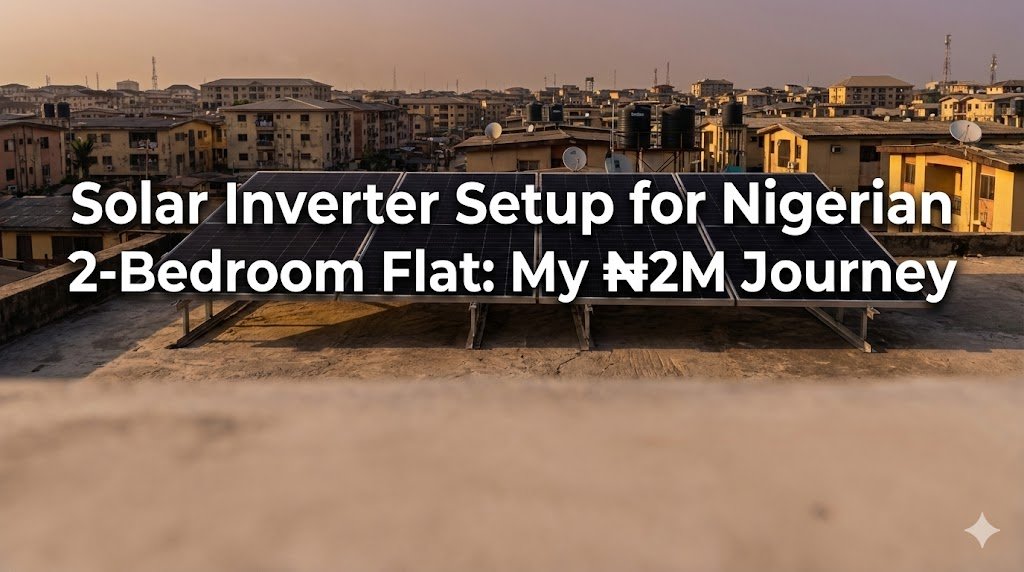
6. How Many Solar Panels Does a Two- or Three-Bedroom Flat Need?
The number of panels depends on their individual wattage, the energy you consume daily, the amount of sunlight available at your location, system losses and the battery’s charging needs.
Do not select panels solely because an installer says that a particular number is standard for a two-bedroom or three-bedroom flat.
For example, four 550W panels have a combined rated capacity of:
4 × 550W = 2,200W, or 2.2kWp.
If that array receives an illustrative four peak-sun-hours per day, its theoretical daily generation would be:
2.2kW × 4 hours = 8.8kWh.
Actual energy delivered will be lower because of temperature, shading, dust, wiring, inverter conversion, panel orientation and other system losses. Daily production also changes with weather and season. Four peak-sun-hours is a calculation assumption, not a guarantee for every Nigerian location or day.
What to check before buying panels
- The total rated capacity of the proposed array.
- Available unshaded roof space and panel orientation.
- The inverter’s supported PV input voltage and maximum current.
- The permitted solar array capacity.
- Whether the array can meet daily appliance use and recharge the battery.
- The quality of mounting hardware, cabling and protection equipment.
A properly designed system should match the solar array to both the inverter and the battery bank. An installer should explain the expected energy production and the assumptions used to estimate it.
For more information on how photovoltaic systems work, consult the U.S. Department of Energy’s solar photovoltaic system design overview.
7. What Should a Complete Solar Inverter Installation Include?
When comparing quotations, make sure you are comparing equivalent systems. One installer may quote for an inverter and battery only, while another may include panels, mounting, protection and labour.
Ask whether the quotation includes:
- Hybrid inverter and its accessories.
- Solar panels and mounting structures.
- Battery or batteries, including the correct connections.
- Solar DC isolators and appropriately rated protection devices.
- Suitable AC protection and changeover arrangements.
- Correctly sized cables and connectors.
- Earthing and surge protection where required by the system design.
- Installation, testing and commissioning.
- Configuration of charging, battery and operating settings.
- Manufacturer warranties and installation workmanship terms.
- Transport, roof work and any additional wiring required.
Cable sizes, breaker ratings and protective devices should be selected for the actual current, voltage, cable length, installation method and equipment specifications. There is no single cable size or breaker rating that is correct for every home.
A changeover arrangement must also prevent dangerous backfeeding and keep the grid, inverter and household circuits correctly separated. Use a qualified installer rather than improvising electrical connections.
8. How to Compare Solar Inverter Quotes in Nigeria
A low quotation is not necessarily the best deal. Compare the specifications and what each installer has included.
Use this checklist before making a deposit:
- The inverter’s brand, model, continuous output and surge rating are stated.
- The number, wattage and model of the solar panels are listed.
- Battery chemistry, rated capacity, voltage and warranty are specified.
- The quotation explains the expected backup time and the appliances it covers.
- Installation, mounting, cabling and protection equipment are included or priced separately.
- The installer has explained the system’s limitations.
- Warranty coverage and after-sales support are documented.
- Payment terms and the total installed price are clear.
- The proposed system has been checked against the appliances you actually use.
Obtain at least three itemised quotations where practical. Compare the same inverter capacity, battery energy, panel capacity and installation scope. Otherwise, a cheaper quotation may simply provide less equipment.
Ask each installer to explain what happens during several cloudy days, how the battery is protected from excessive discharge, and which appliances should not be operated together.
9. Can Solar Save Money Compared With a Generator?
Solar can reduce generator fuel consumption, noise and some maintenance costs, but the financial benefit depends on your existing electricity expenses and the system you install.
Avoid relying on a guaranteed payback period. A system that replaces frequent generator use may produce a different financial result from one used only during occasional outages.
To estimate your potential savings, calculate:
Estimated monthly savings = generator fuel and maintenance avoided + grid electricity costs avoided − remaining energy costs
Then estimate a simple payback period:
Simple payback period = initial installed cost ÷ estimated monthly savings
This is only a preliminary calculation. A more realistic assessment also considers battery replacement, equipment maintenance, financing costs, system performance and the electricity you will still obtain from the grid or generator.
For example, if an installed system costs ₦4.8 million and your estimated net savings are ₦100,000 per month, the simple payback calculation is 48 months. That is a mathematical illustration, not a prediction that every ₦4.8 million installation will recover its cost in four years.
The calculation is only as reliable as your savings estimate. Track your actual fuel and electricity spending before deciding whether a proposed system makes financial sense.
10. How to Maintain Your Solar Inverter System
Good maintenance helps protect your investment and makes it easier to identify performance problems.
Keep solar panels clean
Dust and dirt can reduce panel output. Inspect the panels periodically and clean them according to the manufacturer’s instructions. Use suitable cleaning methods and avoid stepping on panels, using harsh chemicals or working on a roof without proper fall protection.
Monitor battery performance
Check the inverter’s battery readings and warning indicators. Follow the manufacturer’s recommended charging settings and temperature limits. Repeatedly discharging a battery beyond its recommended limit can shorten its service life.
Inspect the system safely
Have a qualified technician inspect connections, protective devices, cables, mounting hardware and earthing at appropriate intervals. Do not open live equipment or attempt to tighten battery terminals while the system is energised.
Watch for signs of battery deterioration
A noticeable reduction in backup time, abnormal warning indicators or charging problems may indicate a battery issue, but these symptoms can also arise from increased appliance use or a system fault.
Read how to tell when an inverter battery needs replacement if your backup time has dropped unexpectedly.
11. Ways to Reduce the Cost of Your Solar Inverter Setup
You do not necessarily need to purchase the largest system your budget allows. Start by deciding which appliances matter most during an outage.
Prioritise essential appliances
Lights, fans, communication equipment and selected household electronics may require less capacity than a system intended to power air conditioners, electric irons and water heaters.
Reduce unnecessary consumption
Energy-efficient lighting and appliances can reduce the size of the battery and solar array you need. A rechargeable fan may also be useful when you want to avoid running a larger inverter for a single fan. See this rechargeable fan buying guide.
For remote work, a compatible laptop power bank may help keep a laptop running without drawing as much energy from the household backup system. Check your laptop’s charging requirements before purchasing one; this guide to laptop power banks in Nigeria can help you compare options.
Plan for future expansion
If your budget is limited, ask whether the system can be expanded later. Confirm that the inverter supports the planned PV capacity and battery configuration, and that any future batteries can be safely integrated. Not every battery can be mixed with an older battery or connected to every inverter.
Avoid buying equipment based on price alone
An unusually cheap package may exclude important components or have limited after-sales support. Compare model numbers, warranties, installation details and the system’s usable capacity before choosing.
12. Solar Inverter vs Solar Generator vs Complete Solar System
These terms are often used interchangeably, but they describe different arrangements.
- Solar inverter system: Usually refers to an inverter working with batteries and, depending on the setup, solar panels and grid power.
- Solar generator: Commonly refers to a portable power station, often with an integrated battery and inverter, that can sometimes be charged with solar panels.
- Complete home solar system: A broader installation that may include panels, an inverter, batteries, mounting, protection and the electrical work required to supply selected household circuits.
The best option depends on your energy needs, mobility requirements, budget and whether you want to power a few devices or selected circuits throughout the home.
For a more detailed comparison, see solar generator vs solar inverter vs solar system in Nigeria.
Frequently Asked Questions
How much does a solar inverter setup cost for a two-bedroom flat in Nigeria in 2026?
A modest system for essential appliances may require a budget of approximately ₦2.1 million to ₦4 million. A larger setup with more battery storage, additional panels or air-conditioning support can cost substantially more. Confirm the current price and included components with installers before budgeting.
How much does a solar system cost for a three-bedroom flat?
A three-bedroom flat with moderate electricity use may need a budget of roughly ₦4.5 million to ₦7 million or more. Heavy usage, substantial lithium storage and air-conditioning requirements can push the cost into the ₦7.5 million to ₦12.5 million-plus range. These are indicative planning estimates, not guaranteed market prices.
Is a 3.5kVA inverter enough for a three-bedroom flat?
It may be sufficient for selected essential appliances if the combined running load and startup surges remain within the inverter’s specifications. It may not be suitable for a household running several high-power appliances simultaneously. Calculate the load before buying.
Can a solar inverter run an air conditioner?
Yes, if the inverter can support the air conditioner’s running and startup requirements and the battery and solar array provide enough energy. The number of hours you want to run the AC is particularly important when sizing the battery.
Is lithium better than tubular batteries?
Lithium batteries often provide more usable capacity and longer cycle life, but they generally cost more initially. Tubular batteries can be a lower-cost entry point, although their maintenance needs and replacement frequency affect the long-term cost. Compare product-specific warranties and specifications.
How many solar panels do I need for a two-bedroom flat?
There is no fixed number. The answer depends on panel wattage, daily energy consumption, sunlight conditions, shading, system losses and the inverter’s permitted PV input. Ask the installer to provide the total array capacity in kWp and explain the expected daily generation.
Should I buy the inverter first and add solar panels later?
That can be possible if the inverter supports solar input and is suitable for the planned battery and panel configuration. Before purchasing, confirm the supported panel voltage, current, array capacity and battery compatibility so that a future expansion does not require replacing key components.
How long does a solar inverter battery last?
Battery life depends on its chemistry, quality, temperature, charge settings, discharge depth and frequency of use. Follow the manufacturer’s specifications and warranty terms rather than relying on a fixed lifespan for every battery.
Is solar completely independent of the national grid?
Not necessarily. A hybrid system can use solar, batteries and grid power together. Its level of independence depends on panel capacity, battery storage, household demand and weather. A system designed to cover essential loads may still require grid or generator support for heavy appliances or extended periods of poor sunlight.
Final Thoughts
The right solar inverter setup for a Nigerian two- or three-bedroom flat is the one that matches your actual electricity use, backup-time requirements and budget.
For a smaller household, prioritising essential appliances may keep the system affordable. For a three-bedroom flat with freezers, pumps or regular air-conditioning use, a larger inverter, more solar panels and additional battery storage may be necessary.
Before committing your money, calculate your appliance loads, compare battery and panel specifications, and request at least three itemised quotations. Focus on the complete installed system and the appliances it can reliably support—not just the inverter’s advertised kVA rating or the lowest package price.

Oladepo Babatunde (Prince Babatee Tunde) is a Computer Scientist, researcher, and professional content writer with a Higher National Diploma in Computer Science from Kwara State Polytechnic, Nigeria.
With a background in technology and a passion for clear communication, Babatunde specializes in creating thoroughly researched, reader-focused content on productivity, personal development, home living, and technology. Every article he writes is backed by extensive research and fact-checking to ensure readers receive accurate, actionable information.
As a freelance writer, he has helped brands and publications deliver content that educates, engages, and empowers their audiences. His mission at 9jaboizgist is simple: make complex topics easy to understand and help Nigerians live smarter, more productive lives.