My phone died at 2:47 PM on a Tuesday. I was in the middle of a client voice note on WhatsApp, confirming a ₦75,000 invoice payment. The screen went black. No warning. No “5% remaining” notification. Just dead.
NEPA had been off since morning. My power bank was already drained from keeping my laptop alive. The nearest charging spot was a provision store about 10 minutes away; at the time, it charged ₦200 for 30 minutes of power.
That was the moment I realised my phone’s battery life was not just inconvenient. It was costing me money.
At the time of this testing, I was a freelance content creator working from a self-contained apartment in Yaba, Lagos. I am now based in Ilorin, Kwara State. My phone was not a luxury; it was my primary work tool. I use it for client communication on WhatsApp, content creation on Canva and CapCut, social media management through Meta Business Suite, mobile banking on OPay, and sometimes as a hotspot when my router dies.
If my phone cannot last a full working day, I cannot earn. It is that simple.
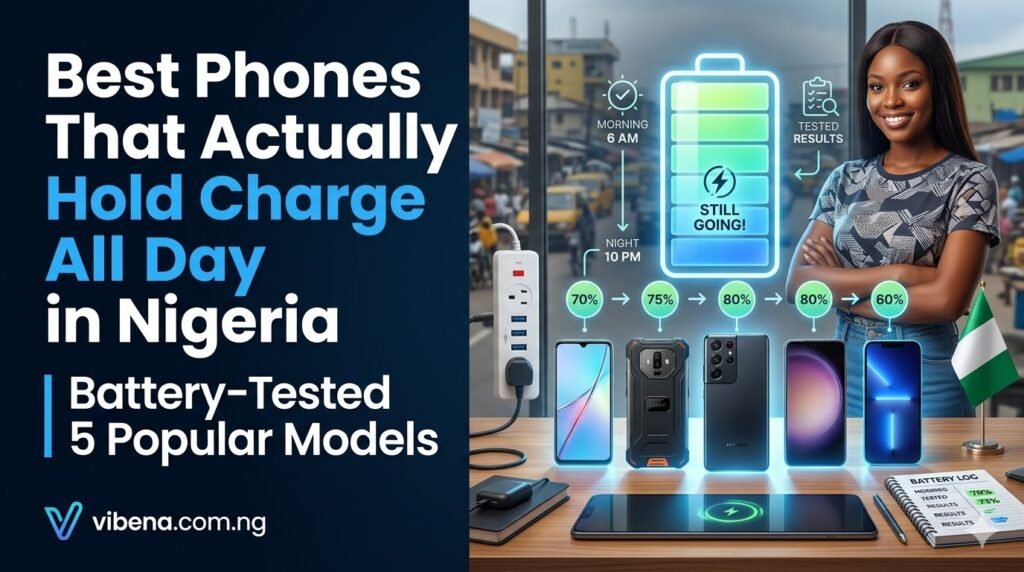
I wanted to compare how five phones handled a practical working-day routine, so I borrowed some models from friends and family and bought one myself. I used a repeatable list of everyday activities and recorded the battery percentages during the sessions. This is a personal field comparison, not a laboratory benchmark; the test conditions and limitations are explained below.
Here is exactly what happened.
Why Battery Life Matters in Nigeria
Battery life can be especially important when electricity supply is unreliable or when you spend long periods away from a charging point. That does not mean Nigeria has worse battery conditions than every other country; it means a phone that lasts through your workday can be useful when charging opportunities are limited.
The Nigerian Electricity Regulatory Commission (NERC) defines minimum daily supply targets for service-based tariff bands: Band A is at least 20 hours, Band B 16 hours, Band C 12 hours, Band D 8 hours and Band E 4 hours. These are regulatory service targets, not a claim that every household receives exactly those hours every day. Check your own DisCo and tariff band for the applicable service level. NERC’s service-band explanation.
For example, someone who is away from home during the hours when electricity is available may have fewer convenient opportunities to charge than a person who works near a socket. This is an illustration, not a measurement of the average Nigerian household’s charging time.
If you often work through outages, a phone with good endurance can reduce how often you need to reach for a power bank. A power bank is still a useful backup; see our guide to power banks for mobile and laptop work. I have removed the old petrol-price example because fuel prices change and the previous figure was not a current quotation.
This is why choosing the best battery phone in Nigeria involves more than checking the mAh figure. Think about your daily screen time, mobile-data use, hotspot needs, charging speed and access to power.
Five Battery Phones in Nigeria: Specifications Compared
These five models cover different battery capacities, charging speeds and price tiers. The comparison below uses the manufacturers’ published specifications for the named versions. It does not mean all five have the same network capabilities: the Redmi Note 14 Pro discussed here and the TECNO SPARK 30 Pro are 4G models, while the POVA 6 Pro and Galaxy A36 are 5G phones.
| Phone | Battery capacity | Processor | Wired charging | Network |
|---|---|---|---|---|
| TECNO POVA 6 Pro 5G | 6,000mAh | MediaTek Dimensity 6080 | 70W | 5G |
| Samsung Galaxy A36 5G | 5,000mAh typical | Qualcomm Snapdragon 6 Gen 3 | 45W | 5G |
| Xiaomi Redmi Note 14 Pro (4G) | 5,500mAh typical | MediaTek Helio G100-Ultra | 45W | 4G LTE; not 5G |
| TECNO SPARK 30 Pro | 5,000mAh | MediaTek Helio G100 | 33W | 4G LTE; not 5G |
| itel P65 | 5,000mAh typical, plus separate 2,400mAh charging case | Unisoc T615 | 18W | 4G LTE |
The models may still be found through Nigerian retailers, but stock, warranty and prices vary. I have removed the March 2026 prices rather than leave old estimates that could mislead someone shopping today. Confirm the exact model code, storage size, condition and warranty before paying.
How to Read the Battery Test Results
The figures in the individual phone sections are the author’s reported observations from use in Yaba, Lagos, in March 2026. They are not laboratory benchmarks or a promise that another buyer will get the same runtime. The phones were used for a practical mix of messaging, social apps, video, hotspot, calls, banking and camera activity. Differences in battery age, software, screen brightness, signal strength, temperature and app versions can change the result.
The Usage Routine
The author’s recorded routine began at 7:00 AM with a full charge and included WhatsApp, social media, Canva, YouTube, a one-hour mobile-hotspot session, phone calls, banking apps, lighter screen-off periods, social media management and camera use. The schedule is included to show the type of activity involved, not to suggest that every reader will use a phone in exactly the same way.
7:00 AM to 8:00 AM: WhatsApp messaging (texts and voice notes, 15 messages sent, 10 voice notes played)
8:00 AM to 9:30 AM: Social media browsing (30 minutes Instagram, 30 minutes Twitter/X, 30 minutes Facebook) with screen brightness set to 50% and Wi-Fi connected
9:30 AM to 10:30 AM: Canva content creation (designing 3 Instagram posts using templates)
10:30 AM to 11:00 AM: YouTube video playback (30 minutes, 720p quality, Wi-Fi, speaker audio at 60% volume)
11:00 AM to 12:00 PM: Phone used as mobile hotspot for laptop (MTN 4G data, tethered to one device)
12:00 PM to 12:30 PM: Phone calls (two calls, roughly 15 minutes total)
12:30 PM to 1:00 PM: Banking apps (OPay, checking balance, one transfer)
1:00 PM to 2:00 PM: Light usage (occasional WhatsApp checks, screen mostly off)
2:00 PM to 3:30 PM: Social media management (Meta Business Suite, scheduling posts, responding to DMs)
3:30 PM to 4:00 PM: Camera use (took 20 photos, 2 short videos of about 30 seconds each)
4:00 PM onward: Mixed light usage (WhatsApp, occasional browsing) until the phone died
Test Conditions and Limitations
The author reports carrying out the comparisons in Yaba, Lagos, using MTN 4G for the mobile-data portion and Wi-Fi when the home router was available. The routine also included hotspot tethering. Because Wi-Fi and mobile data were both used, these results should be read as a real-world usage account rather than a controlled radio or battery laboratory test.
The author recorded warm March conditions of approximately 32°C–35°C during the sessions. Ambient heat can affect phone temperature and battery behaviour, but a single local test cannot establish how every phone will perform in all Nigerian climates or seasons.
The original notes describe two sessions for each phone. The published hourly tables show the author’s recorded usage timeline; they are not independent laboratory measurements. Treat the runtimes as personal observations, not guaranteed endurance ratings. Manufacturer laboratory claims are identified separately where available.
1. TECNO POVA 6 Pro 5G (6,000mAh)
TECNO’s official specification lists a 6,000mAh battery, 70W charging and the MediaTek Dimensity 6080 5G processor. It also lists a 6.78-inch 120Hz AMOLED display. See the official TECNO POVA 6 Pro 5G specifications.
Author-Recorded Battery Timeline
| Time | Activity | Battery Remaining |
|---|---|---|
| 7:00 AM | Start (100%) | 100% |
| 8:00 AM | After WhatsApp session | 96% |
| 9:30 AM | After social media browsing | 87% |
| 10:30 AM | After Canva design session | 80% |
| 11:00 AM | After YouTube playback | 75% |
| 12:00 PM | After 1 hour hotspot | 63% |
| 12:30 PM | After phone calls | 61% |
| 1:00 PM | After banking apps | 60% |
| 2:00 PM | After light usage period | 57% |
| 3:30 PM | After social media management | 48% |
| 4:00 PM | After camera usage | 45% |
| 6:00 PM | Mixed light usage | 38% |
| 9:00 PM | Still alive | 24% |
| 11:30 PM | Phone died | 0% |
Total runtime: approximately 16 hours and 30 minutes from 100% to 0%.
My Experience Using It
In the author’s reported usage sessions, the POVA 6 Pro lasted into the evening and was the highest-capacity built-in battery among the five models compared. Its 6,000mAh rating is a useful starting point, but capacity alone does not prove it will outlast every 5,000mAh phone under different settings or network conditions.
The 6.78-inch AMOLED panel supports a refresh rate of up to 120Hz. A higher refresh rate can make scrolling look smoother, but it may use more power than a lower setting. If endurance matters more than animation smoothness, try the phone’s adaptive or lower refresh-rate option if available.
TECNO specifies 70W charging. The author’s earlier charging observation is a single use case, not a guaranteed 0–100% charging time. Charging speed changes with the starting battery level, temperature, screen use and charger. Use the compatible charger supplied for the device and check the package contents when buying.
The author observed noticeable battery use while running a laptop hotspot. Hotspot tethering is a demanding task because the phone maintains a mobile-data connection and creates a Wi-Fi connection for another device. Google’s Android battery guidance also lists tethering among activities that can shorten a charge. Android’s battery-saving guidance.
Who Should Buy This Phone
The POVA 6 Pro is worth considering if you use your phone heavily, want a 6,000mAh built-in battery and value 70W charging. It may suit people who use messaging, social apps and hotspot features throughout the day, but actual runtime depends on signal, screen settings, battery age and workload.
Who Should Not Buy This Phone
Consider the POVA 6 Pro if you want a large built-in battery and fast wired charging and are comfortable with a large 6.78-inch phone. It is not a compact handset, and the 5G feature is useful only where your carrier has compatible coverage. Check the current local price and warranty rather than relying on an old estimate.
2. Samsung Galaxy A36 5G (5,000mAh)
The Galaxy A36 5G does not have a 6,500mAh battery and does not use an Exynos processor. Samsung’s published specifications list a typical 5,000mAh battery, Qualcomm Snapdragon 6 Gen 3 processor and 45W Super Fast Charging 2.0. Samsung also states up to 29 hours of video playback under its own test conditions; actual battery life varies with network, apps, settings and usage. See Samsung Africa’s Galaxy A36 5G specifications.
Author-Recorded Battery Timeline
| Time | Activity | Battery Remaining |
|---|---|---|
| 7:00 AM | Start (100%) | 100% |
| 8:00 AM | After WhatsApp session | 97% |
| 9:30 AM | After social media browsing | 89% |
| 10:30 AM | After Canva design session | 83% |
| 11:00 AM | After YouTube playback | 79% |
| 12:00 PM | After 1 hour hotspot | 68% |
| 12:30 PM | After phone calls | 66% |
| 1:00 PM | After banking apps | 65% |
| 2:00 PM | After light usage period | 63% |
| 3:30 PM | After social media management | 55% |
| 4:00 PM | After camera usage | 52% |
| 6:00 PM | Mixed light usage | 44% |
| 9:00 PM | Still alive | 31% |
| 12:30 AM (next day) | Phone died | 0% |
Total runtime: approximately 17 hours and 30 minutes from 100% to 0%.
My Experience Using It
The author’s reported test notes placed the A36 ahead of the other phones in this particular usage routine. That is a result from this author’s sessions, not proof that every Galaxy A36 will last longer than every POVA 6 Pro. Samsung’s own up-to-29-hour video figure uses a different test method and should not be directly compared with the author’s mixed-use routine.
The lighter-use period had a smaller battery-percentage change in the author’s notes. Short periods of light use are not enough to establish overall efficiency on their own; background syncing, signal strength, screen-on time and battery condition all matter.
Samsung specifies 45W charging. Its 45W wall charger may be sold separately, so check what the Nigerian retailer includes in the box. The time needed to charge from a particular percentage depends on the charger, cable, temperature and whether the phone is being used while charging.
One UI includes Power saving options that can limit background activity and some performance or display features. The exact controls vary by software version. Use the phone’s Battery settings to see what Power saving changes on your model; do not assume it will add a fixed number of hours.
Samsung lists a long software-support commitment for the Galaxy A36 5G, but software support and battery endurance are separate buying considerations. A long update period does not guarantee that the battery will retain its original capacity for the same number of years. Battery wear depends on heat, charge cycles and use.
Who Should Buy This Phone
Choose the Galaxy A36 5G if you want a mainstream Samsung 5G phone, a 5,000mAh battery, 45W charging and a long software-support commitment. The author’s personal test notes were favourable, but do not treat that result as a guaranteed runtime for every user.
Who Should Not Buy This Phone
The A36’s 5,000mAh capacity is smaller than the POVA 6 Pro’s 6,000mAh cell. That does not automatically mean the POVA will last longer in every situation, because chipset, screen, software, signal and workload also matter. Compare the current price, storage configuration, warranty and charger-in-box details before choosing.
3. Xiaomi Redmi Note 14 Pro (4G, 5,500mAh)
This section refers to the Nigerian Redmi Note 14 Pro 4G model, not the Redmi Note 14 Pro+ 5G or another similarly named 5G variant. Xiaomi Nigeria lists a 5,500mAh typical battery, MediaTek Helio G100-Ultra processor and 45W turbo charging. The official network specification for this model lists LTE rather than 5G. Check Xiaomi Nigeria’s Redmi Note 14 Pro specifications before buying.
Author-Recorded Battery Timeline
| Time | Activity | Battery Remaining |
|---|---|---|
| 7:00 AM | Start (100%) | 100% |
| 8:00 AM | After WhatsApp session | 95% |
| 9:30 AM | After social media browsing | 85% |
| 10:30 AM | After Canva design session | 77% |
| 11:00 AM | After YouTube playback | 72% |
| 12:00 PM | After 1 hour hotspot | 59% |
| 12:30 PM | After phone calls | 57% |
| 1:00 PM | After banking apps | 55% |
| 2:00 PM | After light usage period | 52% |
| 3:30 PM | After social media management | 42% |
| 4:00 PM | After camera usage | 37% |
| 6:00 PM | Mixed light usage | 28% |
| 9:00 PM | Still alive | 12% |
| 10:15 PM | Phone died | 0% |
Total runtime: approximately 15 hours and 15 minutes from 100% to 0%.
My Experience Using It
The author’s reported runtime placed the Redmi Note 14 Pro between the POVA 6 Pro and the lower-capacity models in this particular routine. This should not be treated as a universal battery ranking. Xiaomi’s own lab figures use different activities and test conditions.
Xiaomi lists a 6.67-inch AMOLED display with up to 120Hz refresh rate. A bright, high-refresh-rate screen can use more power, especially outdoors when automatic brightness raises the display output. Reducing refresh rate and brightness can help extend runtime.
The Nigerian model’s published specification includes a 200MP main camera with optical image stabilisation, an 8MP ultra-wide camera and a 2MP macro camera. A higher megapixel count does not automatically make every photo better; image quality also depends on sensor size, lens, processing and lighting.
The author reported higher battery use during hotspot tethering than during lighter tasks. Treat that percentage as an observation from the test location, not a fixed drain rate. Signal quality, connected-device activity and mobile-data speed can all affect hotspot consumption.
Xiaomi specifies 45W turbo charging for the Nigerian Redmi Note 14 Pro and lists a 45W charger in the package contents on its product page. Actual charging time still depends on temperature, starting charge and use while charging.
Who Should Buy This Phone
Consider this model if you want a 5,500mAh battery, an AMOLED display and a high-resolution main camera, and you do not need 5G on this particular device. Confirm that the seller is supplying the Nigerian 4G model rather than a different Redmi Note 14 variant.
Who Should Not Buy This Phone
If 5G connectivity is essential, this 4G Redmi Note 14 Pro is not the right variant. If your main priority is the largest battery capacity in this group, the POVA 6 Pro has a higher manufacturer-rated capacity. Compare the exact model and current price before choosing.
4. TECNO SPARK 30 Pro (4G, 5,000mAh)
The TECNO SPARK 30 Pro is a 4G phone, not a 5G model. TECNO’s Nigeria specification lists the MediaTek Helio G100, a 5,000mAh battery and 33W Super Charge. It also lists a 6.78-inch 120Hz AMOLED display. See TECNO Nigeria’s official SPARK 30 Pro specifications.
Author-Recorded Battery Timeline
| Time | Activity | Battery Remaining |
|---|---|---|
| 7:00 AM | Start (100%) | 100% |
| 8:00 AM | After WhatsApp session | 94% |
| 9:30 AM | After social media browsing | 82% |
| 10:30 AM | After Canva design session | 73% |
| 11:00 AM | After YouTube playback | 67% |
| 12:00 PM | After 1 hour hotspot | 53% |
| 12:30 PM | After phone calls | 50% |
| 1:00 PM | After banking apps | 48% |
| 2:00 PM | After light usage period | 44% |
| 3:30 PM | After social media management | 33% |
| 4:00 PM | After camera usage | 28% |
| 6:00 PM | Mixed light usage | 17% |
| 8:30 PM | Phone died | 0% |
Total runtime: approximately 13 hours and 30 minutes from 100% to 0%.
My Experience Using It
The author’s reported usage notes show the SPARK 30 Pro reaching the end of its recorded session earlier than the other phones. That observation is specific to the author’s routine and should not be interpreted as a controlled battery benchmark.
The Helio G100 is a 4G chipset. The phone is suitable for everyday messaging, browsing and social apps, but it should not be recommended to someone who specifically needs 5G connectivity. Storage, RAM configuration and software version can affect how smoothly demanding apps run.
The earlier version incorrectly described the SPARK 30 Pro as having 18W charging. TECNO specifies 33W Super Charge. Any charging-time observation from one session should not be treated as a guaranteed result; use the compatible charger and cable and check the exact package contents.
TECNO lists a 108MP rear camera. Megapixels alone do not determine image quality, especially in low light. If camera performance matters, compare real sample photos from the exact model and software version you intend to buy.
Pre-installed apps and background permissions vary by software version and region. Review the battery-usage screen on the individual phone to identify apps that are active in the background instead of assuming every TECNO handset has the same level of background drain.
Who Should Buy This Phone
Consider the SPARK 30 Pro if you want a 5,000mAh battery, AMOLED display and 33W charging and do not need 5G. It is a 4G model, so do not buy it expecting to connect to a 5G network.
Who Should Not Buy This Phone
If you regularly tether a laptop, play demanding games or record long videos, compare independent battery tests for the exact phone variant and consider carrying a power bank. A 5,000mAh label alone cannot predict how long those workloads will run.
5. itel P65 (5,000mAh battery + 2,400mAh charging case)
itel’s Nigerian product information lists a 5,000mAh typical internal battery, a separate 2,400mAh charging case, an 18W charging rate and the Unisoc T615 processor. The case is an additional accessory battery; do not add its capacity to the phone’s internal battery and describe the result as one 7,400mAh phone battery. See itel Nigeria’s P65 specifications.
The author’s notes describe using the phone first without the case and then with the charging case available as an extra source of power. The case can provide an additional top-up away from a wall socket, but the amount of extra use depends on conversion losses, phone activity and how much charge remains in the case.
Author-Recorded Battery Timeline Without the Case
| Time | Activity | Battery Remaining |
|---|---|---|
| 7:00 AM | Start (100%) | 100% |
| 8:00 AM | After WhatsApp session | 93% |
| 9:30 AM | After social media browsing | 79% |
| 10:30 AM | After Canva design session | 68% |
| 11:00 AM | After YouTube playback | 61% |
| 12:00 PM | After 1 hour hotspot | 45% |
| 12:30 PM | After phone calls | 42% |
| 1:00 PM | After banking apps | 40% |
| 2:00 PM | After light usage period | 36% |
| 3:30 PM | After social media management | 23% |
| 4:00 PM | After camera usage | 18% |
| 6:00 PM | Mixed light usage | 5% |
| 6:30 PM | Phone died | 0% |
Total runtime without case: approximately 11 hours and 30 minutes from 100% to 0%.
Author-Recorded Use With the Charging Case
In the author’s reported session, the charging case extended the time before the phone needed a wall socket. This is a practical convenience rather than proof that the phone’s internal battery has a larger capacity. itel says the charging case is bundled in some markets, but availability is limited and varies by region; confirm that the case is included with the exact Nigerian retail package.
The useful feature here is the separate charging case. It is closer to carrying a small, phone-specific power bank than having a larger battery built into the handset. Check that the case is included, compatible and in good condition before paying.
My Experience Using It
The P65 uses the Unisoc T615 and is positioned as an entry-level phone. That does not make it unsuitable for basic tasks, but buyers planning heavy gaming or intensive video editing should compare performance reviews for the exact memory configuration before purchase.
itel lists a 50MP rear camera. In the author’s use, indoor and low-light photos were less convincing than the results from the more expensive models in this comparison. Treat that as a subjective observation, not a controlled camera test; review sample photos from the exact version before buying.
However, and this is important, the Itel P65 does what it needs to do for the price. WhatsApp works. OPay works. Instagram works. YouTube works. It is not fast, but it is functional.
itel specifies 18W wired charging for the P65. The charging case is a separate power source and has its own charging time. The actual time for either device depends on the adapter, cable, temperature and starting charge.
Who Should Buy This Phone
The P65 may suit someone who wants an entry-level phone and values the convenience of a bundled charging case. Do not assume every retailer includes the case: itel explicitly says availability of the free case varies by region and stock.
Who Should Not Buy This Phone
If you edit long videos, run demanding games or keep many heavy apps open, compare independent performance reviews before buying. The T615 is an entry-level platform, so it may not be the best fit for sustained demanding workloads.
At-a-Glance: Battery Capacity and Charging Compared
| Phone | Manufacturer-stated battery | Wired charging | What stands out | Important limitation |
|---|---|---|---|---|
| TECNO POVA 6 Pro 5G | 6,000mAh | 70W | Largest built-in battery in this group | Large 6.78-inch handset; 5G support depends on coverage and model variant |
| Samsung Galaxy A36 5G | 5,000mAh typical | 45W | Samsung states up to 29 hours of video playback under its test conditions | Actual endurance depends on use; 45W adapter may be sold separately |
| Xiaomi Redmi Note 14 Pro (4G) | 5,500mAh typical | 45W | AMOLED display and 200MP main camera | This specific Nigeria model is 4G, not 5G |
| TECNO SPARK 30 Pro | 5,000mAh | 33W | AMOLED display and 120Hz refresh rate | Official specification lists 4G, not 5G |
| itel P65 | 5,000mAh typical + 2,400mAh charging case | 18W | Charging case can provide an extra top-up away from a wall socket | Case availability varies by region and retailer |
The Real-World Factor: What Specs Cannot Tell You
A phone’s battery capacity is only one part of battery life. The display, chipset, software, mobile signal, camera use, background apps, battery age and ambient temperature all affect how long a charge lasts. The same model can produce different results for two people.
Network Signal Strength
A weak mobile signal can increase power use because the phone may need to work harder to maintain its connection. If battery drain is unusually high in one location, compare it with a period on stable Wi-Fi or in an area with better reception. Do not assume that one network or operator always drains more battery than another.
Using Wi-Fi instead of a mobile hotspot may reduce battery use in some situations, but the result depends on the phone, Wi-Fi signal and what the connected device is doing. For longer laptop sessions, a separate router or power bank can reduce the phone’s workload. See our power-bank guide.
Screen Brightness in Lagos Sunlight
A 50% brightness slider setting does not produce the same screen brightness on every phone. Outdoors, automatic brightness may raise the display output and increase power use. Lower the brightness when comfortable and use automatic brightness if it suits your environment.
Background Apps and Bloatware
Background apps can consume power when they sync, send notifications or use location services. The amount varies by app and software build. Open Settings and check the battery-usage list on your own phone before uninstalling or restricting apps.
Samsung phones include battery and background-usage controls, but menu names change across One UI versions. Other Android manufacturers also provide app battery restrictions. Use the Settings search box for “Battery” or “Background usage limits” if the menu path differs.
Heat
Heat is an important battery-care factor. Google advises keeping an Android phone cool because high temperatures can increase battery drain and damage the battery over time. Avoid leaving a phone in direct sunlight, inside a parked car or under a pillow while charging. Google’s Android battery-care guidance.
Practical Ways to Make Your Phone Battery Last Longer
These are general Android battery-saving steps. The exact settings and names vary by phone model and software version.
Use Dark Mode on AMOLED Screens
Dark theme can reduce power use on OLED and AMOLED displays because dark pixels use less power. The benefit depends on the screen, brightness and the apps you use. Google includes dark theme among its Android battery-saving suggestions.
When to Try LTE Instead of 5G
Only the POVA 6 Pro and Galaxy A36 in this comparison support 5G. If your 5G phone is in an area with weak or unstable 5G reception, try LTE/4G temporarily and compare battery use. Do not assume that 5G always drains more power; the result depends on coverage, modem behaviour and network conditions. The Redmi Note 14 Pro and SPARK 30 Pro discussed here are 4G models.
Review App Location Permissions
Location access can use battery when apps repeatedly request GPS or scan for nearby networks. Review which apps have location permission and allow access only when needed. You do not have to disable all location services: navigation, emergency and device-finding features may rely on them.
Invest in a Power Bank
A power bank is useful when you cannot reach a wall socket, but choose one by its watt-hour capacity, output ports and supported charging standards—not only the mAh number printed on the case. Read our power-bank buying guide or 50,000mAh power-bank guide. Check the actual model’s rated energy and output before buying.

For anyone working from home, a power bank is not optional. It is part of your essential remote work gadget kit.
Use Optimised Charging If Your Phone Offers It
You do not need to routinely drain a lithium-ion phone battery to 0% before charging it. Google recommends keeping the device cool and using a suitable charger; some phones also offer an optimised-charging or battery-protection limit. If your model has that feature, follow the manufacturer’s guidance. Avoid treating 20%–80% as a mandatory rule for every phone. Google’s Android battery guidance.
How to Choose the Best Battery Phone in Nigeria
After testing all five phones, here is my honest recommendation for different types of users:
If Money Is Not the Primary Concern: Samsung Galaxy A36 5G
The Galaxy A36 is a reasonable choice if you prefer Samsung’s software support and a 5,000mAh battery with 45W charging. The author’s reported test result was the longest among these five, but that is not a guarantee for every user and does not make it the universal battery-life winner.
If You Want the Best Value for a Worker’s Budget: Tecno Pova 6 Pro
The POVA 6 Pro would be my pick from this group if I prioritised the largest built-in battery and faster wired charging. TECNO specifies 6,000mAh and 70W. Its size and 5G availability are worth considering before buying.
If You Create Visual Content: Xiaomi Redmi Note 14 Pro
The Redmi Note 14 Pro 4G is worth considering if you value its 200MP main camera, 5,500mAh battery and 45W charging. A 200MP label does not automatically make it better than every other camera, and this Nigerian model is not 5G.
If You Are on a Tight Budget: Itel P65 With Charging Case
The P65’s strongest differentiator is the separate 2,400mAh charging case, if the retailer includes it. Compare the full package and warranty rather than using an old price or treating the case capacity as part of the phone’s internal battery.
A Basic 4G Option for Students: TECNO SPARK 30 Pro
The SPARK 30 Pro offers a 5,000mAh battery, 33W charging and an AMOLED display. It is a 4G phone, so it is not suitable for someone who specifically needs 5G.
Frequently Asked Questions
Which of these phones has the largest built-in battery?
The TECNO POVA 6 Pro has a manufacturer-rated 6,000mAh battery. The Redmi Note 14 Pro (4G) is listed at 5,500mAh typical, while the Galaxy A36, SPARK 30 Pro and itel P65 are listed at 5,000mAh typical or nominal capacity. Battery capacity alone does not determine actual runtime.
Is a 5,000mAh phone enough for a full day?
It can be enough for many users, but there is no guaranteed number of hours. Screen brightness, gaming, hotspot use, mobile signal, background apps, temperature and battery age all affect runtime. Compare tests that reflect your own usage.
Does fast charging damage a phone battery?
Fast charging is designed to operate within the phone’s supported charging system, but heat is an important factor in long-term battery health. Use a compatible charger and cable, avoid charging in direct heat and follow the phone maker’s battery-care advice.
Does the itel P65 have a 7,400mAh battery?
No. itel lists a 5,000mAh typical internal battery and a separate 2,400mAh charging case. The case is an additional charging accessory, not part of the phone’s built-in battery capacity. Confirm that the case is included with the exact retail package.
How do I check which apps are draining my battery?
Open Settings and search for Battery usage or App battery usage. The menu and details vary by Android brand and version. Check the apps with unusually high background use, then restrict background activity only where it will not interrupt important notifications.
Are the Redmi Note 14 Pro and TECNO SPARK 30 Pro 5G phones?
The Nigerian Redmi Note 14 Pro specifications discussed here list the 4G model with the Helio G100-Ultra. TECNO’s official SPARK 30 Pro specification lists 2G, 3G and 4G, not 5G. Check the exact model name and model code before buying.
Final Thoughts
For Nigerian buyers who cannot always charge whenever they want, a phone’s battery capacity, charging speed and power-saving options all matter. But a larger mAh number does not automatically guarantee the longest runtime. Check the exact model, consider your daily workload and compare independent tests that use a method similar to your own routine.
The author’s March 2026 sessions in Yaba produced personal runtime observations for these five phones. They are useful as context, but not a laboratory ranking or a promise of the hours another buyer will get. For verified specifications, the manufacturer’s published capacity and charging details are the safer basis for comparison.
To stretch a charge, reduce unnecessary screen brightness and refresh rate, restrict apps that use excessive background power, avoid heat, and use battery saver when needed. Hotspot tethering, long video sessions, gaming and camera use can all shorten runtime. Google’s Android battery guide explains these steps in more detail.
A phone that lasts through your working day is valuable, but choose it using the full specification and your own workload—not battery capacity alone.
If you need extra power for work away from a socket, read our guide to choosing a power bank for a laptop and mobile devices.

Oladepo Babatunde (also known as Prince Babatee Tunde) is a Computer Scientist, researcher, professional content writer and SEO content strategist with more than eight years of experience. He holds a Higher National Diploma (HND) in Computer Science from Kwara State Polytechnic, Nigeria, and is based in Ilorin, Kwara State. As a freelance writer, he creates research-led, practical content on technology, Nigerian internet services, AI tools, gadgets and solar power. His work combines research, source checking, technical understanding and SEO strategy. Where an article includes hands-on testing, the product, method and relevant conditions are described in the article; research-based guides are identified as such.