
It’s 6:30 PM. You just managed to escape the relentless chaos of the Third Mainland Bridge or the frantic energy of Wuse market traffic. Your body feels heavy, your phone battery is blinking at 10%, and the thought of standing in your kitchen to pound yam or fry plantain feels like a Herculean task you simply cannot manage.
kitchen organization for Nigerian cooking
stay focused during power outages
Does this routine feel all too familiar?
We have all been there. You inevitably surrender to a roadside vendor or a fast food spot, dropping ₦3,500 on rice and chicken that, while convenient, feels like a direct hit to your savings. Or perhaps you choose the “soak garri and crash” route, whispering a hollow promise that you will “do better tomorrow.” Rolling into your house at 8 PM to face a sink full of dirty pots and raw ingredients is the most exhausting reality of the 9-5 grind. Meal prep stops this cycle dead in its tracks, but for those nights when the stress just hits differently, these ways to relieve stress quickly at home can help you reclaim your evening.
Living and working in Nigeria is a full-time sport. Between the demands of a high-pressure job, the unpredictable “go-slow,” and the weight of family responsibilities, finding the bandwidth to cook fresh food daily is a challenge. As the Federal Ministry of Health continues to push for better nutrition across the country, building a consistent meal plan is the only way for working professionals to guarantee they are eating well while navigating such a demanding schedule.
But what if I shared a secret? You could dedicate a small window on a Saturday or Sunday to stock your kitchen and eat like royalty for the next five days without touching a frying pan again.
This is about more than just reclaimed time. It is about protecting your mental energy and your wallet. In this guide, we are building a Meal Prep Timetable for Busy 9-5ers that feels authentic to our Nigerian palate, our fluctuating economy, and the reality of our daily hunger.
Understanding Meal Prep for Nigerian 9-5ers
Why Traditional Meal Planning Fails Busy Professionals
Let us look at the facts. Most online meal plans are completely disconnected from our reality. They obsess over salads and quinoa bowls, but we need our spicy stew, our hearty swallow, and our therapeutic pepper soup.
Nigerian cooking is labor-intensive. You are picking beans for hours, scrubbing bitter leaf, boiling tough meats, and blending buckets of pepper. Attempting this every weekday evening after a stressful shift is a guaranteed path to total burnout.
The hurdles are obvious:
- The Traffic Factor: Leaving the office at 5 PM only to arrive home by 8 PM effectively wipes out your night. If you are juggling a 9-5 alongside a side hustle, your time is your most precious asset. To help manage your output, have a look at our time management strategies for side hustlers, which offer a roadmap for balancing your ambition without sacrificing your health.
- The “Freshness” Myth: We were raised to believe food should be cooked from scratch every day. However, given our modern access to high-performance freezers and solar-powered inverters, that old mindset is ripe for an update.
- Budget Wahala: Buying ingredients in daily bits from a neighborhood kiosk is roughly 35% more expensive than bulk procurement. This lack of strategic planning is exactly why budget meal planning Nigeria feels impossible for most people.
The Cook Once, Eat All Week Philosophy
This is the cornerstone of the system. The ‘Cook once eat all week’ method is simple: you dedicate 4 to 6 hours on a weekend to do 90% of the work.
It changes the game entirely:
- Batch Cooking Efficiency: Why boil two pieces of beef when you can boil three kilos? It consumes the same amount of gas and significantly cuts down on active cooking days.
- Financial Intelligence: Heading to wholesale hubs like Mile 12 ensures you buy at prices that don’t fluctuate with every street-side demand. This is the heart of effective budget meal planning Nigeria.
- Energy Allocation: You front-load your labor when you have the strength during the weekend, allowing you to breeze through your week by just warming up your pre-prepared, delicious meals.
By strictly following a meal prep schedule for Nigerian 9-5 workers, your kitchen stops being a source of stress and starts being your personal refueling station.
The Nigerian 3-3-3 Meal Prep Method
If you are testing the waters of Nigerian meal prep, the 3-3-3 rule is the best way to avoid getting overwhelmed. It creates a flexible framework that keeps your menu varied.
What is the 3 3 3 Rule for Eating?
In a standard, busy Nigerian household, the 3-3-3 structure implies you prepare:
- 3 Protein Sources: For instance, fried Titus fish, oven-grilled chicken, and a large portion of assorted beef or brown beans.
- 3 Soup/Stew Bases: A massive pot of spicy tomato stew, a rich Egusi base, and a quick-cooking Okro or fresh Efo Riro base.
- 3 Carbohydrate (Swallow/Grain) Options: Basics like steamed white rice, a supply of frozen Eba balls, and boiled yam or pasta.
This matrix creates infinite permutations. Rice and stew on Monday, Eba and Egusi on Tuesday, and boiled yam with leftover stew on Wednesday. The boredom factor is zero.
Why Eating Every 3-4 Hours Works for 9-5ers
Many of us fall into the trap of skipping meals because we are buried in spreadsheets or stuck in traffic, but this just sets us up for a binge later. Eating every 3 to 4 hours is scientifically sound for maintaining steady blood sugar.
- The 2 PM Slump: Do you ever find your eyelids heavy at your desk after lunch? That is usually a blood sugar crash caused by waiting too long to eat and then consuming a massive, heavy portion of carbs that spikes your energy before pulling it right down.
- The Solution: By portioning out smaller, pre-prepped meals (breakfast at 8 AM, lunch at noon, a small snack at 4 PM, and dinner at 8 PM), you keep your energy output consistent. You stop needing sugary energy drinks to survive the afternoon.
- Metabolic Efficiency: Your body consumes calories during the digestion process. Consistent, smaller meals keep your internal engine running, preventing the body from hoarding fat in “starvation mode.”
The 5 4 3 2 1 Meal Plan for Nigerian Families
If you are feeding a family, the 5-4-3-2-1 method is your ultimate shopping blueprint. The World Health Organization stresses that dietary diversity is non-negotiable for long-term health, and this framework ensures you get your greens, proteins, and grains every single week.
- 5 Vegetables: Fresh Ugu, Spinach (Efo), Tomatoes, Scotch Bonnet (Rodo), and Onions.
- 4 Proteins: Chicken, fish, beef, and eggs for rapid breakfasts.
- 3 Carbs: A full bag of rice, fresh tubers of yam, and enough garri or wheat to last the month.
- 2 Fats/Oils: Cold-pressed Palm oil and sunflower or vegetable oil.
- 1 Treat: Plantain chips or local fruits for your mid-day energy lulls.
This shopping structure stops the impulse-buy cycle and keeps your grocery list targeted and efficient.
Budget-Friendly Meal Prep
Food inflation is a constant shadow, but it shouldn’t stop you from eating well. With nutritional access becoming a broader challenge, as cited by the WHO, smart, strategic budget meal planning Nigeria style is the best weapon you have to keep your family healthy without breaking the bank.
What Can I Cook with 3000 Naira in Nigeria?
It is a common question, and yes, ₦3,000 still carries weight if you avoid the supermarkets and head straight to the local markets. You must prioritize local, seasonal ingredients to maximize this budget.
Option 1: The Seasonal Okro Pot
- Okro: ₦500
- Fresh Ugu: ₦300
- Iru: ₦200
- Crayfish: ₦300
- Smoked Panla Fish: ₦1,200
- Pepper/Onions: ₦300
- Palm Oil: (Stock from home)
- Total: ~₦2,800 (Yields 4-5 servings)
Option 2: Native Concoction Rice
- 2 De-ricas of Rice: ~₦1,800
- Smoked Fish: ₦500
- Pepper/Onions: ₦400
- Palm Oil/Seasoning: ₦300
- Total: ~₦3,000
Option 3: Beans and Dodo
- Beans (Oloyin): ₦1,000
- Plantain: ₦1,000
- Smoked Fish: ₦600
- Oil/Onions: ₦400
- Total: ₦3,000.
- Pro Tip: Always soak your beans with onions for an hour before boiling to cut your gas usage by half.
Detailed Price Comparison: Mile 12/Oyingbo vs. Street Vendor
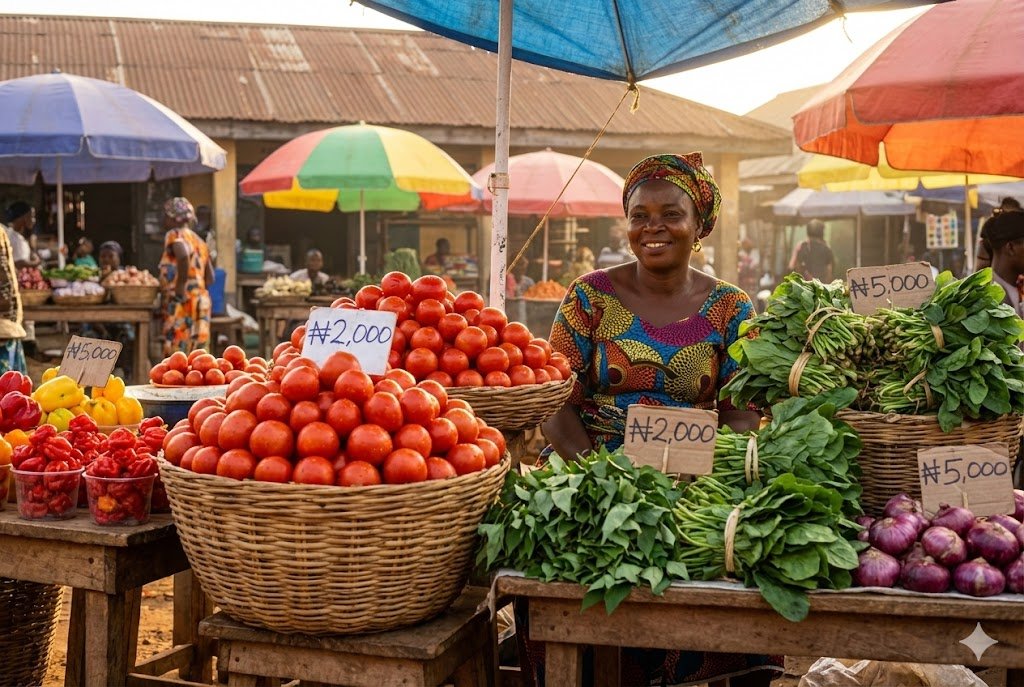
The most expensive habit a 9-5er can have is “retail convenience.” Buying daily portions from the corner shop means you are paying a heavy premium for every single onion and tomato. This is the exact opposite of the cook once eat all week lifestyle.
| Item | Street Price (Retail) | Market Price (Bulk) | Monthly Savings |
|---|---|---|---|
| Tomatoes | ₦500 (4 pieces) | ₦5,000 (Full basket) | ₦3,500+ |
| Rice | ₦1,800/De-rica | ₦85,000/Bag | ₦5,000+ |
| Pepper | ₦200/tiny nylon | ₦2,000/bucket | ₦4,000+ |
| Yam | ₦2,500/tuber | ₦8,000/5 tubers | ₦4,500 |
| Palm Oil | ₦1,200/bottle | ₦7,000/4 Liters | ₦2,000+ |
| Total Savings | ~₦19,000/month |
The Verdict: Spending just one Saturday morning at a wholesale market saves you enough cash every month to cover your internet data or subsidize your generator fuel. It is simple math.
Specific Market Tips for Maximum Savings
You don’t just stroll into a busy market; you enter with a calculated plan.
- The “6 PM Clearance” Rule: Traders want to go home with zero stock. Arriving at the market around 6:00 PM means you are buying during the desperation phase for the sellers.
- The Hack: Approach the vendor with a smile and a fair offer. “Madam, let me help you clear this table so we can all go home.” You will walk away with bags of produce at nearly half the price.
- Walk Past the Front Gate: The traders at the entrance have the highest overheads and the highest prices. Walk deeper into the market toward the sections where local farmers congregate. That is where the real value lives.
- The “Co-op” Strategy: If a full bag of onions is too much for your kitchen, partner up with your neighbor or a colleague.
- Buy the wholesale unit together.
- Split the goods instantly.
- You both benefit from the wholesale price without the risk of food spoilage in your home.
Maximizing Modern Appliances
To really crush your prep time, you need to use your tools wisely. An air fryer isn’t just for snacks; it can perfectly roast a whole chicken or fish in twenty minutes, leaving your stove free for the soup pots. If you have a pressure cooker, use it to tenderize tough beef or beans in a fraction of the time, saving gas and your evening.
The 2-2-2 Rule for Food Safety
When you are prepping for the week, you have to be careful with the heat. Follow the 2-2-2 rule: chill food within 2 hours of cooking, use containers no more than 2 inches deep, and try to consume within 2 days if you aren’t freezing it. For frozen meals, remember that cooling your stew in an ice bath before putting it in the freezer preserves the texture and prevents bacteria growth. I’ve used this for years, and it is the only way to ensure your food tastes fresh on Wednesday night.
Zero-Waste Cooking Habits
Don’t throw away your vegetable stalks or onion peels. Boil them with water to create a nutrient-dense stock that you can use to flavor your rice or beans. If you have leftover proteins, shred them into a quick morning omelet or stir them into your next pot of stew. Nothing should go to waste in a tight economy.
By keeping a permanent marker and masking tape handy, you can label every container with the “Date Cooked.” It sounds simple, but it is the difference between eating a delicious meal and wondering if that container at the back of the freezer is still safe.
Sustainability and the 80-20 Approach
You don’t have to be perfect. Aim for the 80-20 rule; prep 80% of your meals to stay on track and save money, while leaving 20% of your time and budget for the unexpected, like that coworker’s birthday lunch or a spontaneous craving for something you didn’t plan. Consistency, not perfection, is what will keep your health and your bank account in the green.
Complete Weekly Meal Prep Timetable for Busy 9-5ers
Now that you have optimized your budget, let’s pivot to the logistics of execution. This is where you reclaim your sanity during the workweek. I have refined this step-by-step Meal Prep Timetable for Busy 9-5ers to reflect the realities of 2026. Living and working in Nigeria is a full-time sport. The ‘Cook once eat all week’ method is simple: you dedicate 4 to 6 hours on a weekend to do 90% of the work. This structure is the difference between eating a nutritious home-cooked meal and settling for greasy roadside snacks.
The Saturday/Sunday Prep Schedule
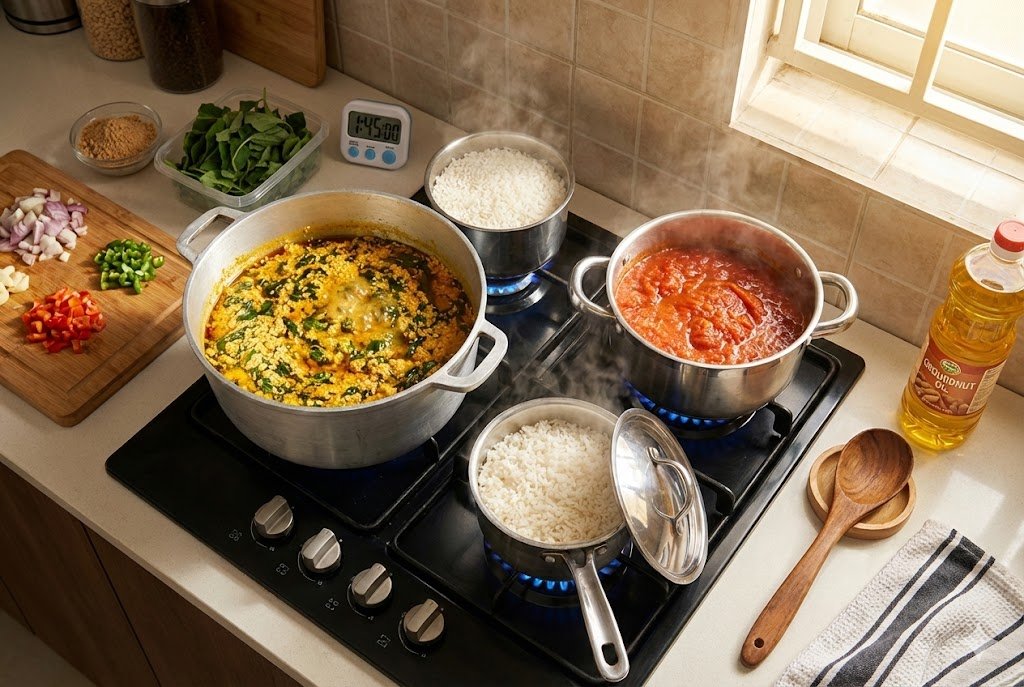
Avoid the temptation to spend your entire weekend tethered to the stove. With a disciplined 6-hour window, you can prep enough food to cover lunch and dinner for the next five days. Efficiency is the primary goal here.
- 9:00 AM: Hit the market. Leveraging the ‘6 PM Clearance’ strategy is excellent, but early morning trips to major hubs like Mile 12 or Oyingbo ensure you get the freshest produce before the heat sets in. You can save up to 40% on groceries by buying in bulk here.
- 10:30 AM: Sorting and cleaning. Wash your meat and proteins immediately. This is also when you should blend your pepper mix and prep your vegetables.
- 11:30 AM: Pot 1 – The Base Sauce. Create a massive pot of tomato and pepper stew base. Reducing the water content completely is essential, as this allows you to safely store it for up to 3 months in the freezer.
- 12:45 PM: Pot 2 – The Soup. While the stew bubbles, start your Egusi, Ogbono, or Efo Riro. Use an ice bath to cool these large pots rapidly once finished, as this is critical in our tropical climate to prevent bacterial growth.
- 2:00 PM: Proteins. Utilize a pressure cooker to tenderize tough meats in minutes. Once done, move them to an air fryer to finish. This method is significantly faster than traditional frying and avoids the messy oil splatters.
- 3:30 PM: Sides. Boil beans or prepare Moi-moi. If you are struggling with power, keep 3 or 4 frozen water bottles in your freezer to act as a cold-sink during unexpected outages.
- 4:30 PM: Cool and Pack. Always portion food into single-serve containers. Use masking tape and a permanent marker to label the ‘Date Cooked’ to ensure you follow the 2-2-2 food safety rule.
- 5:15 PM: Sanitization. Clean your workspace immediately. A messy kitchen makes Monday morning feel twice as long. Refer to our guide on keeping a house clean with a busy schedule for systems that keep your home functional without requiring a deep clean every single day.
Nigerian Food Time Table for Family (Complete Week)
Serves: 4-6 | Focus: Balanced Nutrition & Time Efficiency
With your containers stocked, your mornings will lose that frantic, disorganized edge. By preparing the heavy lifting upfront, you protect your energy for the workday. A well-organized kitchen workflow complements an efficient morning routine, allowing you to walk out the door feeling ready rather than depleted.
| Day | Breakfast | Lunch (Packable) | Dinner (Comfort) | Prep Notes | Time to Assemble |
|---|---|---|---|---|---|
| Mon | Boiled Yam & Egg Sauce | Jollof Rice & Chicken | Eba with Egusi Soup | Use frozen batches | 15 mins |
| Tue | Bread, Butter & Tea | Jollof Rice & Beef | Semo with Egusi Soup | Defrost soup overnight | 20 mins |
| Wed | Pap & Moi-Moi | White Rice & Stew | Porridge Beans | Reheat pre-portioned beans | 10 mins |
| Thu | Oats & Milk | Spaghetti & Turkey | Wheat & Okro Soup | Use stew base for pasta | 25 mins |
| Fri | Fried Yam & Sauce | Beans & Garri | Fufu with Veg Soup | Pre-made soup variety | 15 mins |
| Sat | Akara & Pap | Indomie & Egg | Pepper soup | Flexible weekend cooking | 30 mins |
| Sun | Sunday Rice & Chicken | Salad & Meat | Leftovers / Tea | Fresh prep for week | 1 hour+ |
Note: Customize these staples based on your regional heritage. Northern families might incorporate more millet-based breakfast options, while Southern families might gravitate toward plantain or yam-heavy dishes. Adaptability is key to keeping the diet fresh.
Nigerian Food Time Table for School Children
Managing the morning school run requires the precision of a logistics officer. This schedule ensures your kids are fed and ready before the transport arrives.
The School Run Routine:
- 6:30 AM (Breakfast): Focus on high-energy, nutrient-dense meals that are quick to consume before the school bus arrives.
- 12:00 PM (Lunch): Utilize insulated food flasks to keep home-cooked meals warm and appetizing by midday.
- 4:00 PM (Snack): Offer light, portable snacks to maintain energy levels until the evening family meal.
- 7:00 PM (Dinner): Prioritize substantial meals that encourage healthy sleep patterns for growing children.
Portable Lunch Box Ideas:
| Day | Lunch Box Menu | Snack Box Idea | Prep Tip |
|---|---|---|---|
| Monday | Jollof Rice with Diced Chicken | Apple slices | Use Sunday batch |
| Tuesday | Yam Sticks & Egg Sauce | Yogurt | Air-fry yam sticks |
| Wednesday | Spaghetti with Sausages | Groundnuts | Use stew base |
| Thursday | Indomie with Veggies | Chin-Chin | Use thermal flask |
| Friday | Moi-Moi & Custard | Plantain Chips | Prepare in bulk |
Advanced Meal Prep Strategies
Refining your Meal Prep Timetable for Busy 9-5ers is a journey. Over time, you will find shortcuts that suit your specific family dynamic, but these foundational strategies will help you get there faster.
How Should a Beginner Meal Prep for the Week?
Do not attempt a five-course marathon on your first attempt. It is a recipe for frustration.
- Master the Basics: Limit your first week to a single batch of tomato stew and one type of soup. Once you master the timing, you can expand.
- Optimize Storage: Invest in high-quality stackable containers. They save significant freezer real estate compared to mismatched plastic bowls.
- Labeling: Never trust your memory. Use masking tape to mark the dish name and the date you cooked it. This prevents the mystery-meat syndrome later in the week.
Understanding the 80-20 Rule for Sustainable Eating
The 80-20 rule is a sustainable path to nutrition without the misery of extreme restriction. As highlighted by global health standards, sustainable eating is defined by flexibility. Rigid, perfectionist diets rarely survive a Nigerian work week.
- The 80% Foundation: Between Monday and Friday lunch, commit to your healthy, home-prepped meals. This forms your stable nutritional base.
- The 20% Flexibility: Use your Friday evening or Saturday to enjoy social treats, whether that is office birthday cake or a weekend outing with friends.
- Long-Term Sustainability: Knowing that you have ‘freedom’ built into your schedule makes it significantly easier to stick to your healthy routine during the stressful work hours. This flexibility is what makes a meal prep schedule for Nigerian 9-5 workers actually work for years rather than just weeks.
Batch Cooking Techniques for Nigerian Soups
- Vegetable Management: For soups like Efo Riro or Okro, undercook your greens slightly. Reheating will finish the cooking process, ensuring the vegetables retain their color and texture rather than turning into mush.
- Waste Reduction: Adopt a ‘Zero-Waste’ mindset. Save vegetable stalks, clean peelings, and leftover chicken bones to boil into a nutrient-dense stock, which adds depth to your Jollof rice or pasta.
- Flavor Density: Never discard your meat stock. Freeze it in small, portioned containers to provide a ready-made flavor base for future meals.
Specific Recipe Guides and Costs
This section is detailed because the success of your Nigerian meal prep depends on these recipes tasting good and lasting long. When you spend your precious weekend hours in the kitchen, you need the assurance that by Wednesday, your food will taste as fresh as the day you cooked it. I have adjusted these estimates for 2026 inflation, though I highly recommend the 6 PM clearance strategy at markets like Mile 12 or Oyingbo, which can cut these costs by an additional 30 to 40 percent.
1. The Perfect Freezer Egusi Soup
Cost Estimate: ₦12,000 – ₦15,000 (Family Size Pot) This recipe is designed specifically to withstand the deep freezer. It uses the frying method, which prevents the soup from going sour quickly compared to the boiling method. I’ve used this for years because it allows for high-volume batching without sacrificing the authentic texture.
Ingredients Breakdown:
- Egusi (Melon seeds): 4 milk cups (approx 550g), blended smoothly.
- Beef/Shaki (Tripe): 1.5kg combined for protein density.
- Stockfish & Smoked Fish: Essential for that deep, complex Nigerian flavor.
- Palm Oil: 3 cooking spoons (ensure it is high quality).
- Vegetables: Ugu (Pumpkin leaves) – 3 bunches, washed, shredded, and dried.
- Pepper Mix: 8 Scotch Bonnet (Rodo), 3 Bell Peppers (Tatase), 3 Onions – blended roughly.
- Locust Beans (Iru): 3 tablespoons for depth.
- Crayfish: 4 tablespoons (ground).
- Seasoning: Natural spices like garlic and ginger, plus your preferred seasoning cubes.
Step-by-Step Method:
- Boil the Meat: Wash beef and shaki thoroughly. Season with garlic, ginger, onions, and salt. Cook until tender. Crucial: Do not let the water dry up. You need the nutrient-rich stock for the soup base.
- Prep the Paste: Mix the ground Egusi with a little warm water to form a thick, spreadable paste. Set aside.
- Fry the Oil: In a dry, heavy-bottomed pot, heat the palm oil on medium heat. Add chopped onions and fry until they are soft and fragrant.
- Fry the Egusi: Add the Egusi paste to the hot oil. Fry it like you are preparing scrambled eggs. Keep stirring for 10 to 12 minutes until it becomes crumbly and starts to smell nutty. This frying step is the secret to longevity.
- Add Pepper & Stock: Pour in your blended pepper mix and the meat stock. Stir until the mixture is uniform. If it is too thick, add a small splash of warm water.
- Simmer: Cover the pot and let it cook for 20 minutes. You want the oil to rise to the top. This indicates the Egusi is fully cooked and stable.
- Add Proteins: Incorporate the boiled meat, stockfish, and smoked fish. Add the Iru and crayfish now. Adjust for salt.
- Vegetables Last: Turn down the heat to the lowest setting. Fold in the Ugu leaves. Stir and cook for only 2 to 3 minutes.
- Finish: Turn off the heat immediately. The residual heat finishes the greens without turning them into mush.
Storage Instructions: Allow the soup to cool completely in an open pot. Divide into individual 500ml or 1-liter containers. Place in the deep freezer. This will last up to 8 weeks, maintaining its integrity throughout the workweek.
2. The All-Purpose Nigerian Tomato Stew
Cost Estimate: ₦9,000 (Large Pot) This is the base for Jollof Rice, Pasta, Yam sauce, or just White Rice and Stew. Freezing cooked tomato stew base can extend shelf life up to 3 months if the water content is fully reduced during the initial frying phase.
Ingredients Breakdown:
- Tomatoes: 1.5 paint buckets (fresh).
- Tatase (Red Bell Pepper): 15 pieces for color and sweetness.
- Rodo (Scotch Bonnet): 12 pieces (adjust for heat tolerance).
- Onions: 6 large bulbs for depth.
- Vegetable Oil: 750ml for the deep fry method.
- Tomato Paste: 2 tins (for thickness and richness).
- Seasoning: Thyme, Curry powder, fresh garlic, and ginger paste.
Step-by-Step Method:
- Blend & Boil: Blend your tomatoes, peppers, and onions. Pour into a large pot and boil on medium heat until the water evaporates completely. This is the secret. If there is any water left, your stew will taste sour within days.
- Heat Oil: Heat vegetable oil in a separate large pot. Add sliced onions and fry until they are golden brown.
- Fry Paste: Add the tomato paste and fry in the oil for 5 to 7 minutes. This removes the metallic tang and brings out the sweetness.
- Fry the Mix: Add the dehydrated tomato-pepper puree. Fry on low-medium heat.
- Season: Add curry, thyme, garlic, ginger, and seasoning cubes.
- The Long Fry: Keep frying and stirring frequently for 30 to 40 minutes. You know it is done when the oil clarifies and floats on top and the aroma is sweet rather than acidic.
- Add Meat Stock: Pour in your savory meat stock. Let it simmer together for 15 minutes to marry the flavors.
Storage Instructions: Cool completely. Store in 1-liter airtight containers. When you need it, simply thaw a portion, heat it up, and your base is ready for Jollof or pasta. I use this for the 80-20 rule of meal prep, where 80 percent of my cooking is done on Sunday, leaving only 20 percent for fresh finishing during the week.
3. Beans Porridge (Ewa Riro)
Cost Estimate: ₦4,000 Beans are an elite protein source. They freeze remarkably well and, in my experience, the texture often improves after a night or two in the freezer.
Ingredients Breakdown:
- Beans: 4 cups (Oloyin or Honey beans).
- Palm Oil: 1.5 cooking spoons.
- Onions: 3 bulbs, finely chopped.
- Crayfish: 4 tablespoons, coarsely ground.
- Pepper: Blended Rodo and onions.
- Protein Booster: Smoked fish or finely diced ponmo for texture.
Step-by-Step Method:
- Pick & Wash: Remove all stones and debris. Wash thoroughly until the water runs clear.
- Pre-cook: Boil the beans for 10 minutes and drain the water. This effectively reduces the starch that causes bloating.
- Cook to Tender: Add fresh water and chopped onions. Cook until soft. If you have a pressure cooker, use it to cut your cooking time by half, as this is a major efficiency boost for a busy 9-5 professional.
- Make the Sauce: While the beans cook, heat palm oil in a pan. Fry onions and blended pepper. Add crayfish and your preferred seasoning.
- Combine: Once the beans are tender enough to mash with a fork, stir in the sauce and your smoked fish or ponmo.
- Simmer: Add salt. Remember: Never add salt at the start, as it toughens the skin of the beans. Simmer for 15 minutes on low heat to allow the beans to absorb the oil and flavor.
Storage Instructions: Portion into single-serve, airtight containers. Beans freeze perfectly for up to 3 months. Always keep an extra portion in the freezer for nights when you are too tired to cook.
4. Oven-Baked Jollof Rice (Batch Method)
Cost Estimate: ₦6,500 Cooking Jollof on the stovetop requires constant vigilance. The oven method is perfect for batch cooking because you can load the oven and use that time to clean the kitchen or pack your work bags.
Ingredients:
- Rice: 6 cups (Long grain or Basmati).
- Stew Base: 4 cups of your pre-made Tomato Stew.
- Stock: 4 cups of meat stock + 2 cups hot water.
- Seasoning: Bay leaves, Curry, Thyme, and extra seasoning to taste.
- Foil Paper: Crucial for maintaining the internal steam pressure.
Step-by-Step Method:
- Prep: Preheat your oven to 180°C. Wash the rice with boiling water to remove excess starch.
- Mix: In a large, deep oven-safe tray, combine the rice, stew base, stock, and seasonings. Stir until every grain is coated in the red base.
- Seal: Use high-quality foil to cover the tray tightly. Seal the edges thoroughly to prevent any steam from escaping.
- Bake: Bake for 50 minutes. Do not open the oven door, as this drops the temperature and ruins the steaming process.
- Fluff: Remove from the oven, carefully open the foil, and fluff with a fork. You get perfectly individual grains every single time.
Why this works for 9-5ers: It eliminates the risk of burning the bottom of the pot. When you are tired, the last thing you need is to scrub a scorched pot at 10 PM. This method simplifies the entire workflow.
Storage and Food Safety
You have cooked all this food. Great! But improper storage will ruin everything. Here is how to keep your food fresh in the Nigerian climate. Proper storage is the difference between food that saves you money and food that sends you to the hospital. Following NAFDAC’s food safety guidelines, always ensure cooked food is properly cooled and stored within safe temperature ranges to prevent bacterial growth. The 2-2-2 food safety rule is critical in our tropical climate to prevent the rapid bacterial growth that occurs when food lingers at ambient temperatures.
The 2-2-2 Food Safety Rule
Food safety is critical, especially given the heat in cities like Lagos and Abuja. The “2-2-2 Rule” helps ensure your meal prep doesn’t make you sick:
- 2 Hours (Room Temp): Do not leave cooked food at room temperature for more than 2 hours. Bacteria multiply rapidly in our warm climate. If you leave that pot of soup on the counter overnight, it has almost certainly begun to ferment.
- 2 Hours (Refrigerate): Refrigerate prepared food within 2 hours of cooking. To cool a large pot of soup faster, place the pot in a large basin of cold water, or an ice bath, stirring occasionally. This brings the temperature down rapidly, which is safer for your freezer and the food quality.
- 2 Months (Freezer): While frozen food remains safe indefinitely if kept at a consistent temperature, for the best taste, try to consume your soups and stews within 2 months. After this, delicate ingredients like crayfish and smoked fish may start to lose their flavor profile.
Power Outage Emergency Guide: The “No Light” Protocol
The biggest fear for Nigerian meal preppers is power outages. Beyond the immediate threat to your soup, power interruptions affect every aspect of life. Here is your survival strategy timeline:
- 0 – 4 Hours: Do nothing. Do not open the freezer door. A full freezer acts like a solid block of ice and will hold its temperature perfectly.
- 4 – 24 Hours: Cover the freezer with thick blankets or duvets. This provides extra insulation. If you have a generator, run it for 2 hours every 6 hours to maintain the ice block.
- 24 – 48 Hours: Use your emergency stockpile. Always keep 3 to 4 frozen water bottles in your freezer for this exact moment. Move them to the top shelf. Cold air sinks, so this helps cool the food below.
- 48+ Hours (Critical Zone): Check the food.
- Ice Crystals: If the food is partially thawed but still has ice crystals, it is safe to refreeze.
- Fully Thawed (Cold): If it is fully thawed but still refrigerator-cold (4°C), cook it immediately and eat it, or cook it and re-freeze it.
- Warm: If the food feels warm or room temperature, throw it away. Do not taste it to check. When in doubt, throw it out.
Container Recommendations: Invest to Save
Stop using old ice cream bowls. They crack, leak, and don’t seal properly. Invest in quality storage now to save money later.
- Square over Round: Square or rectangular containers stack like bricks in a wall. Round containers leave empty, wasted space in your freezer.
- Recommended Brand/Type: Look for BPA-free plastic containers with clip-lock lids. These are airtight and leak-proof.
- Where to Buy:
- Tejuosho Market (Yaba): You can get a set of 6 sturdy square containers for about ₦4,500 – ₦6,000.
- Supermarkets: Often sell the same for double the price. Go to the market.
- Glass vs. Plastic: Glass is excellent for health and reheating, but heavy and breakable. For a busy 9-5er commuting with food, high-quality BPA-free plastic is far more practical.
Having an organized kitchen makes meal prep 10 times easier. Your pots, containers, and ingredients should all have designated spots so you can move efficiently during your 4-hour cooking session. Always strive for a zero-waste kitchen by repurposing vegetable stalks for stock and ensuring no protein goes to waste.
The Labeling System
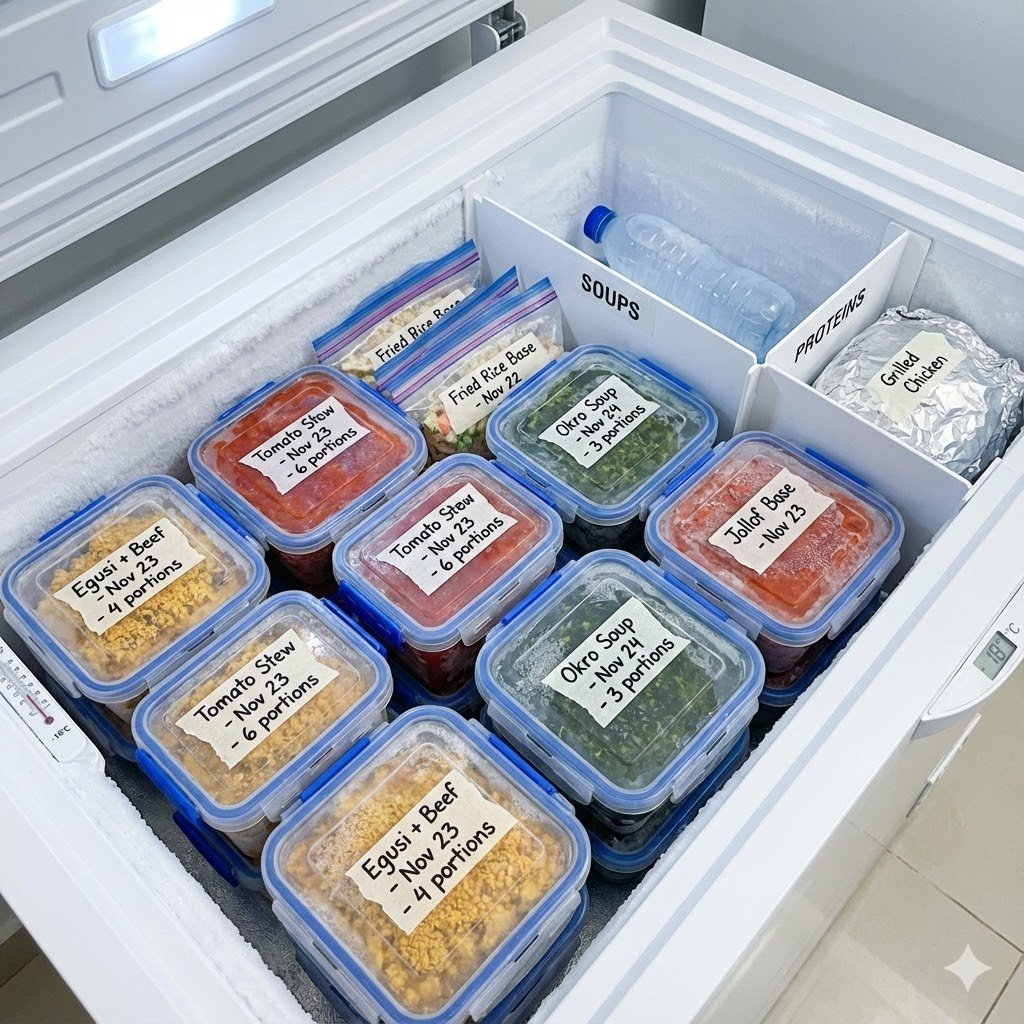
You think you will remember that the red stew is “Fish Stew” and the other red stew is “Beef Stew.” You won’t. Two weeks later, they all look identical.
- Tools: Buy a roll of Masking Tape and a Permanent Marker.
- What to Write:
- Contents: e.g., “Egusi + Goat Meat”
- Date Cooked: e.g., “Nov 24”
- Portions: e.g., “2 servings”
- FIFO Method: First In, First Out. When you put new food in the freezer, place it at the back. Always eat the older food first so nothing stays frozen for 6 months. By utilizing this system, you ensure that you are always eating the freshest possible version of your meal prep.
Monthly Planning and Rotation
Cooking the same Egusi soup every week will make you grow to resent your own kitchen. The secret to long-term success is rotation. I’ve realized that by mixing up the textures and flavors, I stay excited about my meals rather than seeing them as a chore. The ‘Cook once eat all week’ method is simple: you dedicate 4 to 6 hours on a weekend to do 90% of the work. For 2026, I have shifted toward an 80-20 approach, where I ensure 80% of my meals follow the planned rotation while leaving 20% for spontaneous cravings or quick fixes like air-fried plantain or fresh fruit.
Complete 4-Week Rotation Timetable
This timetable ensures you don’t eat the same soup twice in a row. It is designed to keep your palate guessing while keeping your pantry organized.
| Week | Soup Base (Swallow) | Stew Base (Rice/Pasta) | Side Dish/Special | Breakfast Focus | Shopping Focus |
|---|---|---|---|---|---|
| Week 1 | Egusi Soup (Beef & Shaki) | Tomato Stew (Chicken) | Moi-Moi (Beans pudding) | Bread & Tea / Eggs | Bulk Meat & Tomatoes |
| Week 2 | Okro/Ogbono (Fish) | Curry Sauce (Turkey) | Fried Plantain (Dodo) | Pap (Ogi) & Akara | Fish & Vegetables |
| Week 3 | Vegetable Soup (Efo Riro) | Ofada Sauce (Assorted) | Beans Porridge | Oats / Cereal | Palm Oil & Assorted Meat |
| Week 4 | Native Soup (Oha/Bitterleaf) | Jollof Rice (Batch cook) | Yam Porridge (Asaro) | Yam & Egg Sauce | Tubers & Spices |
Note: You cook Week 1’s menu on the first weekend. When Week 2 approaches, your Week 1 food should be finished or nearly finished. This staggering helps with cash flow too, you don’t buy everything every week. Living and working in Nigeria is a full-time sport. By utilizing a “co-op” strategy with neighbors to buy full bags of rice or baskets of tomatoes, you can slice your monthly grocery bill by up to 40% compared to daily retail shopping.
Seasonal Ingredient Calendar: Save Money by Knowing When to Buy
Prices in Nigeria are heavily dictated by the rain. Knowing this calendar saves you thousands of Naira and is vital for budget meal planning Nigeria. I have found that the ‘6 PM Clearance’ strategy at local markets is a consistent way to reduce grocery costs by another 30% on top of bulk savings.
- December – February (Dry Season):
- Buy: Tomatoes are usually cheaper and redder (especially from the North). Onions are abundant. Use this time to freeze your pureed tomato base, which can last up to 3 months if the water content is fully reduced.
- Avoid: Corn is scarce or expensive. Ugu might be dry and sandy during the harmattan.
- June – August (Rainy Season):
- Buy: Ugu and Waterleaf are lush, green, and cheap. Corn is everywhere (boil or roast).
- Avoid: Tomatoes. This is usually the scarcity season. Prices often triple.
- Strategy: During these months, switch to Palm Oil based soups (Native soups, Banga) or use concentrated Tin Tomato for stews instead of relying on fresh ones.
- September – November (Harvest):
- Buy: Yams! New yam enters the market. Prices drop significantly. This is also the best time to stock up on dried spices and seasonings.
Monthly Grocery Budget Breakdown (Estimates)
How much should you budget for a full month of meal prepping? Prices fluctuate in 2026, but the strategy remains the same.
1. Single Person (The Bachelor/Spinster)
- Budget: ₦55,000 – ₦70,000
- Strategy: Focus on one pot of soup per week. Buy half-kilo of meat and leverage eggs for protein versatility. Zero-waste tip: use vegetable stalks in your stock to add extra depth.
2. Young Couple (No Kids)
- Budget: ₦100,000 – ₦130,000
- Strategy: Buy a quarter bag of rice. Share a basket of tomatoes with neighbors to minimize wastage. Use pressure cookers to reduce your energy consumption and gas costs.
3. Family of 4 (Parents + 2 Kids)
- Budget: ₦180,000 – ₦220,000
- Strategy: Must buy in bulk (Bag of rice, 5 liters oil, Carton of turkey). Buying retail will bankrupt you. Batch cook school lunches (Meatpies/Sausage rolls) to avoid the daily expense of cafeteria food.
Troubleshooting and FAQs
Common Meal Prep Challenges
- “My soup tastes watery after freezing.”
- Solution: You didn’t let the liquid reduce enough during the cooking process. Use an ice bath to cool large pots of soup rapidly before placing them in the freezer, this keeps the flavors locked in and prevents bacteria. Always use masking tape on containers to track the ‘Date Cooked’.
- “I don’t have constant power.”
- Solution: The 2-2-2 rule is your savior here: cool within 2 hours, store in small portions, and consume within 2 weeks. Invest in a high-quality cooler with ice packs, and keep 3-4 frozen water bottles in your freezer to act as a cold-sink during outages.
Meal Frequency and Weight Management
We often hear questions like “How many times should I eat a day to reach my health goals?” or “Which meal is best to skip for weight loss?”
- The Reality: While meal prep aids portion control, there is no one-size-fits-all answer. Consistency is what drives results.
- The Golden Rule: Avoid heavy eating after 8 PM, which is a common pitfall due to traffic delays. Use an air fryer for your proteins to cut down on excess oil without sacrificing the Nigerian flavor profile.
- Advice: Don’t rely on “starving” yourself. If you are worried about nutrient degradation from reheating, prepare your bases in advance and finish the final assembly with fresh garnishes like sliced onions or peppers.
Frequently Asked Questions
Q: What is the 3 3 3 rule for eating? A: It is a simplified meal planning method: 3 proteins, 3 carb sources, and 3 vegetable bases. It ensures variety without complicating your shopping list.
Q: What can I cook with a limited budget? A: You can make a nutrient-dense pot of beans porridge or concoction rice with smoked fish and extra crayfish, which are excellent low-cost protein sources.
Q: How should a beginner start? A: Start by batch cooking just your proteins and one base stew. Assemble meals daily using these pre-cooked bases. You don’t need a professional setup to start.
Q: What is the healthiest way to cook? A: Steam your proteins or use an air fryer instead of deep frying. Vegetable soups like Efo Riro are incredibly healthy when prepared with moderate oil and fresh ingredients.
Q: What is a classic Nigerian 3-course meal? A: Starter: Pepper soup. Main: Jollof Rice with chicken and Moi-moi. Dessert: Fresh sliced watermelon or pineapple.
Getting Started This Weekend
You have the plan. Now you need the action. I’ve created a printable checklist for my subscribers that simplifies these steps, but you can get started right now without one.
- Step 1 (Friday Night): Review your pantry and write your shopping list using the 5-4-3-2-1 method.
- Step 2 (Saturday Morning): Head to the market. Carry cash, negotiate firmly, and focus on your bulk items.
- Step 3 (Saturday Afternoon): Use your pressure cooker or stove to prep your base stews and soups.
I know the temptation to say ‘I’ll start next month’ is strong. Don’t fall into that trap. The best time to start is this weekend. If you find yourself hesitating, remember that planning is the greatest gift you can give your future self. By 5 PM Saturday, you’ll have your entire week sorted.
By next Friday, when your colleagues are exhausted from the daily search for food, you’ll walk through your door knowing a high-quality, homemade meal is waiting. That feeling makes every minute of weekend prep feel like a win.
Drop a comment below: Which soup will you prep first: Egusi, Okro, or Vegetable? I read every reply!
Comparison Table: Daily Cooking vs. Meal Prep
| Feature | Daily Cooking | Meal Prep (Batch Cooking) |
|---|---|---|
| Time Spent | 1.5 – 2 hours daily (10+ hours/week) | 4-5 hours once (Weekend) |
| Cost | High (Buying retail/small portions) | Low (Buying bulk saves up to 40%) |
| Stress Level | High (Cooking when exhausted) | Low (Just warming your food) |
| Health | Lower (Risk of impulse junk food) | Higher (Controlled, fresh portions) |
| Cleanup | Daily washing of pots/pans | One major cleanup per weekend |
| Variety | Limited (whatever energy allows) | High (9 combinations from 3-3-3 method) |
| Family Impact | Often separate times | Everyone eats together, same quality |
Conclusion
Meal prepping is a personal journey, not a sprint. The goal isn’t to reach perfection on day one, but to reclaim your time and health from the unpredictable chaos of city life. By dedicating a few hours on the weekend, you’re not just cooking soup; you’re buying yourself peace of mind for the entire week.
Remember that consistency always beats intensity. Start with the 3-3-3 method, find the recipes that make you feel truly nourished, and adapt the budget as your needs change. Whether you are a young professional working in Lagos or a parent raising a family, this system is your primary tool for a balanced, stress-free life in 2026.
Now, turn off this screen, grab your market bag, and take that first step. Your future self, enjoying a delicious, home-cooked meal on a chaotic Tuesday evening, is already thanking you for the effort you put in today.

Oladepo Babatunde (Prince Babatee Tunde) is a Computer Scientist, researcher, and professional content writer with a Higher National Diploma in Computer Science from Kwara State Polytechnic, Nigeria.
With a background in technology and a passion for clear communication, Babatunde specializes in creating thoroughly researched, reader-focused content on productivity, personal development, home living, and technology. Every article he writes is backed by extensive research and fact-checking to ensure readers receive accurate, actionable information.
As a freelance writer, he has helped brands and publications deliver content that educates, engages, and empowers their audiences. His mission at Vibena is simple: make complex topics easy to understand and help Nigerians live smarter, more productive lives.