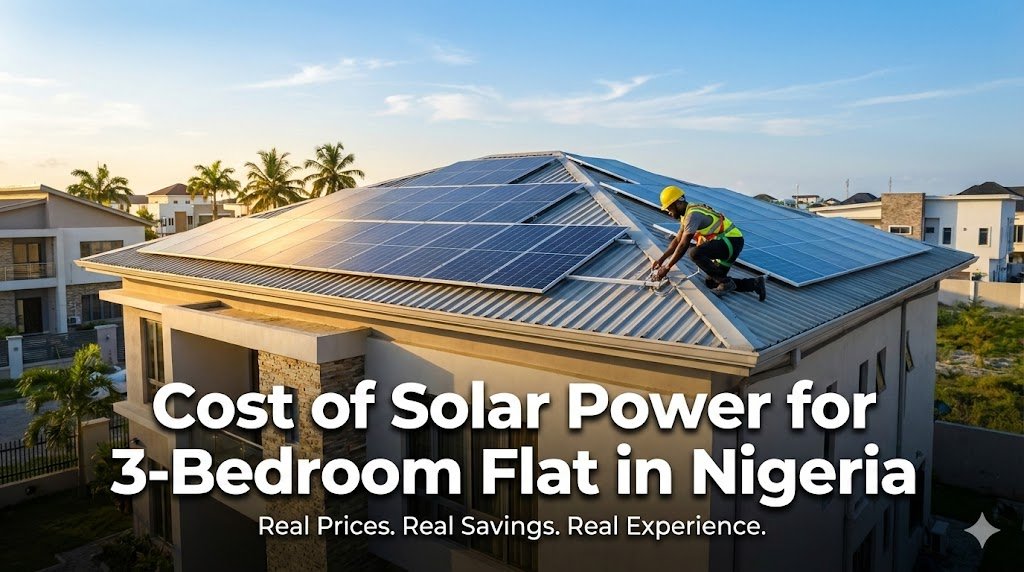
If you are tired of the constant struggle with NEPA bills and the endless noise of a generator, you are not alone. This article covers the cost of solar power for a 3-bedroom flat in Nigeria, detailing a ₦3.8M setup after 8 months with real bills included.
Like many of us, I was spending over ₦145,000 every month just to keep the lights on and the fridge running, thanks to high Band A tariffs and the ever-increasing cost of petrol.
I finally decided to stop the bleeding in May 2025 by installing a 5kW hybrid solar system. The total cost of this setup is a journey I want to share with you.
I am just a homeowner who got fed up with the system, not a solar engineer, so take this as a practical guide based on my own experience.
- A 5kVA solar system for a 3-bedroom flat in Nigeria typically costs between ₦3.8M and ₦6.0M as of 2026.
- My own 5kVA setup cost ₦3.8M back in May 2025, though prices fluctuate based on the brand and the installer you choose.
- I have been tracking my data for 8 months, and I am seeing average monthly savings of around ₦93,000.
- At this rate, the system will pay for itself in about 3.4 years, which is a huge relief for my monthly budget.
- Remember that the total price includes more than just panels; you have to account for the inverter, batteries, and the cost of professional installation, which usually adds ₦350,000 to ₦550,000 or more.
- While lithium batteries are much more expensive upfront, they are a better investment than tubular batteries because they last significantly longer.
- Please note that these figures are estimates; your final bill will depend on your specific location, the quality of components, and the expertise of your installer.
- I strongly advise against DIY installation unless you are a professional, as it is risky and can lead to expensive damage.
Understanding Solar Panel Prices in Nigeria (2026)
Knowing the market price for panels is the best way to ensure you aren’t being overcharged by a contractor. Based on verified street prices in Lagos as of January 2026, here is what you should expect to pay for quality mono-crystalline panels.
| Panel Capacity | Estimated Price Range |
|---|---|
| 200W | ₦50,000 – ₦65,000 |
| 300W | ₦70,000 – ₦85,000 |
| 450W | ₦100,000 – ₦115,000 |
| 550W | ₦130,000 – ₦150,000 |
| 600W+ | ₦148,000 – ₦165,000 |
If you see someone advertising a “1000W” panel online, be very careful, as these are often fake or misleading. I have found that bifacial panels are a great option because they capture more energy and often provide better value than standard panels.
Always compare prices across at least three different platforms, like Jiji or Jumia, before you commit to a purchase. Also, do not be fooled by labels claiming a panel is “German” or “USA” made; most reputable panels on the market today are actually manufactured in China.
Complete Solar System Cost Breakdown for a 3-Bedroom Flat
When you start looking into the cost of solar power for a 3-bedroom flat in Nigeria, it is easy to get overwhelmed by the different options.
For most standard 3-bedroom flats, a 5kVA system is the sweet spot that balances power needs with your budget.
Keep in mind that the final price you pay depends heavily on the type of battery you choose. Lithium batteries are more expensive upfront but last much longer than traditional tubular batteries.
| System Size | Estimated Price Range |
|---|---|
| 3.5kVA | ₦1.8M – ₦3.2M |
| 5kVA | ₦3.4M – ₦6.0M |
| 6kW (Lithium) | ₦6.5M – ₦7.8M |
| 8kW | ₦9.8M – ₦12.5M |
| 10kVA | ₦7.5M – ₦13.0M |
These figures generally include the cost of installation and necessary accessories like cables and mounting racks. While it might be tempting to go for a larger system, anything above 5kVA is often overkill for a typical flat unless you are running multiple heavy-duty appliances simultaneously.
My Personal Solar Installation Story: The Decision and The Invoice
Before I made the switch, I was spending a fortune on power. My monthly electricity bill was hitting ₦145,000, split between ₦95,000 for fuel and ₦50,000 for the grid supply.
I set a budget of ₦3.5M, but after finalizing the components, the total solar installation project in Nigeria came to ₦3,798,000 in May 2025. I managed to keep the cost from ballooning further by negotiating the package and opting for specific, reliable brands rather than the most expensive ones on the market.
Choosing your own components can save you money, but it does come with more risk if you aren’t familiar with the hardware. Here is the breakdown of the core equipment I used for my 5kW solar system cost:
| Component | Specification |
|---|---|
| Inverter | Felicity 5kVA Hybrid |
| Solar Panels | 10x Jinko 550W |
| Batteries | 4x Luminous 220Ah Tubular |
Installation Day ‘Wahala’: What to Watch Out For
The actual installation process took two full days of work. Even with a solid plan, you should expect some solar installation challenges in Nigeria, such as unexpected structural needs.
For instance, my installer noticed the roof rafters were not strong enough to hold the weight of the panels. We had to spend an extra ₦15,000 to reinforce the roof structure before they could mount anything safely.
To protect my appliances, we also installed a separate distribution board specifically for heavy loads like the AC and electric cooker. This ensures that if there is a surge or a fault, the rest of the house remains powered.
- Always have a COREN-registered engineer handle your wiring to avoid safety hazards.
- Check your roof rafters for stability before the panels arrive.
- Ensure all DC connections are tight, as loose wiring is a common cause of electrical fires.
Never cut corners on the quality of the wiring or the expertise of the person doing the job. Professional installation is the only way to ensure your system lasts as long as it should.
3.5kVA vs. 5kVA Solar System: Which is Right for Your Flat?
Choosing between a 3.5kVA and a 5kVA system is the biggest decision you will make for your home. Many people try to save money by opting for the smaller 3.
5kVA setup, only to realize later that it cannot handle the appliances they actually use.
If you are living in a 3-bedroom flat with a family of four, I strongly recommend going for a 5kVA system. It saves you the headache of constant tripping and the regret of not being able to power your basic comforts.
| Feature | 3.5kVA System | 5kVA System |
|---|---|---|
| Estimated Cost | ₦1.8M – ₦2.8M | ₦3.8M – ₦5.5M |
| Best For | Light loads (TV, fans, laptops) | Full home (AC, iron, water pump) |
| Heavy Appliances | Not supported | Supported (with management) |
The main trap with the 3.5kVA option is its inability to run heavy-duty appliances like pressing irons or air conditioners. If you try to push it, the system will likely trip under the load, leaving you in the dark until you reset it.
A 5kVA system gives you the breathing room to use a microwave or a pumping machine without worrying about a total system shutdown. It is a bigger investment upfront, but it is the only way to get true peace of mind in a standard Nigerian flat.
What Can a 5kVA System Actually Power? (Daily Load Profile)
Understanding your solar power journey starts with knowing your daily consumption. A typical 3-bedroom flat usually consumes between 15 and 31 kWh every day.
In Lagos, a 5kW solar array typically generates between 27 and 33 kWh daily. To account for system losses, which usually hover around 20%, you really need to aim for a daily production of about 37 kWh to stay comfortable.
| Appliance | Quantity | Estimated Daily Usage |
|---|---|---|
| LED Bulbs | 15 | Included in total |
| Fans | 6 | Included in total |
| 1.5HP AC | 2 | 5 hours/day |
| Fridge/Freezer | 2 | 24 hours |
| TV/Decoder | 2 | Included in total |
| Water Pump | 1 | As needed |
This setup totals roughly 31 kWh, which fits well within the capacity of a 5kVA system. However, you must practice good load management to keep things running smoothly.
Avoid running all your heavy appliances at the same time, especially at night when the sun is down. If you absolutely need to run your AC all night, you will likely need a larger battery bank, which will increase your total setup cost.
How Much Does Solar Installation Cost in Nigeria? (Labor & Hidden Fees)
When budgeting for your solar project, do not just look at the price of the panels and batteries. The installation cost in Nigeria can vary, and there are several hidden expenses that often catch people off guard.
Professional labor for a quality job typically ranges from ₦350,000 to ₦550,000. Never be tempted to use an unqualified electrician for your DC wiring, as the risk of electrical fires is simply too high.
| Item | Estimated Cost |
|---|---|
| Professional Labor | ₦350,000 – ₦550,000 |
| 16mm Pure Copper Cable | ₦3,000 – ₦5,200 per meter |
| Earthing Installation | ₦25,000 |
| Roof Reinforcement | ₦0 – ₦50,000 |
| Automatic Changeover Wiring | ₦40,000 |
Cabling is one area where costs can really add up, especially if your panels are far from your battery bank. Always insist on 16mm pure copper cables to ensure efficiency and safety.
I also spent an extra ₦40,000 to have my changeover switch rewired to be automatic. It makes life much easier when the grid goes off, as the house switches to solar power without me having to lift a finger.
Is 10kW Enough to Run a House in Nigeria?
Many people ask if they should go big with a 10kW system, but for a standard 3-bedroom flat, that is usually overkill. A 10kW setup is a beast that can generate about 40-50 kWh of electricity every single day.
It is designed more for large duplexes or homes running heavy commercial equipment, not your average family setup.
If you are just trying to keep the lights on, run your fridge, and power a few AC units, a 5kVA system is usually plenty. The cost of solar power for a 3-bedroom flat in Nigeria, with my ₦3.
8M setup after 8 months, shows that you can get great results without spending millions more on capacity you won’t actually use.
To help you decide, here is a quick breakdown of how these systems compare in terms of investment and typical use cases:
| System Size | Estimated Cost | Best For |
|---|---|---|
| 5kVA | ₦3.5M – ₦5M | Standard 3-bedroom flat |
| 10kW | ₦7.5M – ₦13M | Large duplexes or heavy loads |
Keep in mind that the price jump from a 5kVA to a 10kW system is massive. Unless you have a specific need for that much power, stick to what your actual consumption requires to keep your budget in check.
My 8-Month Solar Performance Log: Real Savings & ROI
After running my system for eight months, I have been tracking every kobo saved. In total, I have kept ₦745,000 in my pocket that would have otherwise gone to fuel or grid bills. That averages out to about ₦93,000 in savings every month.
Based on my ₦3.8M investment, I am looking at a payback period of roughly 3.4 years.
Once that time passes, the electricity I use becomes essentially free, which is a huge relief for any landlord or homeowner. Even when fuel prices went crazy in late 2025, my solar setup stayed steady and kept my costs low.
Here is a summary of the financial performance so far:
| Metric | Data |
|---|---|
| Total Savings (8 Months) | ₦745,000 |
| Average Monthly Savings | ₦93,000 |
| Estimated Payback Period | 3.4 Years |
Please remember that these savings are based on my specific lifestyle and what I used to pay for power. If electricity tariffs go up again, my payback period might actually get even shorter.
Problems I Faced: Performance Issues and Maintenance
Solar is not a “set it and forget it” solution, especially in our environment. During the Harmattan, the dust buildup on my panels was so bad that it cut my power generation by 30%.
I had to make it a habit to clean the panels regularly to keep the system running at its best.
The rainy season also brings its own wahala. When the clouds are thick, my generation drops by about 20-30% compared to a sunny day. You have to be prepared for these dips in performance when the weather turns.
Maintenance is another area where you need to be hands-on, depending on your battery choice:
- Tubular Batteries: These require regular topping up with distilled water. It is a messy job and you cannot afford to ignore it if you want the batteries to last.
- Lithium Batteries: These are the gold standard for zero maintenance. They cost more upfront, but they last longer and save you the stress of manual upkeep.
If your budget allows, I highly recommend going for lithium batteries to avoid the constant maintenance cycle. Just remember that no matter what you choose, you must keep your panels clean and expect lower output during the rainy months.
Comparison: Cost of Solar Panels for a 2-Bedroom House
If you are living in a 2-bedroom flat or a BQ, you do not necessarily need the massive setup required for a full family house. A smaller system is often enough to keep your lights, fans, TV, and a small fridge running without any wahala.
When looking at the cost of solar power for a 3-bedroom flat in Nigeria, it is helpful to see how smaller configurations compare. For a 2-bedroom space, you are typically looking at a 2.5kVA or 3.
5kVA system.
| System Capacity | Estimated Price Range | Best For |
|---|---|---|
| 2.5kVA System | ₦1.8M – ₦2.2M | Single person or couple |
| 3.5kVA System | ₦2.3M – ₦2.8M | Small family (no AC) |
These systems are perfect for people who do not need to run heavy appliances like multiple air conditioners or large water pumping machines. If you try to push these smaller setups beyond their limits, you will only end up damaging your inverter or draining your batteries too fast.
Regional Price Differences: Lagos vs. Abuja vs. Port Harcourt
Where you live in Nigeria plays a big role in the final price you pay for your solar installation. Because Lagos is the main hub for imports, it usually has the most competitive base prices for equipment.
If you are buying your gear in other parts of the country, you have to factor in the cost of moving heavy batteries and panels across states. Here is a rough breakdown of how location impacts your total cost.
| Location | Price Variation | Key Factor |
|---|---|---|
| Lagos | Base Price | Proximity to ports |
| Abuja | 5% – 8% higher | Transport logistics |
| Port Harcourt | 10% – 15% higher | Logistics and corrosion risk |
In the North, while logistics costs can be similar to Abuja, you often get the benefit of 15% to 20% more sunlight, which might allow you to use slightly fewer panels. However, if you are in a coastal city like Port Harcourt, you must be careful about humidity.
The salt air in coastal areas can rust your equipment quickly. Always insist on corrosion-resistant mounting racks, even if it adds a little extra to your budget.
Lithium vs. Tubular Batteries: My Regret?
Looking back at my journey, if there is one thing I would change, it is the type of battery I started with. I went for tubular batteries because they were cheaper upfront, but the constant maintenance has been a real headache.
Tubular batteries cost about ₦285,000 each, meaning ₦1.14M for a set of four. While that sounds like a bargain, they only last 3 to 4 years and require you to keep checking the water levels.
If you forget, you are basically throwing your money away.
| Feature | Tubular (Lead-Acid) | Lithium (LiFePO4) |
|---|---|---|
| Upfront Cost | ~₦1.14M (for 4) | ~₦2.8M – ₦3.5M (10kWh) |
| Lifespan | 3 – 4 years | 10 – 15 years |
| Maintenance | Regular (water top-ups) | Zero |
Lithium batteries are the gold standard for a reason. Yes, the cost of solar power for a 3-bedroom flat in Nigeria would have been much higher if I had chosen lithium from day one, but I would have saved myself years of stress.
If your budget allows, please go for lithium. You will pay more today, but you will avoid the cycle of replacing batteries every few years and the messy job of manual maintenance.
Financing Options for Solar in Nigeria (2025)
Getting the money together for a full solar setup is often the biggest hurdle for most of us. While many people look for government-backed schemes like the REA Solar Power Naija program, it is important to know that these are usually designed for entire communities rather than individual flats.
If you are looking to finance your own system, you have a few private options to consider. Banks like Sterling Bank and First Bank have specific solar loan products, typically carrying interest rates between 20% and 25% per annum.
You could also use personal loan apps such as Carbon or FairMoney, but be careful here. These apps are often faster to access, but their interest rates can climb as high as 30%, which will significantly increase the total cost of your system over time.
For those just starting with small kits, Pay-As-You-Go services like SunKing or d. light are available. However, these are rarely suitable for a full 3-bedroom flat setup and can become quite expensive if you try to scale them up.
Important Note: Always read the fine print before signing any loan agreement. High interest rates can turn a good investment into a financial burden, so calculate your total repayment amount before you commit.
How to Spot a Bad Solar Deal (Red Flags)
The solar market in Nigeria is full of people trying to make a quick profit by selling low-quality gear. If you want to avoid solar scams, you need to keep your eyes open for these common warning signs.
If a price looks too good to be true, it probably is. Any quote that is more than 30% below the current market average is a massive red flag, as it likely involves used, refurbished, or fake components.
Watch out for these specific tricks when you are getting quotes:
| Red Flag | What It Actually Means |
|---|---|
| Massive price gaps | Likely fake or refurbished parts. |
| ‘1000W’ panels | These do not exist; it is a marketing lie. |
| No written warranty | You have no protection if the system fails. |
| Unbranded ‘German’ panels | Usually cheap, generic Chinese imports. |
| Suspiciously light batteries | Often indicates a fake or gutted battery. |
Always demand an itemized invoice that breaks down the cost of every single component. If a vendor refuses to give you a written warranty or a detailed breakdown, walk away immediately.
FAQ
When you are looking into the cost of solar power for a 3-bedroom flat in Nigeria, you will find that the numbers vary based on your specific needs.
A standard 5kVA system is usually the sweet spot for a 3-bedroom house, but the final price depends heavily on the battery technology you choose.
Here are the answers to the most common questions I get about solar setups:
| Question | Typical Answer |
|---|---|
| What is the total cost? | ₦3.8M to ₦6.0M for a 5kVA system. |
| How much is installation? | ₦350,000 to ₦550,000. |
| How long do parts last? | Panels (25 years), Inverters (10-15 years), Batteries (3-15 years). |
| Can I run my AC? | Yes, but night use requires a large battery bank. |
A 550W mono panel currently costs between ₦130,000 and ₦150,000. While the upfront cost is high, solar is almost always cheaper than running a generator in the long run, with most people seeing a full payback on their investment within 3 to 4 years.
Caution: Your battery choice is the most important factor for both your budget and your system’s lifespan. If you plan to run air conditioners at night, you must invest in a substantial battery bank, or you will quickly drain your power and shorten the life of your batteries.
Conclusion
Looking back at my solar power journey, I can honestly say the peace of mind is worth every kobo.
While dropping that much money at once is a serious financial commitment, the silence and reliability have completely changed how I live at home.
Don’t expect these prices to drop anytime soon, as most components are tied to the dollar. If you are tired of the generator wahala and want to finally take control of your power, investing in solar is a smart move for the long run.
Key Takeaways
- The upfront cost is high, but the long-term savings on fuel and maintenance are real.
- Solar provides true energy independence, freeing you from the stress of grid instability.
- Careful financial planning is necessary before you start your installation.
- Focus on quality batteries to ensure your system lasts for years to come.
Sources & Methodology
To make sure the numbers I shared are grounded in reality, I didn’t just guess based on my own experience. I verified the equipment prices against multiple installer quotes to ensure they reflect the current market reality.
I also cross-referenced these figures with industry reports from reputable sources. The table below shows where I pulled the data to keep this guide as accurate as possible.
| Data Category | Source |
|---|---|
| Equipment & Installation Costs | Market Installer Quotes, AFSIA Reports |
| Industry Trends | Techpoint Africa, TechCabal |
| Electricity Tariff Data | Nigerian Electricity Regulatory Commission (NERC) |
By combining these official reports with real-world installation costs, I aimed to give you a clear picture of what to expect. Always remember that prices can shift depending on your location and the specific brand of equipment you choose.

Oladepo Babatunde (Prince Babatee Tunde) is a Computer Scientist, researcher, and professional content writer with a Higher National Diploma in Computer Science from Kwara State Polytechnic, Nigeria.
With a background in technology and a passion for clear communication, Babatunde specializes in creating thoroughly researched, reader-focused content on productivity, personal development, home living, and technology. Every article he writes is backed by extensive research and fact-checking to ensure readers receive accurate, actionable information.
As a freelance writer, he has helped brands and publications deliver content that educates, engages, and empowers their audiences. His mission at Vibena is simple: make complex topics easy to understand and help Nigerians live smarter, more productive lives.