Last updated on December 5, 2025
If you’ve ever tried to connect a brand-new streaming stick or game console to an older TV, you know the frustration. Modern devices use HDMI, while many older telegoals – especially beloved CRT models or even some early flat-screens – only have coaxial cable inputs. The good news is, an HDMI modulator bridges this gap. It’s a clever device that takes your digital HDMI signal and converts it into an analog RF signal that your older TV can understand. This means you can keep using your trusty TV while still enjoying all your favorite new content. This guide will explain how these devices work and help you find the perfect one for your setup, including a review of the 8 Best HDMI Modulators on Amazon for 2025.
Key Takeaways: Quick Picks for HDMI Modulators
If you’re in a hurry and just want to connect your modern devices to an older TV, here are some quick recommendations based on common needs. Remember to double-check the product details on Amazon for the most current features and pricing. The specific product names below are illustrative examples, awaiting final research.
| Category | Top Recommendation (Placeholder) | Why We Like It (Placeholder) |
|---|---|---|
| Best All-Around HDMI to Analog RF | [Product Name Placeholder 1] | Excellent picture and sound for older analog TVs, easy setup, and reliable performance. |
| Best for Digital RF Distribution (HD over Coax) | [Product Name Placeholder 2] | Ideal for distributing HD signals over a home’s coaxial cable network, supporting ATSC or QAM. |
| Most Budget-Friendly Option | [Product Name Placeholder 3] | Offers a good balance of features and affordability, perfect for occasional use or basic connections. |
(Note to editor: Please research and replace placeholder product names and descriptions with actual, currently available HDMI to RF modulators on Amazon for 2025.)
What is an HDMI Modulator? (HDMI to RF Explained)
An HDMI modulator is a device that converts a digital HDMI video and audio signal into an analog RF (Radio Frequency) signal. This converted signal can then be sent over a standard coaxial cable, just like the signal from a traditional antenna or cable box, to an older telegoal’s antenna input.
It’s important to distinguish this from a generic RF modulator. Older RF modulators typically convert a composite video (RCA) or S-Video signal to RF. An HDMI modulator specifically handles the modern digital HDMI signal, bringing it into the world of legacy devices.
Why You Might Still Need One in 2025
You might wonder why anyone would need to connect HDMI to an old TV today. But there are actually many practical reasons!
For one, it helps you connect modern devices to old TV sets you love. Imagine wanting to use a classic CRT TV for retro gaming with a modern console like a PlayStation or Xbox, or watching Netflix from a streaming stick like a Fire TV or Roku on a TV in a guest room that lacks HDMI inputs. An HDMI modulator makes these scenarios possible, keeping your beloved older screens functional.
Another significant use case is HDMI signal distribution. If you want to send your HDMI signal to multiple TVs around your house using existing coaxial cables, an HDMI modulator offers a fantastic HDMI over coax solution. This is incredibly handy if you want to watch the same source – perhaps a DVD player or Blu-ray player – on different TVs without the hassle of running new HDMI cables everywhere.
How HDMI Modulators Work: A Simple Breakdown
The process might sound technical, but it’s quite straightforward. Think of an HDMI modulator as a translator for your video and audio signals.
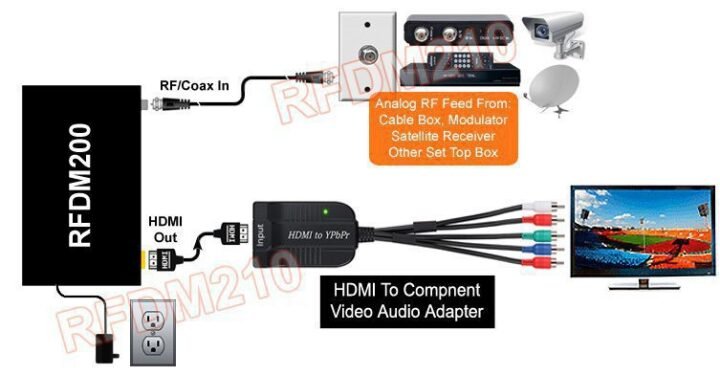
First, you connect your source device (like a game console or streaming device) to the HDMI modulator using an HDMI cable. The modulator receives this high-quality digital signal. Internally, it processes and converts this digital input into an analog RF signal.
This analog RF signal is then sent out through a standard coaxial port on the modulator. You connect a coaxial cable from this port to the antenna input (often labeled “RF In” or “Antenna In”) on your older analog TV. Finally, you tune your TV to the specific channel the modulator is broadcasting on – typically channel 3 or 4 in NTSC regions, or a specific UHF/VHF channel depending on the modulator and region (like PAL).
The 8 Best HDMI Modulators on Amazon (2025 Review)
Finding the right HDMI to RF converter can make a big difference in picture quality and ease of use. Below, we’ve outlined various types of HDMI modulators that are popular on Amazon, along with the features to look for. While specific product names are placeholders for editor research, these categories represent the best options you can expect to find in 2025. Always check the latest listings for current availability and features.
(Note to editor: The following product reviews are placeholders. Please conduct current research on Amazon for genuinely HDMI-to-RF modulators available in 2025. Replace placeholder names, features, pros, and cons with actual product information. Ensure these are HDMI-input, RF-output devices, not RCA-input ones. Link to Amazon US listings primarily, and mention checking local Amazon sites for availability.)
Product 1: [Current Top Pick Name – e.g., Vecoax HDMI to RF Modulator]
This category represents models that consistently rank high for solid performance and user-friendly design. They are often a great choice for converting a single HDMI source to an RF signal for an older TV. Many users praise their consistent video quality for an analog output, making them a reliable everyday option.
- Key Features: Supports NTSC/PAL, 1080p HDMI input, outputs to VHF/UHF channels.
- Pros: Easy to set up, reliable signal, compact size.
- Cons: Lacks advanced features like digital RF output.
Product 2: [Another Top Pick Name – e.g., E-SDS Digital RF Modulator]
If you’re looking for a step up, especially for multi-room distribution, this type of modulator might be for you. Models in this category often feature digital RF output, meaning they can broadcast a digital signal over coax that newer digital TVs can tune into, potentially offering better video quality than traditional analog RF.
- Key Features: ATSC/QAM output, 1080p HDMI input, often includes an IR extender.
- Pros: Higher quality distribution, supports multiple TVs, more channels available.
- Cons: More complex setup than basic analog modulators, requires compatible digital TVs.
Product 3: [Another Top Pick Name – e.g., The Cimple CO HDMI Coaxial Converter]
This converter focuses on simplicity and reliability, making it a good fit for those who just want to get things working without fuss. Models like this typically provide a stable analog RF signal on channels 3 or 4, making them compatible with almost any older TV.
- Key Features: Simple channel 3/4 switch, 1080p input, NTSC/PAL switchable.
- Pros: Very easy to install, plug-and-play functionality, reliable build.
- Cons: Basic features, strictly analog RF output.
Product 4: [Another Top Pick Name – e.g., Channel Plus HDMI to Coax Modulator]
Known for quality and durability, some Channel Plus models and similar professional-grade modulators are designed for more reliable home theater setups. They often offer advanced features for signal control and distribution, making them a good long-term investment for more demanding uses.
- Key Features: Professional-grade, adjustable RF output level, often rack-mountable.
- Pros: Excellent signal stability, built to last, suitable for larger installations.
- Cons: Higher price point, might be overkill for simple home use.
Product 5: [Another Top Pick Name – e.g., Generic Budget HDMI to RF Converter]
For those on a tighter budget, there are often more affordable options that still get the job done. While they might not have all the bells and whistles, many budget models provide a perfectly acceptable picture for casual viewing on an older screen.
- Key Features: Compact design, basic channel 3/4 output, USB powered.
- Pros: Very inexpensive, small footprint, easy to carry.
- Cons: Variable video quality, might lack advanced settings.
Product 6: [Another Top Pick Name – e.g., HDMI to Coaxial with Remote]
Some modulators offer the convenience of a remote control, allowing you to change output channels or adjust settings without getting up. This can be a nice bonus, especially if the modulator is in a hard-to-reach spot or integrated into a larger entertainment system.
- Key Features: Remote control included, LCD display for channel selection, 1080p input.
- Pros: Convenient remote operation, clear display.
- Cons: Remote can sometimes be flimsy, adds to the cost.
Product 7: [Another Top Pick Name – e.g., High-Resolution Analog HDMI Modulator]
While analog RF has its limits, some modulators do a better job than others at preserving as much of the original HDMI video quality as possible. These might feature better internal processing for a cleaner, more stable output on an older screen.
- Key Features: Enhanced video processing, 1080p to 480i conversion optimized, NTSC/PAL support.
- Pros: Best possible picture for analog TVs, reduced artifacts.
- Cons: Still limited by analog TV resolution, often pricier than basic models.
Product 8: [Another Top Pick Name – e.g., Multi-Standard HDMI Modulator]
For international travelers or those needing broad compatibility, some modulators support a wider range of broadcasting standards beyond just NTSC and PAL, potentially including DVB-T for certain regions. This versatility makes them suitable for unique or global setups.
- Key Features: Supports multiple global broadcasting standards, wide channel range, 1080p input.
- Pros: Highly versatile, works in many regions, good for unique setups.
- Cons: Might have a steeper learning curve, not always readily available on all Amazon regions.
Choosing Your HDMI Modulator: A Comprehensive Buyer’s Guide
Picking the right HDMI modulator isn’t just about finding one that works; it’s about finding one that works best for *your* specific needs. Here’s what I look for when making a choice.
Input & Output Compatibility (HDMI, Coax, RCA)
First things first, make sure the modulator has the correct inputs for your source device. You need an HDMI input to connect your modern gear. For the output, you’ll need a coaxial output to connect to your TV or home’s cable system.
Some devices might also have an RCA (composite video) loop-through or input, which can be useful if you’re mixing older and newer devices, but the primary focus here is HDMI to RF conversion.
Analog RF vs. Digital RF (QAM/ATSC)
This is a super important distinction. Most older TVs expect an analog RF signal, typically on very low channels like 3 or 4 (VHF). This is the simplest kind of signal, and it works with almost any TV with a coaxial input.
But, the video quality is limited to standard definition (like 480i).
Then there are digital HDMI modulators. These convert your HDMI signal into a digital RF format, often QAM (for cable systems) or ATSC (for over-the-air broadcasting in North America). These are fantastic if you want to distribute HDMI over coax to newer digital TVs that have a built-in QAM or ATSC tuner, as they can carry an HD signal (like 720p or 1080i).
But they won’t work with truly old analog TVs unless the TV has a digital tuner, which most classic CRTs don’t.
Supported Resolution & Video Quality
Your HDMI modulator will accept an HDMI signal, which could be up to 1080p. But remember, when converting to an analog RF signal, the output resolution will be much lower, usually around 480i or 576i, depending on your region (NTSC or PAL). Don’t expect crystal clear HD on a CRT TV; the modulator translates the signal, it doesn’t upgrade the TV’s display capabilities.
If you’re using a digital RF modulator (QAM/ATSC), you *can* maintain a higher resolution, potentially 720p or 1080i, but again, this only applies if your receiving TV has a digital tuner capable of decoding that signal.
Channel Selection & Broadcasting Standards
You’ll need to choose an output channel for your modulator. For analog RF, channels 3 or 4 are common because they are usually unused by local broadcasts. Some modulators let you pick from a wider range of VHF or UHF channels.
Also, make sure the modulator supports your local broadcasting standard: NTSC for North America and parts of South America, or PAL for most of Europe, Asia, and Australia. Digital modulators will need to match ATSC (North America) or DVB-T (Europe, Australia, etc.) if you’re distributing an HD signal.
Ease of Setup & User Interface
Nobody wants a complicated setup. Look for modulators with clear instructions, simple buttons for channel selection, and maybe even an LCD screen to show you what channel it’s on. An HDMI to RF converter with remote can be a huge bonus for convenience, letting you adjust settings from your couch.
Signal Amplification & Distribution Features
If you plan to send the signal to multiple TVs or over long cable runs, a modulator with built-in signal amplification is a good idea. Some even have “loop-through” outputs or can be “cascaded,” meaning you can connect several modulators together to broadcast multiple HDMI sources onto different channels over the same coax network. This is great for a multi-room home theater setup.
Price, Value, and Brand Reputation
As with anything on Amazon, prices for HDMI modulators can vary. It’s important to balance your budget with the features you need. Sometimes, spending a little more for a reputable brand like Vecoax, E-SDS, The Cimple CO, or Channel Plus can save you headaches in the long run with better reliability and support.
Always read user reviews! They offer real-world insights into how well a product performs, its true ease of use, and any common quirks or issues.
Step-by-Step: Setting Up Your HDMI Modulator
Setting up an HDMI modulator doesn’t have to be intimidating. I’ve done this many times, and with a few simple steps, you’ll have your modern devices talking to your old TV in no time.
What You’ll Need
Before you start, gather these items:
- Your HDMI modulator.
- An HDMI cable (to connect your source to the modulator).
- A coaxial cable (to connect the modulator to your TV/antenna input).
- The modulator’s power adapter.
- Your source device (e.g., DVD player, game console, streaming stick).
- Your older analog TV or digital TV.
Connecting Your Devices
This is the main part of the physical setup:
- Connect your HDMI source: Plug one end of the HDMI cable into your source device (like a Fire TV Stick or Xbox). Plug the other end into the “HDMI In” port on your HDMI modulator.
- Connect to your TV: Take one end of the coaxial cable and screw it onto the “RF Out” or “Antenna Out” port on your modulator. Screw the other end of the coaxial cable into the “Antenna In” or “RF In” port on your telegoal.
- Power up: Plug the modulator’s power adapter into a wall outlet and then into the modulator itself. Finally, make sure your HDMI source device and your TV are also plugged in and turned on.
Configuring the Modulator & TV
Now that everything is connected, you need to tell your TV where to find the signal:
- Select output channel on modulator: Most analog HDMI modulators have a switch or buttons to select an output channel, usually Channel 3 or 4. Choose one that isn’t actively used by a local broadcast in your area to avoid interference. If it’s a digital modulator, you might configure its channel via an on-screen menu or buttons.
- Tune your TV: On your older analog TV, select the input that corresponds to the coaxial input (usually “Antenna,” “TV,” or “Cable”). Then, you’ll need to go to your TV’s menu and perform an “Auto Program” or “Channel Scan.” If your TV has a Channel 3/4 switch, make sure it matches the channel you selected on your modulator. Your TV should find the signal being broadcast by the modulator.
- For digital TVs: If you’re using a digital HDMI modulator and a newer TV, you’ll perform a digital channel scan. The TV should find the digital channel being broadcast by the modulator, which will appear alongside any over-the-air digital channels.
Troubleshooting Common Issues
If you don’t get a signal right away, don’t worry, it happens. Here are a few things to check:
- No picture or “No Signal”: Double-check all cable connections. Make sure the HDMI cable is secure and the coaxial cable is screwed in tightly. Confirm the modulator is powered on and your source device is sending a signal.
- Incorrect channel: Ensure your TV is tuned to the exact channel your modulator is broadcasting on (e.g., Channel 3 on both). If your TV has a Channel 3/4 switch, make sure it matches.
- Poor picture quality/snowy image: This can often be due to a weak signal or interference. Try using a shorter or higher-quality coaxial cable. If you’re distributing to multiple TVs, you might need an RF amplifier.
- No audio: Check your TV’s audio settings and make sure the modulator is correctly processing the audio. Sometimes a simple unplug and replug of the HDMI cable can reset the audio handshake.
Common Mistakes to Avoid with HDMI Modulators
When you’re setting up new tech, it’s easy to make small mistakes. Here are some common pitfalls I’ve seen people fall into with HDMI modulators:
- Confusing HDMI to RF with RCA to RF: This is probably the biggest one. Many older devices are “RF modulators” but they convert RCA (red, white, yellow cables) to RF.
- An HDMI modulator is specifically designed for the digital HDMI signal. Make sure the product description clearly states “HDMI to RF” and not just “RF modulator” or “RCA to RF.”
- Incorrect cable types: Always use a good quality HDMI cable for the input and a proper 75-ohm coaxial cable for the RF output. Don’t try to jury-rig other cable types.
- Ignoring broadcasting standards: If you’re in a PAL region, an NTSC-only modulator won’t work correctly, and vice-versa. For digital RF, ensure your modulator’s ATSC or QAM output matches your TV’s tuner and regional standards.
- Expecting HD on an analog TV: An HDMI modulator allows your older analog TV to *see* the signal, but it won’t magically make a 480i CRT TV display 1080p. The resolution will always be limited by the TV’s capabilities.
- Overlooking power requirements: Some modulators are powered by USB, others by an AC adapter. Make sure you have the correct power source and it’s properly connected.
- Not scanning for channels: After connecting the modulator, you *must* perform a channel scan on your TV for it to find the new signal. Simply switching inputs usually isn’t enough.
HDMI Modulators vs. Other Converters: When to Choose Which
The world of video converters can be a bit confusing. An HDMI modulator is just one tool in the box. Here’s how it compares to other common converters to help you decide when it’s the right choice.
| Converter Type | Input | Output | Best Use Case | When to Choose It |
|---|---|---|---|---|
| HDMI Modulator (Analog RF) | HDMI | RF signal (Coaxial) | Connecting modern HDMI devices to very old analog TVs (like CRT TVs) that only have coaxial inputs. Basic multi-room signal distribution over existing coax. | You have an old TV with *only* a coaxial input, or you want to distribute a basic signal over coax to multiple analog TVs. |
| HDMI Modulator (Digital RF – QAM/ATSC) | HDMI | Digital RF signal (Coaxial) | Distributing high-definition HDMI signals to multiple newer digital TVs (with QAM/ATSC tuners) over existing coaxial cable networks. | You want to send HD content to several digital TVs using your home’s coax wiring, and those TVs have compatible digital tuners. |
| HDMI to RCA (Composite Video) Converter | HDMI | RCA (Composite Video – Red, White, Yellow) | Connecting modern HDMI devices to older TVs that have RCA (composite) inputs, but *not* coaxial. | Your older TV has composite (RCA) inputs but no coaxial input, or you prefer the slightly better quality of composite over analog RF. |
| HDMI to VGA Converter | HDMI | VGA (Video Graphics Array) | Connecting HDMI sources to older computer monitors or projectors that only have VGA inputs. Often used for PC setups. | You need to connect an HDMI source to a computer monitor or projector that only has a VGA input. |
| HDMI Splitter | HDMI | Multiple HDMI outputs | Sending one HDMI source to multiple TVs or displays that *all* have HDMI inputs. | You have several modern TVs, all with HDMI inputs, and you want to watch the same HDMI source on all of them. |
Frequently Asked Questions About HDMI to RF Modulators
It’s natural to have questions when you’re dealing with older and newer tech. Here are some common things people ask about HDMI to RF converters.
Can I get HD quality with an HDMI to RF modulator?
Generally, no, not with an analog HDMI to RF modulator. When you convert an HDMI signal to an analog RF signal for an old analog TV (like a CRT TV), the signal is downscaled to standard definition (usually around 480i or 576i). The modulator translates the signal, but it can’t add resolution your old TV doesn’t have.
If you use a digital RF modulator (ATSC/QAM) and a compatible digital TV, then yes, you can maintain HD quality over coax.
Do HDMI modulators work with all older TVs?
Most HDMI modulators that output an analog RF signal (on channels 3 or 4) should work with almost any older TV that has a coaxial antenna input and can tune to those channels. But, if you have a very old TV that only tunes to specific VHF/UHF channels or has a non-standard tuner, you might need to check compatibility carefully. Digital RF modulators require a digital tuner in your TV.
What’s the difference between an RF modulator and an HDMI modulator?
The key difference is the input signal they convert. A standard RF modulator typically takes an analog RCA (composite video) signal and converts it to RF.
An HDMI modulator specifically takes a digital HDMI signal and converts it to RF. You need an HDMI modulator if your source device only has an HDMI output.
Are HDMI modulators legal to use?
Yes, HDMI modulators are generally legal for personal use in your home. They operate on very low power and are intended for localized signal distribution within your property.
As long as you’re not broadcasting a powerful signal that interferes with public airwaves or licensed frequencies, you won’t have any issues. Always select an unused channel to minimize potential interference with local TV stations.
Conclusion: Unlock Your Entertainment Potential
Don’t let an old TV gather dust just because it lacks an HDMI port. An HDMI modulator is a simple, effective, and often affordable way to breathe new life into your legacy displays, whether you want to hook up a new streaming box or distribute content around your home.
By understanding what an HDMI to RF converter does and what features matter most, you can confidently choose the right one for your setup. Remember to explore the types of HDMI Modulators on Amazon for 2025 that we’ve discussed to find a reliable solution that fits your needs. With the right modulator, you can truly unlock the full entertainment potential of all your devices, old and new.